Blog
News from Everdust
Everdust ships on a lot of devices, at different times. This is where we say what came out, what changed, and what to try first.
Updates, release by releaseGet Everdust on every deviceRSS feed
Everdust has a subreddit: r/everdust
Everdust now has its own subreddit, r/everdust, run by Seth, who makes the app. What you'll find there (clips, questions, bug reports, feature ideas and release notes), how to report a bug so it gets fixed fast, and where the FAQ is.
Free astronomy and night sky apps for iPhone (2026): an honest guide
Which free iPhone app to pick for what you want from the sky, whether that's a night sky app that names the stars and planets you point at, a constellation finder, what's visible tonight, NASA's missions or playing with how galaxies and black holes work. Each described from its own App Store listing, with what's free and what costs money, by the maker of one of them.
Free space VJ loops and visuals (2026): where to get them, and what the licenses let you do
Where VJs, streamers and video makers can get free space visuals, from Beeple's Creative Commons VJ clips and ESO's fulldome VJ clips to NASA's public domain visualizations, ESA's Hubble and Webb videos and the big stock sites, plus Everdust's free 4K loop sampler. What each license allows for live shows and paid work, and the credit each one asks for, by the maker of one of them.
Geminid meteor shower 2026: the best shower of the year, with almost no Moon
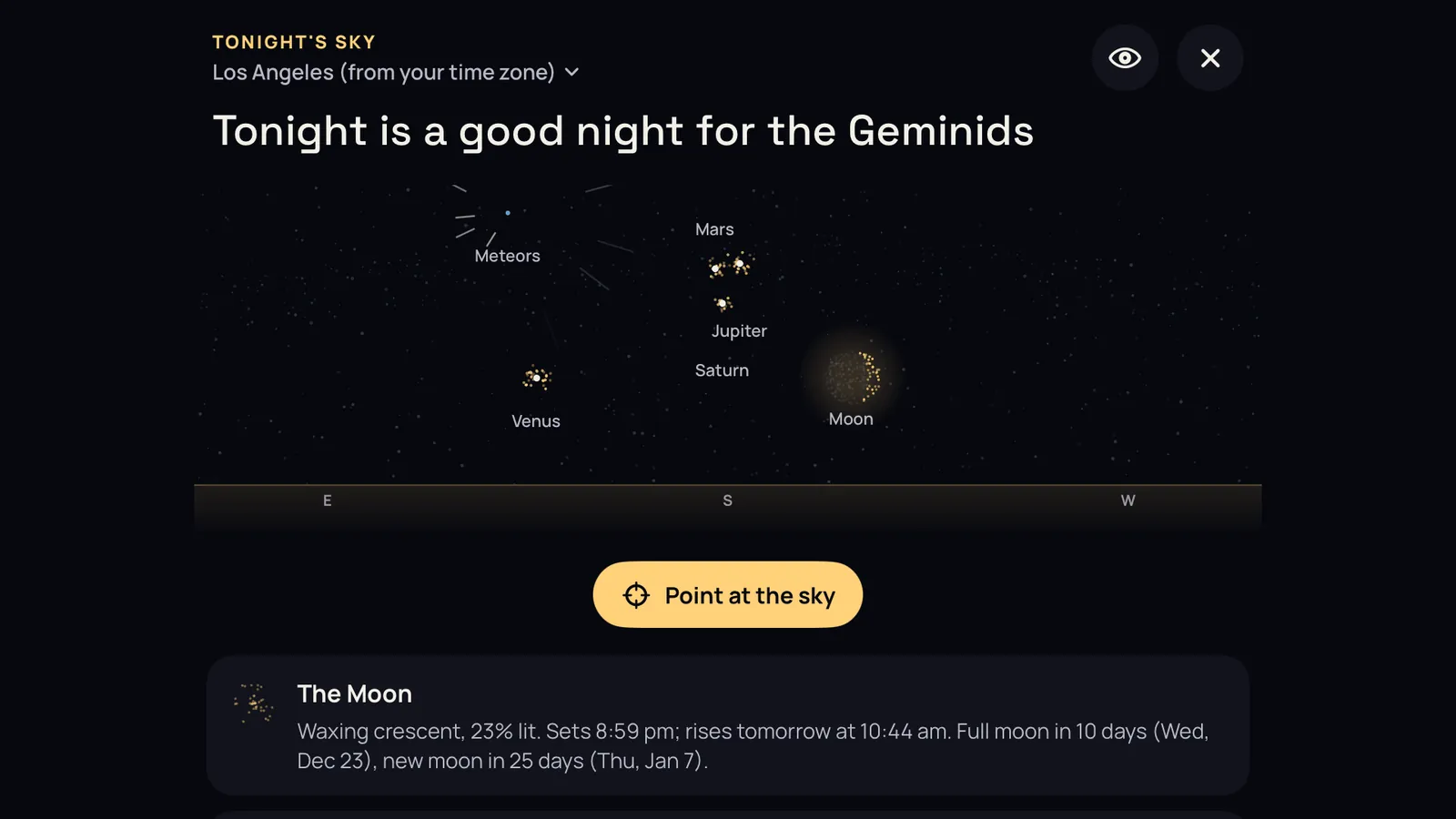
The 2026 Geminids peak on December 13 to 14 under a thin crescent Moon that sets early, which makes this one of the best Geminid years in a while. When to look from your city, where the radiant is hour by hour, how many you might really see, and why these meteors come from an asteroid, worked out with the same sky model as Everdust's Tonight's Sky.
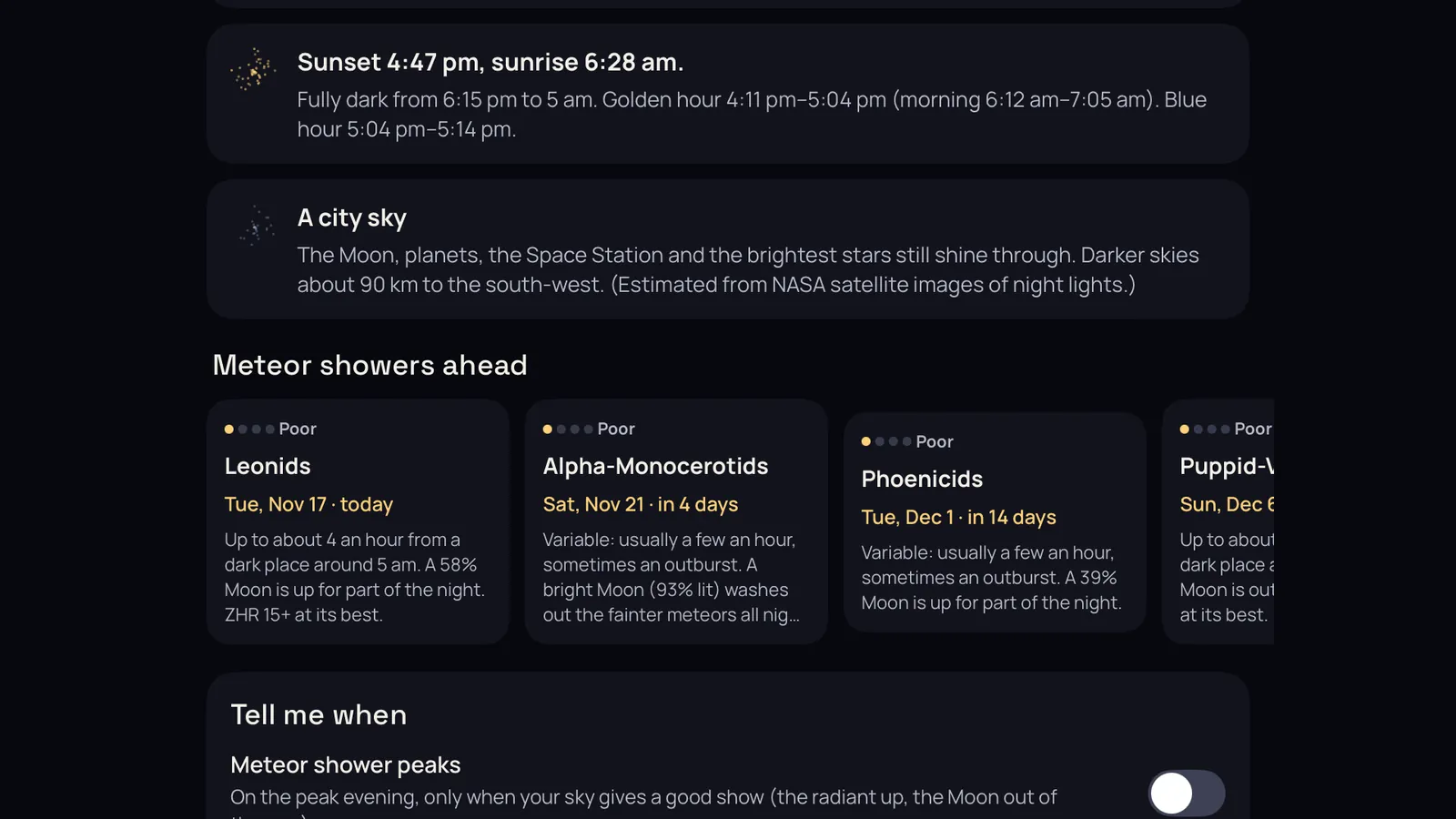
Leonid meteor shower 2026: when and where to look, and how many you'll really see
The 2026 Leonids peak on the night of November 17 to 18. When to look in your city, where the radiant is hour by hour, what the first-quarter Moon does, and an honest number for how many you might see, worked out with the same sky model as Everdust's Tonight's Sky. No storm is expected this year.
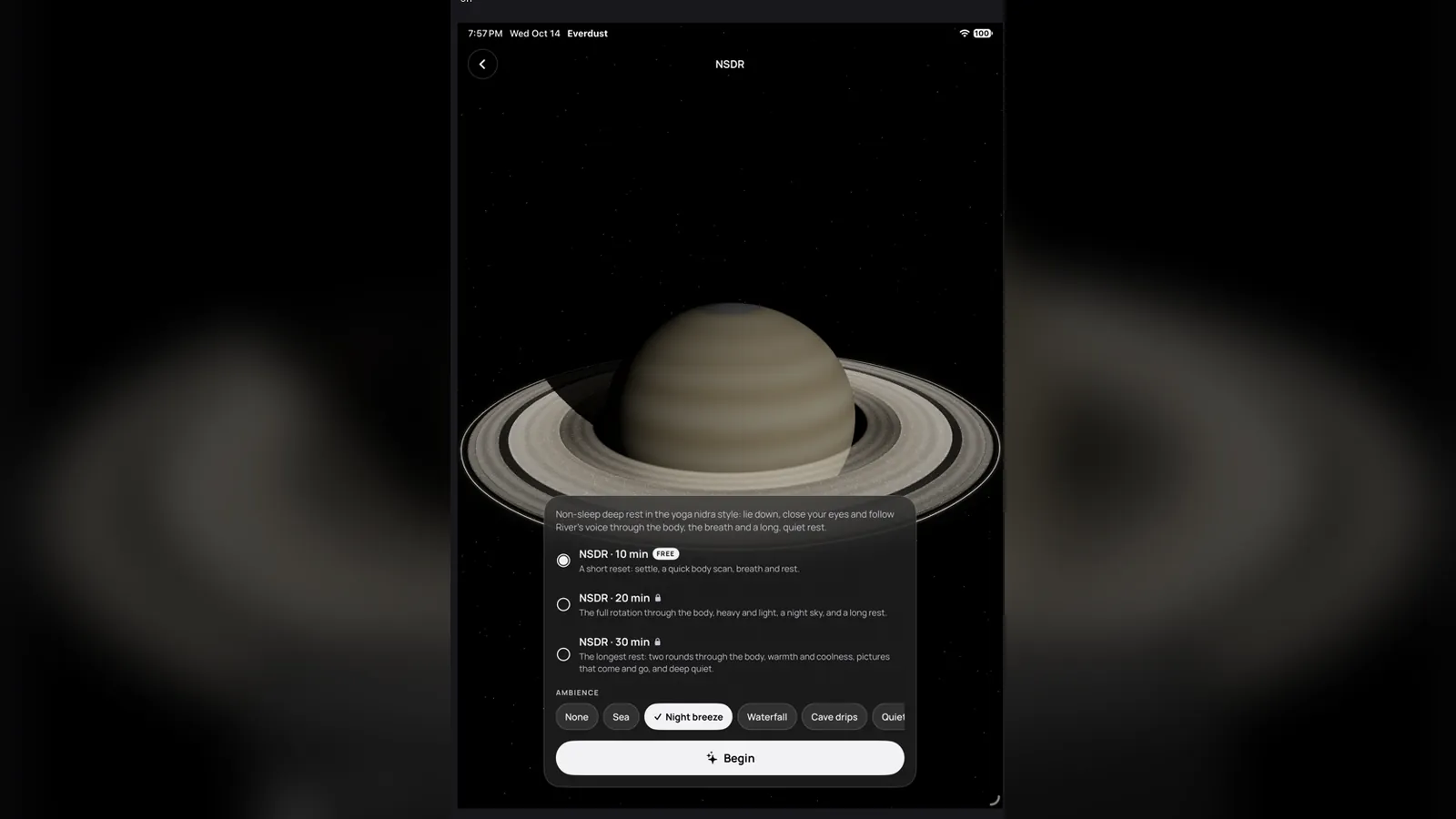
NSDR and yoga nidra apps for iPhone (2026): an honest guide
Where to do NSDR (non-sleep deep rest) or yoga nidra on an iPhone, and which apps give you sessions of different lengths, from Huberman's free 10, 20 and 30-minute recordings and Insight Timer's library to apps built only for it, plus the free 10-minute session in Everdust's Calm section. What each offers and costs, from its own App Store listing, by the maker of one of them.
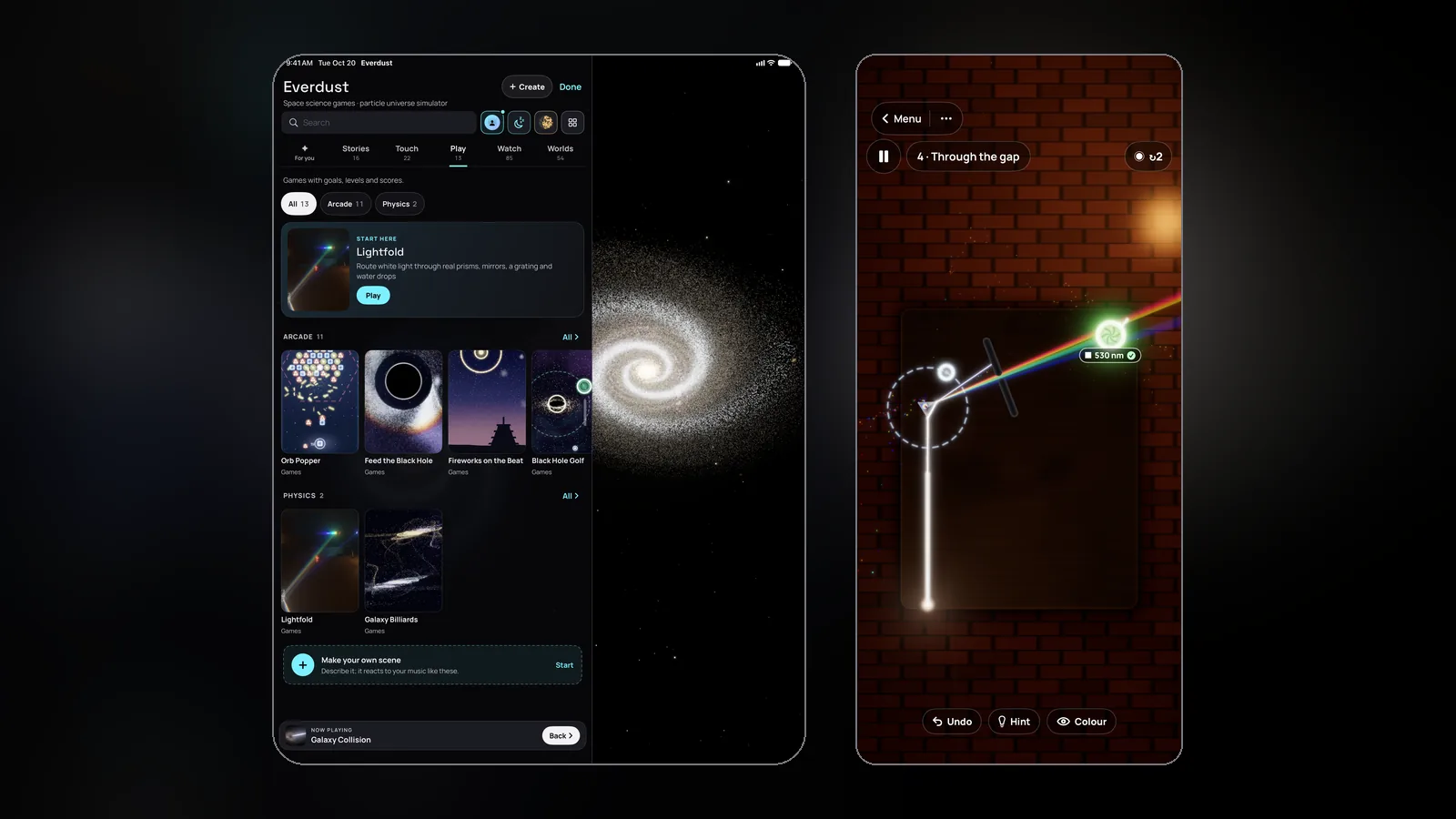
Space apps and games for kids (2026): an honest guide for parents
The best space and astronomy apps for kids by age, from narrated planet stories for 4-year-olds to a 3D solar system, NASA's own app, free browser games from NASA Space Place and physics games for older kids. What each one does, what it costs and whether it has ads, each described from its own App Store listing, by the maker of one of them.
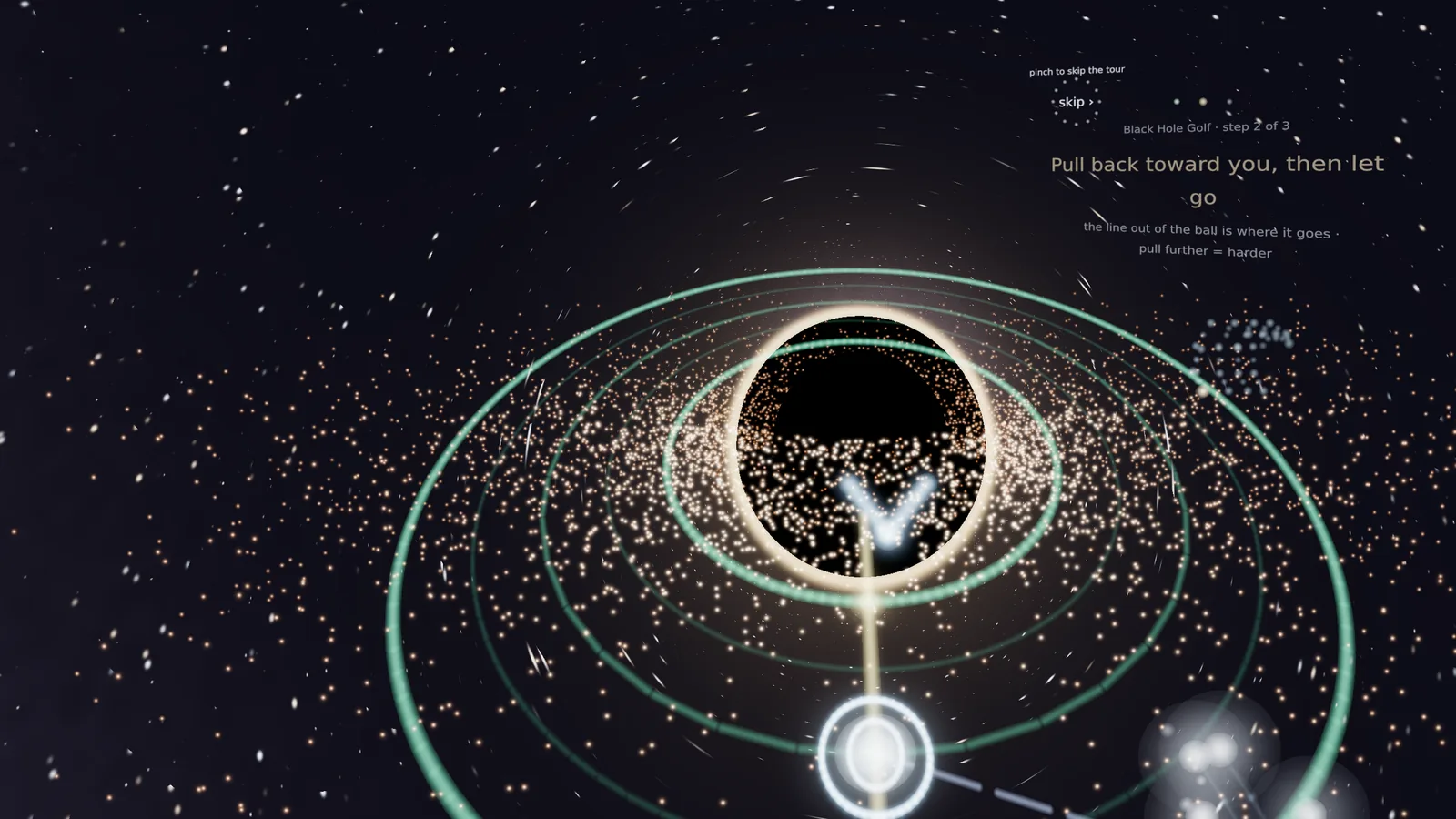
Space and astronomy apps for Meta Quest 3 and 3S (2026): an honest guide
Which Quest app to pick for space, whether you want to learn the real night sky, tour the solar system at scale, float inside the International Space Station, relive Apollo 11 or play with galaxies and black holes with your hands. What each one does and costs on the Meta Horizon Store, and which famous space sims aren't on Quest at all, by the maker of one of them.
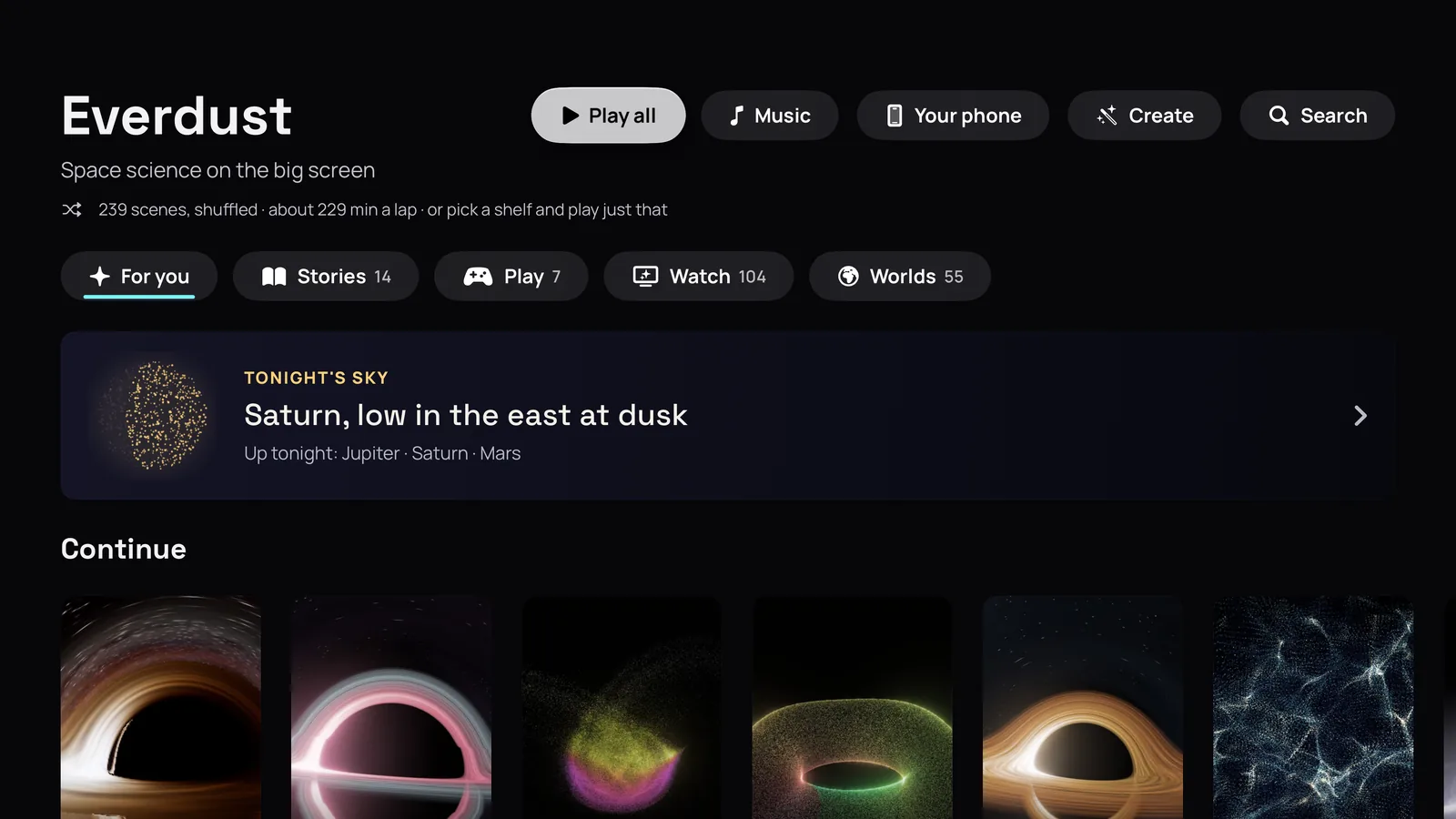
Everdust is on Apple TV
Everdust is free on the App Store for Apple TV, with no ads: an Ambient mode that plays live particle worlds hands off like a screen saver, narrated science stories, space games for the Siri Remote and music for the living room. What's free, what Everdust Plus costs and what to try first.
Everdust is on iPhone and iPad
Everdust is free on the App Store for iPhone and iPad, with no ads and no account: space science games you play with your fingers, narrated science stories, Night Sky (since version 1.1), Tonight's Sky, Calm and a particle universe simulator. What's free, what Everdust Plus costs and what to try first.
Everdust is on Meta Quest
Everdust is free on the Meta Horizon Store for Meta Quest 3 and 3S, with no ads and no account: over 150 living worlds you can reach into with your hands or Touch controllers, headset games, narrated science stories and Calm. What's free, what's in the headset and what to try first.
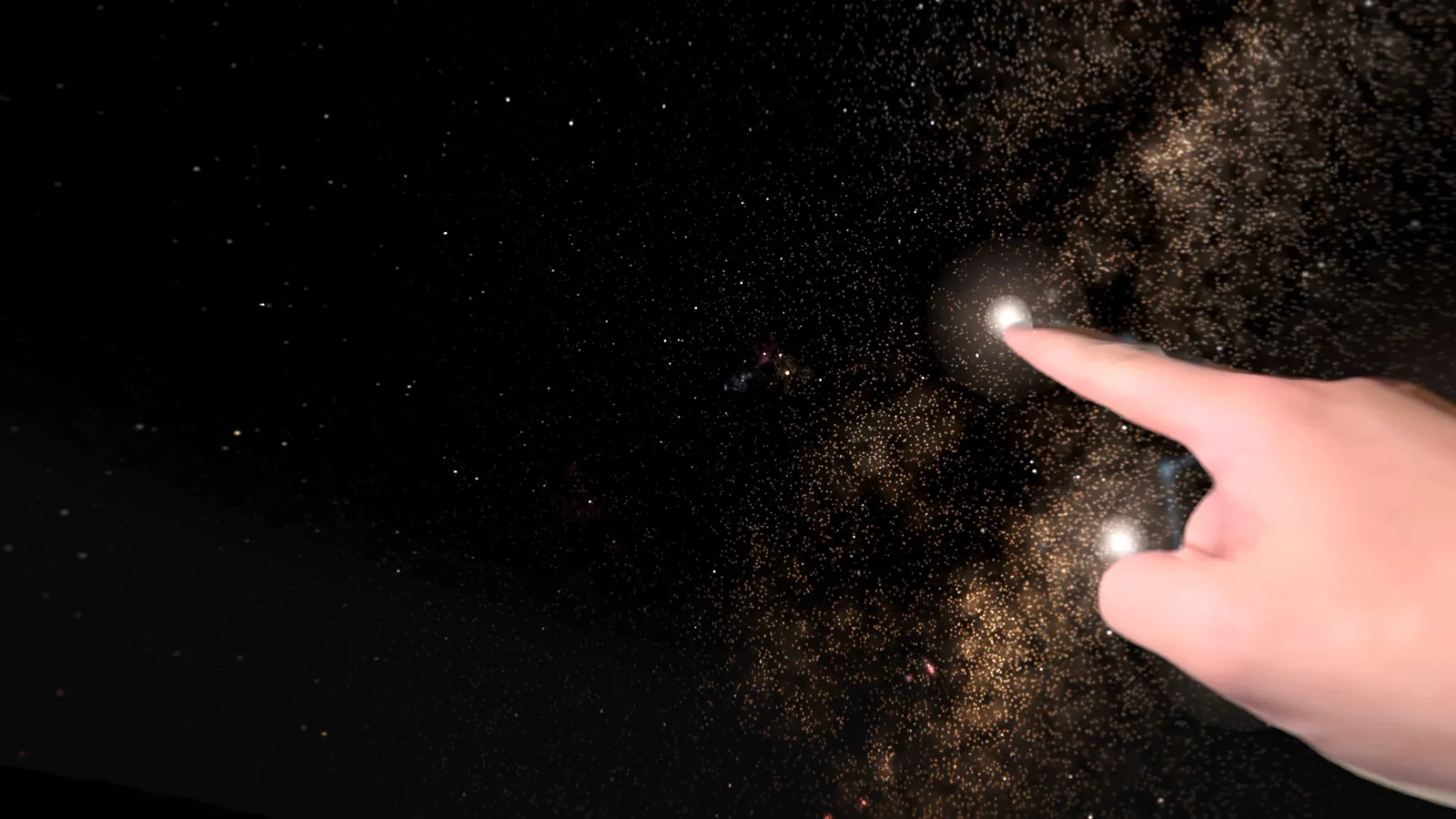
Everdust 1.1 for Apple Vision Pro: Night Sky
Everdust 1.1 for Apple Vision Pro puts the real night sky all around you, from home or from some of the darkest places on Earth. Look at a planet or a nebula and pinch to fly there. What's real in it, what's a model, what else is new in 1.1, and what's free.
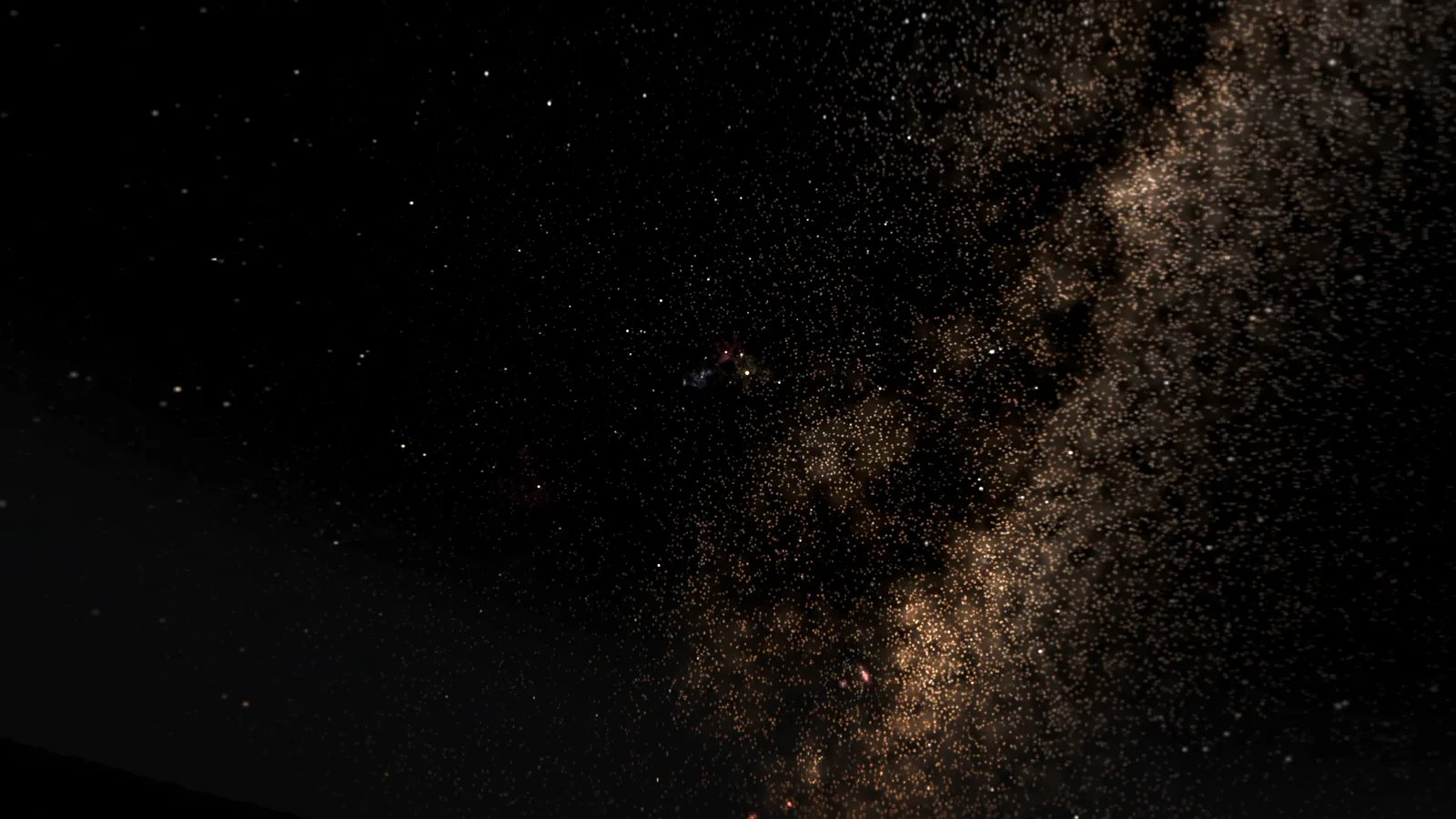
How to see the real night sky in VR (and what light pollution hides)
A dark sky shows about 4,000 stars at once; a city sky shows a few hundred. What the Bortle scale and limiting magnitude mean, how fast light pollution is growing, and the headset apps that put the real sky for your place and time around you, by the maker of one of them.
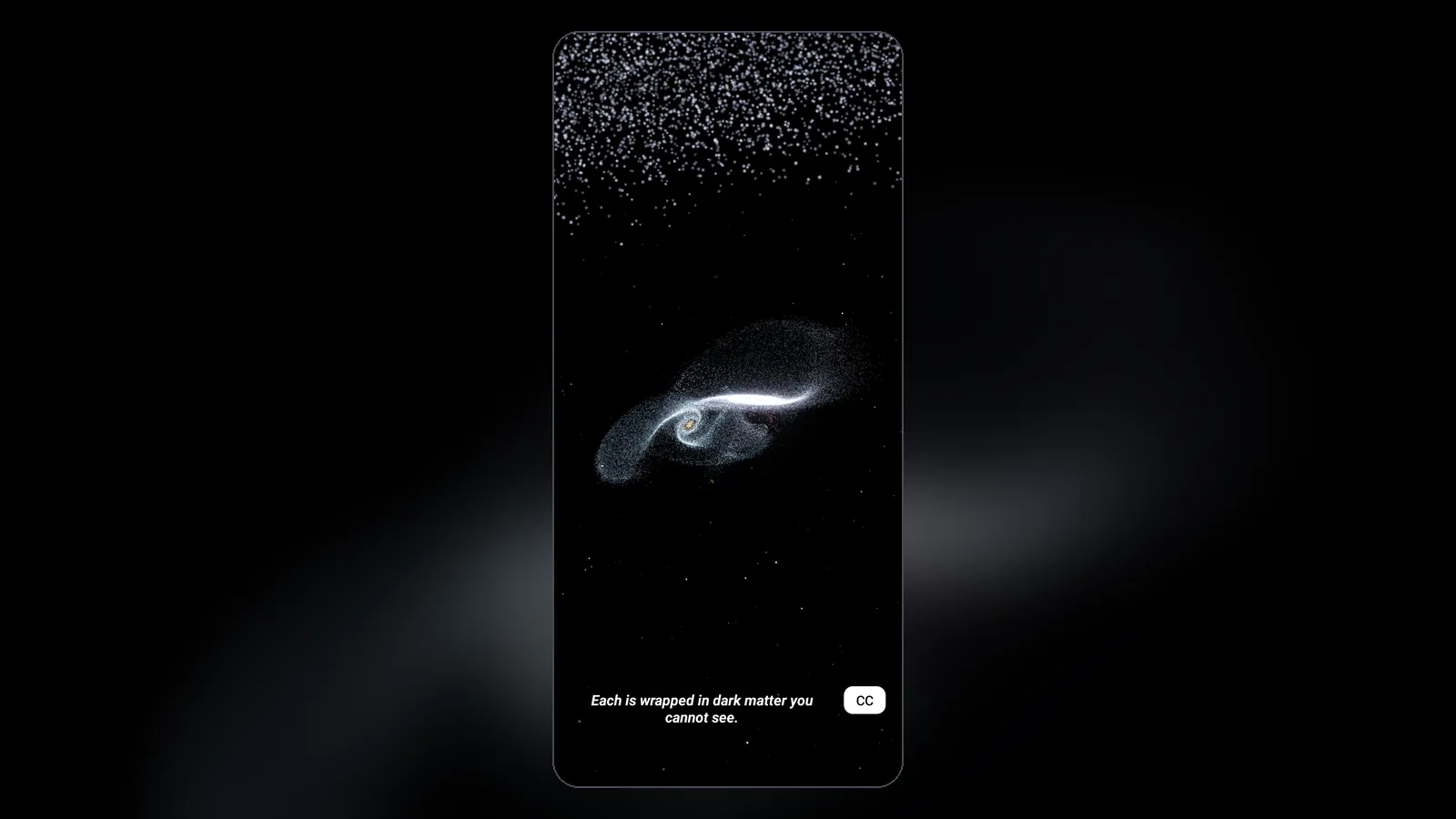
NSDR and yoga nidra apps for Android (2026): an honest guide
Where to do NSDR (non-sleep deep rest) or yoga nidra on an Android phone, from free recordings and Insight Timer's library to apps built only for it, and the free 10-minute NSDR session in Everdust's Calm section. What each offers and costs, each described from its own Google Play listing, by the maker of one of them.
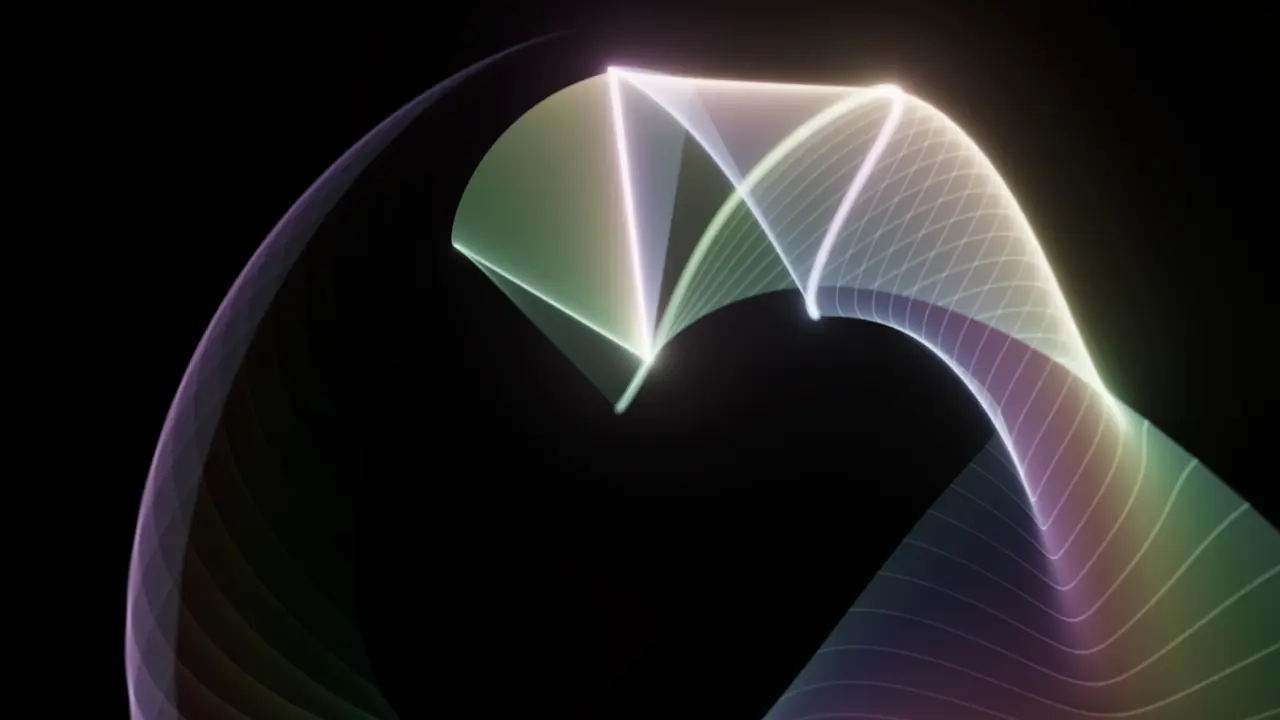
Double pendulums and chaos: why a hair's difference changes everything
A double pendulum is chaotic, so two swings started a hair apart soon have nothing in common, even though the physics is exactly the same. Here is why, what a Lyapunov exponent measures, why weather forecasts run out at about two weeks, and how to watch it happen.
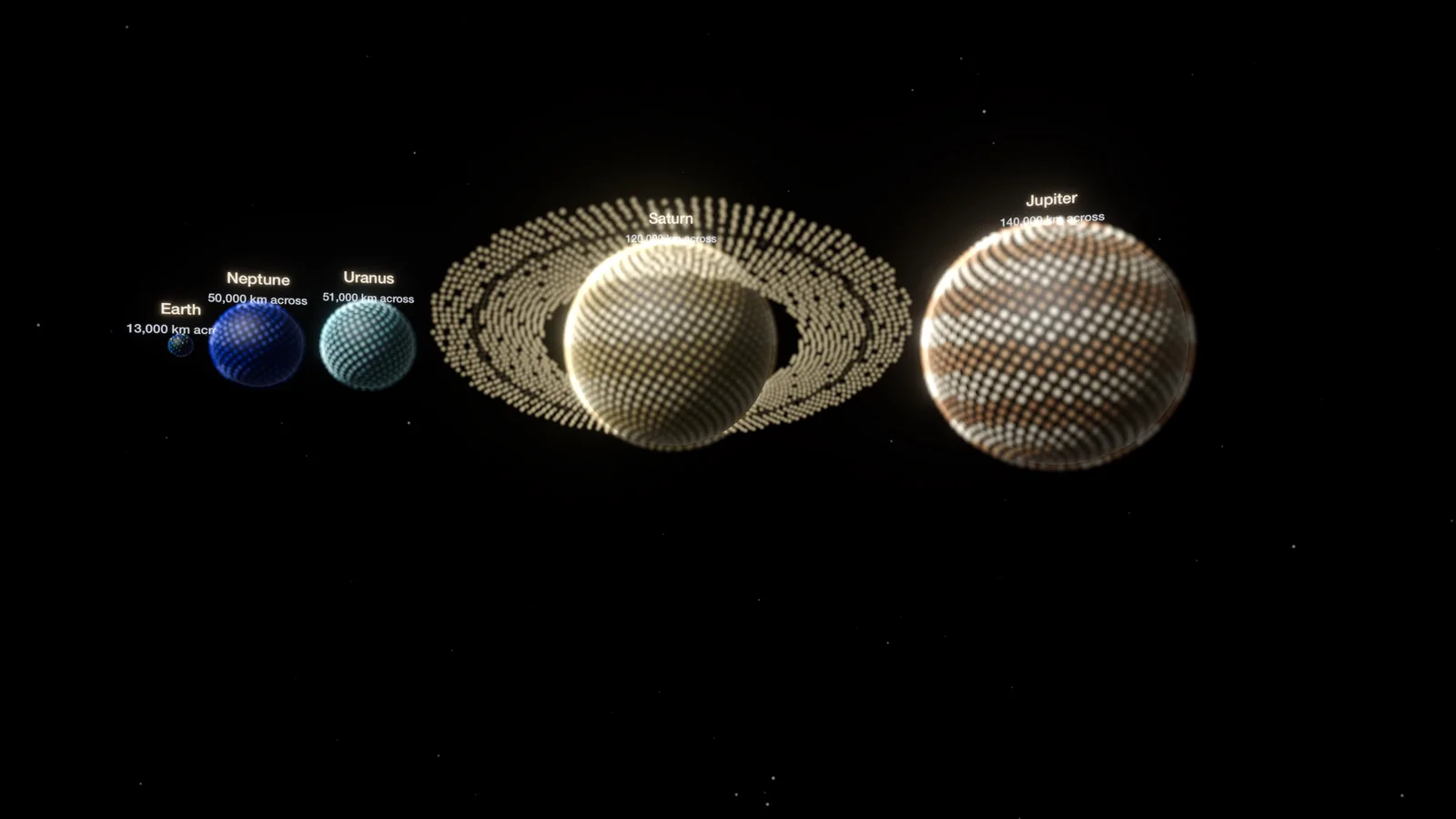
Free astronomy apps for Apple Vision Pro (2026)
The free astronomy and space apps on Apple Vision Pro, split honestly into the ones with nothing to buy and the ones that are free to download with paid extras, from sky atlases and a free 3D universe to NASA's Mars rover, the live space station and galaxy simulations. Each described from its own App Store listing, by the maker of one of them.
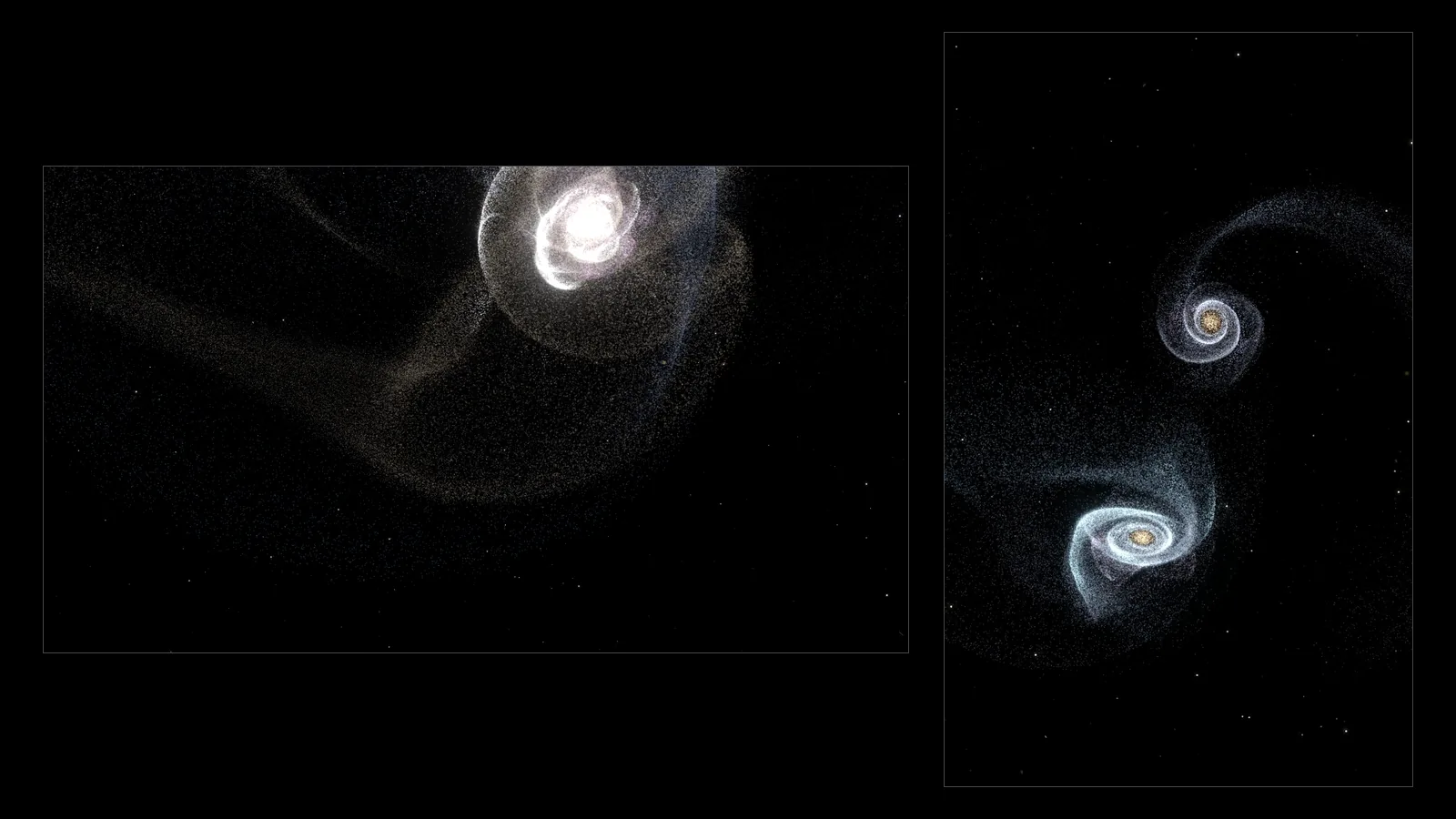
Galaxy simulator apps (2026): every platform
The galaxy simulator apps worth trying in 2026 on PC and Mac, in a web browser, on Android, on iPhone and iPad, and on Apple Vision Pro. Which ones really simulate galaxies with gravity and which show you a model or a map of them, what each costs, each described from its own store page or website, by the maker of one of them.
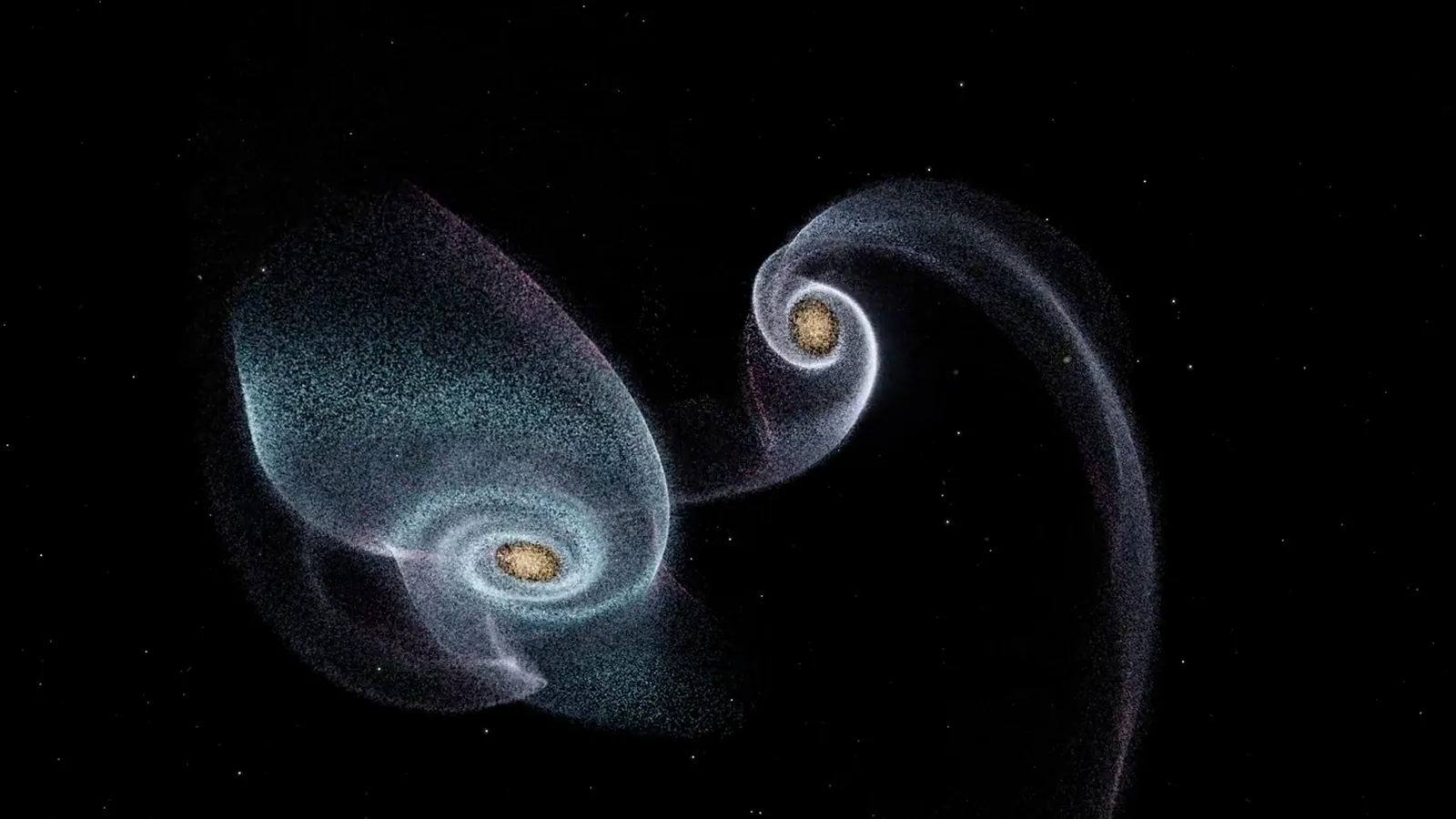
How galaxy simulations work, explained with what you see
A galaxy simulation turns stars into particles, adds up the gravity on each one and steps time forward, with shortcuts that decide what you see. Tidal tails come from differences in gravity across a galaxy; real galaxies merge because dark matter drains their orbits; and gas and new stars are always approximated. Explained with frames from a live simulation, by the maker of one.
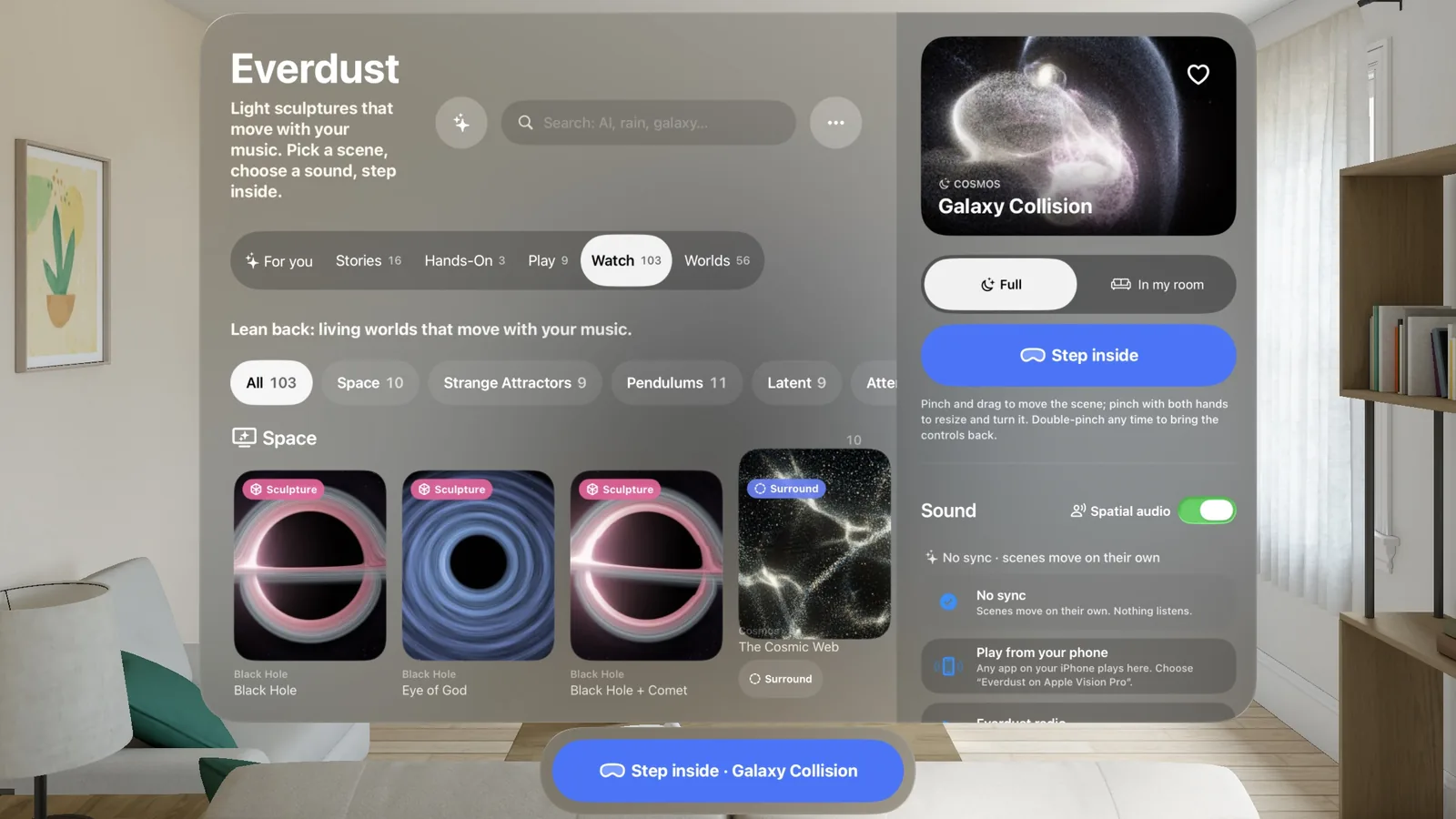
Music visualizer apps for Apple Vision Pro (2026)
The music visualizer apps on Apple Vision Pro, from beat-tracking immersive worlds and MilkDrop presets to spectrograms, and why most of them listen through the microphone instead of reading Apple Music or Spotify. What each does and costs, each described from its own App Store listing, by the maker of one of them.
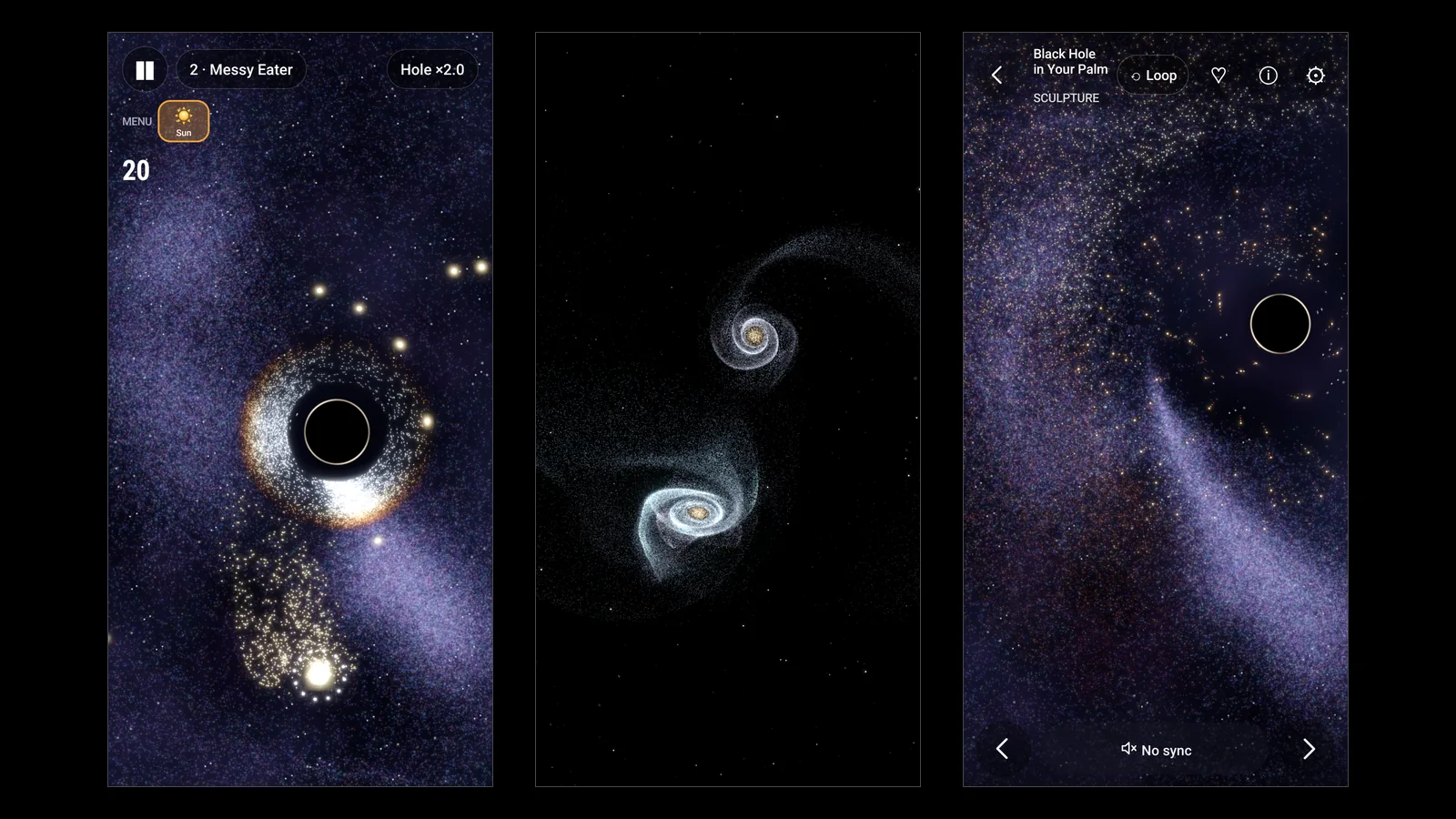
Physics sandbox and simulation apps for Android (2026): an honest guide
The physics sandbox and simulation apps worth trying on Android in 2026, from gravity sandboxes like the ones people want instead of Universe Sandbox to The Powder Toy, rocket builders and classroom simulations. What each one simulates, what it costs and which have ads, each described from its own Google Play listing, by the maker of one of them.
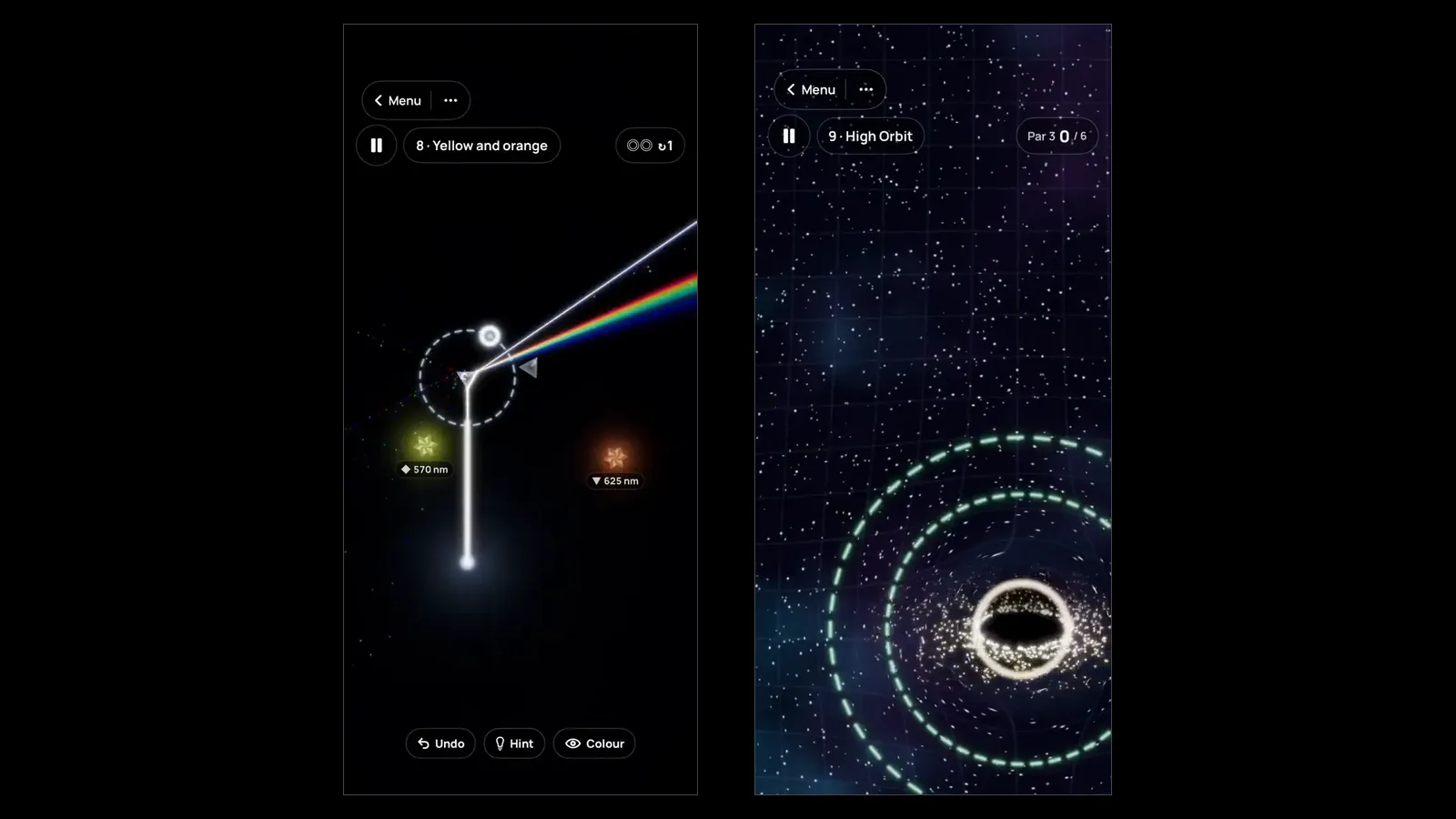
Space games for Apple Vision Pro and Android (2026)
The space games worth playing on Apple Vision Pro and on Android in 2026, from hand-tracked physics games and a rocket sandbox in your room to orbital puzzlers, roguelike star voyages and space RPGs. What each one is and costs, each described from its own App Store or Google Play listing, by the maker of one of them.
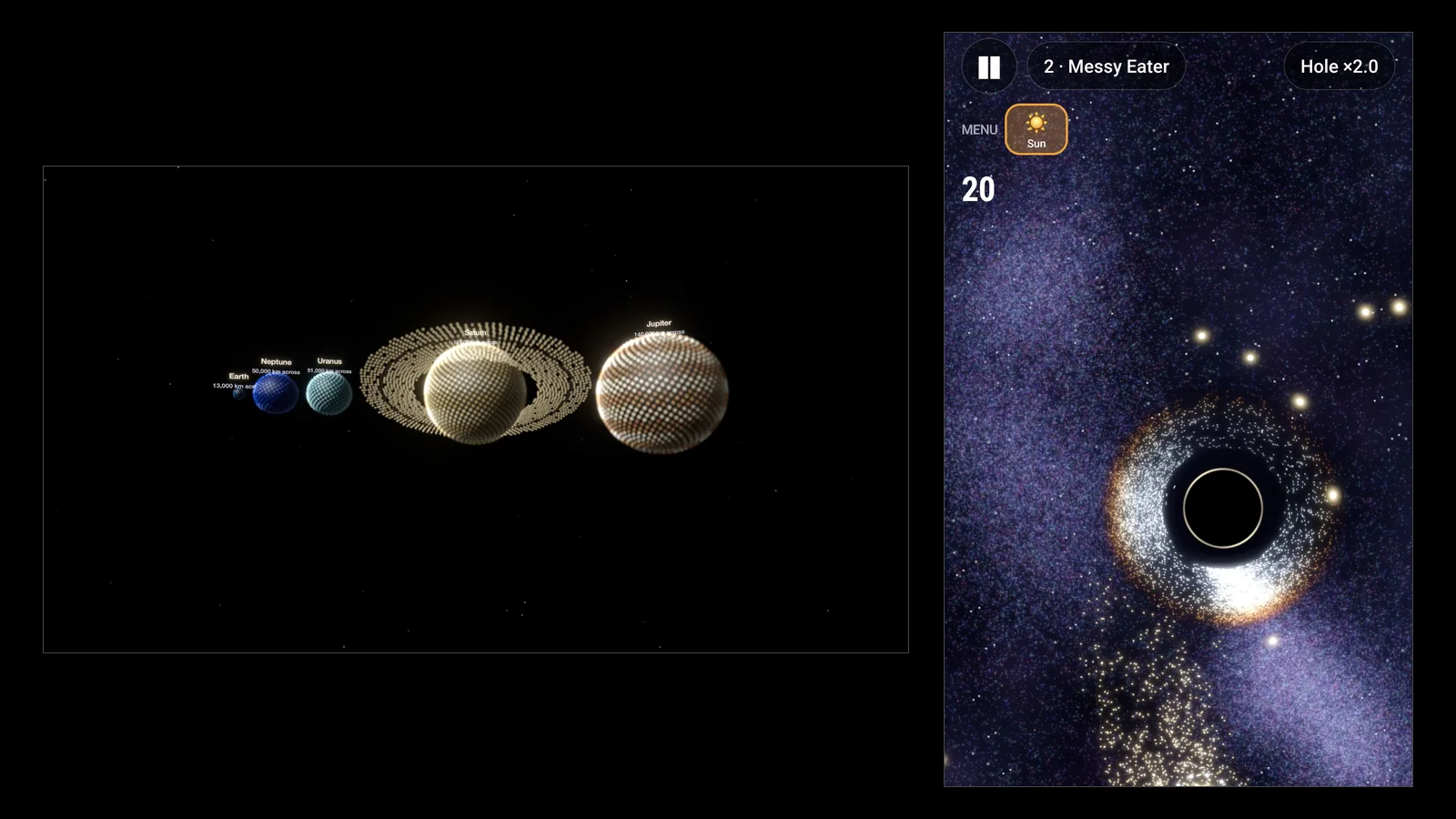
Universe Sandbox alternatives on Android and Vision Pro (2026)
Universe Sandbox isn't on Android, iPhone or Apple Vision Pro. Here are the closest alternatives on each, from gravity sandboxes where you build and smash solar systems to galaxy mergers and black holes you can touch, plus two ways to run the real thing. An honest comparison, each app described from its own store listing, by the maker of one of them.
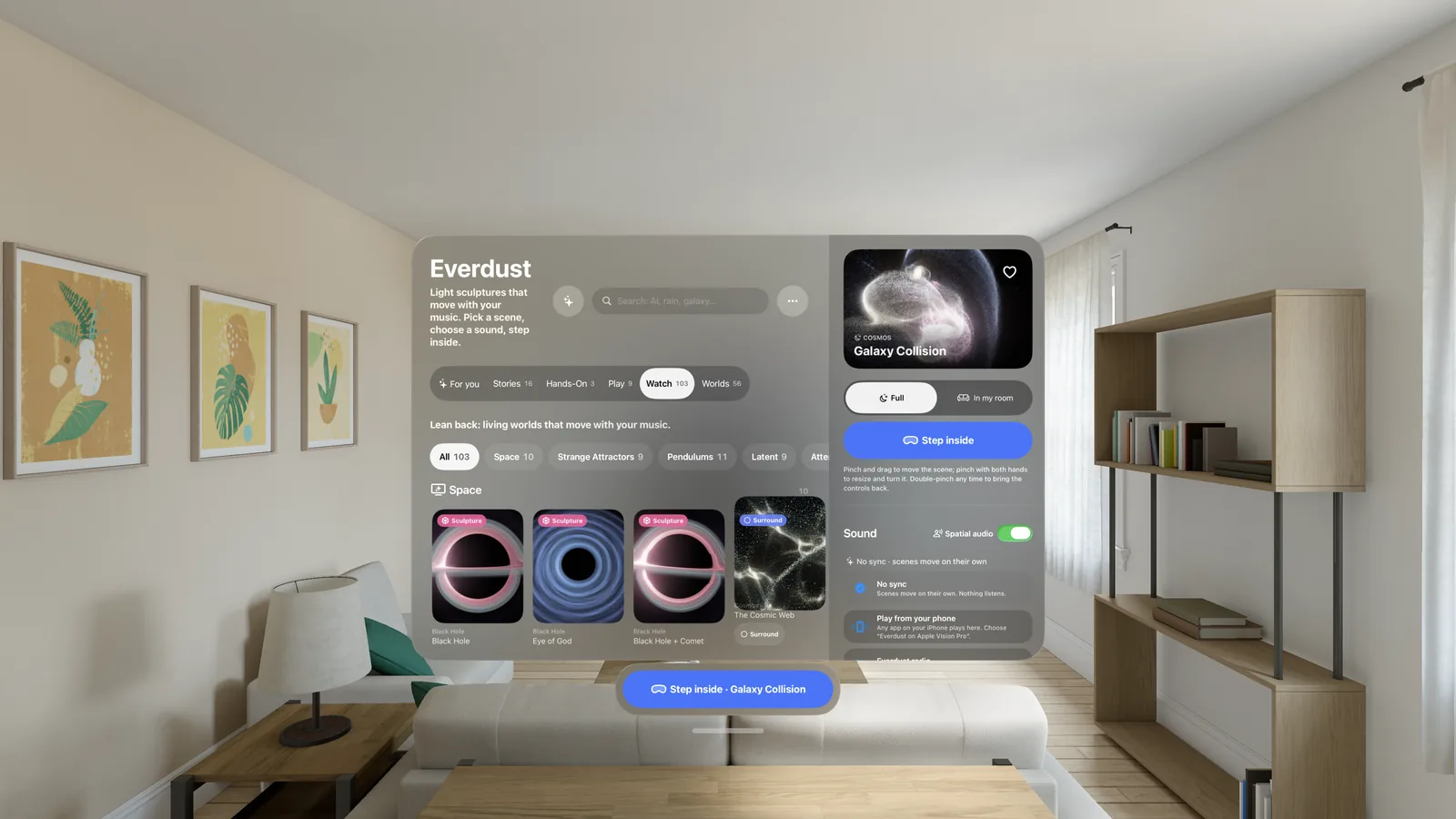
The best Vision Pro apps for space and astronomy (2026)
Twelve Apple Vision Pro apps for space and astronomy, from star maps and planetariums to a NASA-data solar system, a space museum, Mars with Perseverance and live physics simulations. What each does and what it costs, each described from its own App Store listing, by the maker of one of them.
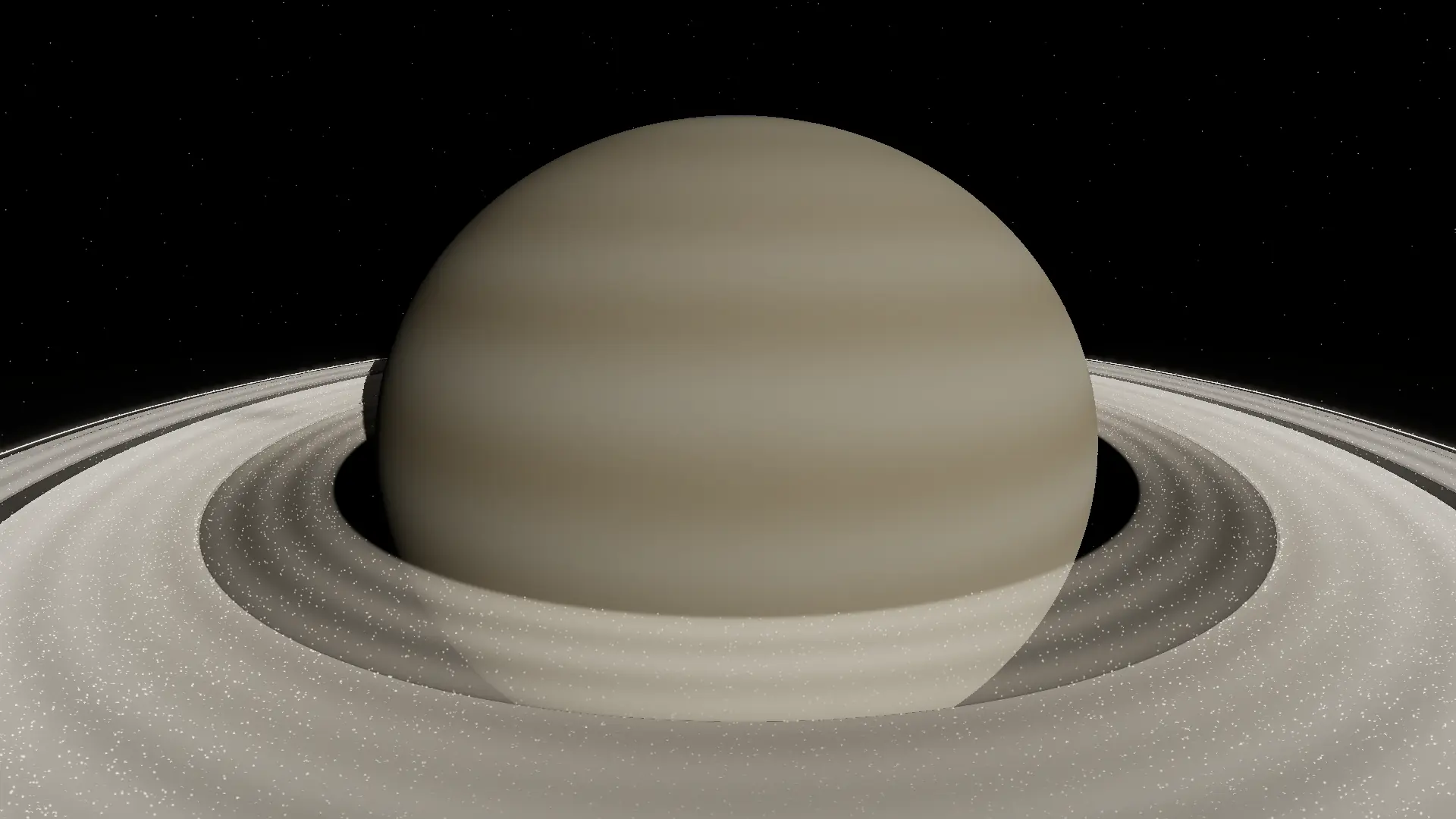
How to find Saturn and the Moon tonight
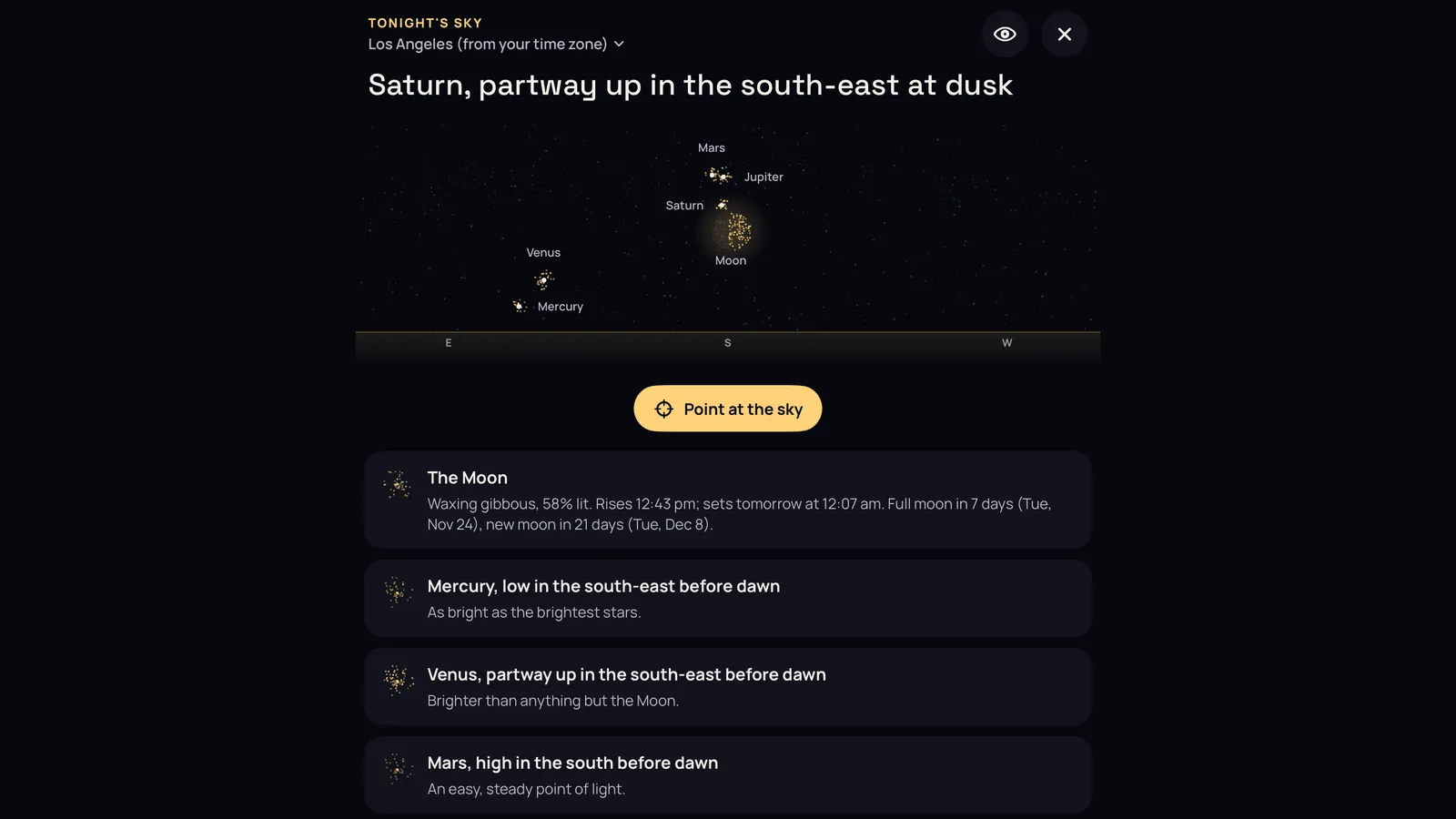
Where Saturn and the Moon are in this week's evening sky, with directions and heights at 9 pm for New York, Chicago, Los Angeles and London, updated every week. Plus how to tell Saturn from a star, why its rings change tilt, and when the Moon is up.
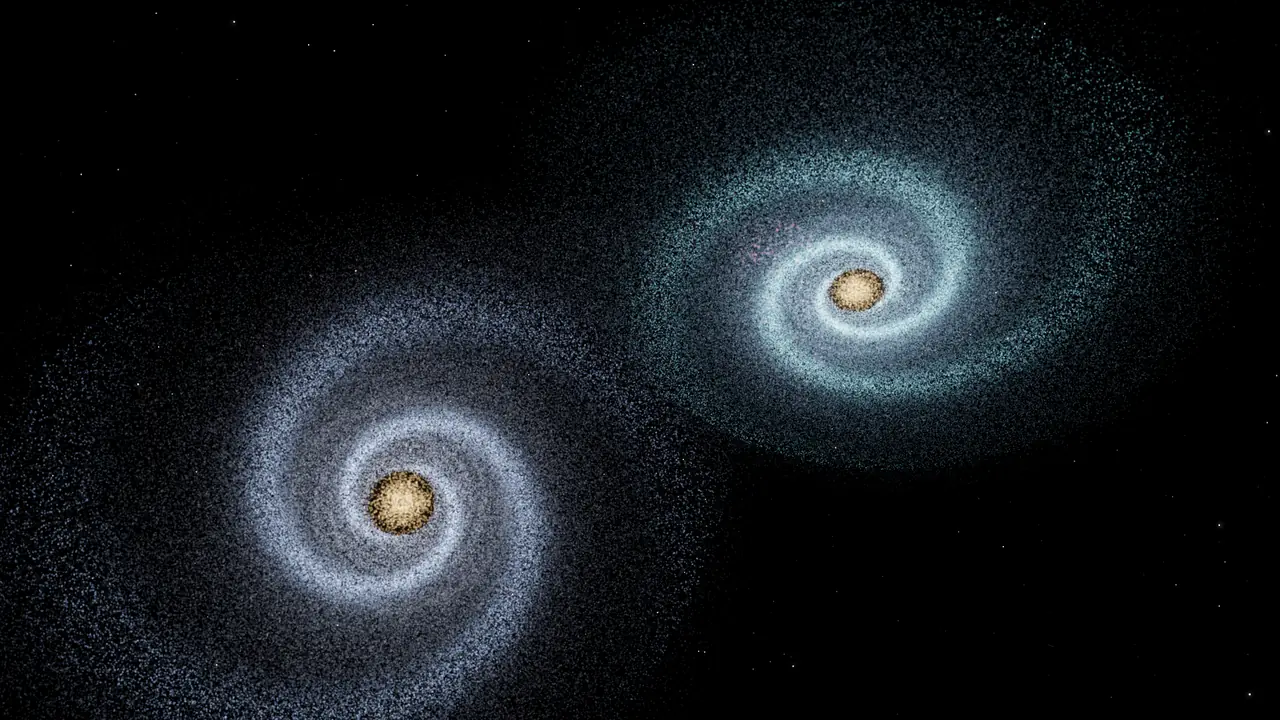
When will the Milky Way collide with Andromeda? What Hubble and Gaia say
Andromeda is 2.5 million light-years away and closing at about 110 kilometers a second. A 2012 Hubble study forecast a head-on collision in about 4 billion years; a 2025 re-analysis with Gaia data puts a merger within 10 billion years at roughly a coin toss. Here is what changed, and what a collision would do.
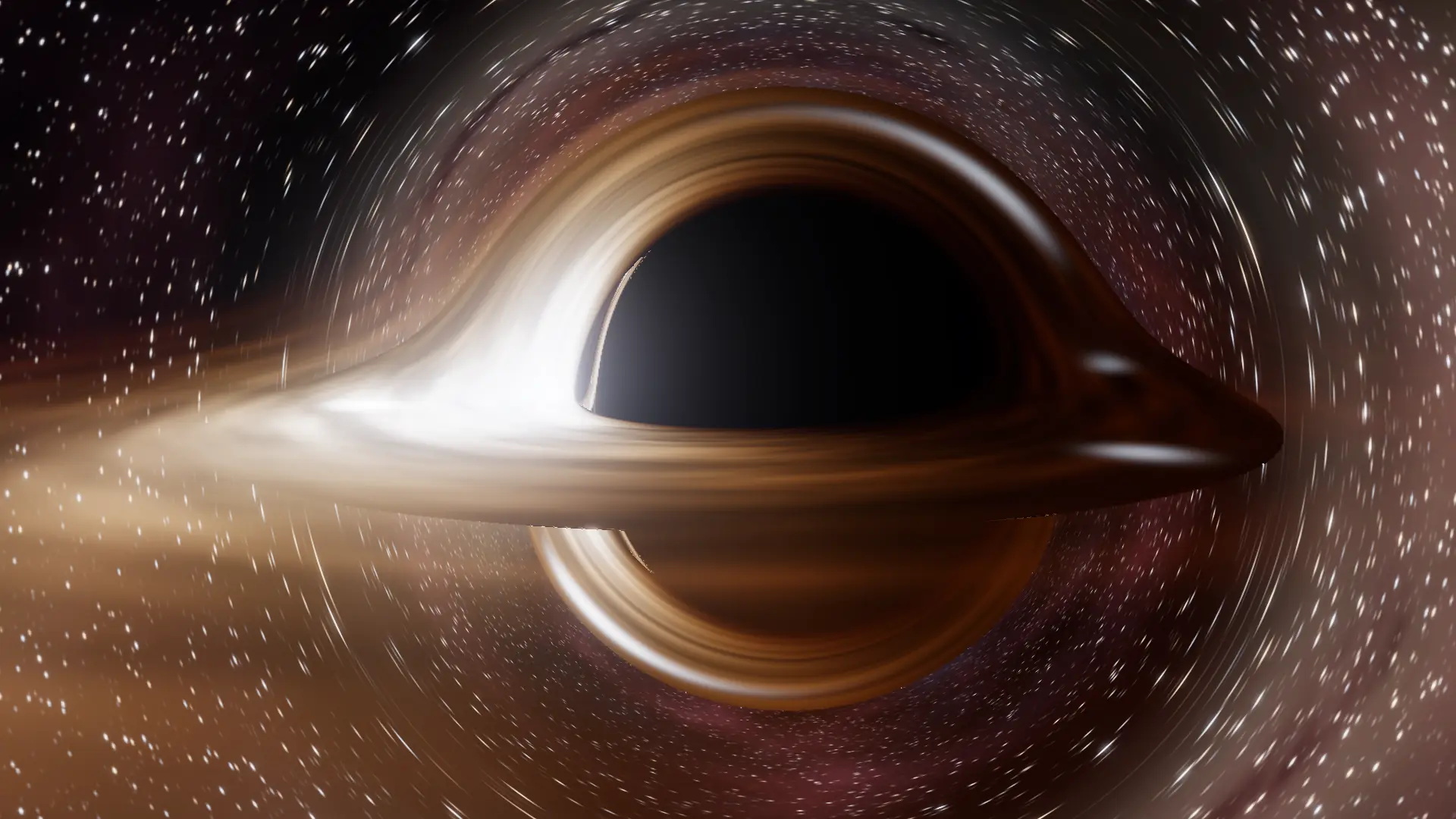
What a spinning black hole really looks like
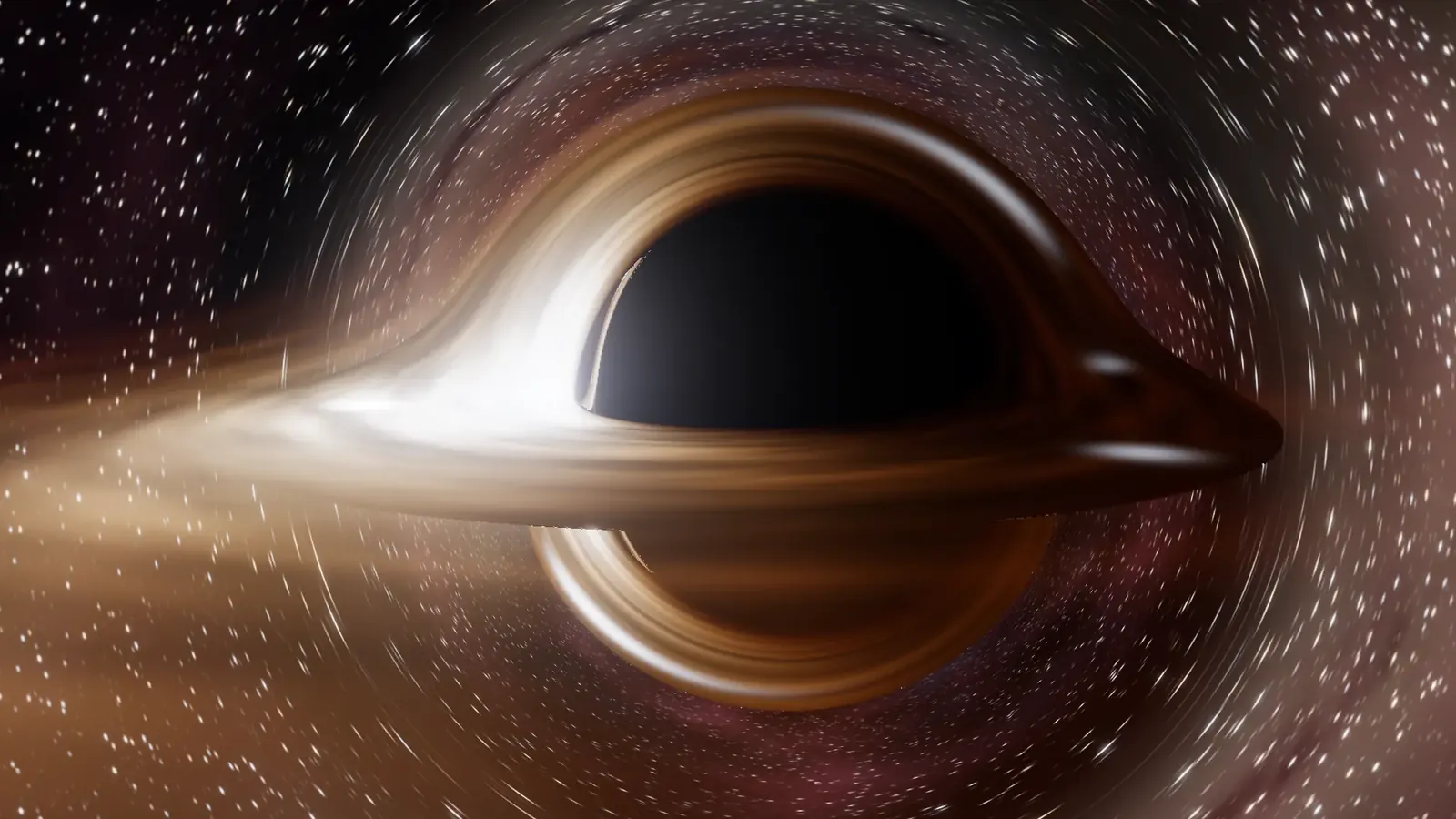
A spinning black hole looks like a dark shadow ringed by a thin bright photon ring, with its glowing disk bent up over the top and under the bottom, one side far brighter than the other. The Kerr solution, gravitational lensing, the photon ring and what the Event Horizon Telescope's images of M87* and Sagittarius A* actually show.
Free astronomy and stargazing apps for Android (2026): an honest guide
Which free Android app to pick for what you want from the sky, whether that's a stargazing app that names the stars and planets overhead, a constellation finder, seeing what's visible tonight, following NASA missions or playing with how galaxies and black holes work. Each described from its own Google Play listing, by the maker of one of them.
Galaxy and black hole simulator apps for Android: an honest guide
The galaxy and black hole simulator apps on Google Play, from build-your-own gravity sandboxes such as Pocket Galaxy to a ray-traced black hole. What each does, what it costs, and which have ads, each described from its own Google Play listing, by the maker of one of them.
Galaxy and black hole simulators: an honest guide
The galaxy and black hole simulators people actually use, from Universe Sandbox and SpaceEngine to the free Gaia Sky and Celestia and the free browser worlds on this site. Where each runs, what it costs and which to pick. Written by the maker of one of them.
Space and astronomy apps for Apple Vision Pro: an honest guide
Which Vision Pro app to pick for what you want from space, whether that's naming tonight's stars, touring the solar system with NASA data, walking a space museum or putting your hands in a galaxy collision. Written by the maker of one of them.
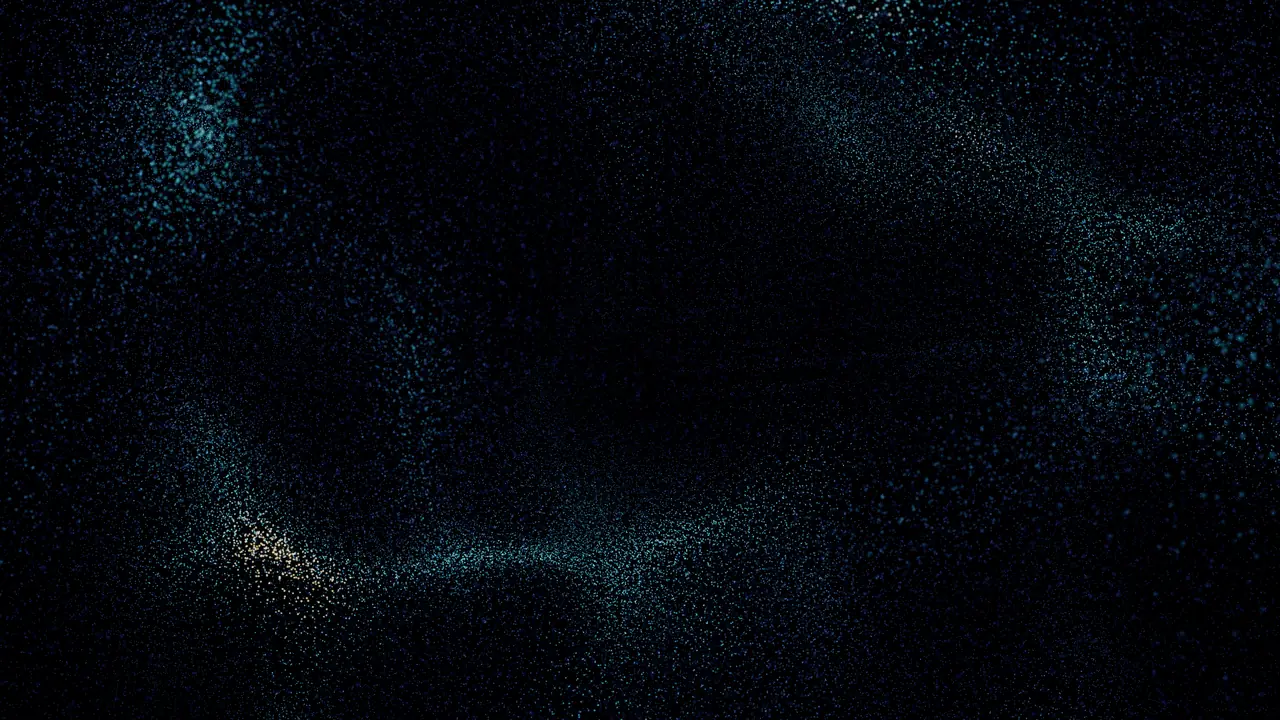
Universe simulator: how Everdust builds the cosmos from particles
What a universe simulator is, how the big research simulations and Everdust's particle universe simulator differ, and what you can do with Everdust, from the Big Bang to colliding galaxies and black holes. Free in your browser, on Android and on Apple Vision Pro.
Everdust is on Apple Vision Pro
Everdust is out on the App Store for Apple Vision Pro, free. What it is in the headset, a few worlds to try first, and what's coming next.
Free space science games for Android: Everdust on Google Play
Everdust is free on Google Play for Android phones and tablets, with no ads and no account: space science games, narrated science stories and a particle universe simulator. What's free, what Everdust Plus adds and which devices it runs on.
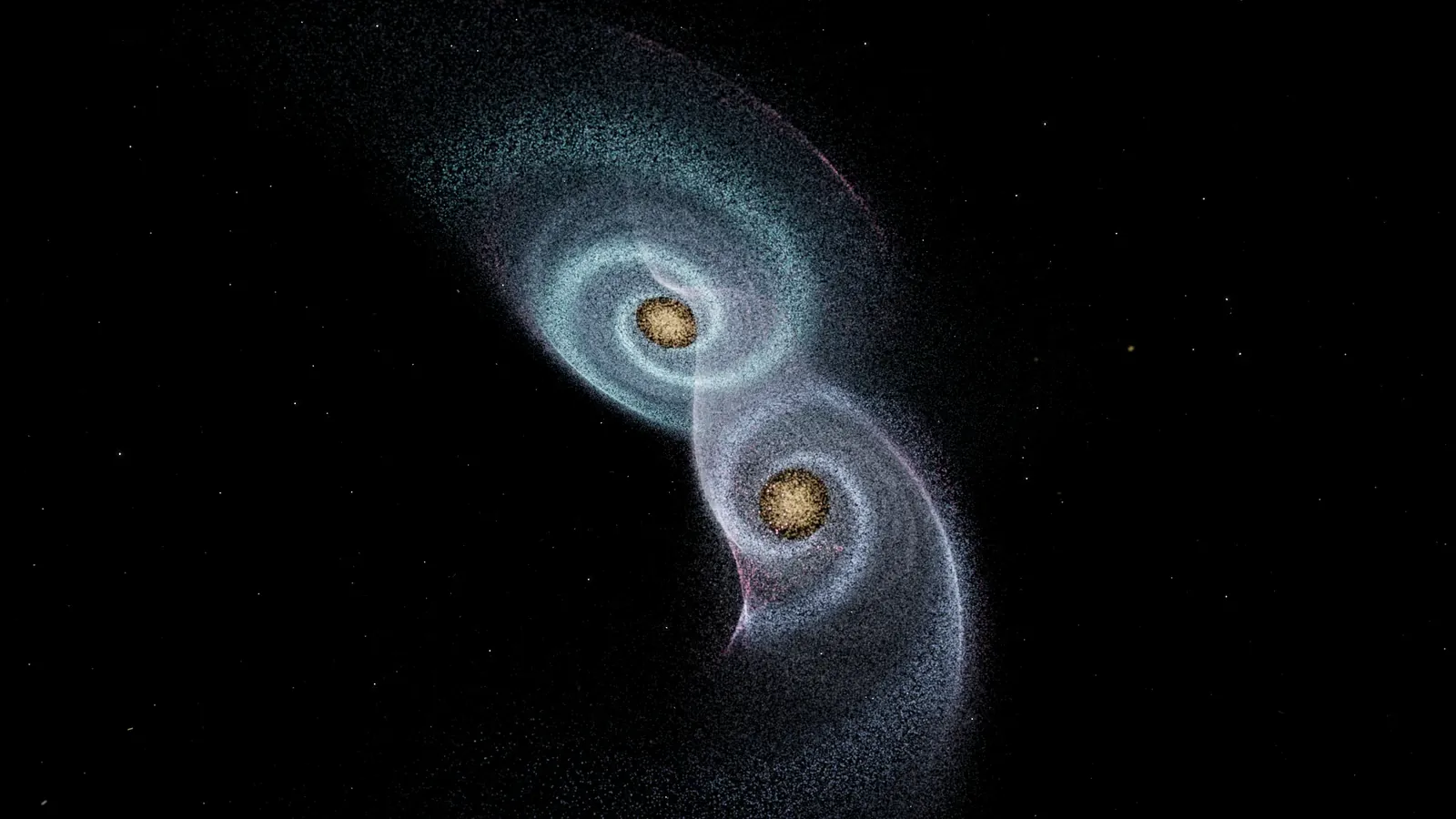
A free live space screensaver for Mac, and what to run on Apple TV
Everdust Screen Saver is a free Mac screen saver where galaxies collide, a black hole spins and starlings flock, all simulated live. Apple TV doesn't take third-party screen savers, so there Everdust's Ambient mode does the same job.
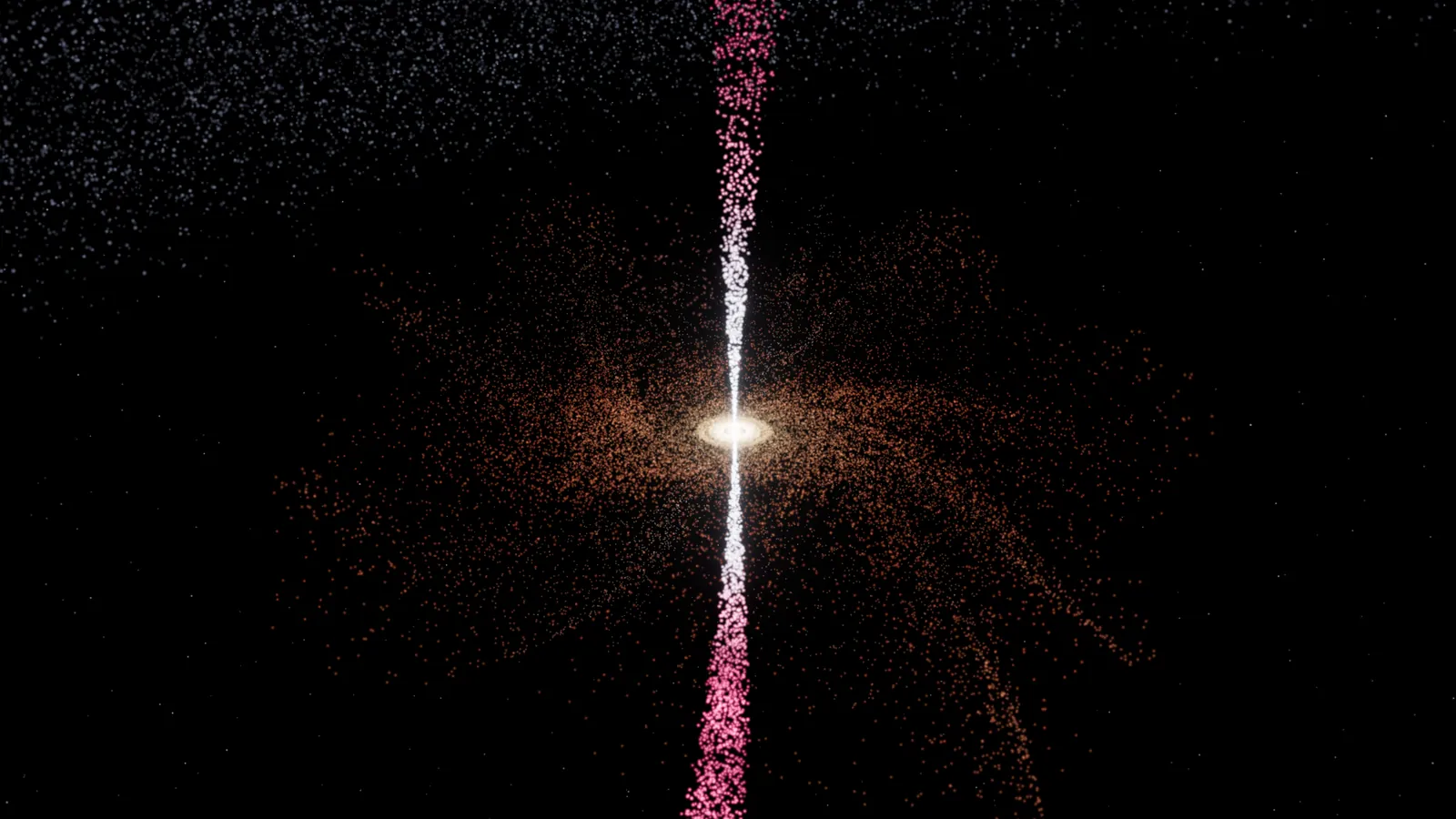
How a star is born
A star is born when a cold cloud of gas collapses under its own gravity, spins up into a disk and heats its center until hydrogen fuses. Here is how it happened to the Sun, step by step, with a live simulation you can watch.
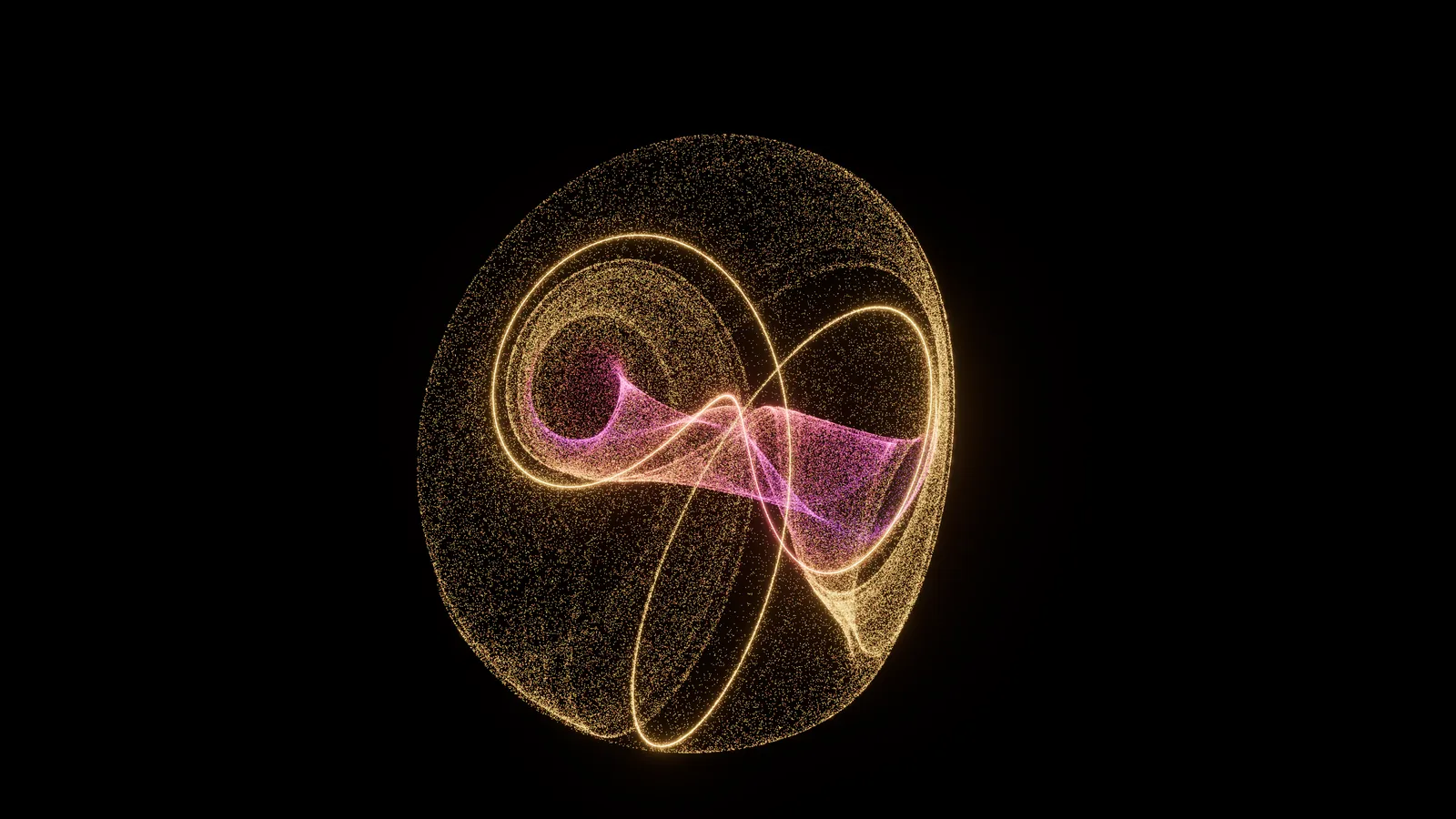
What is a strange attractor?
A strange attractor is the shape a chaotic system settles onto, a path that never repeats and never escapes. The Lorenz butterfly is the famous one; here's what makes it strange, and a free visualizer to watch four of them live.
What is Everdust?
The short version, with the facts in one place: what Everdust is, what's in it, where it runs and what's free.
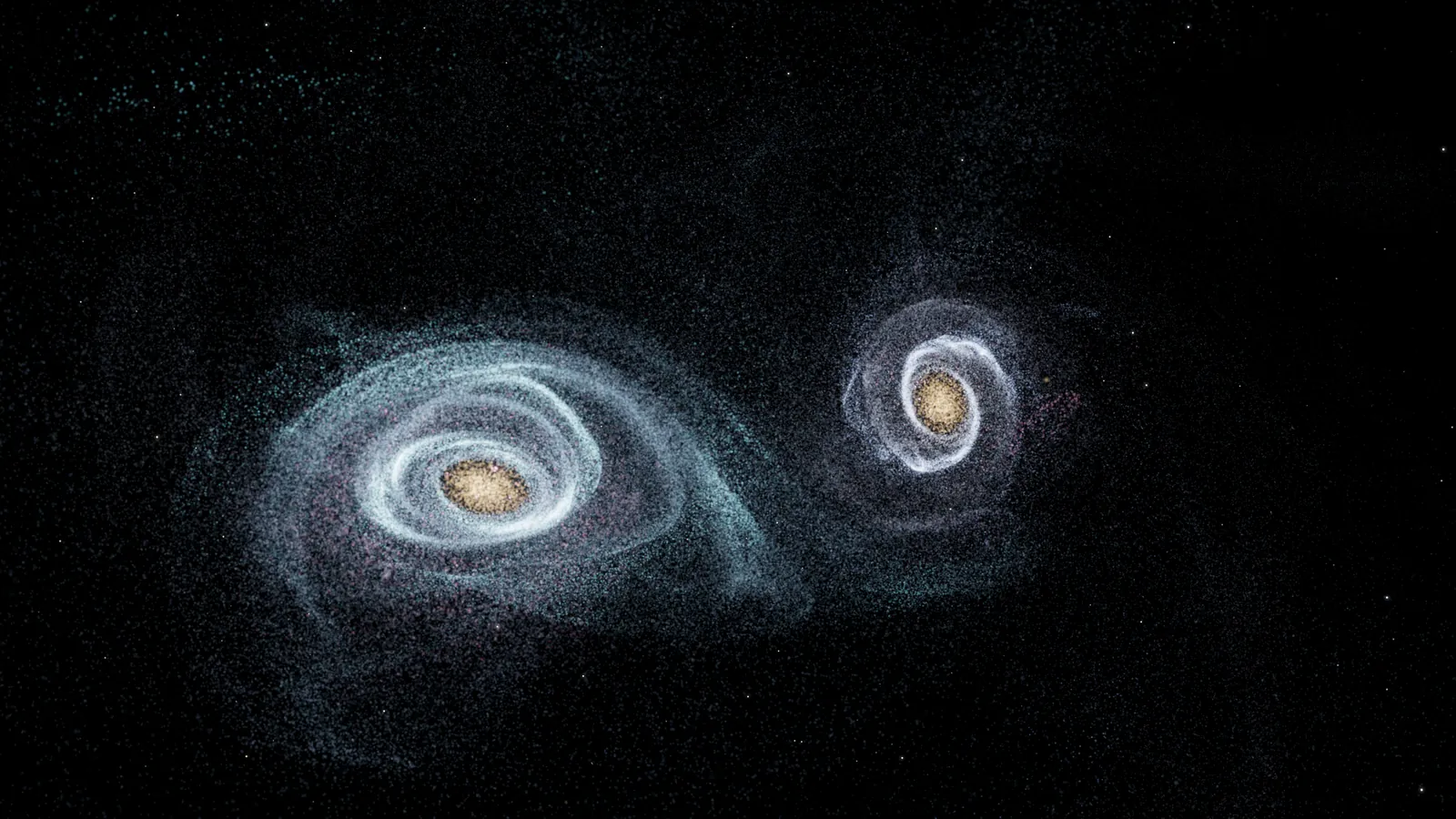
Why stars almost never collide when galaxies do
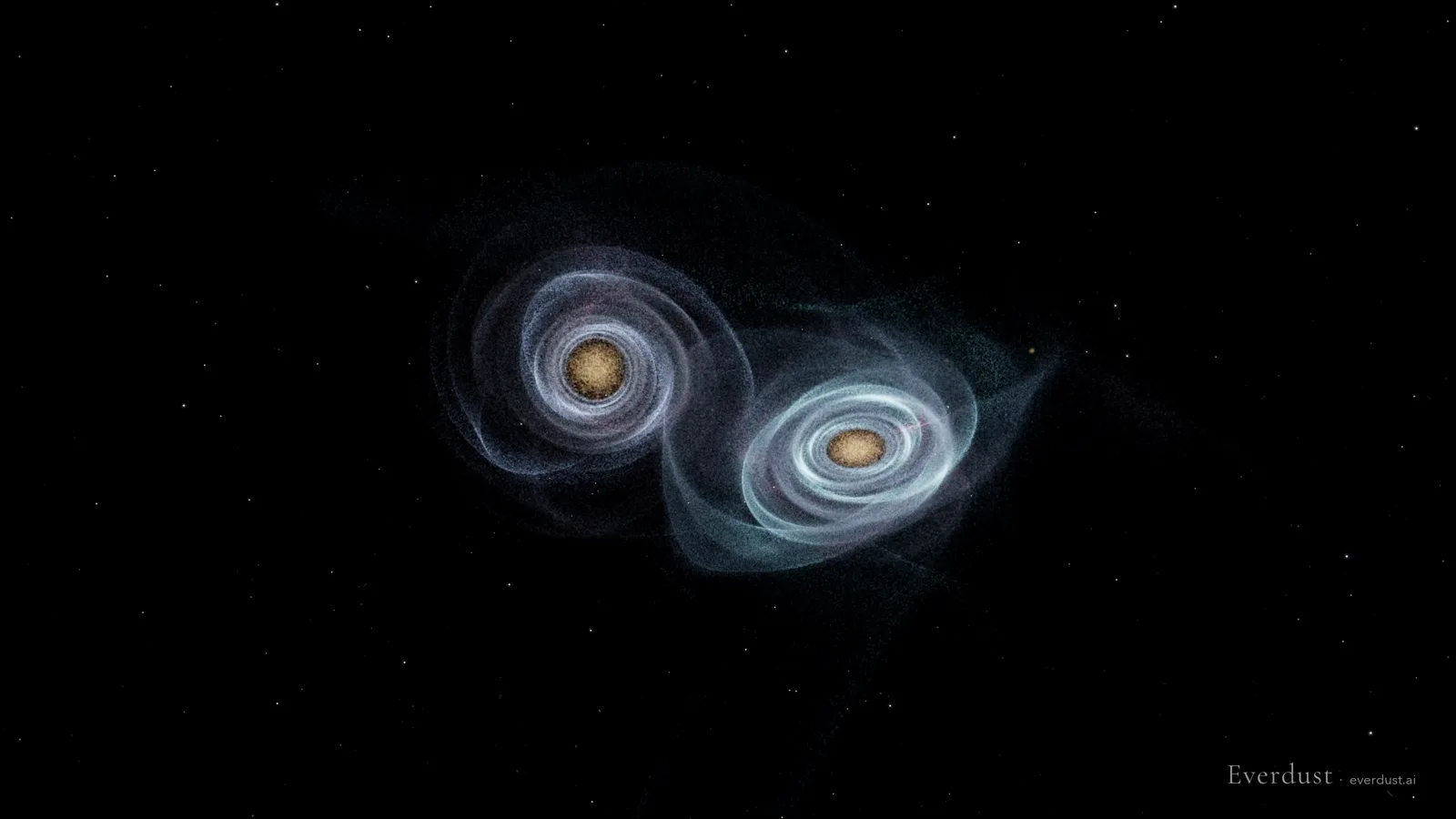
When two galaxies collide, almost none of their stars hit each other, because the gaps between stars are enormous. Gravity does the damage instead, and you can watch it happen in a free galaxy collision simulator.
Get Everdust on every device
- Apple Vision ProDownload on the App StoreEverdust 1.1 for Apple Vision Pro: Night SkyEverdust is on Apple Vision Pro
- iPhone and iPadDownload on the App StoreEverdust is on iPhone and iPad
- Apple TVDownload on the App StoreEverdust is on Apple TV
- Android phones and tabletsGet it on Google PlayFree space science games for Android: Everdust on Google Play
- Meta Quest 3 and 3SGet it on the Meta Horizon StoreEverdust is on Meta Quest
- MacDownload for MacFree. Mac App Store version in review.
- Any web browserTry the worlds free
Free to download on every store, with no ads. Everdust Plus is optional: what it costs and where.