Space and astronomy apps for Meta Quest 3 and 3S (2026): an honest guide
Which Quest app to pick for space, whether you want to learn the real night sky, tour the solar system at scale, float inside the International Space Station, relive Apollo 11 or play with galaxies and black holes with your hands. What each one does and costs on the Meta Horizon Store, and which famous space sims aren't on Quest at all, by the maker of one of them.
The best space apps on Meta Quest 3 and 3S depend on what you want. To learn the real night sky, get Stellarium VR ($9.99). For the size of the planets and stars, Titans of Space PLUS ($9.99) is the classic guided tour. For the International Space Station, Mission: ISS is a free, hands-on simulation, and Space Explorers: Ultimate Edition is a free filmed series shot aboard the station. Apollo 11 ($9.99) retells the Moon landing, and BRINK Traveler ($14.99) puts a real star-filled sky over real places. To play with colliding galaxies and black holes with your hands, there's Everdust, free, which I make. Universe Sandbox and SpaceEngine aren't standalone Quest apps; they run in PC VR, if at all.
I make Everdust, so read this with that in mind. I've described every other app from its Meta Horizon Store listing, checked November 6, 2026, with the maker and supported headsets from the developer's site or the store tracker VRDB where the store page doesn't name them. Prices are list prices on that day. Quest apps go on sale often, so check.
The short answer
- Learn the real night sky: Stellarium VR.
- Feel the scale of the solar system and the biggest stars: Titans of Space PLUS.
- Be on the Space Station: Mission: ISS (a simulation you do things in) or Space Explorers: Ultimate Edition (filmed in 3D aboard the station). Both free.
- The Moon landing: Apollo 11.
- Stars over real landscapes: BRINK Traveler.
- Play with gravity, galaxies and black holes using your hands: Everdust, free.
Stellarium VR
Stellarium VR by Stellarium Labs, the makers of Stellarium Mobile, is a planetarium you stand inside. Its listing describes identifying stars, constellations, planets and satellites such as the ISS in real time, setting the sky to any date, time and place, deep-sky objects, the constellations of other sky cultures, and 3D planets and moons. It says it comes from the original creator of the desktop Stellarium. $9.99.
Pick it if you want to learn the real sky, from where you live, in a headset.
Titans of Space PLUS
Titans of Space PLUS by DrashVR is a guided tour of a shrunk-down Solar System. It stops at each planet, the major moons and dwarf planets, then goes on to some of the largest stars we know. The listing gives about two hours of narration in English, a zero-gravity mode for walking around, a comfort mode and full hand tracking. $9.99.
Pick it if you want the size of things to sink in, with a narrator.
Mission: ISS
Mission: ISS by Magnopus simulates life on the International Space Station. You move in zero gravity, dock a capsule and go on a spacewalk, with NASA astronauts guiding you through videos. It uses controllers. Free.
Pick it if you want to try the station's work with your own hands.
Space Explorers: Ultimate Edition
Space Explorers: Ultimate Edition from Felix & Paul Studios, with TIME Studios, collects the 3D series filmed aboard the ISS in one app, released November 3, 2025. It adds a new episode, Mission to the Moon, and small mixed-reality extras. It's for Quest 3 and 3S only, controlled with your hands. Free. (Quest 2 owners can watch the films in Meta Quest TV.)
Pick it if you'd rather watch astronauts at work, filmed for real, than play.
Apollo 11
Apollo 11 by Immersive VR Education retells the mission with original archive audio and video, and recreated spacecraft and locations. It's a rebuilt version of the team's earlier Apollo 11 VR. $9.99.
Pick it if you want history, from the launch to the landing.
Star Chart
Star Chart by Escapist Games has a real-time night sky, a 3D solar system and an orrery tour, plus "Moments in Time" scenes on the Moon, on Mars, in the ISS Cupola and with New Horizons. It uses controllers. $9.99. It came out in 2019, and Stellarium VR covers the sky side in more depth.
BRINK Traveler
BRINK Traveler by BRINK XR is a travel app of 3D-scanned natural landmarks, not an astronomy app. Since a late-2024 update, its night skies match each place's real location and date, with star names and all 88 constellations labeled, as MIXED reported. Hands or controllers. $14.99.
Pick it if you want to stand in a canyon or on a mountain under its real sky.
Everdust
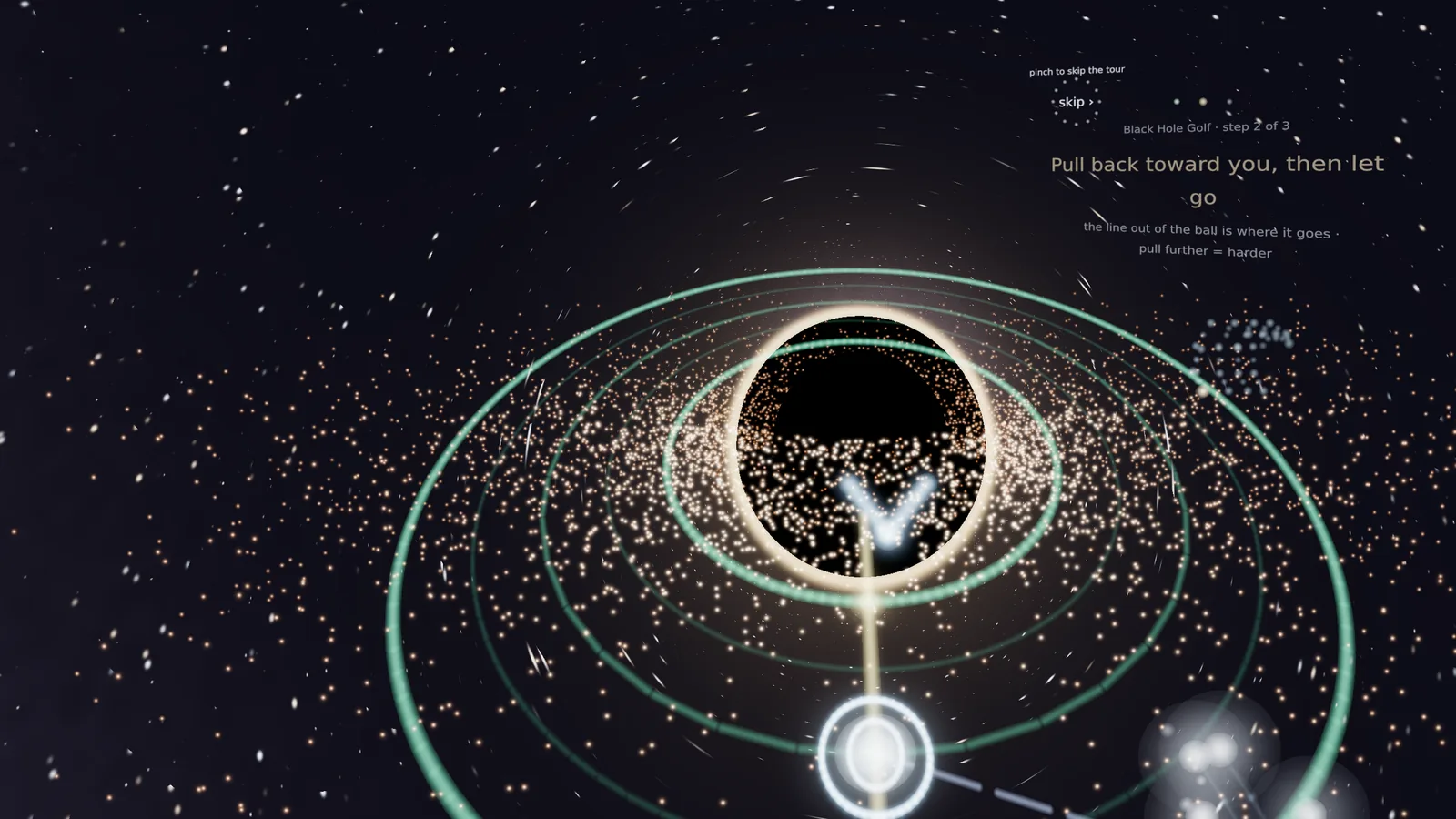
Everdust is the one I make. It isn't a planetarium. It's over 150 living worlds, from colliding galaxies and black holes to murmurations and the deep sea, where every one is a live simulation, not a video, and your hands move it.
- Space games you play with your hands. Galaxy Billiards (collide two galaxies), Black Hole Golf (let gravity bend the shot), Fireworks, Lightfold and Orb Popper are free in full. Others start free.
- Narrated science stories. The Story of Everything, from the first light of the universe to the Earth, is free in all nine chapters, each a world you stand in.
- Calm and Tonight's Sky. A sleep timer, a focus timer, guided breathing and a 10-minute NSDR session. Tonight's Sky shows what's up in your sky tonight.
It's built for hand tracking, and Touch controllers work too. Play seated, standing or roomscale, in passthrough or fully immersed. It's free, with no ads and no account.
What it doesn't have on Quest yet: Night Sky, the real night sky you can fly into, which is on Apple Vision Pro since version 1.1 and comes to Quest in a later update. For the real sky on Quest today, use Stellarium VR. More in Everdust on Meta Quest.
Pick it if you want to put your hands into gravity and light, more than learn the constellations.
Not on Quest: Universe Sandbox and SpaceEngine
People often ask for these two, so here's where they stand.
- Universe Sandbox by Giant Army is on Steam for PC and Mac. Its team wrote in February 2025 that VR support ended with Update 35, with an older update still available for VR. There's no Quest version. I've written about alternatives on headsets and phones.
- SpaceEngine by Cosmographic Software is a PC program with SteamVR support. On a Quest you'd run it from a gaming PC over Link or Air Link, not on the headset itself. See SpaceEngine vs Universe Sandbox.
How to choose
- To learn the sky, Stellarium VR. Pair it with a phone star map for nights outside.
- For scale and wonder with a narrator, Titans of Space PLUS.
- For the Space Station, both free ISS apps: Mission: ISS to do, Space Explorers to watch.
- For hands-on physics, Everdust, free. Start with Galaxy Billiards.
If you'd like the science behind what a headset can show of the sky, I wrote a guide to seeing the real night sky in VR. On Vision Pro instead? See the best Vision Pro apps for space and astronomy.
Questions people ask
What is the best astronomy app for Meta Quest 3? For learning the real night sky, Stellarium VR ($9.99), from the makers of Stellarium. Star Chart ($9.99) covers similar ground but is older. Everdust is free but isn't a planetarium on Quest yet.
Is there a free space app for Quest 3? Yes. Mission: ISS and Space Explorers: Ultimate Edition are free, and so is Everdust, with five free games and a free nine-chapter story about the universe.
Is Universe Sandbox on Quest? No. Universe Sandbox is a PC and Mac program on Steam, and its developers ended VR support with Update 35 in 2025.
Can I run SpaceEngine on a Quest 3? Only from a gaming PC, through SteamVR over Link or Air Link. There's no standalone Quest version.
Which Quest apps let me see the real stars? Stellarium VR and Star Chart are night-sky apps. BRINK Traveler shows the real sky over its scanned landscapes. Everdust's Night Sky is on Vision Pro, iPhone, iPad and Android now and comes to Quest later.
Which Quest space apps work with hand tracking? Titans of Space PLUS lists full hand tracking. Space Explorers: Ultimate Edition is controlled with your hands, and Everdust and BRINK Traveler work with hands or controllers. Mission: ISS and Star Chart use controllers.
Sources
- Each app's Meta Horizon Store listing, linked in its section, checked November 6, 2026 (price, description, controls). Makers and supported headsets from VRDB, which tracks the Quest store, where the listing doesn't show them.
- Felix & Paul Studios' Space Explorers: Ultimate Edition: collectSPACE, November 3, 2025.
- Magnopus, Mission: ISS.
- Universe Sandbox blog, The Future of VR on Universe Sandbox (February 19, 2025).
- MIXED, BRINK Traveler's dynamic skies and star constellations.
- Everdust on the Meta Horizon Store and Everdust on Meta Quest.