Free astronomy and night sky apps for iPhone (2026): an honest guide
Which free iPhone app to pick for what you want from the sky, whether that's a night sky app that names the stars and planets you point at, a constellation finder, what's visible tonight, NASA's missions or playing with how galaxies and black holes work. Each described from its own App Store listing, with what's free and what costs money, by the maker of one of them.
The best free astronomy app for iPhone depends on what you want. To point your phone at the sky and know what you're looking at, start with Stellarium Mobile or Sky Guide. Night Sky, Star Walk 2 Plus and SkyView Lite also do that well. To know what's worth seeing tonight, Sky Tonight is built for it. For launches and the Space Station, get the NASA app. For playing with the physics of galaxies and black holes rather than mapping the sky, there's Everdust, which I make. All of these are free to download. Most sell an upgrade, and I've said what each one locks.
I make Everdust, so read this with that in mind. I've described every other app by what its own App Store listing says, checked on the US store on November 6, 2026, and said plainly where another app is the better pick. Prices change, so check before you pay.
The short answer
- Point your phone at the sky and know what's there (a star map or constellation finder): Stellarium Mobile, Sky Guide, Night Sky, Star Walk 2 Plus or SkyView Lite.
- The most depth, and maybe a telescope later: Stellarium Mobile. If you'll pay, SkySafari.
- What's visible tonight and when to look: Sky Tonight. SkySafari's new Tonight section does this too, if you buy it.
- Launches, live NASA video and Space Station passes: the NASA app.
- Colliding galaxies, black holes bending light, stars forming: Everdust.
- Want no ads and nothing to buy: the NASA app. Of the star maps, every one sells something; Stellarium's free version is the most complete.
Stellarium Mobile
Stellarium Mobile - Star Map by Noctua Software is a planetarium app from the maker of Stellarium, the open source desktop planetarium. Point your phone and it identifies stars, constellations, planets, comets and satellites such as the ISS. It shows the sky for any date, time and place, and has constellation figures from many sky cultures and a night mode.
It's free. Stellarium Plus, an in-app purchase listed at $1.99 and $18.99, takes it from stars down to magnitude 8 to objects as faint as magnitude 22, adds an offline data set and controls GoTo telescopes over Wi-Fi.
Pick it if you want the deepest free star map and expect to grow into it.
Sky Guide
Sky Guide by Fifth Star Labs is the one people often call the prettiest. Hold it up and it names stars, constellations, planets and satellites. It has an AR mode that draws the figures over your camera view, time controls, and notifications when the Space Station is about to pass over. It needs iOS 18 or later.
It's free, with in-app purchases: Plus ($4.99 or $39.99), Pro ($8.99 or $59.99, or $249.99 for Pro Lifetime) and an All Constellations unlock for $1.99.
Pick it if you want the most beautiful way to learn the constellations.
Night Sky
Night Sky by iCandi Apps identifies stars, planets, constellations and satellites when you hold up your iPhone, iPad or Apple Watch. It also lets you pull objects out of the sky in AR, and pin your own Sky Tags. Night Sky Aura, an AI astronomer you can ask questions, needs a subscription.
It's free. Its listing shows Night Sky+ and Night Sky+ Aura purchases from $5.99 to $69.99. (This Night Sky is iCandi's app. Everdust also has a part called Night Sky, on Vision Pro and, since version 1.1, on iPhone and iPad, which is something else.) To choose between the two best-known iPhone star maps, see Night Sky vs Sky Guide; for four of them side by side, Stellarium vs SkySafari vs Sky Guide vs Star Walk 2.
Pick it if you have an Apple Watch, or you want to ask questions as you look.
Star Walk 2 Plus
Star Walk 2 Plus: Live Sky Map by Vito Technology is a star map with an AR mode, a time machine, 3D constellation figures with their stories, the sky at different wavelengths and a Visible Tonight list. Its listing says plainly that it's ad-supported, with an optional subscription that removes the ads and unlocks extra content. If you'd rather pay once, Star Walk 2 Pro is $2.99 without ads.
Pick it if you like stories and visuals alongside the map, and don't mind ads.
SkyView Lite
SkyView Lite by Terminal Eleven is the simplest of the camera star maps: point your phone and it labels stars, constellations and satellites. Its listing says it doesn't need Wi-Fi, a data signal or GPS, so it works camping or on a plane. It's free, with two small in-app purchases ($0.99 each). The full SkyView costs $2.99.
Pick it if you want the quickest "what's that star" app, and one that works far from a signal.
Sky Tonight
Sky Tonight - Stargazing Guide, also by Vito Technology, is built around three questions: what's that bright dot, what can I see tonight, and how do I find it. It has a sky map with AR, a time machine, and a calendar of Moon phases, meteor showers, eclipses and other events with a stargazing index and weather.
Be aware of what's free. Its listing says that without the Premium subscription "you can't see most of the interface items" in sections such as Visible Tonight and the Calendar, and that Premium removes advertisements. Premium is listed from $0.99 a month to $12.99 for lifetime.
Pick it if planning a night out is the point, and you'll likely pay for it.
NASA
NASA, from NASA, isn't a star map. It has NASA+ live coverage and video with no subscription, over 21,000 NASA images, news and mission updates on Artemis and Webb, podcasts, alerts for Space Station passes with a sky view to spot it, and AR models of rovers and rockets. It's free, with no in-app purchases.
Pick it if you want to follow real missions, at no cost at all.
Everdust
Everdust is the one I make. It isn't a star map, so it's not the answer if you want to identify every star overhead. It's space science games, narrated science stories and a particle universe simulator, where every world is a live simulation, not a video.
- A galaxy collision of up to about a million stars, each pulled by gravity. Drag to orbit, pinch to zoom.
- Narrated science stories, from the first light after the Big Bang to a giant star exploding, where every chapter is a live world. The Story of Everything is free in full.
- Games built on real physics, such as Feed the Black Hole, Lightfold and Black Hole Golf, each with free levels and a free daily level.
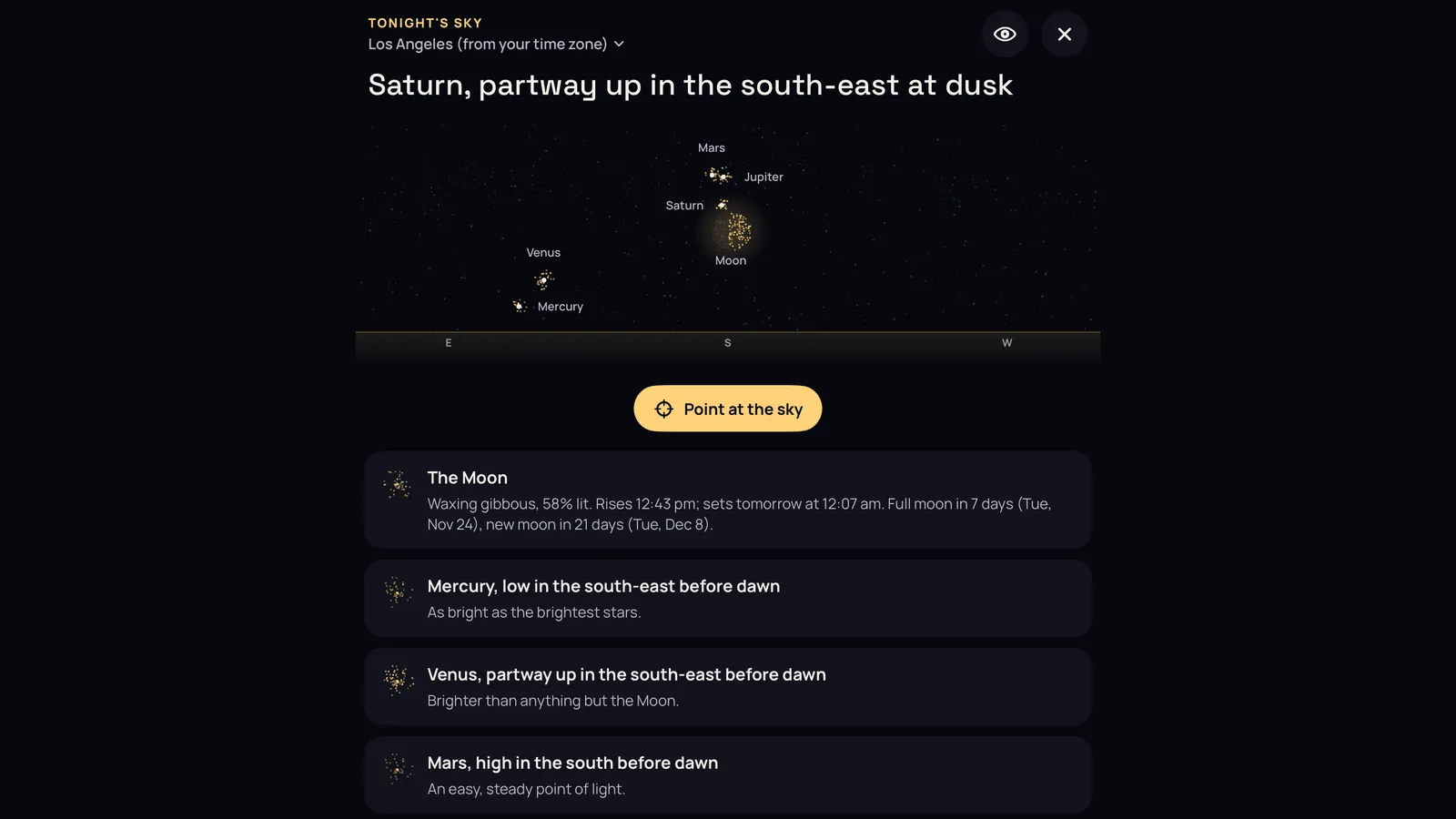
- Tonight's Sky: the Moon, the planets, meteor showers rated for your place, Space Station passes, the chance of aurora and the clouds, in plain words. A Point at the sky view shows what's behind your phone. It's a quick look at tonight, not a replacement for the star maps above.
- Night Sky (since version 1.1, November 7, 2026): hold your phone up to see the real sky where you are, lined up with true north, and tap a wonder such as the Orion Nebula or the Pillars of Creation to fly into real photographs from Hubble, Webb and other observatories, given depth. It's for going inside the wonders, not for naming every star.
It's free, with no ads and no account. Everdust Plus, optional, unlocks every Story chapter and game level. It needs iOS 17 or later. The same App Store listing covers iPad, Apple Vision Pro and Apple TV, and on Vision Pro, Everdust's Night Sky puts the real sky all around you (what it does). You can try a few worlds in your browser first, at everdust.ai/play.
Pick it if you want to see how galaxies merge and black holes bend light, more than you want to know what's overhead tonight.
If you'll pay for one: SkySafari
SkySafari by Simulation Curriculum costs $4.99, so it isn't in the free list above. Version 8 has point and identify, a new Tonight section with Moon and Sun times and the best-placed objects, an image gallery that imports from AstroBin, and time travel. An optional Premium subscription adds a much larger deep-sky database and more. Many observers use it to plan nights at the telescope. If that's you, read its listing next to Stellarium Plus.
How to choose
- To find Saturn tonight, use a star map. SkyView Lite is the simplest, Stellarium goes deepest and Sky Guide looks the best.
- To plan around events, use Sky Tonight, and budget for Premium.
- To follow launches and the Space Station for free, use the NASA app.
- To get a feel for gravity and light by touching them, use Everdust.
They're all free to start, so the honest advice is to install one star map and one of the others, and see which you keep opening. On Android? There's a version of this guide for Android. Without installing anything, what's in my sky tonight works out the planets in your browser, and the meteor shower calendar rates the coming showers for your city. The next two worth a look are the Leonids and the Geminids.
Questions people ask
What is the best free astronomy app for iPhone? For a free star map, Stellarium Mobile goes deepest and Sky Guide is the most polished. Both identify what you point at, and both sell upgrades. SkyView Lite is the simplest. For missions rather than the sky, the NASA app is free with no in-app purchases. Everdust is free but isn't a full star map.
What is the best night sky app for iPhone? If you mean an app that names the stars, planets and constellations as you hold up your phone, any of Stellarium Mobile, Sky Guide, Night Sky, Star Walk 2 Plus or SkyView Lite. Night Sky by iCandi Apps also works on Apple Watch.
Which iPhone app shows what planets are visible tonight? Sky Tonight is built for it, though much of it needs Premium. SkySafari ($4.99) has a Tonight section. Everdust's Tonight's Sky lists the Moon and planets for where you are, free. Without an app, what's in my sky tonight works it out in your browser.
Is there a constellation finder app for iPhone? Yes. Every star map here draws the constellations where they really are when you hold up your phone. Sky Guide's AR mode overlays the figures on your camera view.
Which of these iPhone astronomy apps have ads? Star Walk 2 Plus says it's ad-supported, and Sky Tonight's listing says Premium removes advertisements. Everdust, the NASA app, Stellarium, Sky Guide, Night Sky and SkyView Lite don't mention ads in their listings.
Which iPhone astronomy app works without a signal? SkyView Lite's listing says it needs no Wi-Fi, data or GPS. Stellarium Plus adds an offline data set.
Is Everdust a star map? No. It's a space physics simulator with a Tonight's Sky screen and, since version 1.1, a Night Sky you fly into. For naming stars and constellations, Stellarium, Sky Guide or SkyView Lite is the better pick.
Sources
- Each app's own US App Store listing, linked in its section, checked November 6, 2026: price, in-app purchase list, seller, minimum iOS and the features its description names.
- Everdust: Space Science Games on the App Store (version 1.1 on iPhone and iPad since November 7, 2026, with Night Sky) and Everdust on iPhone and iPad.