Space apps and games for kids (2026): an honest guide for parents
The best space and astronomy apps for kids by age, from narrated planet stories for 4-year-olds to a 3D solar system, NASA's own app, free browser games from NASA Space Place and physics games for older kids. What each one does, what it costs and whether it has ads, each described from its own App Store listing, by the maker of one of them.
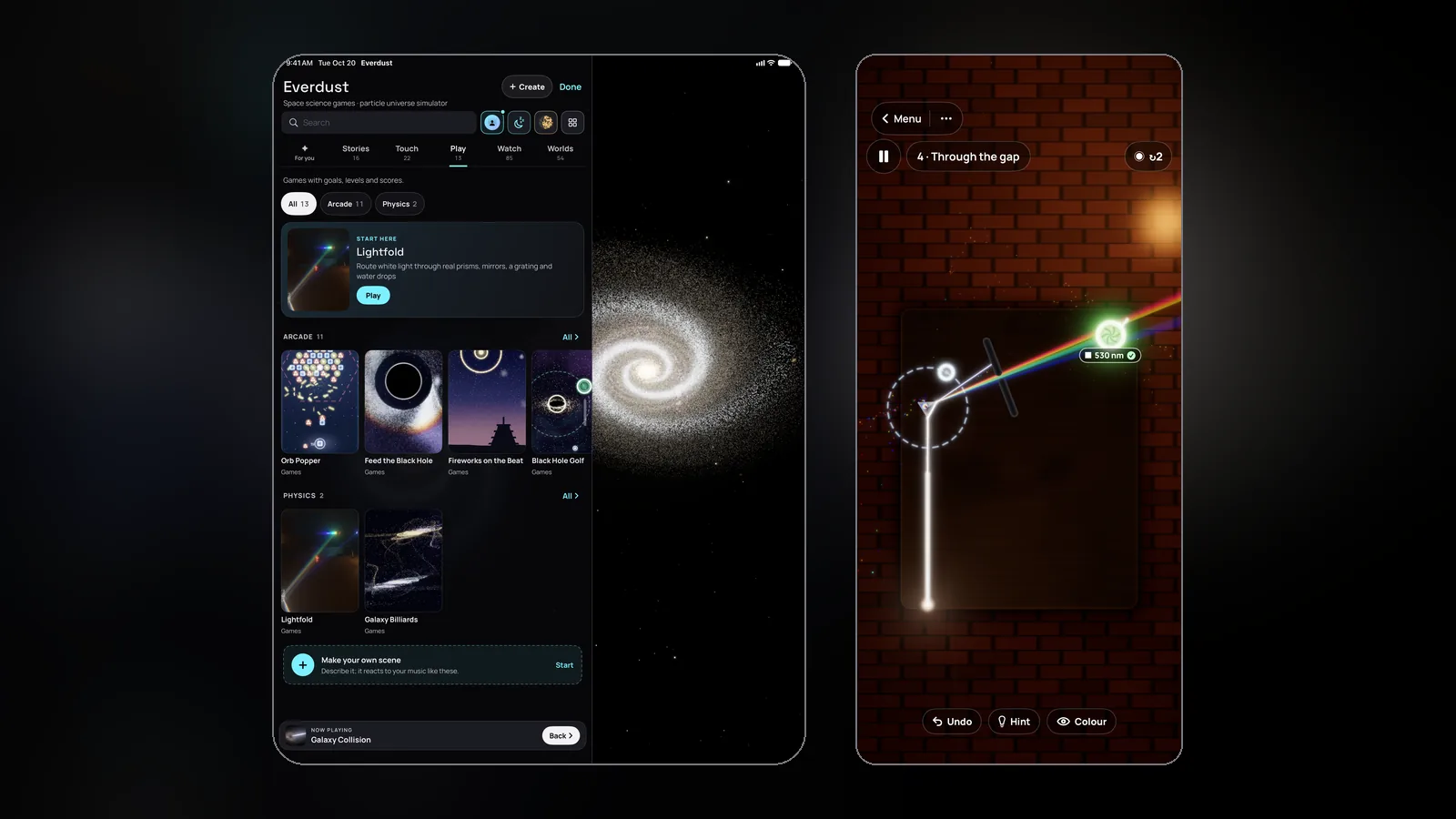
The best space app for a child depends on their age. For ages 4 to 7, narrated apps like Star Walk Kids, What's in Space? and Astronomy & Space for Kids teach the planets through stories and simple games. For a 3D solar system any age can explore, Solar System Scope and Solar Walk Lite are free. The NASA app brings real images, missions and NASA+ video, and NASA Space Place has free space games in a web browser. For older kids, Tiny Space Program is a space-agency sim, and Everdust, which I make, has physics games with black holes and colliding galaxies.
I make Everdust, so read this with that in mind. I've described every other app from what its own US App Store listing says, checked on November 6, 2026, including its age rating and what its listing says about ads and in-app purchases. Prices change, so check the listing before you buy anything.
The short answer
- Ages 4 to 7, learning the planets through a story and games: Star Walk Kids, What's in Space?, Astronomy & Space for Kids, or Solar Family.
- A 3D solar system to explore, any age, free: Solar System Scope, or Solar Walk Lite (no in-app purchases).
- Real NASA images, missions and launches: the NASA app, free.
- Free space games in a web browser, no install: NASA Space Place.
- Older kids who like building and managing things: Tiny Space Program.
- Older kids who want to play with real physics, such as black holes and colliding galaxies: Everdust (rated 9+).
At a glance
| App | Best for | Age rating | Price | Ads (per its listing) | Platforms |
|---|---|---|---|---|---|
| Star Walk Kids | First astronomy lessons, cartoons, quizzes | 4+ | Free | "No ads or in-app purchases" | iPhone, iPad, Android |
| What's in Space? | Narrated games for non-readers | 4+ | Free to download | "No Ads" | iPhone, iPad |
| Astronomy & Space for Kids | A narrated guided tour of the solar system | 4+ | Free to try; $7.99 once unlocks everything | "Ad-free" | iPhone, iPad |
| Solar Family | A storybook and games about the planets | 4+ | Free to download | Not stated | iPhone, iPad |
| Solar System Scope | A 3D solar system and encyclopedia | 4+ | Free to download | Not stated | iPhone, iPad, Android |
| Solar Walk Lite | A free 3D planetarium of the solar system | 4+ | Free, "no In-App Purchases" | Not stated | iPhone, iPad, Android |
| NASA | NASA images, news, missions, NASA+ video | 4+ | Free | Not stated | iPhone, iPad, Android |
| NASA Space Place | Free space games and activities | Website | Free | None seen | Any web browser |
| Tiny Space Program | Running your own space agency | 4+ | Free to download | "No forced ads" | iPhone, iPad |
| Everdust | Physics games, narrated science stories | 9+ | Free; optional Everdust Plus | No ads | iPhone, iPad, Android, Apple Vision Pro, Apple TV, Meta Quest 3 and 3S, Mac |
For younger kids (about 4 to 7)
Star Walk Kids
Star Walk Kids: Astronomy Game by Vito Technology, the makers of Star Walk, is "an entertaining astronomy game for children to learn about astronomy and our solar system". Its listing describes cartoons about celestial objects, space facts voiced by actors, a solar system in motion and short tests to see what kids have learned, and says it has no ads or in-app purchases. It's also on Google Play.
Pick it if you want a gentle first astronomy lesson with characters and quizzes.
What's in Space?
What's in Space? by Learny Land is completely narrated, which its listing says makes it "perfect for non-readers and children who are starting to read". Kids build a space rocket, dress an astronaut, learn the planets' names and follow the stars of the constellations, with no rules, stress or time limits. Its listing says "No Ads".
Pick it if your child can't read yet and you want play without pressure.
Astronomy & Space for Kids
Astronomy & Space for Kids by Tappity is a narrated, interactive tour of the solar system led by Haley, a science teacher, with more than 100 space facts and trivia questions. Its listing says the lessons align with the Next Generation Science Standards, that it works offline and that it's ad-free. You can try complete lessons free; unlocking everything is a one-time $7.99.
Pick it if you want something that feels like a short lesson with a real teacher.
Solar Family by BubbleBud Kids
Solar Family by Dweek Studios is adapted from the storybook "Comet Meets the Solar Family". Its listing describes an interactive story about the planets and more than 30 activities and games.
Pick it if your child loves storybooks.
For any age: the solar system in 3D
Solar System Scope
Solar System Scope by INOVE calls itself "a fun way of Exploring, Discovering and Playing with the Solar System and Outer Space". It has a 3D encyclopedia of every planet, dwarf planet and major moon in 10 languages, with realistic 3D views. It's also on Google Play.
Pick it if you want one solar-system model the whole family can use for homework and curiosity.
Solar Walk Lite
Solar Walk Lite, also by Vito Technology, is a free 3D model of the solar system. Its listing says it's "absolutely free: no In-App Purchases" and needs no internet connection. It's also on Google Play.
Pick it if you want a free planetarium with nothing to buy.
Real space, from NASA
The NASA app
The NASA app is free and, per its listing, includes NASA+ video with no subscription, more than 21,000 recent NASA images, news and mission updates on Artemis and the James Webb Space Telescope, and augmented reality experiences. It's also on Google Play. It's made for everyone rather than for kids, so it's best for school-age children with a parent nearby.
Pick it if your child wants the real thing: launches, astronauts and telescope pictures.
NASA Space Place (a website)
NASA Space Place is NASA's science site for kids. Its Play section has free games and activities in any web browser, such as building a NASA spacecraft in CubeSat Builder, Name That Nebula, and seeing what Hubble saw on your birthday. Nothing to install, and it's in English and Spanish.
Pick it if you'd rather not install anything.
For older kids
Tiny Space Program
Tiny Space Program: Sim Tycoon, by one developer, Jerry Neimann, lets you build and run a space program: launch rockets, manage astronauts, mine moons and build colonies, which its listing says is based on real orbital mechanics and ship propulsion. It's rated 4+, but it's a management game, so it suits kids who like planning. Its listing says "no forced ads".
Pick it if your child likes building and managing more than reading facts.
Everdust
Everdust is the one I make. The App Store rates it 9+, so it's for older kids rather than preschoolers. Every world is a live simulation, not a video, so kids learn by playing with physics:
- Games built on real physics, such as Feed the Black Hole, Lightfold (bend a sunbeam through prisms) and Black Hole Golf, with free levels and a free daily level.
- Narrated science stories, from the first light after the Big Bang to a giant star exploding. The Story of Everything is free in full.
- A galaxy collision of up to about a million stars that they can pinch and turn.
It's free, with no ads and no account. Everdust Plus, an optional purchase, unlocks the rest of every Story and game level. It's on the App Store for iPhone, iPad, Apple Vision Pro and Apple TV, on Google Play for Android, and on the Meta Horizon Store for Quest 3 and 3S. Mac: a free download from everdust.ai (version 1.0.1; macOS 14 Sonoma or later, Apple silicon (M1 or later)), signed and notarized by Apple. The Mac App Store version is in review. You can try a few worlds in a web browser first at everdust.ai/play.
Pick it if your child asks how black holes and galaxies actually work, and likes to find out by touching.
How to choose
- Under 7: pick a narrated app (Star Walk Kids, What's in Space?, Astronomy & Space for Kids or Solar Family). Reading isn't needed.
- 7 to 12: Solar System Scope or Solar Walk Lite for the planets, NASA Space Place for games, and the NASA app for real missions.
- 9 and up, curious about physics: Everdust. For planning games, Tiny Space Program.
- No ads at all: Star Walk Kids, What's in Space?, Astronomy & Space for Kids and Everdust say so in their listings.
Questions people ask
What is the best space app for kids? For young children, Star Walk Kids: it teaches the basics of astronomy with cartoons and quizzes, and its listing says it has no ads or in-app purchases. For a free 3D solar system, Solar System Scope or Solar Walk Lite. For older kids who like physics, Everdust.
Are there free space apps for kids with no ads? Yes. Star Walk Kids says it has no ads or in-app purchases, Solar Walk Lite says it has no in-app purchases, What's in Space? says it has no ads, and Everdust is free with no ads. NASA Space Place is a free website.
What's a good space game for a 10-year-old? Everdust's physics games (Feed the Black Hole, Lightfold, Black Hole Golf), Tiny Space Program for building a space agency, and the games on NASA Space Place.
Is there a space app for kids who can't read yet? What's in Space? is completely narrated, and its listing says it's made for non-readers. Astronomy & Space for Kids is narrated too.
Can kids play space games in a web browser? Yes. NASA Space Place has free games and activities, and Everdust has free simulations at everdust.ai/play, with nothing to install.
Is Everdust OK for young kids? The App Store rates Everdust 9+. It has no ads and needs no account. For under-7s, a narrated app like Star Walk Kids is a better first pick.
Sources
- Each app's own US App Store listing, linked in its section, checked November 6, 2026: seller, price, age rating and what its description says about features, ads and in-app purchases. Google Play links checked the same day.
- NASA Space Place: Play, checked November 6, 2026.
- Everdust: Space Science Games on the App Store and Everdust on iPhone and iPad.