Leonid meteor shower 2026: when and where to look, and how many you'll really see
The 2026 Leonids peak on the night of November 17 to 18. When to look in your city, where the radiant is hour by hour, what the first-quarter Moon does, and an honest number for how many you might see, worked out with the same sky model as Everdust's Tonight's Sky. No storm is expected this year.
The Leonid meteor shower peaks on the night of Tuesday, November 17, into Wednesday, November 18, 2026. The International Meteor Organization (IMO) puts the maximum at 23:45 UT on November 17. Go out after midnight, when the shower's radiant in Leo has risen in the east, and keep watching until dawn starts. From the northern hemisphere the best hour is the one before the sky starts to brighten, around 4 to 5 am. This is a quiet year. The Leonids' perfect-sky rate is only about 15 an hour, and with a real sky most people will count a handful an hour. No storm is expected. If you only go out for one meteor shower this year, make it the Geminids on December 13 to 14, which have almost no Moon and many times the rate.
I make Everdust, whose Tonight's Sky rates showers like this for where you are, so read the app parts with that in mind. Everything before them works with your eyes alone and costs nothing. Last reviewed November 6, 2026.
When are the Leonids in 2026?
- Active: November 6 to 30, per the IMO's 2026 Meteor Shower Calendar.
- Peak: November 17 at 23:45 UT, when Earth crosses the stream's node (solar longitude 235.27°). Maslov's model, which the IMO also quotes, gives November 17 at about 16:00 UT. Either way, the night to watch is November 17 to 18.
- Rate: a zenithal hourly rate (ZHR) of about 15. That's what one observer would see under a perfect dark sky with the radiant overhead. You'll see fewer.
- Speed: about 71 km/s. Leonids hit our atmosphere almost head-on, so they're among the fastest meteors of the year, and the bright ones can leave a glowing trail for a second or two.
- Parent comet: 55P/Tempel-Tuttle, which goes round the Sun about every 33 years. Its next perihelion is May 20, 2031.
The nights either side are worth a look too, because the shower builds and fades over several days. On the night of November 16 to 17 the Moon sets about an hour earlier.
Where to look from your city
The radiant, the point the meteors seem to come from, sits in the Sickle of Leo, the backwards question mark that forms the lion's head. It rises in the north-east around midnight and climbs into the south-east by dawn. You don't need to stare at it. Meteors can appear anywhere in the sky, and the ones far from the radiant leave the longest trails.
Here's the night of November 17 to 18 for a few cities. Times are local and rounded to the quarter hour.
| City | Fully dark | Radiant 10° up | The Moon | Best time |
|---|---|---|---|---|
| New York | 6:15 pm to 5:15 am | 12 am | 55% lit, sets 12 am | 5 am, radiant 65° up in the south-east |
| Chicago | 6 pm to 5 am | 11:45 pm | 55% lit, sets 11:45 pm | 5 am, 66° up in the south-east |
| Denver | 6:15 pm to 5:15 am | 12 am | 56% lit, sets 12 am | 5 am, 66° up in the south-east |
| Los Angeles | 6:15 pm to 5 am | 12 am | 56% lit, sets 12:15 am | 5 am, 70° up in the south-east |
| Toronto | 6:30 pm to 5:30 am | 12:15 am | 55% lit, sets 12:15 am | 5:30 am, 64° up in the south-east |
| London | 6 pm to 5:30 am | 11:30 pm | 53% lit, sets 11:30 pm | 5:15 am, 58° up in the south-east |
| Berlin | 6:15 pm to 5:30 am | 11:45 pm | 52% lit, sets 11:30 pm | 5:30 am, 57° up in the south-east |
| Tokyo | 6 pm to 4:45 am | 11:45 pm | 49% lit, sets 11:15 pm | 4:45 am, 68° up in the south-east |
| Sydney | 9:15 pm to 4 am | 3:15 am | 50% lit, sets 1:30 am | 4 am, only 17° up in the north-east |
From the southern hemisphere the Leonids are a poor show. In Sydney the radiant only clears the horizon in the last hour of darkness.
What the Moon does this year
The Moon is at first quarter on November 17 (11:48 UT), so it's about half lit. It sits in the south-west in the evening and sets around midnight in most of the cities above, which is about when the radiant rises. That's a good arrangement. By the time the Leonids are worth watching, the Moon is gone, and the IMO's calendar expects no moonlight trouble near the maximum.
Here's the radiant hour by hour from New York. London is within a few degrees of it.
| Local time | Leo's radiant | The Moon |
|---|---|---|
| 10 pm | below the horizon | 19° up in the south-west |
| 11 pm | just rising in the north-east | 9° up in the west |
| 12 am | 11° up in the east | set |
| 1 am | 22° up in the east | set |
| 2 am | 33° up in the east | set |
| 3 am | 45° up in the east | set |
| 4 am | 56° up in the south-east | set |
| 5 am | 65° up in the south-east | set |
How many will you really see?
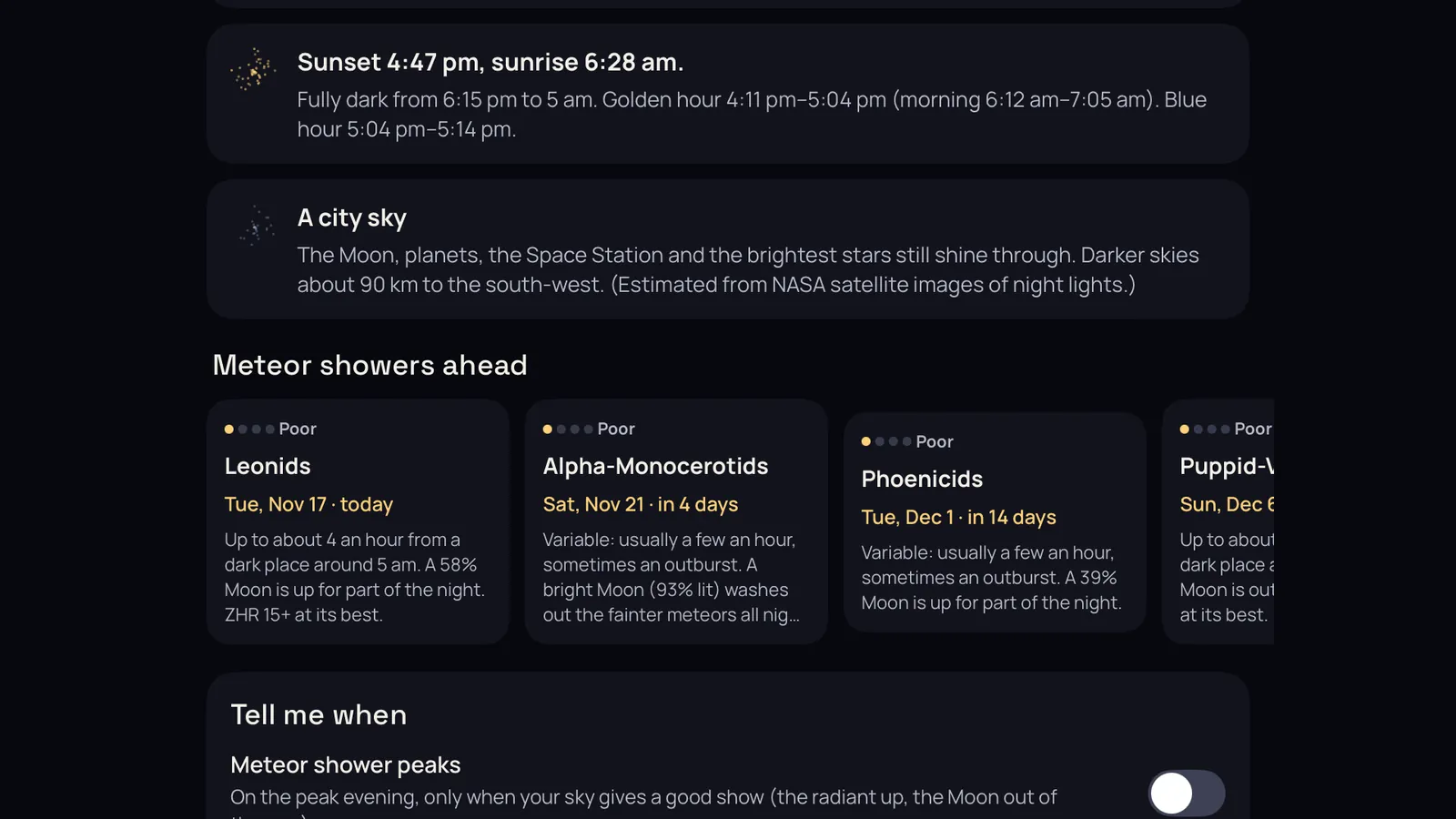
Fewer than the headlines say. The ZHR of 15 assumes the radiant overhead and a perfect dark sky. Scale it for how high the radiant really gets, for a sky that's typical of where people live, and for the Moon, and you get about 4 an hour at the best time from all the northern cities above, and about 1 an hour from Sydney. Everdust's Tonight's Sky rates the night Poor for that reason, and the meteor shower calendar on this site, which uses the same model, agrees.
From a properly dark site, away from town lights, you'll do better than that, because your eyes pick up the faint meteors a suburban sky hides. If you've never seen how much light pollution takes away, this guide to dark skies has the numbers.
Is there a Leonid storm in 2026?
No. Leonid storms, a thousand meteors an hour or more, come when Earth runs through a fresh trail of dust from Tempel-Tuttle, which happens around the comet's returns. NASA lists 1966 as a famous storm and 2002 as the last one. For 2026 the IMO calendar quotes models by Vaubaillon and Sato that find only old, thin trails. They expect weak, low-level activity at times such as November 18 at 21:55 UT and November 19 around 03:30 UT. That might add a few meteors, but no one predicts an outburst.
That's why the Leonids vary so much from year to year. The usual rate comes from old, spread-out dust all along the comet's orbit. The big years come from narrow trails of dust the comet shed at particular past returns, and only when Earth's path happens to cross one. Those fresh trails sit near the comet itself, so the best chances cluster around its perihelia. With Tempel-Tuttle back in May 2031, the years around then are the ones to watch, though the IMO's current models don't promise a storm.
How to watch, with or without an app
- Pick the night of November 17 to 18, and check the clouds that afternoon. The night before or after is a fine backup.
- Get away from lights if you can. Even a park or a dark corner of a yard helps a lot.
- Go out after the Moon sets, around midnight, and give your eyes 20 minutes to adjust. Don't look at your phone. If you must, turn its screen red and dim.
- Lie back and look about halfway up, a little away from Leo. Face east or south-east from the northern hemisphere.
- Dress for a cold night. Mid-November pre-dawn hours are cold almost everywhere the Leonids are worth watching.
You don't need binoculars or a telescope. They narrow your view, and meteors are about catching movement across a wide sky.
The night in Everdust
If you'd rather not work the timing out by hand, Everdust does it for your place.
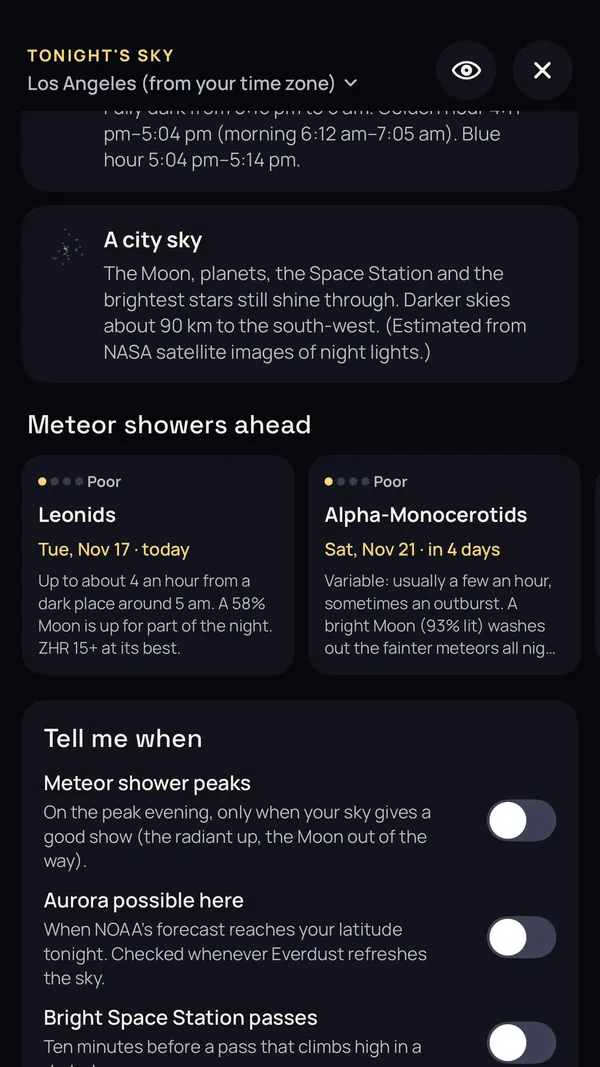
Tonight's Sky, on iPhone, iPad and Android. It starts from your time zone's city, or your approximate location if you allow it. On the peak night it shows a "Leonids peak tonight" card with how many you might see from a dark place, the best time and what the Moon is doing. The Meteor showers ahead row rates each coming peak Great, Good, Fair or Poor for where you are, with dots and the word, not color alone. Under Tell me when, you can turn on a reminder for meteor shower peaks. It only fires on nights your sky gives a good show, so this year it would stay quiet for the Leonids. That's on purpose.
On Apple Vision Pro, see where Leo will be before you go out. Night Sky in Everdust 1.1 puts the real sky for your place all around you. Pick November 18 in the panel, turn the time dial to 5 am, and use Find to light up Leo. You'll see where the radiant will stand above your real horizon, and the Sky quality setting shows how much a city sky hides. Night Sky doesn't draw meteors. It's a way to learn where to look, not a replacement for the real night. More in Night Sky on Apple Vision Pro.
Everdust is free on the App Store (one listing for iPhone, iPad, Apple Vision Pro and Apple TV) and Google Play, with no ads.
Other apps do this well too. Sky Tonight's calendar and Sky Guide list the showers, and Stellarium or SkySafari can show you the radiant at any time. I've compared them in free astronomy apps for iPhone and for Android. If you don't want an app, what's in my sky tonight works it out in your browser.
Questions people ask
When is the Leonid meteor shower in 2026? The Leonids are active from November 6 to 30, 2026, and peak on the night of November 17 to 18. The IMO gives the maximum as 23:45 UT on November 17. Watch from about midnight until dawn starts.
What time is best to see the Leonids? The last hours before dawn, around 4 to 5 am local time in the northern hemisphere, when the radiant in Leo is highest. The shower is barely visible before midnight, because the radiant hasn't risen yet.
How many Leonids will I see in 2026? Not many. The perfect-sky rate is about 15 an hour, and from a typical sky at the best time it works out to about 4 an hour in the northern hemisphere. A truly dark site does better.
Will the Moon ruin the 2026 Leonids? No. The Moon is at first quarter on November 17 and sets around midnight, before the radiant gets high, so the best hours are moonless.
Where do I look for the Leonids? East to south-east, about halfway up the sky, a little away from Leo's Sickle. Meteors can appear anywhere, so a wide view of the sky matters more than the exact direction.
Is there a Leonid meteor storm in 2026? No. Models quoted in the IMO's 2026 calendar find only weak dust trails, and no outburst is predicted. The last Leonid storm was in 2002.
What causes the Leonids? Dust from comet 55P/Tempel-Tuttle, which orbits the Sun about every 33 years. Earth crosses its debris every November, and the grains burn up at about 71 km/s.
Sources
- International Meteor Organization, 2026 Meteor Shower Calendar (Rendtel, ed.): the Leonids' activity, maximum, ZHR, radiant, speed, the Maslov, Vaubaillon and Sato trail models, and the Moon at the maxima.
- International Meteor Organization, 2026/2027 Meteor Shower Calendar web page (checked November 6, 2026): rates above 100 an hour possible around the comet's 2031 return, but no storm expected.
- NASA Science, Leonids: Tempel-Tuttle's 33-year orbit, the 1966 storm, the last storm in 2002, and the 1,000-an-hour definition of a storm.
- The city tables and hourly heights were computed for this post with Astronomy Engine (Don Cross, MIT license), using the IMO radiant and the same rating model as Everdust's Tonight's Sky and the meteor shower calendar. The Moon's first quarter is from the same engine.