How to see the real night sky in VR (and what light pollution hides)
A dark sky shows about 4,000 stars at once; a city sky shows a few hundred. What the Bortle scale and limiting magnitude mean, how fast light pollution is growing, and the headset apps that put the real sky for your place and time around you, by the maker of one of them.
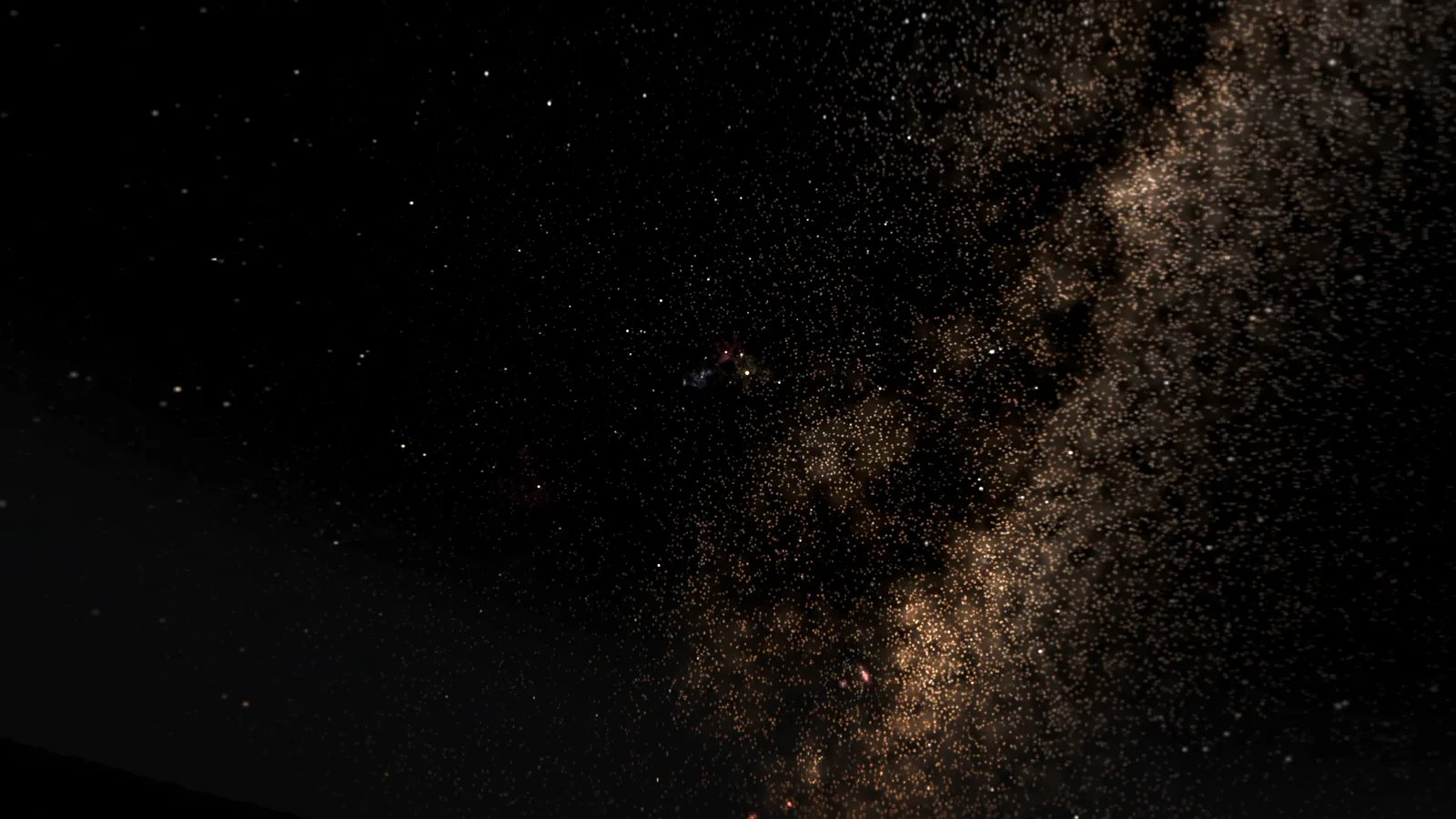
To see the real night sky in VR, use a planetarium app that places stars from a real star catalogue at their true positions for your location and the current time, such as Caelum, Orbis Caeli XR or Sky Guide on Apple Vision Pro, Stellarium VR on Meta Quest, or SpaceEngine on a PC headset. Under a truly dark sky your eyes can see about 9,000 stars across the whole sky and roughly 4,000 at once. Under a city sky you see a few hundred. A headset can show you the sky light pollution hides, though it can't fully match the real thing.
I make Everdust, whose Night Sky is one of the options below, so read this with that in mind. The cover is my own headset recording of it.
How many stars can you see with the naked eye?
Astronomers measure brightness in magnitudes, where bigger numbers mean fainter stars. The faintest star you can see without a telescope is your naked-eye limiting magnitude. The usual figure for a good dark sky is magnitude 6.5, and that is the cut-off the Yale Bright Star Catalogue uses for "every star visible to the naked eye". It lists about 9,100 objects across the whole sky.
You only ever see half the sky, because the Earth is under the other half, so a perfect dark site shows around 4,000 to 4,500 stars at once. In practice it's fewer near the horizon, where you look through much more air.
Lose a couple of magnitudes and the count collapses, because faint stars far outnumber bright ones. Counting the stars in the Bright Star Catalogue:
| Faintest star you can see | Stars that bright, whole sky | Roughly above your horizon |
|---|---|---|
| Magnitude 4.0 (inner city) | about 520 | about 250 |
| Magnitude 5.0 (bright suburbs) | about 1,600 | about 800 |
| Magnitude 6.0 (rural) | about 5,100 | about 2,500 |
| Magnitude 6.5 (dark site) | about 8,400 | about 4,200 |
The numbers above the horizon are simply half, before any loss near the horizon.
What is the Bortle scale?
The Bortle scale rates how dark a sky is, from Class 1 to Class 9. The amateur astronomer John Bortle published it in Sky & Telescope in 2001 so observers could compare sites by what they can actually see.
- Class 1, an excellent dark site: the faintest naked-eye stars are around magnitude 7.6 to 8.0 with effort. The Milky Way in Scorpius and Sagittarius casts shadows, and the zodiacal light is obvious.
- Class 3 to 4, rural to the edge of the suburbs: around magnitude 6.1 to 7.0. The Milky Way is still striking overhead.
- Class 5 to 6, the suburbs: around 5.1 to 6.0. The Milky Way is weak or gone near the horizon.
- Class 8 to 9, city and inner city: 4.5 at best, and 4.0 or brighter in the inner city. Only the brightest stars and the planets show, and the Milky Way is invisible.
Those are Bortle's figures for a keen observer. A 2014 study of human contrast thresholds suggests a typical person's limit, even at a very dark site, is nearer 6.0 to 6.5.
To find your own class, look your location up on a light pollution map such as lightpollutionmap.info, or count the stars inside a constellation and compare them with the charts at Globe at Night.
What light pollution hides
Light pollution is the glow of artificial light scattered back down by the air. A 2016 world atlas of night sky brightness found that more than 80% of the world's people, and more than 99% of people in the United States and Europe, live under light-polluted skies, and that the Milky Way is hidden from more than a third of humanity, including nearly 80% of North Americans.
It is getting worse faster than satellites suggest. In 2023, a study of more than 50,000 naked-eye star counts sent in to Globe at Night between 2011 and 2022 found the sky brightening by about 9.6% a year. At that rate, the researchers said, a child born where 250 stars were visible would see only about 100 by their 18th birthday.
What goes first is everything faint: the Milky Way, the Andromeda Galaxy (magnitude 3.4 but spread out, so it vanishes early), the fainter stars that give constellations their shapes, meteors and the zodiacal light. The bright planets and a few dozen bright stars survive almost anywhere.
Can VR show you the real night sky?
Yes, within limits. A good sky app takes a real star catalogue, works out where each star sits in your sky for your location and the time, and draws it around you, so you can learn the constellations, see the Milky Way you can't see from home, and plan what to look for next time you're somewhere dark.
What it can't do is match the real sky's range of brightness. A headset display has a ceiling on how bright a star can be and a floor on how dark the sky can be, so a VR sky is a faithful map of where everything is, not a replacement for standing under a Class 1 sky. The Milky Way in most apps is a photograph or a model, so check what your app uses.
Ways to see it in a headset
On Apple Vision Pro:
- Caelum: Spatial Planetarium: its listing describes thousands of stars, the constellations and the Milky Way placed around you and aligned to your location, with a time slider and deep-sky objects. Free, with a $9.99 Pro+ upgrade.
- Orbis Caeli XR: an immersive sky atlas, with time and location controls and reference lines such as the ecliptic and the meridian. Free.
- Sky Guide and Night Sky (by iCandi Apps): iPhone and iPad star maps for naming what's overhead, which also run on Vision Pro as iPad apps. Free, with in-app subscriptions.
- Night Sky in Everdust (not the iCandi app above): new in Everdust 1.1, November 2026. It surrounds you with about 8,900 naked-eye stars, the HYG catalogue down to magnitude 6.5, at their true positions for your place and the time now, turning at the real rate of 15° an hour (or held still). Constellation lines and the names of the brightest stars are on by default and switch off. A Sky quality setting runs from Bortle 1 to Bortle 9, so you can watch the faint stars and the Milky Way go as the sky brightens, and you can watch from dark-sky sites such as the Atacama or Maunakea. Look at a planet or a nebula and pinch to fly to it. The Milky Way is a model of the galaxy seen from the Sun, not a photograph, and the app says so. Everdust and Night Sky are free on Vision Pro.
On Meta Quest, Stellarium VR ($9.99 on the Meta Horizon Store) describes itself as a planetarium that shows exactly what you see when you look up at the stars. Brink Traveler, a VR travel app, added a physically accurate night sky to its scanned landscapes.
On a PC VR headset, SpaceEngine ($29.99 on Steam, which lists VR support) lets you stand on Earth or any other world and look up.
For a phone or tablet outdoors, a star map such as Sky Guide or Night Sky on iPhone points you at the real thing. Everdust, on iPhone and iPad and Android, has Tonight's Sky, which says what's up tonight, and since November 7, 2026, Night Sky: hold the phone up to the real sky and tap a wonder to fly into it.
Then go and look
The best use of a VR sky is as a rehearsal. Learn the shape of the Summer Triangle or Orion in the headset, then find somewhere darker, give your eyes at least 20 minutes away from screens and bright lights, and look for the same shapes overhead. Dark Sky Places listed by DarkSky International are protected for exactly this.
Questions people ask
How many stars can you see with the naked eye? About 9,000 across the whole sky down to magnitude 6.5, the usual naked-eye limit, which means roughly 4,000 to 4,500 above the horizon at once from a truly dark site. From a city, where the limit is around magnitude 4, it is only a few hundred.
What is the naked-eye limiting magnitude? It's the brightness of the faintest star you can see without optical aid. About 6.5 is the classic figure for a dark sky; experienced observers at the darkest sites reach 7.6 to 8.0, and in a city it can be 4.0 or worse.
What does the Bortle scale measure? How dark a sky is, from Class 1 (an excellent dark site) to Class 9 (an inner-city sky), judged by what you can see: the faintest stars, the Milky Way, the zodiacal light. John Bortle published it in Sky & Telescope in 2001.
Why can't I see the Milky Way? Almost certainly light pollution. A 2016 world atlas found the Milky Way is hidden from more than a third of humanity and nearly 80% of North Americans. You need roughly a rural sky, Bortle Class 4 or darker, and no Moon.
Can a VR headset show the real night sky? Yes. Planetarium apps place real catalogue stars at their true positions for your location and time, so the map is accurate. They can't match the real sky's brightness range, so treat them as a guide to what's up there rather than a replacement for a dark site.
What is the best Vision Pro app for the real night sky? Caelum and Orbis Caeli XR surround you with the real sky for your location, with time controls. Sky Guide and iCandi's Night Sky app are best for naming objects. Everdust's Night Sky, free since version 1.1, surrounds you with the real stars for your place and time, lets you set how dark the sky is, and flies you to the planets and nebulae.
Sources
- Hoffleit, D. and Warren, W. H., The Bright Star Catalogue, 5th revised edition (Yale University Observatory, 1991), via CDS VizieR. The star counts in the table are our count of its V magnitudes.
- Bortle, J. E., "Introducing the Bortle Dark-Sky Scale", Sky & Telescope (February 2001); summary at Sky & Telescope.
- Falchi, F. et al., The new world atlas of artificial night sky brightness, Science Advances 2, e1600377 (2016).
- Kyba, C. C. M. et al., Citizen scientists report global rapid reductions in the visibility of stars from 2011 to 2022, Science 379, 265 (2023); summary from NOIRLab via ScienceDaily.
- Nash, D., the HYG database, version 4.0 (CC BY-SA 4.0), the star catalogue Everdust's Night Sky draws.
- Crumey, A., Human contrast threshold and astronomical visibility, Monthly Notices of the Royal Astronomical Society 442, 2600 (2014).
- MIXED, Meta Quest's best VR travel app now offers dynamic skies and star constellations.
- App details from each app's own App Store, Meta Horizon Store or Steam listing, checked November 4, 2026.