Geminid meteor shower 2026: the best shower of the year, with almost no Moon
The 2026 Geminids peak on December 13 to 14 under a thin crescent Moon that sets early, which makes this one of the best Geminid years in a while. When to look from your city, where the radiant is hour by hour, how many you might really see, and why these meteors come from an asteroid, worked out with the same sky model as Everdust's Tonight's Sky.
The Geminid meteor shower peaks on the night of Sunday, December 13, into Monday, December 14, 2026. The International Meteor Organization (IMO) centers the maximum on 14:00 UT on December 14. In the Americas and Europe the night of the 13th is the one to watch. In East Asia and Australia it's the night of the 14th. The radiant near Castor in Gemini rises in the north-east in early evening, so the Geminids start around 9 or 10 pm and are best around 2 am. This year the Moon is a thin crescent that sets by about 9 pm. From a typical sky that works out to about 50 meteors an hour at the best time, and more from a dark site.
I make Everdust, whose Tonight's Sky rates showers like this for where you are, so read the app parts with that in mind. Everything before them works with your eyes alone and costs nothing. Last reviewed November 6, 2026.
When are the Geminids in 2026?
- Active: December 4 to 20, per the IMO's 2026 Meteor Shower Calendar.
- Peak: December 14 around 14:00 UT (solar longitude 262.2°). The maximum is broad: the IMO notes that peaks of the last two decades all fell between December 13, 21:00 UT and December 14, 18:00 UT in 2026 terms, with rates of 100 or more lasting 10 to 12 hours.
- Rate: a zenithal hourly rate (ZHR) of about 150, the highest of any annual shower. That's for one observer under a perfect sky with the radiant overhead.
- Speed: about 35 km/s, half the Leonids' speed. That's why Geminids look slower and often brighter, and many are yellowish.
- Parent body: the asteroid 3200 Phaethon, not a comet.
Why the Moon makes 2026 a good year
New Moon is on December 9, so on the peak night the Moon is a crescent about a fifth lit. It sets in the south-west by about 8 to 9 pm, before the radiant is high. The IMO calls the 2026 maximum "moon-free". In some years a bright Moon washes out most of the show, so 2026 is the kind of year to make the effort.
Where to look from your city
The radiant sits close to Castor, the fainter of the two bright "twin" stars of Gemini, with Pollux just beside it. Unlike most showers, the radiant is already up in the evening at northern latitudes. It's highest around 2 am. As always, look about halfway up and a little away from it. Meteors near the radiant are short, and the ones off to the side leave longer trails.
Here's the peak night for a few cities. It's December 13 to 14 for the Americas and Europe, and December 14 to 15 for Tokyo and Sydney, where that's the night the maximum falls in. Times are local and rounded to the quarter hour.
| City | Fully dark | Radiant 10° up | The Moon | Best time |
|---|---|---|---|---|
| New York | 6:15 pm to 5:30 am | 7 pm | 20% lit, sets 8:45 pm | 2 am, radiant 82° up in the south |
| Chicago | 6 pm to 5:30 am | 6:45 pm | 21% lit, sets 8:30 pm | 1:45 am, 81° up in the south |
| Denver | 6:15 pm to 5:30 am | 7 pm | 21% lit, sets 9 pm | 2 am, 83° up in the south |
| Los Angeles | 6:15 pm to 5:15 am | 7:15 pm | 21% lit, sets 9 pm | 1:45 am, nearly overhead |
| Toronto | 6:30 pm to 6 am | 7 pm | 20% lit, sets 9 pm | 2:15 am, 79° up in the south |
| London | 6 pm to 6 am | 6:15 pm | 19% lit, sets 8 pm | 2 am, 71° up in the south |
| Berlin | 6 pm to 6 am | 6:15 pm | 18% lit, sets 8 pm | 2 am, 70° up in the south |
| Tokyo (Dec 14 to 15) | 6 pm to 5:15 am | 7 pm | 25% lit, sets 9 pm | 1:45 am, nearly overhead |
| Sydney (Dec 14 to 15) | 9:45 pm to 4 am | 11:45 pm | 25% lit, sets 11:30 pm | 2:45 am, only 23° up in the north |
Here's the radiant hour by hour from New York on December 13 to 14. London's heights are lower by 10° or so after midnight, but the pattern is the same.
| Local time | Gemini's radiant | The Moon |
|---|---|---|
| 7 pm | 12° up in the north-east | 15° up in the south-west |
| 8 pm | 22° up in the north-east | 6° up in the south-west |
| 9 pm | 32° up in the east | set |
| 10 pm | 43° up in the east | set |
| 11 pm | 55° up in the east | set |
| 12 am | 66° up in the east | set |
| 1 am | 77° up in the south-east | set |
| 2 am | 82° up in the south | set |
| 3 am | 75° up in the south-west | set |
| 4 am | 64° up in the west | set |
| 5 am | 52° up in the west | set |
How many will you really see?
The ZHR of 150 is a perfect-sky number. Scale it for how high the radiant really climbs, for a sky that's typical of where people live, and for the little Moon there is, and you get about 50 an hour at the best time from every northern city in the table, and about 20 an hour from Sydney. (On the peak evening in Los Angeles, Tonight's Sky's cards say up to about 47 and 54 an hour, from estimates made at slightly different times.) Everdust's Tonight's Sky and the meteor shower calendar on this site both rate the night Great from the northern cities for that reason. NASA's own guide says 40 to 50 an hour under dark skies, with up to 120 under perfect conditions.
From a properly dark site you can beat our estimate, because your eyes catch the faint meteors that town light hides. From a city center you'll see far fewer. This guide to dark skies shows how much light pollution takes away.
Why the Geminids come from an asteroid
Most meteor showers are dust shed by comets. The Geminids are different. Their stream belongs to 3200 Phaethon, about 5 km across, found by the IRAS satellite in 1983. It goes round the Sun every 1.4 years. NASA says it may be a "rock comet", a new kind of object astronomers are discussing: rocky like an asteroid, but shedding debris like a comet. Geminid grains arrive at about 35 km/s, half the Leonids' speed, so each one takes longer to cross the sky. That's why the shower looks so different from November's fast Leonids.
The Geminids are also young as showers go. NASA notes they first appeared in the mid-1800s, at 10 to 20 an hour, and have strengthened into the richest shower of the year.
How to watch, with or without an app
- Pick the night of December 13 to 14 (December 14 to 15 in East Asia and Australia) and check the cloud forecast. The night before and after are good too, at lower rates.
- Start any time after about 9 or 10 pm, once the Moon has set, and stay as long as you can stand the cold. The best hours are around 2 am.
- Get away from lights, give your eyes 20 minutes, and keep your phone dim and red if you use it.
- Lie back and look about halfway up, a little away from Gemini.
- Dress for a December night: layers, a hat, something to lie on, and a hot drink.
No telescope or binoculars needed. A meteor is over in a second, and your eyes take in the whole sky.
The night in Everdust
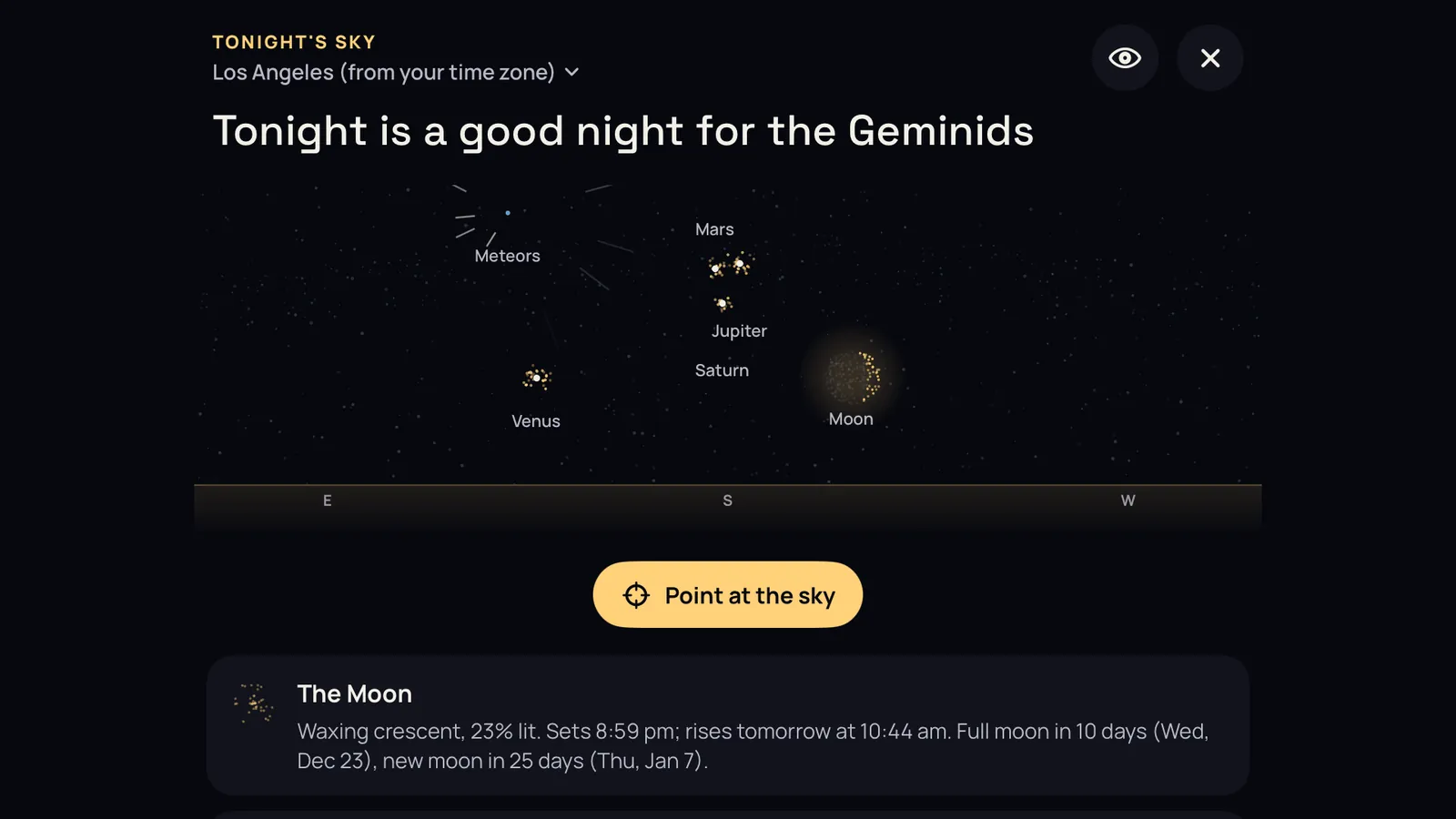
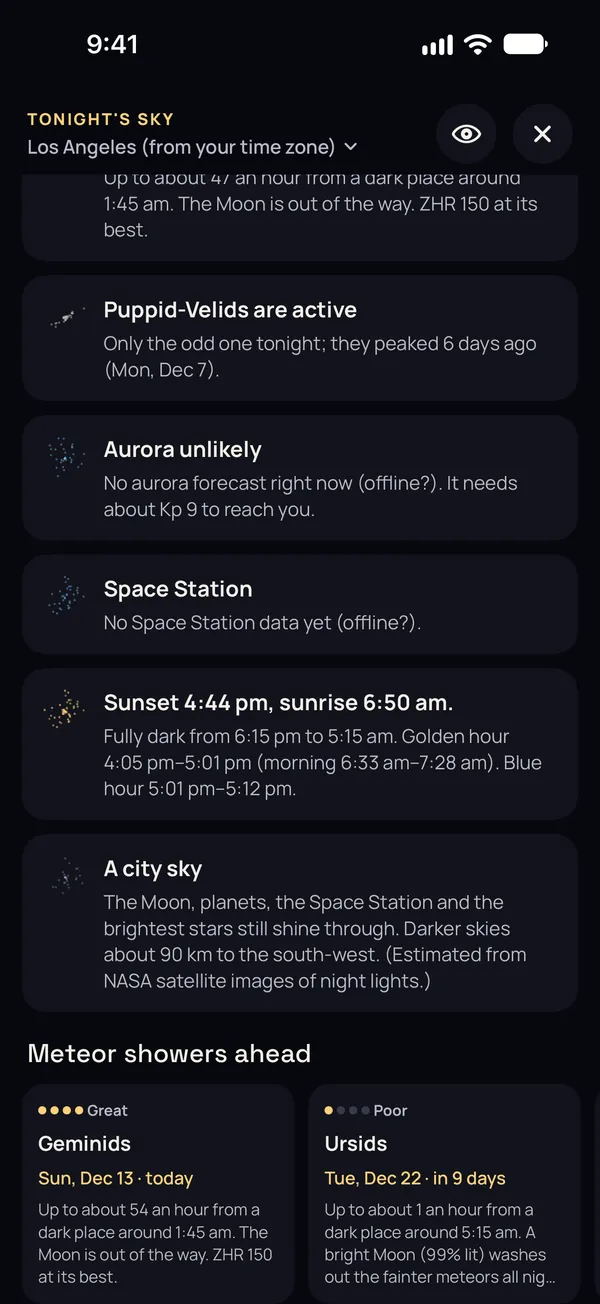
Tonight's Sky, on iPhone, iPad and Android. On the peak evening its headline reads "Tonight is a good night for the Geminids". The sky chart marks where the meteors come from, and the shower card gives how many you might see from a dark place, the best time and what the Moon is doing, for your city or your approximate location if you allow it. The Meteor showers ahead row rates each coming peak Great, Good, Fair or Poor, with dots and the word, not color alone. Under Tell me when, turn on meteor shower peaks and Everdust sends a reminder on the peak evening, only when your sky gives a good show. The Geminids this year qualify from most of the northern hemisphere.
On Apple Vision Pro, find Gemini before you go out. Night Sky in Everdust 1.1 puts the real sky for your place around you. Choose December 14 in the panel, turn the time dial to 2 am, and use Find to light up Gemini. You'll see the radiant nearly overhead, Castor and Pollux side by side. Turn Sky quality from a city sky to a dark site to see what you'd gain by driving out. Night Sky doesn't draw meteors. It's for learning where to look. More in Night Sky on Apple Vision Pro.
Everdust is free on the App Store (one listing for iPhone, iPad, Apple Vision Pro and Apple TV) and Google Play, with no ads.
Plenty of other apps will show you Gemini, too. Stellarium and SkySafari draw the radiant, and Sky Tonight's calendar lists the peak. See free astronomy apps for iPhone and for Android. With no app at all, what's in my sky tonight works it out in your browser. The Leonids, a month earlier, are the quieter shower before this one.
Questions people ask
When is the Geminid meteor shower in 2026? The Geminids are active from December 4 to 20, 2026, and peak around 14:00 UT on December 14. In the Americas and Europe, watch on the night of December 13 to 14. In East Asia and Australia, watch on the night of December 14 to 15.
What time is best to see the Geminids? From about 9 or 10 pm until dawn, best around 2 am local time, when the radiant in Gemini is highest. Unlike most showers, the Geminids are worth watching before midnight.
How many Geminids will I see in 2026? From a typical sky in the northern hemisphere, about 50 an hour at the best time. More from a truly dark site, far fewer from a city. The perfect-sky rate is about 150 an hour.
Is the Moon a problem for the 2026 Geminids? Hardly. New Moon is December 9, so on the peak night a crescent about a fifth lit sets by around 8 to 9 pm, before the best hours.
Where do I look for the Geminids? About halfway up the sky, a little away from the twin stars Castor and Pollux in Gemini. The radiant is in the east in the evening and high in the south around 2 am from northern latitudes.
Can you see the Geminids from the southern hemisphere? Yes, but fewer. The radiant stays low in the north, so from Sydney expect about 20 an hour at best, from about midnight until dawn.
What causes the Geminids? Grit from the asteroid 3200 Phaethon, which orbits the Sun every 1.4 years. Earth crosses its debris every December.
Sources
- International Meteor Organization, 2026 Meteor Shower Calendar (Rendtel, ed.): the Geminids' activity, the maximum and its spread, ZHR, radiant and speed, and the moonless maximum.
- NASA Science, Geminids: 3200 Phaethon (size, 1.4-year orbit, its 1983 discovery by IRAS, the "rock comet" idea), the rates, the yellow color and the shower's history.
- The city tables and hourly heights were computed for this post with Astronomy Engine (Don Cross, MIT license), using the IMO radiant and the same rating model as Everdust's Tonight's Sky and the meteor shower calendar. The Moon's phases are from the same engine.