Free astronomy and stargazing apps for Android (2026): an honest guide
Which free Android app to pick for what you want from the sky, whether that's a stargazing app that names the stars and planets overhead, a constellation finder, seeing what's visible tonight, following NASA missions or playing with how galaxies and black holes work. Each described from its own Google Play listing, by the maker of one of them.
The best free astronomy and stargazing apps for Android are Stellarium, Sky Map, SkyView Lite, Star Walk 2 and Sky Tonight for pointing your phone at the sky and naming what you see, Sky Tonight or Star Walk 2 for what's visible tonight, the NASA app for launches and the Space Station, and Everdust for playing with space physics rather than mapping the sky.
I make Everdust, one of the apps below, so read this with that in mind. I've tried to describe each app by what its own Google Play listing says it does, and to say plainly when another app is the better pick. All seven are free to download; the listings show which ones have ads or in-app purchases, and I've passed that on. Store details were checked on October 25, 2026 (Sky Tonight and SkySafari on October 29).
The short answer
- You want to point your phone at the sky and know what you're looking at (a stargazing app or constellation finder): Stellarium, Sky Map, SkyView Lite, Star Walk 2 or Sky Tonight.
- You want to know what's visible tonight and when to look: Sky Tonight's calendar and stargazing forecast, or Star Walk 2's Visible Tonight guide.
- You want the most detail, and maybe to drive a telescope later: Stellarium.
- You want something simple and open source, with no in-app purchases: Sky Map.
- You want launches, live views from the Space Station and NASA's images: the NASA app.
- You want to play with space physics, such as colliding galaxies, black holes bending light and stars forming: Everdust.
Five of these are star maps. If your goal is to learn the real night sky, start with one of them, not with Everdust.
Stellarium
Stellarium - Star Map by Noctua Software is a planetarium app. Its listing describes identifying stars, constellations, planets, comets and satellites such as the ISS by pointing your phone at the sky, an accurate sky for any date, time and place, sky cultures from other parts of the world, and a red night mode. It says it's made by the original creator of Stellarium, the open source desktop planetarium.
It's free, with in-app purchases. The upgrade, Stellarium Plus, shows much fainter objects, adds large star and deep-sky catalogs, an offline data set and control of GoTo telescopes over Bluetooth or Wi-Fi.
Pick it if you want the deepest star map here and expect to grow into it.
Sky Map
Sky Map by Sky Map Devs helps you identify stars, planets, nebulae and constellations in real time. Its listing says it was originally developed as Google Sky Map and is now open source. It says every permission is optional: location (or type a place in by hand), camera for the through-camera mode, and notifications for meteor-shower peaks. The listing doesn't show ads or in-app purchases.
Pick it if you want a plain, free star map with nothing to buy.
SkyView Lite
SkyView Lite by Terminal Eleven uses your camera to spot and identify stars, constellations, planets, galaxies and satellites, including the ISS and Hubble, day or night. Its listing mentions red or green night modes, sky paths for any object, time travel to past and future skies, and that it doesn't need Wi-Fi, a data signal or GPS. The listing doesn't show ads or in-app purchases.
Pick it if you want a camera view of the sky that works far from a signal.
Star Walk 2
Star Walk 2 Plus: Sky Map View by Vito Technology turns your phone into a star map for stars, constellations, planets, satellites and comets, with an AR view and time controls. Its listing also mentions Planet Walk for seeing all the planets at once, quizzes, infographics, constellation stories, a Visible Tonight guide, a night mode and offline use. The listing shows that it contains ads and offers in-app purchases.
Pick it if you want a polished star map with stories and quizzes built in.
Sky Tonight
Sky Tonight - Star Gazer Guide by Vito Technology, the maker of Star Walk 2, is built around one question: what can I see tonight? Its listing describes a sky map you point at the sky, an AR mode, a Time Machine for past and future skies, an Astronomy Calendar of events, Moon phases and meteor showers, and a Stargazing Index that forecasts conditions from the Moon phase, light pollution and visibility. It says it works offline. The listing shows that it contains ads and offers in-app purchases.
Pick it if you want to plan a night out: what's up, which events are coming and whether tonight is worth it.
NASA
NASA, from NASA, isn't a star map. Its listing describes live rocket launches, live events and a 24/7 view from the International Space Station, NASA+ video (ad-free, no subscription), podcasts, NASA's image library, news, Space Station pass notifications and NASA's Eyes on the Solar System. The listing doesn't show ads or in-app purchases.
Pick it if you want to follow real missions and see what NASA is doing now.
Everdust
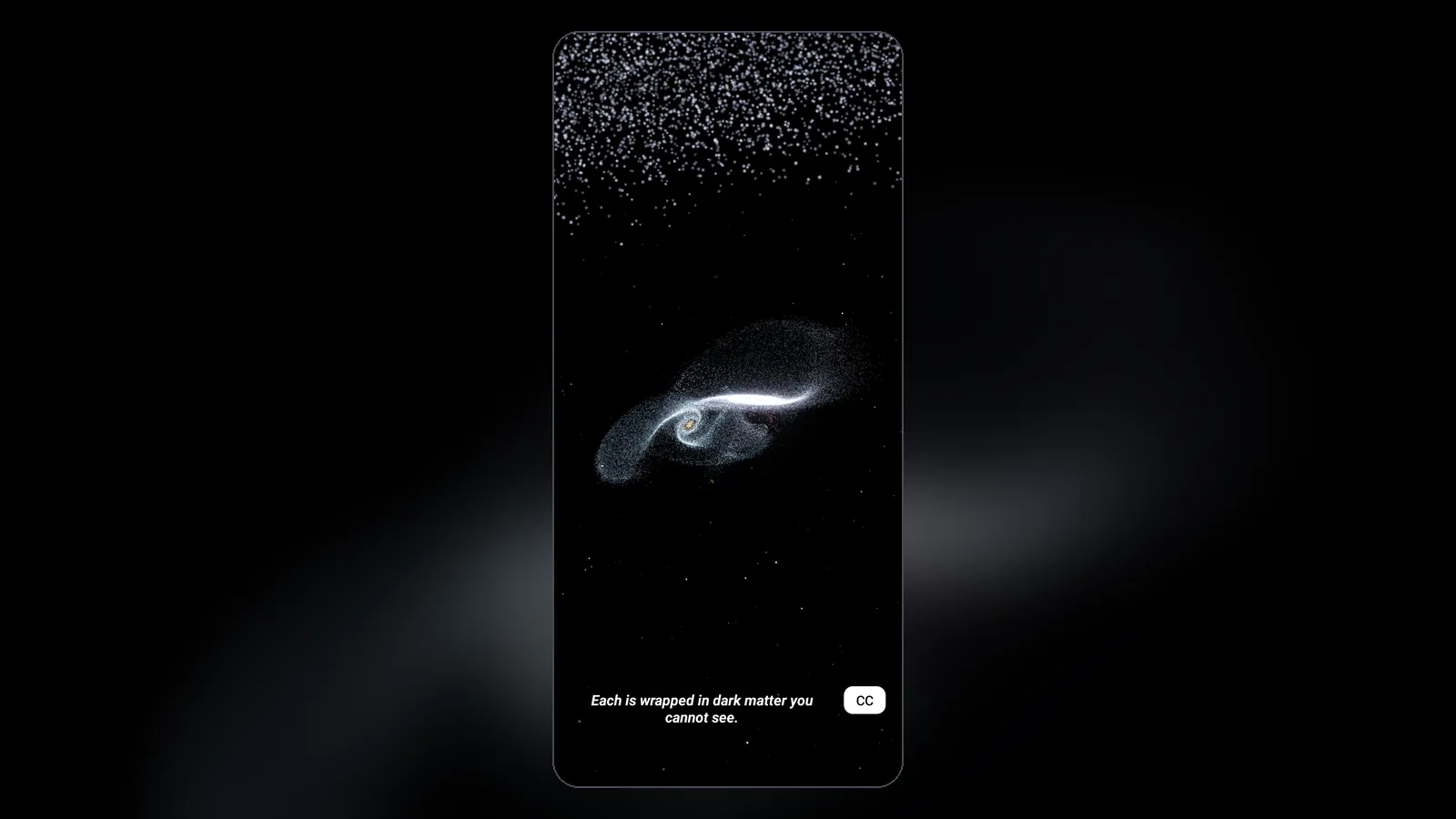
Everdust is the one I make. It isn't a star map. It's space science games, narrated science stories and a particle universe simulator, where every world is a live simulation, not a video, and your fingers move it.
- A galaxy collision of up to about a million stars, each pulled by gravity. Drag to orbit, pinch to zoom, and watch black holes bend light.
- Narrated science stories, from the first light after the Big Bang to a giant star exploding as a supernova, where every chapter is a live simulation.
- Games built on real physics: Feed the Black Hole, Lightfold, Black Hole Golf, Supernova Chain and more, each with levels and a free daily level.
- Tonight's Sky: the Moon, the planets, Space Station passes, meteor showers, the chance of aurora and a cloud forecast for the night, and a Point at the sky view that shows the stars, planets and constellation figures behind your phone. It's a quick look at tonight, not a replacement for the star maps above.
- Night Sky (since version 1.0.8, November 2026): hold up your phone to see the real sky over you, then fly into nebulae, galaxies, star clusters and black holes made from real telescope photographs. It's for going inside the wonders, not for naming every star.
- Calm: a sleep timer, a focus timer, guided breathing and NSDR (non-sleep deep rest) sessions; the 10-minute NSDR session is free.
It's free, with no ads and no account. Every scene, toy and music source is free, as is all of The Story of Everything. Everdust Plus is an optional in-app purchase that unlocks every story chapter and game level. It needs Android 10 or later and a phone or tablet with Vulkan 1.1 graphics. You can try a few worlds in your browser first at everdust.ai/play, such as the galaxy collision simulator and the solar system formation simulator.
Pick it if you want to see how galaxies merge, stars form and black holes bend light, more than you want to know what's overhead tonight.
If you'll pay for one: SkySafari
SkySafari Astronomy by Simulation Curriculum isn't free, so it isn't in the list above: it costs $6.99 on Google Play, with an optional Premium subscription. Its listing describes pointing your phone to identify stars, planets, satellites and deep-sky objects, a Tonight section of what's best placed now, more than four hours of guided audio tours and an Orbit Mode that flies you to the planets. Many astronomy writers recommend it; if you're serious about observing, it's worth reading its listing next to Stellarium Plus.
Looking for Sky Guide? It's only on Apple devices; Sky Guide for Android: the alternatives compares what is on Google Play. And for the four best-known star maps side by side, with prices and telescope control, see Stellarium vs SkySafari vs Sky Guide vs Star Walk 2.
How to choose
Ask what you want to come away with:
- To find Saturn tonight, use a star map. Sky Map is the simplest; Stellarium goes deepest.
- To follow launches and the Space Station, use the NASA app.
- To build a feel for gravity and light by touching them, use Everdust.
They're all free to start, so the honest advice is to install a star map and one of the others, and see which you keep opening. If what you want is a gravity sandbox or a black hole simulator rather than a star map, see galaxy and black hole simulator apps for Android. On an iPhone or iPad, there's a version of this guide for iPhone.
If you just want to know what's up tonight without installing anything, what's in my sky tonight works it out in your browser for your location, and the sky guide has a page for each planet and bright deep-sky object.
Questions people ask
Is Sky Map still on Google Play? Yes. Sky Map, originally Google Sky Map, is on Google Play from the developer Sky Map Devs, and its listing says it is now open source.
What is the best stargazing app for Android? For free, Stellarium goes deepest, Sky Map is the simplest (open source, nothing to buy) and Sky Tonight is built around planning a night out. If you'll pay, SkySafari ($6.99) adds guided audio tours and a Tonight section, per its listing. All of them name what you point your phone at. Everdust isn't a full star map, so it isn't the answer to this question.
Which Android app shows what planets are visible tonight? Sky Tonight's calendar and Stargazing Index, Star Walk 2's Visible Tonight guide and SkySafari's Tonight section all list what's up tonight. Everdust's Tonight's Sky shows the Moon, the planets, Space Station passes and meteor showers for where you are. Without installing anything, what's in my sky tonight works it out in your browser.
What is a good constellation finder app for Android? Any of the star maps: hold the phone up and Sky Map, SkyView Lite, Stellarium, Star Walk 2 or Sky Tonight draws the constellations where they really are. Everdust's Point at the sky does the same with constellation figures, but it's a quick look, not a full star atlas.
Which of these Android astronomy apps contain ads? Of the seven, Star Walk 2's and Sky Tonight's Google Play listings say they contain ads. Stellarium, Star Walk 2, Sky Tonight and Everdust list in-app purchases.
Which Android astronomy apps work without a data connection? SkyView Lite's listing says it doesn't need Wi-Fi, a data signal or GPS, and Star Walk 2's and Sky Tonight's listings say they work offline.
Is Everdust a star map? No. Everdust is a space physics simulator with a Tonight's Sky screen; for naming stars and constellations, Stellarium, Sky Map, SkyView Lite or Star Walk 2 is the better pick.