How to find Saturn and the Moon tonight
Where Saturn and the Moon are in this week's evening sky, with directions and heights at 9 pm for New York, Chicago, Los Angeles and London, updated every week. Plus how to tell Saturn from a star, why its rings change tilt, and when the Moon is up.
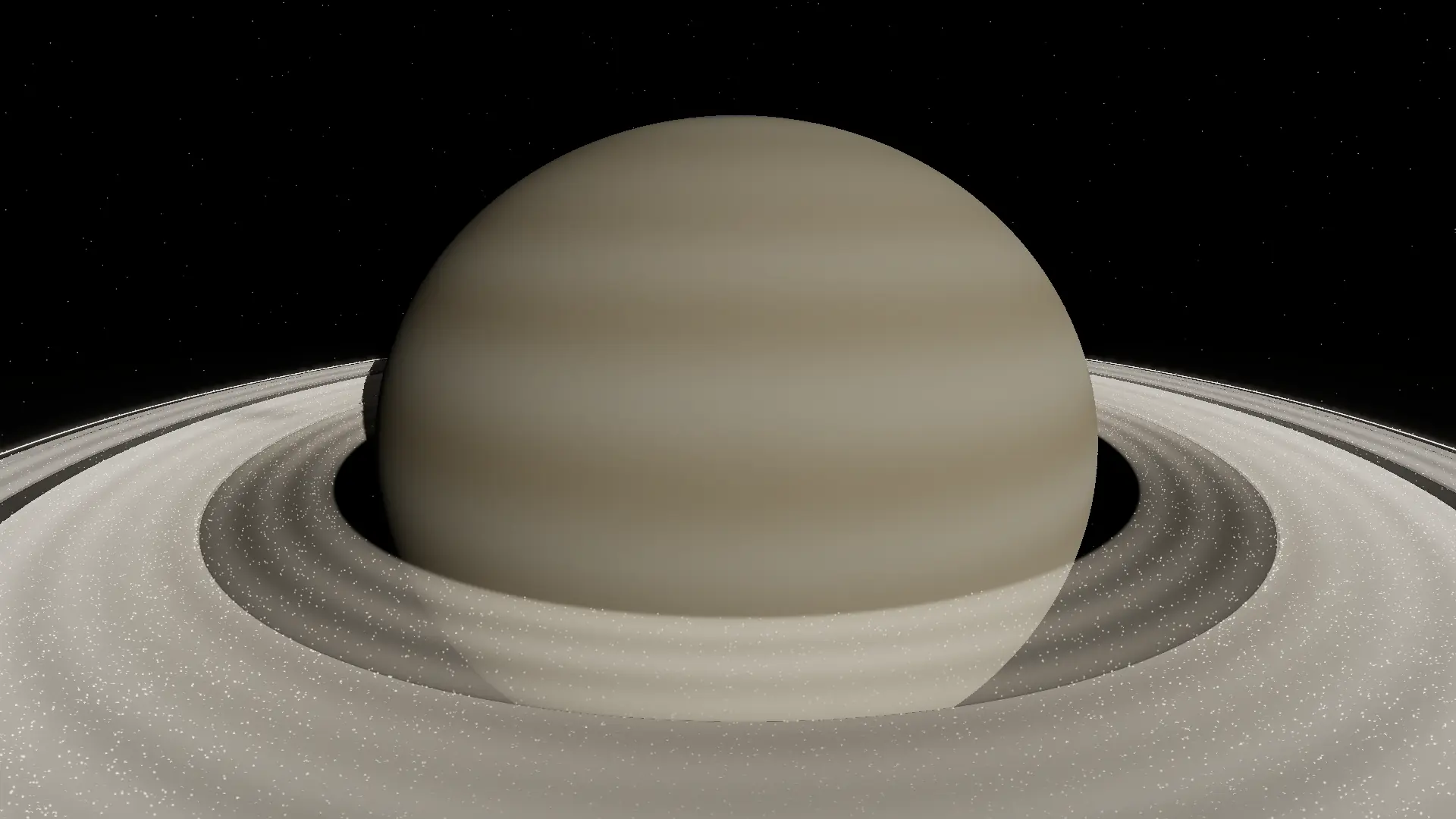
To find Saturn tonight, look for a bright, steady, cream-colored "star" along the path the Sun and Moon take across the sky; the table below gives its direction and height at 9 pm this week. To find the Moon, check its phase: a full Moon rises at sunset, a first quarter is already high at sunset, and a last quarter doesn't rise until around midnight.
Everything here is visible with your eyes alone. Saturn's rings need a small telescope.
This week
Updated October 26, 2026, for the week of October 26 to November 1. Computed with PyEphem; times are local and rounded to the minute.
Saturn this week: in Cetus, magnitude +0.5, so it shines like a bright, steady, cream-colored star. Its rings are tilted about 7° toward us.
| Evening | Moon | Moon at 9 pm (New York) | Saturn at 9 pm (New York) |
|---|---|---|---|
| Mon Oct 26 | full Moon, 99% lit | east, 31° up | south-east, 40° up |
| Tue Oct 27 | waning gibbous, 95% lit | east, 23° up | south-east, 41° up |
| Wed Oct 28 | waning gibbous, 89% lit | north-east, 13° up | south-east, 41° up |
| Thu Oct 29 | waning gibbous, 80% lit | north-east, 3° up | south-east, 42° up |
| Fri Oct 30 | waning gibbous, 70% lit | below the horizon | south-east, 42° up |
| Sat Oct 31 | waning gibbous, 59% lit | below the horizon | south-east, 43° up |
| Sun Nov 1 | last quarter, 48% lit | below the horizon | south, 49° up |
Saturn rise and set, Monday October 26:
| City | Saturn rises | Saturn sets | At 9 pm local |
|---|---|---|---|
| New York | 5:07 pm | 5:20 am | south-east, 40° up |
| Chicago | 5:01 pm | 5:14 am | south-east, 40° up |
| Los Angeles | 5:04 pm | 5:15 am | south-east, 45° up |
| London | 4:09 pm | 4:28 am | south-east, 37° up |
How to tell Saturn from a star
- It doesn't twinkle much. Stars are points, so the air makes them flicker. Planets show a tiny disk, and their light holds steadier.
- It's on the ecliptic. Saturn, like every planet, stays close to the line the Sun and Moon follow, so it's never in the far north or far south of the sky.
- Its color is a soft cream or pale gold. Jupiter, when it's up, is brighter and whiter. Mars is orange-red.
- It moves slowly. Saturn takes about 29.5 years to go around the Sun, so from week to week it barely shifts against the stars. The Moon passes it once a month, which is the easiest time to find it.
A phone star map makes it certain. Point your phone at the sky with Sky Guide or Night Sky, or Tonight's Sky in Everdust for Android, which I make, and it labels Saturn where it actually is. There's a 30-second demo in Point your phone at the sky.
Why do Saturn's rings change tilt?
Saturn's rings line up with its equator, which is tilted about 27 degrees to its orbit. As Saturn travels around the Sun, we see the rings from slightly above, then edge-on, then from slightly below. They go edge-on to Earth about every 13 to 16 years, and the last time was in March 2025, when they all but vanished in small telescopes. Since then they have been slowly opening again, and they'll keep widening for the next few years.
Even edge-on, the rings are vast: the bright main rings are roughly 270,000 kilometers across, but in most places only about 10 meters thick.
When is the Moon up?
The Moon's phase tells you when to look, because the phase depends on where the Moon is relative to the Sun.
- New Moon: near the Sun, up during the day and lost in its glare.
- Waxing crescent: low in the west after sunset.
- First quarter: half-lit, high in the south at sunset (from northern latitudes), setting around midnight.
- Full Moon: opposite the Sun, rising in the east as the Sun sets and up all night.
- Last quarter: rises around midnight and is high in the south at dawn.
The Moon rises about 50 minutes later each day, which is why it sweeps through the evening sky and then out of it over a couple of weeks.
For your own location rather than these four cities, Saturn tonight and the Moon tonight work it out live, and what's in my sky tonight lists every bright planet and deep-sky sight that's up. For nebulae, galaxies and star clusters, the Everdust Atlas works out when each one is up from your city, and the meteor shower calendar rates every shower for where you are, the Moon counted.
Questions people ask
Where is Saturn tonight? See the "This week" table above, which gives Saturn's direction and height at 9 pm local time for New York, Chicago, Los Angeles and London, updated weekly. Look for a steady, cream-colored point of light along the Sun and Moon's path.
Can you see Saturn's rings with the naked eye? No. To your eyes Saturn is a point of light. A small telescope magnifying about 25 times or more shows the rings, and they look narrower than usual while they're still opening after going edge-on in 2025.
Why does the Moon rise at a different time every night? The Moon moves about 13 degrees eastward around the sky each day as it orbits the Earth, so the Earth has to turn a bit further, roughly 50 minutes, before the Moon comes up again.
What does the phase of the Moon tell me? When it will be up. A full Moon rises at sunset and is up all night; a first quarter is high at sunset; a last quarter rises around midnight; a new Moon is up during the day, hidden by the Sun's glare.
Which app shows where the planets are right now? Star maps such as Sky Guide and Night Sky on iPhone, and Tonight's Sky in Everdust on Android, label the planets where they are when you point your phone at the sky. On Apple Vision Pro, Caelum and Orbis Caeli XR show the real sky around you.
Sources
- NASA Science, Saturn: Facts and Saturn's rings.
- NASA Science, Moon phases.
- Positions, rise and set times computed weekly with PyEphem, which uses the VSOP87 theory for the planets and the ELP theory for the Moon.