Saturn tonight: rings, moons and where to look
To the eye, Saturn is a bright, steady, cream-colored point of light; any small telescope magnifying 25 times or more shows its rings. Below is where it is tonight, computed for your location, and what you're looking at.
Tonight from where you are
Working it out for your time zone…
Computed in your browser.
Saturn tonight from four cities
| City | Tonight | Rises / sets |
|---|---|---|
| New York | 5:14 pm to 2:24 am; best 9:24 pm, 50° up in the south | 3:17 pm / 3:29 am |
| Los Angeles | 5:20 pm to 2:30 am; best 9:20 pm, 57° up in the south | 3:15 pm / 3:24 am |
| London | 4:59 pm to 2:29 am; best 9:29 pm, 40° up in the south | 3:20 pm / 3:36 am |
| Sydney | 7:56 pm to 3:26 am; best 10:16 pm, 55° up in the north | 4:22 pm / 4:20 am |
Local times for the night of November 7, 2026, counted as “up” when at least 10° above the horizon after dark. Computed with Astronomy Engine when this page was built; it refreshes every hour.
Right now
- In the constellation
- Cetus
- Brightness
- magnitude 0.4 (lower is brighter)
- Distance from Earth
- 1.3 billion km
- Its light takes
- 1 h 12 min to reach you
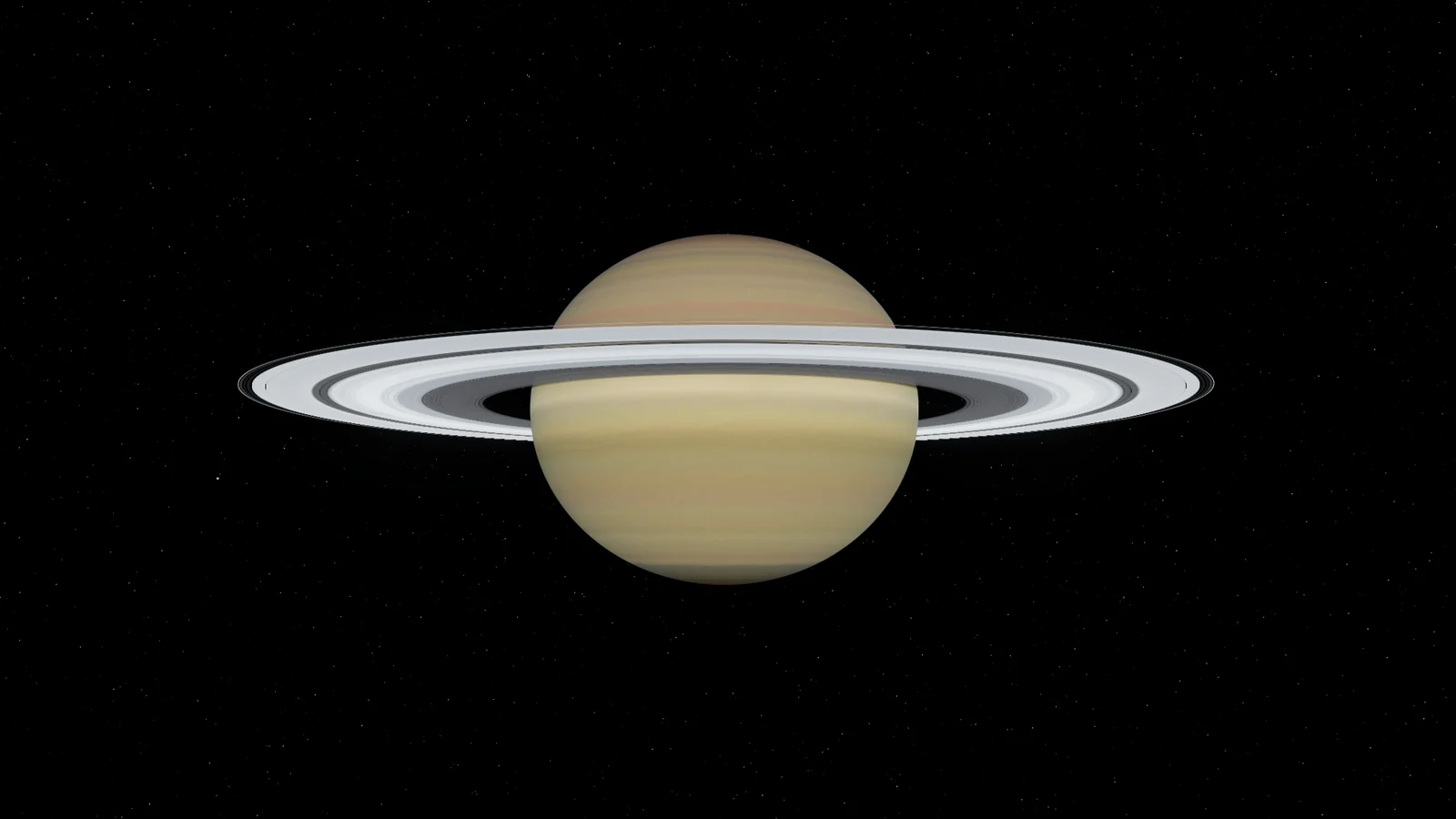
- Rings tilted toward us
- 6.4°
- Next opposition (closest and brightest)
- October 18, 2027
- Rings open widest next
- May 2032
Saturn: the facts
| Width | 120,536 km at the equator, about 9.4 Earths [1] |
|---|---|
| A day | about 10 hours 34 minutes [4] |
| A year | 29.4 Earth years [1] |
| Average distance from the Sun | 1.43 billion km (9.5 times Earth's) [1] |
| Rings | mostly water ice; the main rings span about 270,000 km [2] |
| Ring thickness | typically about 10 m in the main rings [3] |
How do you find Saturn tonight?
Look for a bright point of light that doesn't twinkle much, along the path the Sun and Moon take across the sky. Stars twinkle because they are points; planets show a tiny disk, so their light holds steadier. Saturn's color is a soft cream or pale gold. Jupiter, when it's up, is brighter and whiter; Mars is orange.
Saturn moves slowly against the stars, taking about 29 years to go round the Sun, so it stays in the same part of the sky for months. The Moon passes it once a month, which is the easiest night to find it. A phone star map makes it certain.
Why are Saturn's rings so thin right now?
Saturn's rings line up with its equator, which is tilted about 27° to its orbit. As Saturn goes round the Sun, we see the rings from slightly above, then edge-on, then from slightly below. They go edge-on to Earth about every 13 to 16 years. The last time was in March 2025, when they all but vanished in small telescopes, and since then they've been opening again.
Even edge-on they're vast: the bright main rings span about 270,000 km, two-thirds of the distance from the Earth to the Moon, but in most places they're only about 10 meters thick. They're made of countless pieces of water ice, from grains to boulders.
Which of Saturn's moons can you see?
Titan, the biggest, is easy in a small telescope: a star-like dot a few ring-widths from the planet. It's larger than the planet Mercury and the only moon with a thick atmosphere, a nitrogen haze that hid its surface until the Cassini–Huygens mission saw through it. A 10 to 15 cm telescope adds Rhea, Tethys, Dione and Iapetus as fainter dots, which change places from night to night.
Saturn has more known moons than any other planet, and astronomers keep finding small ones. Most are only a few kilometers across and far too faint for backyard telescopes.
Can you see Saturn in Everdust?
In Everdust's Night Sky on Apple Vision Pro, look at Saturn and pinch to fly there. Saturn Today shows its rings at tonight's tilt, lit from the Sun's real direction, with Titan and six other moons where they are tonight, on Hubble's latest map of its clouds. On iPhone and iPad, tap Saturn in Night Sky to fly there.
Everdust is free on the App Store for Apple Vision Pro, iPhone and iPad; on Android, Tonight’s Sky in Everdust for Android (free on Google Play) shows where Saturn is tonight from where you stand. I make Everdust, so weigh that; a phone star map such as Stellarium or Sky Guide will find Saturn just as well.
Questions people ask
Can I see Saturn tonight? Saturn is up from about 5:14 pm to 2:24 am, highest at about 9:24 pm, 50° up in the south. That's for New York on the night of November 7, 2026; this page works it out for your own location too.
Where is Saturn in the sky right now? Saturn is in Cetus, shining at magnitude 0.4. Its light takes 72 minutes to reach Earth.
How open are Saturn's rings right now? They're tilted 6.4° toward Earth, out of a possible 27° or so. They were edge-on in March 2025 and open widest again around 2032.
Can you see Saturn's rings without a telescope? No. To the eye Saturn is a point of light. A small telescope magnifying about 25 times or more shows the rings, and they look narrower than usual while they're still opening after going edge-on in March 2025.
Why does Saturn look yellow? Its cloud tops are ammonia ice, under a high haze that reflects sunlight with a pale yellow-cream tint. Through a telescope you can sometimes make out faint bands, like a calmer version of Jupiter's.
How long does Saturn take to go round the Sun? 29.4 Earth years. That's why it drifts so slowly against the stars and appears in the same season of the year for several years in a row.
Sources
- NASA NSSDC: Saturn fact sheet
- NASA NSSDC: Saturnian rings fact sheet
- NASA: Saturn facts
- Mankovich et al. 2019, Cassini ring seismology as a probe of Saturn's interior, The Astrophysical Journal 871, 1
- NASA: Titan
- Hubble OPAL (Outer Planet Atmospheres Legacy) program, STScI MAST
Positions, rise and set times, brightness, phases and distances on this page are computed with Astronomy Engine (Don Cross, MIT license), accurate to about an arcminute.