Venus tonight: where to see the brightest planet
Venus is the brightest point of light in the sky after the Moon, so bright it's often mistaken for a plane's landing light. It never strays far from the Sun, so you see it only in twilight: low in the west after sunset as the evening star, or in the east before dawn as the morning star. Below is where it is tonight, computed for your location.
Tonight from where you are
Working it out for your time zone…
Computed in your browser.
Venus tonight from four cities
| City | Tonight | Rises / sets |
|---|---|---|
| New York | 5:54 am to 6:04 am; best 6:04 am, 13° up in the south-east | 4:46 am / 3:27 pm |
| Los Angeles | 5:30 am to 5:50 am; best 5:50 am, 14° up in the south-east | 4:34 am / 3:32 pm |
| London | 6:29 am to 6:29 am; best 6:29 am, 10° up in the south-east | 5:11 am / 3:14 pm |
| Sydney | not up in the dark hours | 4:30 am / 5:38 pm |
Local times for the night of November 7, 2026, counted as “up” when at least 10° above the horizon after dark. Computed with Astronomy Engine when this page was built; it refreshes every hour.
Right now
- In the constellation
- Virgo
- Brightness
- magnitude -4.6 (lower is brighter)
- Distance from Earth
- 44.9 million km
- Its light takes
- 2 minutes to reach you
- Next greatest elongation
- January 3, 2027, 47° from the Sun in the morning sky
Venus: the facts
| Width | 12,104 km, 95% of Earth's [1] |
|---|---|
| A day | 243 Earth days, longer than its year, turning backward [1] |
| A year | 225 Earth days [1] |
| Surface | about 464 °C under air 92 times as dense as Earth's [1] |
| Clouds | sulfuric acid, covering the whole planet [2] |
Is Venus the evening star or the morning star right now?
It takes turns. Venus orbits inside Earth's orbit, so from here it swings from one side of the Sun to the other and back about every 19 months. For several months it trails the Sun and shines in the evening; then it passes between us and the Sun (inferior conjunction) and reappears before dawn. The box below says where it is tonight and when its next best showing, its greatest elongation from the Sun, comes.
When Venus is too close to the Sun in the sky, as it is for a few weeks around each conjunction, you can't see it at all.
Does Venus have phases like the Moon?
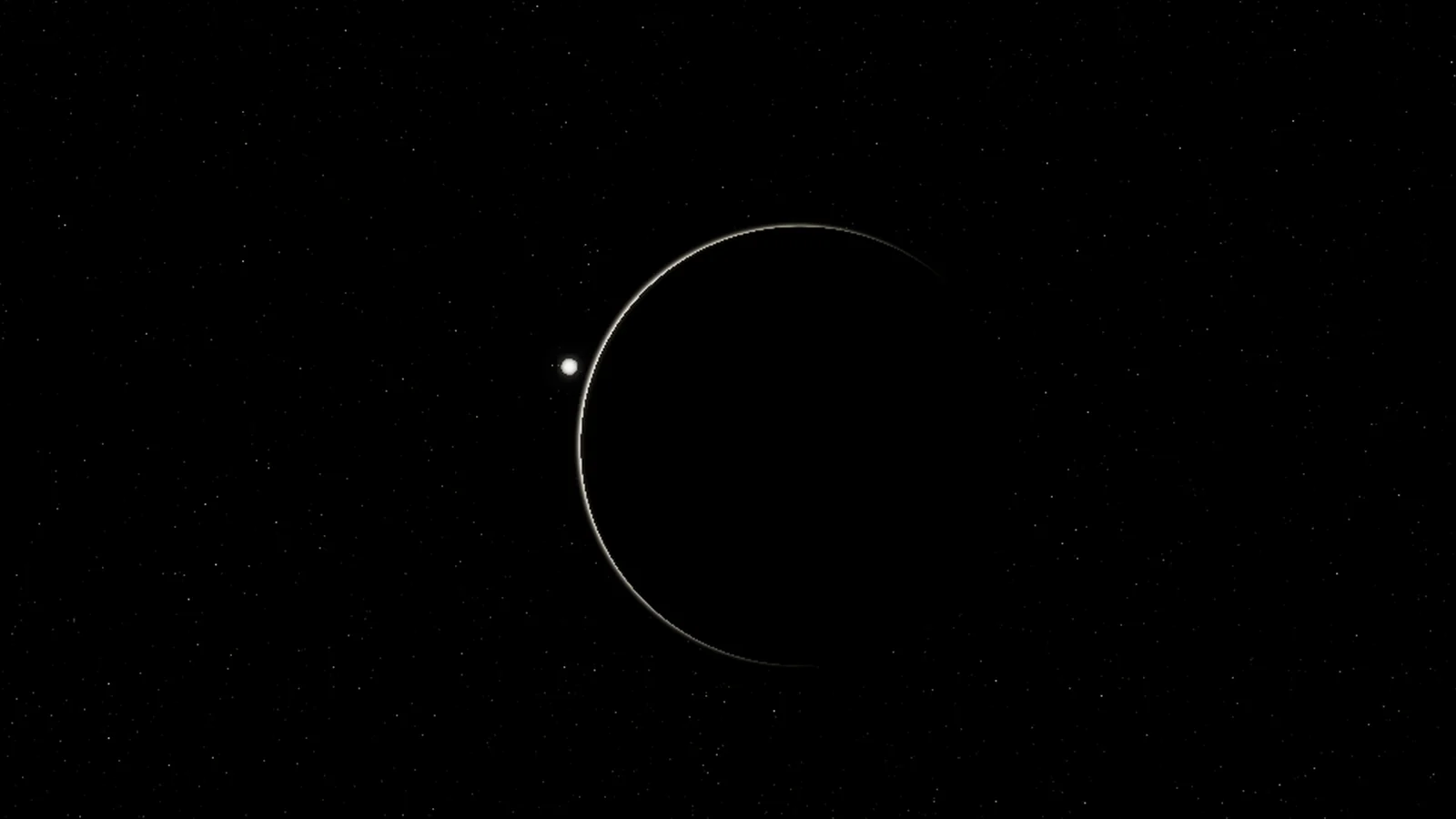
Yes, and you can see them in binoculars held steady or any small telescope. Far from us on the other side of the Sun it's small and nearly full; as it comes round toward us it grows larger and turns into a half, then a thin crescent. Galileo saw the phases in 1610, and they showed that Venus goes round the Sun, not the Earth.
Venus is at its most brilliant not when it's full but as a fat crescent, when it's close enough to look large but still shows plenty of its lit side.
Why is Venus so bright, and so hot?
Its clouds of sulfuric acid reflect most of the sunlight that reaches them, and it comes closer to Earth than any other planet. The same clouds, and air that's mostly carbon dioxide, trap heat so well that the surface is hotter than Mercury's, hot enough to melt lead, even though Venus is almost twice as far from the Sun.
Can you see Venus in Everdust?
In Everdust's Night Sky on Apple Vision Pro, look at Venus and pinch to fly there. Venus Today shows it in tonight's real phase, its clouds as they look in ultraviolet, racing round the planet. On iPhone and iPad, tap Venus in Night Sky to fly there.
Everdust is free on the App Store for Apple Vision Pro, iPhone and iPad; on Android, Tonight’s Sky in Everdust for Android (free on Google Play) shows where Venus is tonight from where you stand. I make Everdust, so weigh that; a phone star map such as Stellarium or Sky Guide will find Venus just as well.
Questions people ask
Can I see Venus tonight? Venus is up from about 5:54 am until dawn, climbing to 13° up in the south-east by about 6:04 am. That's for New York on the night of November 7, 2026; this page works it out for your own location too.
Where is Venus in the sky right now? Venus is in Virgo, shining at magnitude -4.6. Its light takes 2 minutes to reach Earth.
What is the bright star in the west after sunset? If it's very bright, steady and low in the west in twilight, it's almost certainly Venus when Venus is an evening star. This page says whether it is tonight. Jupiter can also be bright in the evening, but it's higher and never as brilliant.
Can you see Venus during the day? Yes, when it's far from the Sun in the sky and you know exactly where to look: it's bright enough to show in a clear blue sky as a tiny white point. Never look near the Sun itself, with or without binoculars.
Why does Venus spin backward? Nobody knows for sure. Venus turns the opposite way from most planets, very slowly. Ideas include a giant early impact or the Sun's tides on its thick atmosphere gradually flipping its spin.
Sources
Positions, rise and set times, brightness, phases and distances on this page are computed with Astronomy Engine (Don Cross, MIT license), accurate to about an arcminute.