Sagittarius A*: the black hole at the center of the Milky Way
Sagittarius A* (say "A-star") is the black hole at the center of our galaxy, about four million times the Sun's mass and about 27,000 light-years away. You can't see it, as dust hides the galaxy's center from our eyes, but you can look straight toward it: it lies just off the spout of the Teapot in Sagittarius, in the brightest part of the Milky Way. Below is when it's up tonight from your location.
Tonight from where you are
Working it out for your time zone…
Computed in your browser.
Sagittarius A* tonight from four cities
| City | Tonight |
|---|---|
| New York | not up in the dark hours |
| Los Angeles | 5:50 pm to 5:50 pm; best 5:50 pm, 11° up in the south-west |
| London | never rises high enough |
| Sydney | 8:28 pm to 9:58 pm; best 8:28 pm, 28° up in the west |
Local times for the night of November 7, 2026, counted as “up” when at least 10° above the horizon after dark. Computed with Astronomy Engine when this page was built; it refreshes every hour.
At a glance
- In the constellation
- Sagittarius
- High in the evening (9 pm)
- June to October from mid-southern latitudes
Sagittarius A*: the facts
| Mass | about 4 million times the Sun's [1] |
|---|---|
| Distance | about 27,000 light-years (8.2 kiloparsecs) [2] |
| Photographed | by the Event Horizon Telescope, image released May 2022 [3] |
| Its fastest-known neighbor | the star S2, which goes round it every 16 years [4] |
How do we know there's a black hole there?
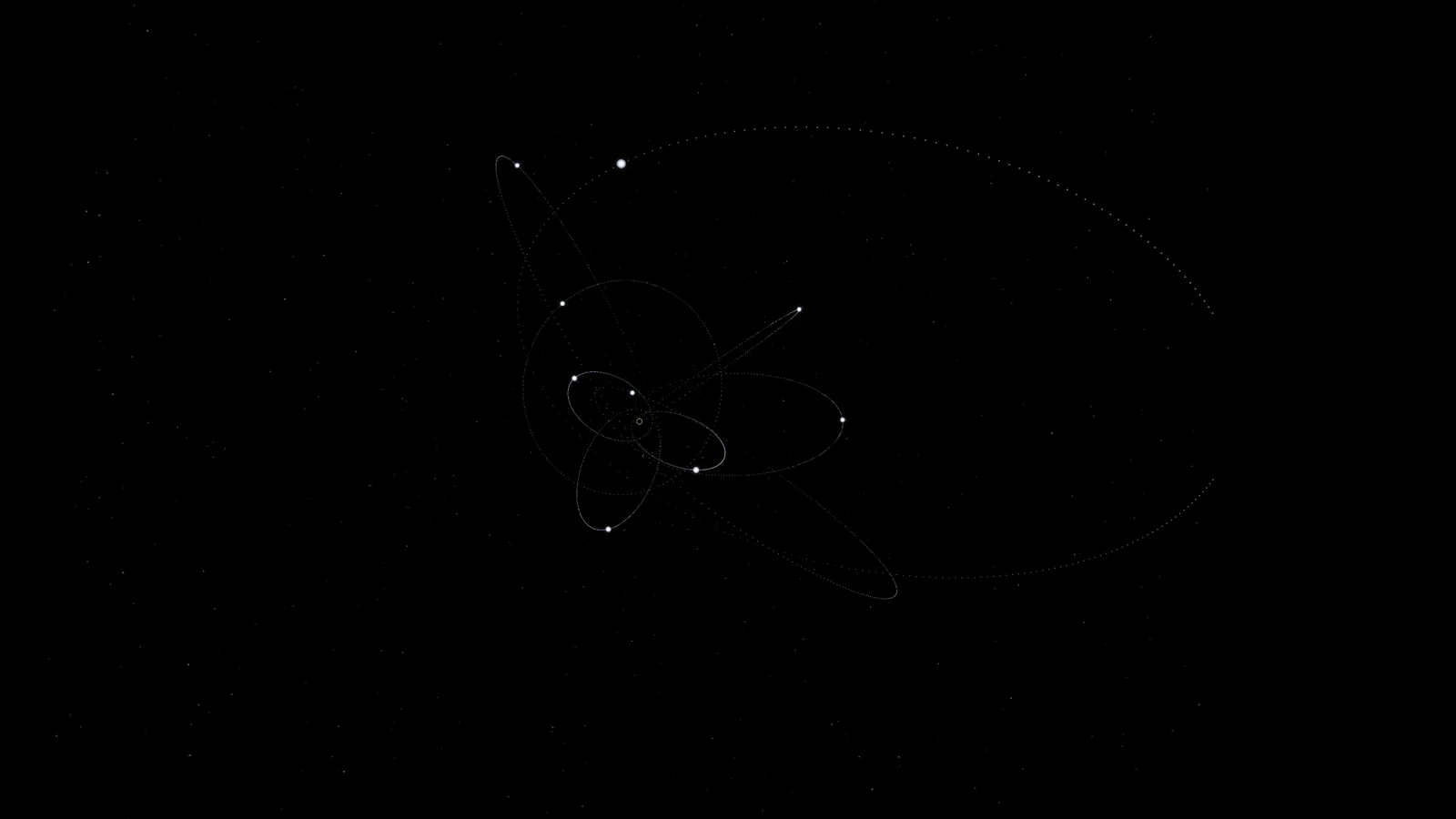
By watching stars orbit it. For three decades, teams led by Reinhard Genzel and Andrea Ghez tracked a few dozen stars in the galaxy's center through the dust, in infrared light. They move on tight ellipses around a point that gives off almost no light, fast enough that only something of four million solar masses packed into a tiny space can hold them. The star S2 swings round it every 16 years and in 2018 passed within about 120 times the Earth–Sun distance, moving at nearly 3% of the speed of light. Genzel and Ghez shared the 2020 Nobel Prize in Physics for the discovery.
In 2022 the Event Horizon Telescope, a network of radio dishes spanning the Earth, released the first image of the hole's shadow: a dark center inside a ring of glowing gas, about the size the orbits predicted.
Where do you look to face the center of the galaxy?
Find Sagittarius, whose brightest stars form a shape like a teapot, low in the south on summer evenings in the Northern Hemisphere and high overhead in winter evenings in the Southern. The galaxy's center lies just west of the Teapot's spout, where the Milky Way is brightest and broken by dark dust lanes. The table below gives when it's up tonight from your place.
Can you see Sagittarius A* in Everdust?
In Everdust's Night Sky on Apple Vision Pro, look toward the galaxy's center and pinch to fly there: the S-stars circle the black hole on their measured orbits, at their places tonight, one year passing every two seconds. On iPhone, iPad and Android, tap Sagittarius A* in Night Sky to fly there.
Everdust is free on the App Store for Apple Vision Pro, iPhone and iPad, and on Google Play for Android. I make Everdust, so weigh that; a phone star map such as Stellarium or Sky Guide will find Sagittarius A* just as well.
Questions people ask
Can I see Sagittarius A* tonight? Sagittarius A* isn't up during the dark hours tonight; it's above the horizon in daylight. That's for New York on the night of November 7, 2026; this page works it out for your own location too.
When is the best time of year to see Sagittarius A*? From mid-southern latitudes (Sydney) it's high in the evening from June to October.
Can you see Sagittarius A* with a telescope? No. Dust between us and the galaxy's center blocks its visible light completely. It's studied in radio, infrared and X-ray light, which get through the dust.
Is the black hole at the center of the Milky Way dangerous? No. It's about 27,000 light-years away, and the Earth orbits the galaxy's center in a stable path, as the Sun has for billions of years.
How big is Sagittarius A*? Its event horizon is about 24 million km across, only about 17 times the Sun's width: four million Suns' worth of mass squeezed into a space that would fit inside Mercury's orbit.
Sources
- GRAVITY Collaboration 2018, Detection of the gravitational redshift in the orbit of the star S2, Astronomy & Astrophysics 615, L15
- GRAVITY Collaboration 2019, A geometric distance measurement to the Galactic center black hole, Astronomy & Astrophysics 625, L10
- Event Horizon Telescope Collaboration 2022, First Sagittarius A* Event Horizon Telescope results I, The Astrophysical Journal Letters 930, L12
- Gillessen et al. 2017, An update on monitoring stellar orbits in the Galactic Center, The Astrophysical Journal 837, 30
- The Nobel Prize in Physics 2020
Positions, rise and set times, brightness, phases and distances on this page are computed with Astronomy Engine (Don Cross, MIT license), accurate to about an arcminute.