What a spinning black hole really looks like
A spinning black hole looks like a dark shadow ringed by a thin bright photon ring, with its glowing disk bent up over the top and under the bottom, one side far brighter than the other. The Kerr solution, gravitational lensing, the photon ring and what the Event Horizon Telescope's images of M87* and Sagittarius A* actually show.
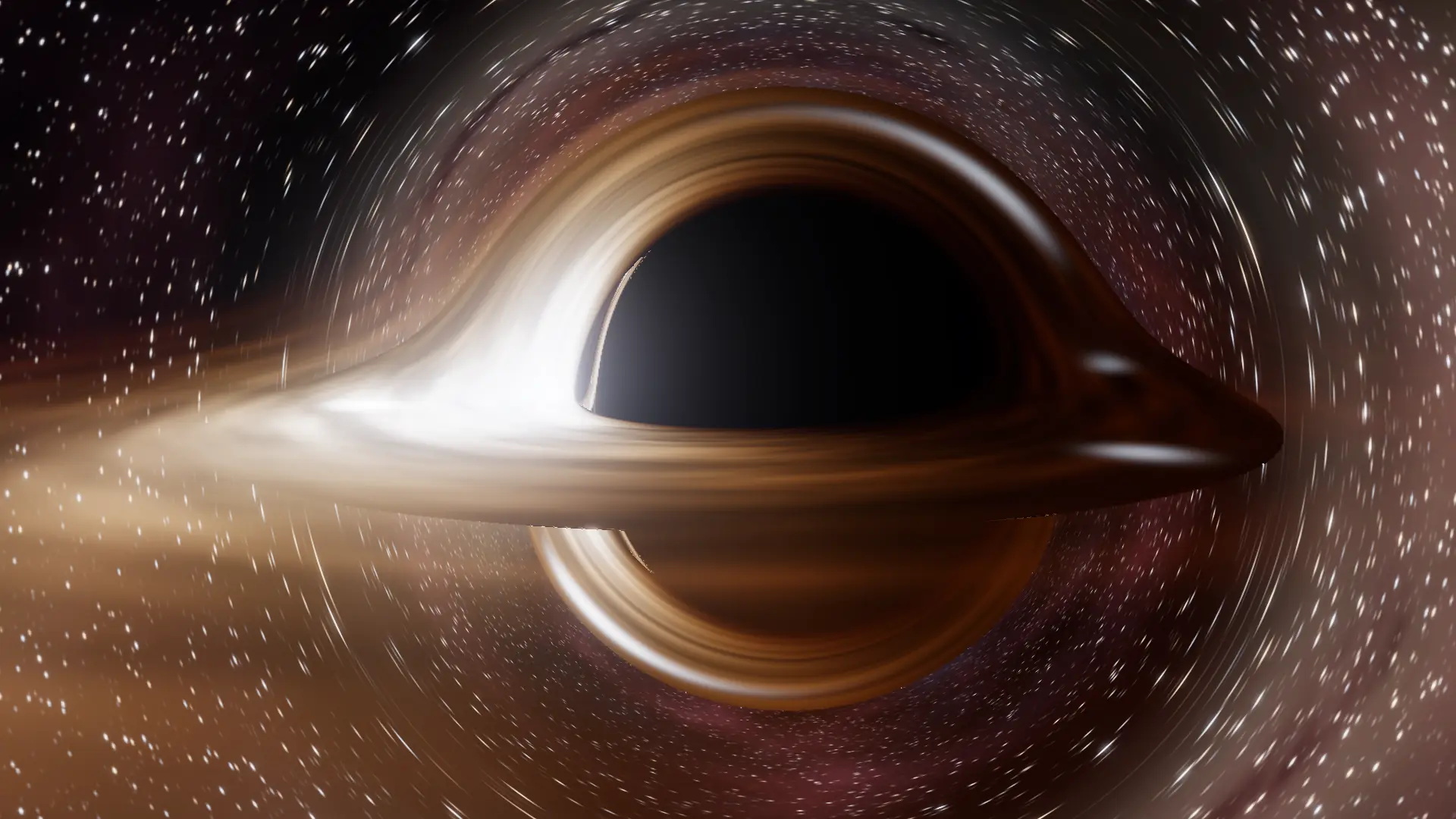
A spinning black hole looks like a dark, slightly lopsided shadow surrounded by a thin bright ring of light, with its glowing disk of gas bent up over the top and under the bottom, so you see the far side of the disk at the same time as the near side. One side of the disk is much brighter than the other, because the gas on that side is rushing toward you.
None of that is artistic license. It is what light does in the curved spacetime around a spinning mass, and since 2019 the Event Horizon Telescope has photographed the real thing twice.
You can watch one in motion in our clip of a spinning black hole and its disk, and two of them merging in Two black holes merge. I make Everdust, the app those clips come from, so take the plugs below with that in mind.
What is a Kerr black hole?
In 1915, Einstein's general relativity described gravity as the bending of spacetime. A few months later, Karl Schwarzschild found the exact solution for a black hole that doesn't spin. Real black holes almost certainly do spin, because the stars and gas they form from spin, and it took until 1963 for the New Zealand mathematician Roy Kerr to find that solution. The Kerr black hole is described by just two numbers: its mass and its spin.
Spin changes three things you can, in principle, see.
- The horizon shrinks. A non-spinning black hole's event horizon sits at twice GM/c² from the center (G is the gravitational constant, M the mass and c the speed of light). At the maximum possible spin it shrinks to half that.
- Space is dragged around. Near a spinning black hole, spacetime itself is pulled round with it, an effect called frame dragging. Inside a region called the ergosphere, nothing can stay still relative to the distant stars, not even light.
- The disk can come closer. Gas orbiting the same way as the spin can circle stably much closer to the horizon, from 6 GM/c² for a non-spinning hole down to almost 1 GM/c² at maximum spin. Closer means hotter and brighter.
Why does the disk bend over the top?
Because gravity bends light. Light leaving the back of the disk, on the far side of the black hole, gets bent over the top and under the bottom on its way to you. So instead of a flat ring seen edge-on, you see a hump of disk rising above the shadow and another curving below it. Both are the far side of the disk, lensed.
The French astrophysicist Jean-Pierre Luminet computed the first image of this in 1979, by hand-plotting the light paths around a black hole with a thin disk. The film Interstellar made it famous in 2014; its team, with the physicist Kip Thorne, wrote up how they traced light through Kerr spacetime for the black hole Gargantua.
Why is one side brighter?
Doppler beaming. The gas in the disk orbits at a good fraction of the speed of light. On the side moving toward you, its light is shifted to higher energies and concentrated in your direction, so that side is far brighter. On the receding side, it is dimmed and reddened.
Interstellar's Gargantua leaves this out on purpose. Its visual-effects team and Kip Thorne describe in their paper how the Doppler and gravitational shifts would make the disk strongly lopsided, brighter and bluer on the approaching side, so the film omits them and shows a gentler, symmetric disk. For visual purposes they also slowed the spin to 0.6 of the maximum, far slower than the story's time dilation needs. A realistic rendering is lopsided, as in the image at the top of this page.
What are the shadow and the photon ring?
Close to a black hole, light can orbit. For a non-spinning black hole, the photon sphere sits at 3 GM/c², one and a half times the horizon's radius. Light that comes in steeper than that falls in; light that comes in shallower escapes. The boundary between them is the edge of the black hole's shadow, a dark patch about two and a half times wider than the horizon itself, because gravity magnifies it.
Just outside the shadow's edge is the photon ring: light that went once, twice or more around the black hole before escaping toward you. Each extra half-orbit makes a thinner, fainter sub-ring stacked on the one before, an effect the Event Horizon Telescope hopes to measure in future.
Spin makes the shadow slightly lopsided, flattened on the side where the gas and light move with the spin. In 1973, James Bardeen worked out the shape: a near-circle at low spin, a D shape seen side-on at high spin. The surprising part is how little the size changes. General relativity predicts the shadow's size depends strongly on mass and only weakly on spin, by a few percent, which is exactly what made it a clean test.
What did the Event Horizon Telescope actually see?
The Event Horizon Telescope links radio dishes across the Earth into one telescope the size of the planet.
- M87*, April 2019. The first image of a black hole showed a bright ring 42 ± 3 microarcseconds across around a dark center, at the core of the galaxy M87, 55 million light-years away. That size gives a mass of about 6.5 billion Suns. The ring is brighter on the bottom, which the team explained as gas moving toward us: Doppler beaming, as above.
- Sagittarius A*, May 2022. The black hole at the center of our own galaxy, about 4 million Suns, showed a ring about 52 microarcseconds across. It is far smaller than M87* but much closer, so the two look a similar size from Earth.
- The ring stays; the gas changes. Later images of M87*, from 2018 and 2021, show a ring of the same size, as general relativity predicts for a black hole whose mass doesn't change. In 2025 the team reported that the pattern of polarized light around it flipped direction between 2017 and 2021, a sign that the magnetic fields in the gas are turbulent.
The images are blurry because the ring is tiny on the sky: 42 microarcseconds is about the size of a doughnut on the Moon, seen from Earth. They don't resolve the thin photon ring by itself. What they show is the bright emission around the shadow, shaped by lensing, and its size matches the prediction for a Kerr black hole of that mass.
How Everdust draws one
In Everdust's surround black hole world and in the Life of a Black Hole story, every direction you look is a light path traced through the Kerr geometry, so the bent disk, the doubled sky near the shadow and the color shifts come from the physics, not from a painted texture. The story's black holes spin fast, up to 90% of the maximum, which is what makes the shadow and disk lopsided. (Some lighter scenes, such as the disk you hold in your hands, approximate the lensing instead, and their Learn notes say so.) On Apple Vision Pro you can walk up to one.
The merger in Two black holes merge follows the leading-order chirp of a real merger, like the ones LIGO hears, with light traced past both holes. It is a simplification: the real final moments need full numerical relativity.
Try it
- Watch: Kerr black hole simulation and Two black holes merge on YouTube.
- Play: Black Hole Golf in your browser, where black holes bend your shot. Free, no install.
- iPhone, iPad and Apple Vision Pro: Everdust on the App Store, free.
- Android phones and tablets: Everdust on Google Play, free, including the narrated Life of a Black Hole's first chapter.
Questions people ask
What does a spinning black hole look like? A dark shadow with a thin bright ring around it, the glowing disk of gas bent up over the top and under the bottom by gravity, and one side of the disk much brighter than the other because that gas is moving toward you. At high spin the shadow is slightly flattened on one side.
What is the difference between a Kerr and a Schwarzschild black hole? A Schwarzschild black hole doesn't spin; a Kerr black hole does. Spin shrinks the event horizon, drags spacetime around with it, lets the disk orbit closer and makes the shadow slightly lopsided. Real black holes are expected to spin.
What is the photon ring? Light that orbited the black hole one or more times before escaping toward you. It forms a very thin, bright ring just outside the shadow's edge, made of ever-thinner sub-rings.
Why is one side of a black hole's disk brighter? Doppler beaming. Gas on one side is moving toward you at a large fraction of the speed of light, which brightens and blue-shifts its light; the other side moves away and dims. The M87* image is brighter on one side for this reason.
Is the Interstellar black hole accurate? Its lensing is computed from real Kerr light paths. The filmmakers deliberately left out the Doppler shifts and slowed the spin to keep the image readable, so a realistic image is more lopsided than Gargantua.
Has anyone photographed a black hole? Yes. The Event Horizon Telescope imaged M87* in 2019 and Sagittarius A*, at the center of the Milky Way, in 2022. Both show a bright ring around a dark shadow, with sizes that match general relativity's prediction.
Sources
- Kerr, R. P., Gravitational Field of a Spinning Mass as an Example of Algebraically Special Metrics, Physical Review Letters 11, 237 (1963).
- Bardeen, J. M., "Timelike and null geodesics in the Kerr metric", in Black Holes (Les Houches 1972), Gordon and Breach (1973).
- Luminet, J.-P., Image of a spherical black hole with thin accretion disk, Astronomy and Astrophysics 75, 228 (1979).
- James, O., von Tunzelmann, E., Franklin, P. and Thorne, K. S., Gravitational lensing by spinning black holes in astrophysics, and in the movie Interstellar, Classical and Quantum Gravity 32, 065001 (2015).
- Event Horizon Telescope Collaboration, First M87 Event Horizon Telescope Results. I. The Shadow of the Supermassive Black Hole, The Astrophysical Journal Letters 875, L1 (2019).
- Event Horizon Telescope Collaboration, First Sagittarius A* Event Horizon Telescope Results. I., The Astrophysical Journal Letters 930, L12 (2022).
- Max Planck Institute for Radio Astronomy, New EHT images reveal unexpected polarization flips at M87* (September 16, 2025).
- Johnson, M. D. et al., Universal interferometric signatures of a black hole's photon ring, Science Advances 6, eaaz1310 (2020).