How a star is born
A star is born when a cold cloud of gas collapses under its own gravity, spins up into a disk and heats its center until hydrogen fuses. Here is how it happened to the Sun, step by step, with a live simulation you can watch.
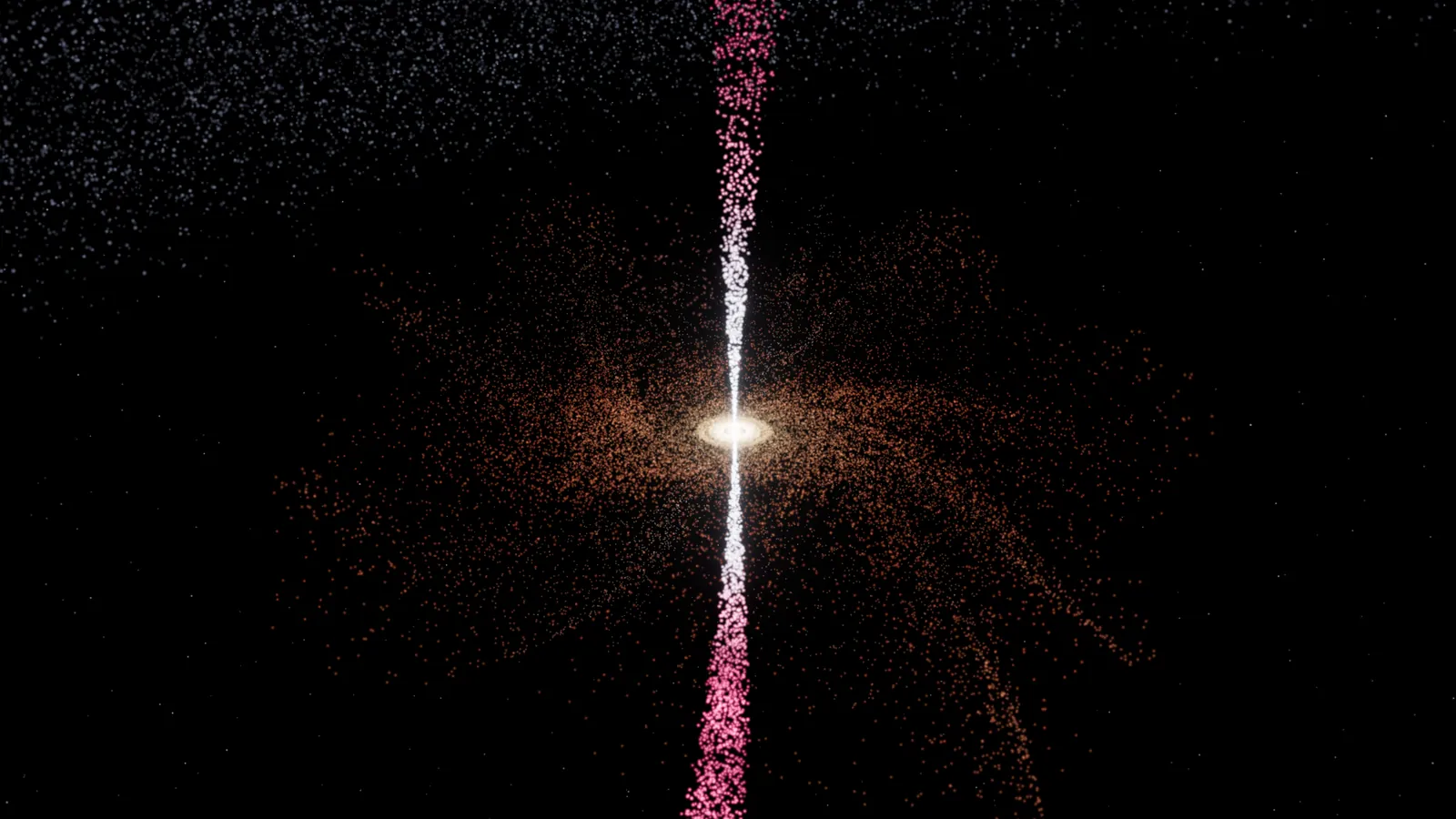
A star is born when a cold, dense knot of gas inside a cloud collapses under its own gravity, flattens into a spinning disk and squeezes its center until it is hot enough to fuse hydrogen into helium.
That is how the Sun began about 4.6 billion years ago, and it is still happening all over the Milky Way today. You can watch it unfold in The Sun Is Born, a live simulation that runs free in your browser.
Where do stars come from?
Stars are born inside giant clouds of gas and dust, mostly hydrogen, called molecular clouds. They are some of the coldest places in the universe, only about 10 to 20 degrees above absolute zero, and they can stretch for dozens of light-years.
Most of a cloud just sits there. Its gas pushes outward with its own pressure, and that holds it up against its own gravity. But clouds are lumpy. In the densest knots, gravity can win. Sometimes something tips the balance, such as the shock wave from a nearby exploding star or a collision between two clouds. Once a dense core starts to fall in on itself, gravity only gets stronger as it shrinks, and the collapse keeps going.
Why does a collapsing cloud make a disk?
Every cloud turns a little, even if very slowly. As it shrinks, it spins faster, the same way a figure skater speeds up by pulling in their arms. Physicists call this conservation of angular momentum.
The spin changes the shape of the collapse. Gas falling in along the spin axis meets nothing in its way. Gas falling in around the middle is flung outward by the spin and can't fall straight in. So the cloud flattens into a disk, with a dense, growing ball at its center. That ball is a protostar: not yet a star, but getting hotter every year as gravity squeezes it.
The disk matters twice. It is how the protostar feeds, as gas spirals inward through the disk and onto the star. And it is where the planets will form later.
What are the jets?
Young stars don't swallow everything that falls toward them. Some of the gas spiraling inward is thrown back out in two narrow jets, one from each pole, moving at supersonic speeds. Where the jets slam into the surrounding gas they make shock waves that glow, often in bright knots called Herbig-Haro objects.
Telescopes see these jets around many newborn stars. NASA's James Webb Space Telescope has photographed jets like HH 212 in Orion, a protostar that will grow to about the mass of the Sun, with jets stretching across several light-years. Astronomers think magnetic fields, wound up by the spinning disk, are what launch them. The jets also carry away spin, which lets more gas fall onto the star.
When does it become a real star?
The protostar keeps contracting and heating. When the temperature in its core reaches around 10 million degrees, hydrogen nuclei start fusing into helium. Fusion releases energy that pushes back against gravity, the collapse stops, and the star settles down to shine steadily for billions of years. For a star like the Sun, getting from collapsing cloud to steady fusion took a few tens of millions of years.
What happened to the leftovers?
The disk around the young Sun didn't vanish. Dust grains stuck together into pebbles, pebbles into boulders, and boulders into the building blocks of planets. We have a picture of this stage today: in 2014, the ALMA telescope in Chile imaged the disk around HL Tauri, a star no more than a million years old, and found it marked by bright rings and dark gaps, almost certainly cleared by young planets forming inside it.
We even know when our own disk started building solids. The oldest grains in meteorites, tiny calcium- and aluminum-rich inclusions, have been dated to about 4,568 million years ago. That is the best clock we have for the birth of the solar system.
How the simulation works
The Sun Is Born is Chapter V of The Story of Everything, the narrated story in the Everdust app. A spinning cloud of gas falls inward, flattens into a disk around a newborn star, and twin jets shoot out from its poles.
The gravity and the spin are computed live, so the disk forms because of the physics, not because it was drawn. The jets are a simplification: they follow a launch rule instead of modeling the magnetic fields that drive real jets. With music on, each beat sets off an accretion burst, a bright knot in the jets, like the clumps real protostars throw off when a burst of gas falls in.
In the app, River narrates each chapter while you watch, from the first light after the Big Bang to the birth of the Sun and beyond, and you can turn the scene in your hands.
Try it
- In your browser: The Sun Is Born, free, no install.
- iPhone, iPad and Apple Vision Pro: Everdust on the App Store, free.
- Android phones and tablets: Everdust on Google Play, free.
- Mac: a free download from everdust.ai (version 1.0.1; macOS 14 Sonoma or later, Apple silicon (M1 or later)), signed and notarized by Apple. The Mac App Store version is in review.
Sources
- NASA, NASA's Webb Telescope Will Investigate Cosmic Jets From Young Stars.
- ESO, Revolutionary ALMA Image Reveals Planetary Genesis (November 6, 2014).
- Bouvier, A. and Wadhwa, M., The age of the Solar System redefined by the oldest Pb–Pb age of a meteoritic inclusion, Nature Geoscience 3, 637–641 (2010).