When will the Milky Way collide with Andromeda? What Hubble and Gaia say
Andromeda is 2.5 million light-years away and closing at about 110 kilometers a second. A 2012 Hubble study forecast a head-on collision in about 4 billion years; a 2025 re-analysis with Gaia data puts a merger within 10 billion years at roughly a coin toss. Here is what changed, and what a collision would do.
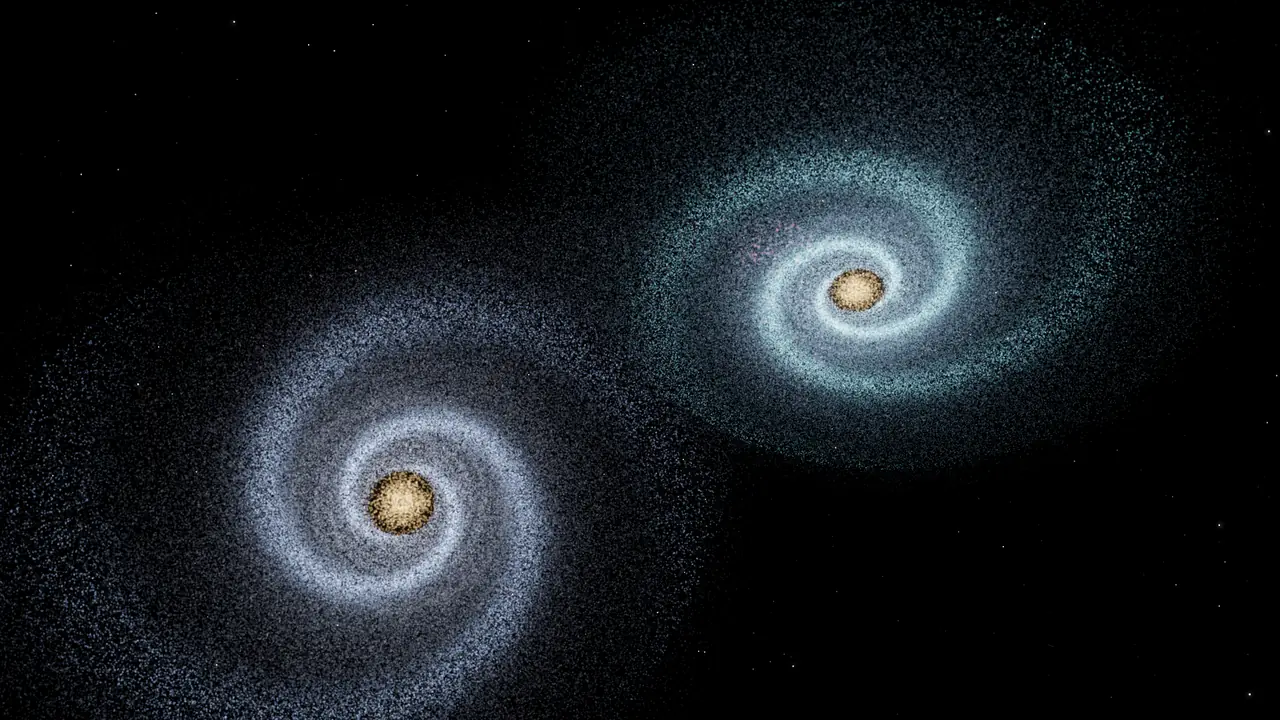
The Milky Way and the Andromeda galaxy may collide, but not soon and not for certain: the latest study gives about a 50 percent chance that they merge within the next 10 billion years, and only about a 2 percent chance within the next 5 billion.
For more than a decade the textbook answer was firmer: a head-on crash in about 4 billion years. That forecast came from Hubble in 2012. In 2025 a team led by Till Sawala at the University of Helsinki went back to the same question with newer data, including measurements from the European Space Agency's Gaia telescope, and found the future far less settled. Here is how both answers were reached, and why they differ.
How far away is Andromeda, and how fast is it coming?
Andromeda is about 2.5 million light-years away, the nearest big spiral galaxy to our own. It is moving toward us at about 110 kilometers a second, which is roughly 400,000 kilometers an hour.
Astronomers have known since 1912 that Andromeda is heading our way, and the approach speed is the easy part to measure. Light from an object moving toward us is shifted toward the blue, and the size of the shift gives the speed along our line of sight. The hard part is the sideways motion. Andromeda could be heading straight for us, or it could be aimed to miss, and the only way to tell is to see it drift across the sky. At 2.5 million light-years that drift is extraordinarily small.
Where did the "4 billion years" figure come from?
In 2012, a team led by Roeland van der Marel at the Space Telescope Science Institute used Hubble to measure that sideways drift for the first time, tracking stars in Andromeda against much more distant background galaxies. The sideways speed came out small, about 17 kilometers a second, compared with the 109 kilometers a second of approach. Andromeda looked to be on a nearly head-on course.
Feeding those numbers into computer models, the team found that the two galaxies would make their first close pass in about 3.9 billion years and finish merging about 2 billion years after that, roughly 5.9 billion years from now. NASA's headline put it simply: "NASA's Hubble Shows Milky Way is Destined for Head-On Collision."
Why is it now a coin toss?
The 2025 study, published in Nature Astronomy, asked a different question. Instead of running the most likely numbers once, Sawala and his colleagues ran 100,000 simulations, each with slightly different starting values drawn from the measurement uncertainties of the galaxies' positions, motions and masses. Their best value for Andromeda's motion used Gaia data alongside Hubble.
Small uncertainties add up. In about half of the simulations, the Milky Way and Andromeda merged within 10 billion years. In the other half they did not merge in that time, and in most of those runs they passed so far apart that both carried on largely undisturbed. A merger in the next 5 billion years happened in only about 2 percent of runs. When a merger did happen, it most often came 7 to 8 billion years from now.
The measurements themselves did not change much. What changed is that the study took their error bars seriously and added the pull of two smaller neighbors.
What do the Large Magellanic Cloud and M33 do?
The Large Magellanic Cloud, or LMC, is a satellite galaxy of the Milky Way, visible to the naked eye from the Southern Hemisphere. M33, the Triangulum galaxy, is a satellite of Andromeda. Both are massive enough to matter, and the 2025 study found they push in opposite directions.
M33's extra mass pulls the Milky Way a little toward Andromeda, which makes a merger more likely. The LMC's orbit runs perpendicular to the path of the Milky Way and Andromeda, so it tugs the Milky Way off that path, which makes a merger less likely. As Sawala put it, the LMC won't "save us from that merger, but it makes it a bit less likely."
The LMC has its own appointment with us. Studies agree it will fall into the Milky Way first, in roughly 1 to 2.5 billion years depending on the model, long before anything happens with Andromeda.
What would happen if they do collide?
The stars themselves would almost certainly not hit each other. The gaps between stars are so large that two galaxies pass through each other like two clouds of sand grains spread kilometers apart; I wrote about why in Why stars almost never collide when galaxies do.
Gravity would do the work instead. On the first pass, tidal forces would stretch both spiral disks and fling out long, curved streams of stars called tidal tails. The cores would swing apart, fall back and pass again, and within a few passes they would sink together. In 2008 the astronomers T. J. Cox and Avi Loeb simulated the encounter and nicknamed the merged galaxy "Milkomeda." In their simulation and in the 2012 ones, the merged galaxy resembles a rounded elliptical galaxy rather than a flat spiral.
The Sun would most likely be moved, not destroyed. In the 2012 simulations, 85 percent of runs left the Sun farther from the center of the merged galaxy than it is from the Milky Way's center today. Earth would be carried along with it.
Should anyone worry?
No. Even the fastest version of this story plays out over billions of years, and the Sun has its own clock. In about 5 billion years it will run low on fuel, swell into a red giant and later shrink into a white dwarf. Long before that, in roughly a billion years, the slowly brightening Sun is expected to make Earth too hot for life as we know it. As ESA put it when the 2025 study came out, a collision with Andromeda "is the least of our cosmic worries."
Watch a galaxy collision
You can't watch the real one, but you can watch the physics. Everdust, the app I make, has a short film on YouTube, Galaxy collision simulation: two galaxies merge, live particles, and the same kind of collision runs live and free in your browser in the galaxy collision simulator.
To be clear about what it is: the simulation follows the method Alar and Juri Toomre published in 1972. Each galaxy is a heavy core with a disk of test stars, every star is pulled by both cores, and the stars don't pull on each other. That is enough to reproduce tidal tails, bridges and an eventual merger. It is not a forecast of the real Milky Way and Andromeda encounter, which depends on dark matter halos, gas, the LMC, M33 and the uncertain measurements above.
To get a feel for millions of points of light moving together, turn any photo into living particles in your browser and stir them.
Questions people ask
When will the Milky Way collide with Andromeda? It might not. A 2025 study using Hubble and Gaia data found about a 50 percent chance of a merger within 10 billion years and about a 2 percent chance within 5 billion years. If a merger happens, it is most likely 7 to 8 billion years from now.
Is the Milky Way–Andromeda collision still going to happen in 4 billion years? That was the 2012 forecast from Hubble measurements. The 2025 re-analysis, which included measurement uncertainties and the pull of M33 and the Large Magellanic Cloud, found a collision that early is unlikely.
How fast is Andromeda moving toward us? About 110 kilometers a second, or roughly 400,000 kilometers an hour. It is about 2.5 million light-years away.
Will stars collide when the Milky Way and Andromeda merge? Almost certainly not. Stars are tiny compared with the distances between them, so the galaxies would pass through each other while gravity reshapes them.
What will happen to the Sun and Earth? In the 2012 simulations the Sun most often ended up farther from the center of the merged galaxy than it is today, with Earth still orbiting it. The Sun itself is expected to become a red giant in about 5 billion years, which matters far more for Earth.
What is Milkomeda? It is the nickname T. J. Cox and Avi Loeb gave in 2008 to the elliptical galaxy the Milky Way and Andromeda would form if they merge.
Try it
- In your browser: Galaxy Collision, free, no install.
- On YouTube: Galaxy collision simulation: two galaxies merge, live particles.
- iPhone, iPad and Apple Vision Pro: Everdust on the App Store, free.
- Android phones and tablets: Everdust on Google Play, free.
- Mac: a free download from everdust.ai (version 1.0.1; macOS 14 Sonoma or later, Apple silicon (M1 or later)), signed and notarized by Apple. The Mac App Store version is in review.
Sources
- NASA, NASA's Hubble Shows Milky Way is Destined for Head-On Collision (May 31, 2012).
- van der Marel, R. P. et al., The M31 Velocity Vector. II. Radial Orbit toward the Milky Way and Implied Local Group Mass, The Astrophysical Journal 753, 8 (2012).
- van der Marel, R. P. et al., The M31 Velocity Vector. III. Future Milky Way M31-M33 Orbital Evolution, Merging, and Fate of the Sun, The Astrophysical Journal 753, 9 (2012).
- Sawala, T. et al., No certainty of a Milky Way–Andromeda collision, Nature Astronomy (2025); preprint on arXiv.
- ESA/Hubble, Hubble casts doubt on certainty of galactic collision (June 2, 2025).
- Durham University, New study casts doubt on the likelihood of Milky Way collision with Andromeda (June 2025).
- Cautun, M. et al., The aftermath of the Great Collision between our Galaxy and the Large Magellanic Cloud, Monthly Notices of the Royal Astronomical Society 483, 2185 (2019).
- Cox, T. J. and Loeb, A., The collision between the Milky Way and Andromeda, Monthly Notices of the Royal Astronomical Society 386, 461 (2008); Center for Astrophysics summary (2008).
- NASA, Sun: Facts.
- Toomre, A. and Toomre, J., Galactic Bridges and Tails, The Astrophysical Journal 178, 623 (1972).