Why stars almost never collide when galaxies do
When two galaxies collide, almost none of their stars hit each other, because the gaps between stars are enormous. Gravity does the damage instead, and you can watch it happen in a free galaxy collision simulator.
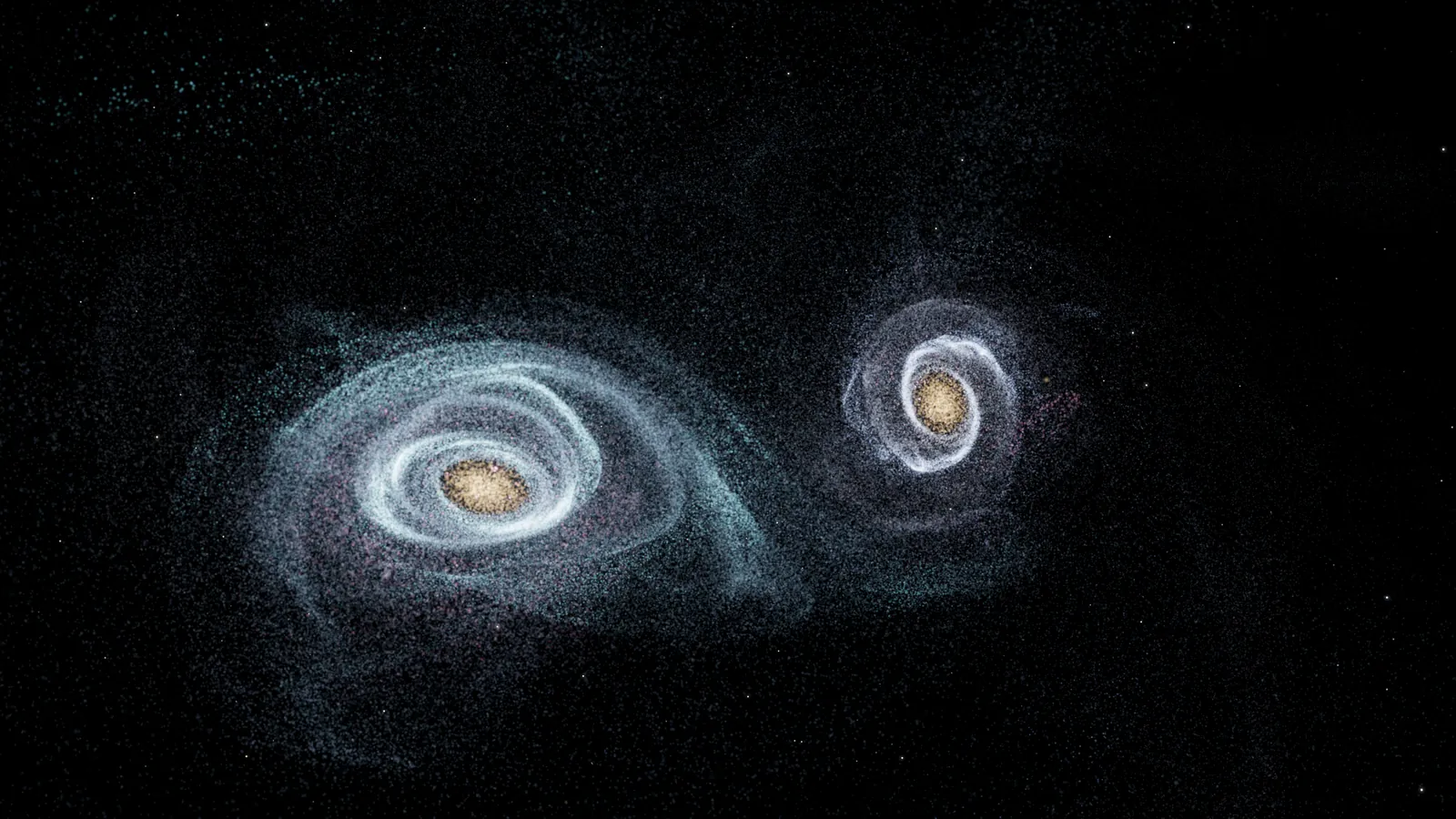
When two galaxies collide, their stars almost never hit each other, because stars are tiny compared with the distances between them; what tears the galaxies apart is gravity, not crashes.
That sounds wrong the first time you hear it. A galaxy has hundreds of billions of stars, and a collision sends two of them straight through each other. Surely something hits something? It almost never does, and the reason is mostly empty space.
You can see it for yourself in the galaxy collision simulator, which runs free in your browser with no install.
Why don't the stars hit each other?
Start with the scale. The Sun is about 1.4 million kilometers across. The nearest star to us, Proxima Centauri, is about 4.2 light-years away, or roughly 40 trillion kilometers. Divide one by the other and the gap between neighboring stars is about 30 million times the width of a star.
Shrink that down to something you can picture. If the Sun were a grain of sand one millimeter wide, the nearest star would be another grain of sand about 30 kilometers away. Two galaxies colliding is like two clouds of sand grains, each grain tens of kilometers from the next, passing through each other. A direct hit is possible, but so rare that it barely matters.
NASA said the same about our own future. In 2012, Hubble measurements showed the Andromeda galaxy heading toward the Milky Way at about 400,000 kilometers an hour, and NASA wrote that "stars inside each galaxy are so far apart that they will not collide with other stars during the encounter."
So what does happen?
Gravity happens. Every star feels the pull of the other galaxy, and that pull is stronger on the near side of a galaxy than on the far side. The difference, called the tidal force, is the same effect that raises tides on Earth because the Moon pulls harder on the ocean facing it.
In a galaxy collision, tidal forces stretch each spiral disk. Stars on the near side get pulled ahead, stars on the far side get left behind, and the galaxy flings out long, curved streams of stars called tidal tails, often with a bridge of stars linking the two.
In 1972, the brothers Alar and Juri Toomre showed this with remarkably simple computer models. They treated each galaxy as a heavy center with a disk of test stars around it. Each star felt the pull of both centers, but the stars didn't pull on each other. That was enough to reproduce the long tails of real galaxy pairs such as the Antennae and the Mice. The tails are not wreckage from crashes. They are stars on new orbits.
After the first pass, the two cores slow down, swing back and pass again. Within a few passes they sink together. The disks are scrambled, and the merged galaxy often ends up as a smooth, rounded elliptical galaxy instead of a spiral.
What about the gas?
Stars pass each other by, but gas clouds do not. Clouds of gas and dust are vastly bigger than stars and fill much more of the space, so when two galaxies meet, their clouds slam together and get squeezed. Squeezed gas collapses into new stars, so colliding galaxies often light up with bursts of star formation. The Antennae galaxies are full of young, bright star clusters for exactly this reason.
So a galaxy collision is quiet for stars and loud for gas. Old stars glide past each other. New stars are born in the shock.
Will the Milky Way collide with Andromeda?
Maybe. For years the standard forecast was a head-on collision in about 4 billion years, based on that 2012 Hubble work. In 2025, a team led by Till Sawala at the University of Helsinki took a fresh look at the Hubble and Gaia measurements, this time including their uncertainties and the pull of the biggest nearby galaxies, such as the Large Magellanic Cloud. Across 100,000 simulations, they found the chance of a merger in the next 10 billion years is about 50 percent, and the chance in the next 5 billion years is only about 2 percent.
Either way, if it happens, the night sky will change and the Sun will probably end up on a new orbit, but the odds of the Sun hitting another star are close to zero.
How the simulator works
The galaxy collision world follows the Toomres' method. Two galactic cores swing past each other, and every star in each disk is pulled by both cores. As in the 1972 models, the stars don't pull on each other, which is what lets it run live on a phone or laptop. Drag to orbit and pinch to zoom. The first pass pulls out the tails and the bridge, and then the cores fall back together.
The flashes you see stand in for the bursts of star formation in the squeezed gas; the simulation has no gas of its own. That is a simplification, and an honest one: the tails, the bridge and the merger come from gravity alone.
In the Everdust app the same collision runs with up to about a million stars, and on Apple Vision Pro you can step inside it and stand in the middle while it happens.
Try it
- In your browser: Galaxy Collision, free, no install.
- iPhone, iPad and Apple Vision Pro: Everdust on the App Store, free.
- Android phones and tablets: Everdust on Google Play, free.
- Mac: a free download from everdust.ai (version 1.0.1; macOS 14 Sonoma or later, Apple silicon (M1 or later)), signed and notarized by Apple. The Mac App Store version is in review.
To play with particles yourself, turn any photo into living particles in your browser, free.
Sources
- NASA, NASA's Hubble Shows Milky Way is Destined for Head-On Collision (May 31, 2012).
- Toomre, A. and Toomre, J., Galactic Bridges and Tails, The Astrophysical Journal 178, 623 (1972).
- Sawala, T. et al., No certainty of a Milky Way–Andromeda collision, Nature Astronomy (2025); summary from Durham University.