What is a strange attractor?
A strange attractor is the shape a chaotic system settles onto, a path that never repeats and never escapes. The Lorenz butterfly is the famous one; here's what makes it strange, and a free visualizer to watch four of them live.
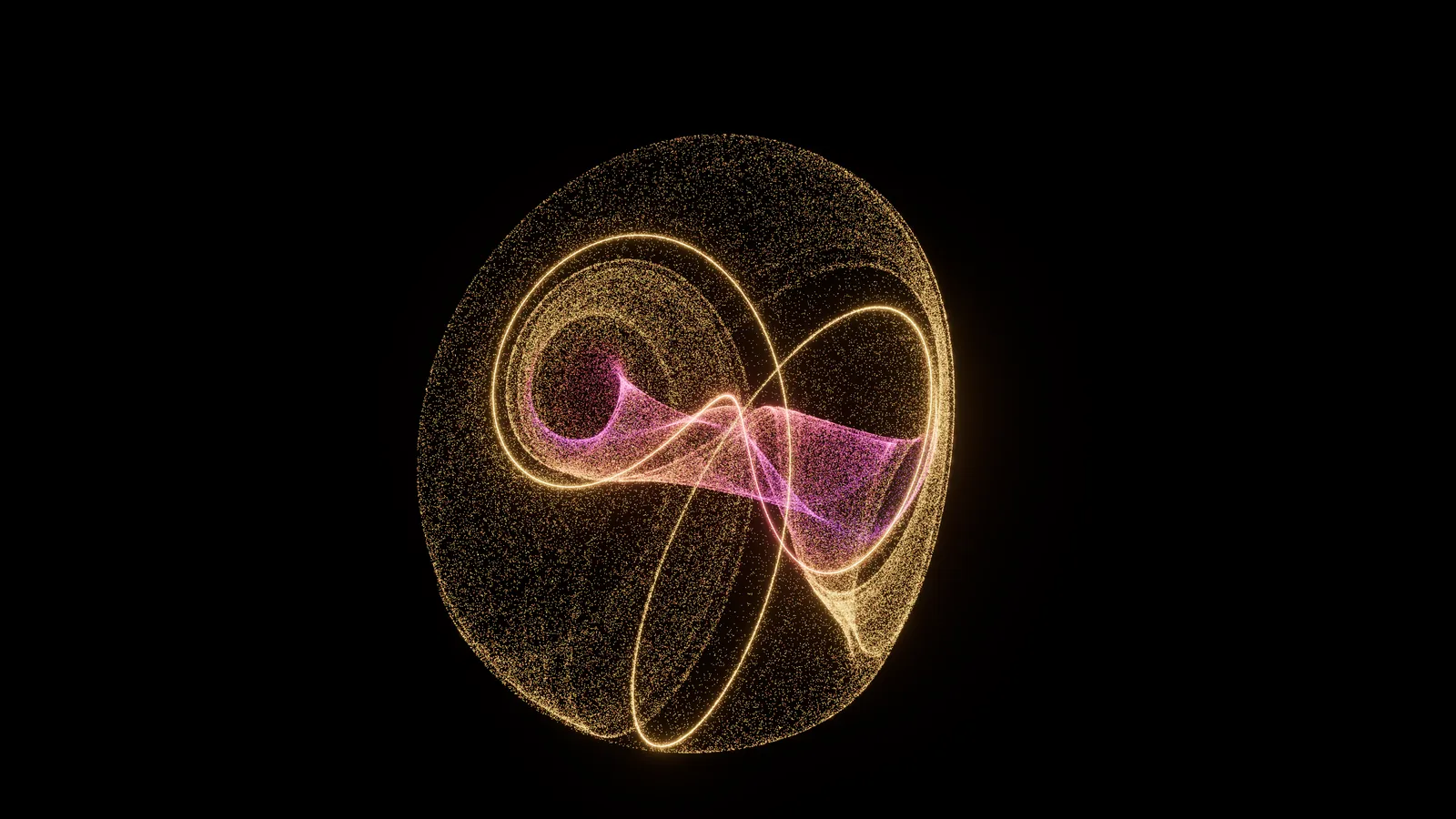
A strange attractor is the shape that a chaotic system's motion is drawn onto: wherever it starts, it ends up tracing the same intricate pattern forever, without ever repeating itself exactly.
The most famous one looks like a pair of butterfly wings. It was found by accident, by a weather scientist, on a computer that filled a room. You can watch it and three others live in the strange attractor visualizer, free in your browser.
What is an attractor?
Start with the plain word. In physics, an attractor is the state a system settles into, whatever it was doing at the start.
A swinging pendulum with friction slows down and stops at the bottom. Start it high or low, fast or slow, and it always ends up hanging still. That resting point is an attractor, the simplest kind.
A healthy heartbeat is another kind. Nudge it and it drifts back to the same steady rhythm, the same loop over and over. That loop is also an attractor.
Points and loops are predictable. A strange attractor is neither.
What makes an attractor strange?
In 1963, the meteorologist Edward Lorenz at MIT was studying a stripped-down model of air heated from below, the kind of rolling motion that drives weather. He boiled it down to three equations:
- dx/dt = σ(y − x)
- dy/dt = x(ρ − z) − y
- dz/dt = xy − βz
with σ = 10, ρ = 28 and β = 8/3. Here x stands for how fast the air turns over, and y and z for differences in temperature.
When Lorenz ran these on his computer, the answer never settled down. It didn't stop at a point, and it didn't fall into a loop. It swung around one lobe a few times, then jumped to the other, then back again, in a pattern that never repeated. Yet it never flew off to infinity either. It stayed on a bounded, two-winged shape. His paper called it "deterministic nonperiodic flow." In 1971, the mathematicians David Ruelle and Floris Takens gave shapes like this their name: strange attractors.
Two things make them strange.
They are chaotic. Start two points a hair apart and they travel together for a while, then drift apart until they have nothing in common. Lorenz had stumbled on this a little earlier with a bigger weather model: he restarted a run from numbers rounded off to three decimal places, and the new run soon looked nothing like the old one. The tiny difference grew until it took over.
They are fractal. Zoom into the wings and you find layers inside layers, sheets folded so finely that the shape is more than a surface but less than a solid. Its fractal dimension is a little over 2.
The butterfly effect
Lorenz later gave a talk titled "Predictability: Does the Flap of a Butterfly's Wings in Brazil Set off a Tornado in Texas?" The name stuck, helped by the shape of his attractor.
This is the real reason weather forecasts lose their grip after a week or two. The equations of the atmosphere are not random, but our measurements of today's weather are never perfect. Small errors grow, and eventually they swamp the forecast.
Chaos is not randomness, though. Lorenz's equations are fixed and fully deterministic. Run them twice from exactly the same start and you get exactly the same path. What runs out is our knowledge of the start.
For decades, nobody could prove that the butterfly on the screen was real and not an artifact of rounding errors in the computer. Proving it was one of the problems the mathematician Steve Smale listed for the 21st century. In 2002, Warwick Tucker settled it with a computer-assisted proof that kept track of every rounding error: the Lorenz equations really do have a strange attractor.
Other strange attractors
Lorenz's is the most famous, but there are many. The visualizer shows four:
- Lorenz: the two-winged butterfly above.
- Aizawa: a sphere-like shell with a tube running through its axis, like an apple with a straw.
- Thomas: found by the biologist René Thomas, with the same rule repeated for each axis, so the shape has a three-way symmetry. Particles wander a lattice of loops.
- Halvorsen: another three-way symmetric system, with three curling lobes like a propeller.
Each one is a set of three simple equations. None of them is hard to write down. What is hard is predicting where any single point will be a minute from now. The same sensitivity makes a double pendulum unpredictable: see double pendulums and chaos.
How the visualizer works
In the Strange Attractors world, a cloud of many thousands of particles each follow the real equations of the Lorenz, Aizawa, Thomas and Halvorsen systems, with the standard constants (σ = 10, ρ = 28, β = 8/3 for Lorenz). Every 15 seconds the flow changes to the next attractor, and the particles fly from one shape to the next. Color shows how fast each particle is moving.
Watch any single particle and it looks lost. Watch all of them and the shape appears, because every path is drawn onto the same attractor. That is the whole idea in one picture: unpredictable in detail, reliable in form.
In the Everdust app, the attractors also move with music if you want: the bass makes the cloud breathe out and brighten. The equations stay the same.
Try it
- In your browser: Strange Attractors, free, no install.
- iPhone, iPad and Apple Vision Pro: Everdust on the App Store, free.
- Android phones and tablets: Everdust on Google Play, free.
- Mac: a free download from everdust.ai (version 1.0.1; macOS 14 Sonoma or later, Apple silicon (M1 or later)), signed and notarized by Apple. The Mac App Store version is in review.
If particles following equations is your thing, you can also turn any photo into living particles in your browser, free.
Sources
- Lorenz, E. N., Deterministic Nonperiodic Flow, Journal of the Atmospheric Sciences 20, 130–141 (1963).
- Ruelle, D. and Takens, F., On the nature of turbulence, Communications in Mathematical Physics 20, 167–192 (1971).
- Tucker, W., A Rigorous ODE Solver and Smale's 14th Problem, Foundations of Computational Mathematics 2, 53–117 (2002).
- Thomas, R., Deterministic chaos seen in terms of feedback circuits, International Journal of Bifurcation and Chaos 9, 1889–1905 (1999).