The Ring Nebula: what a dying star looks like
The Ring Nebula is what's left of a star like the Sun at the end of its life: a glowing shell of gas it puffed off, round a tiny, hot white dwarf. It's about 2,500 light-years away in Lyra and needs a small telescope, where it looks like a tiny gray smoke ring. Below is where it is tonight, computed for your location.
Tonight from where you are
Working it out for your time zone…
Computed in your browser.
The Ring Nebula tonight from four cities
| City | Tonight |
|---|---|
| New York | 5:46 pm to 10:46 pm; best 5:46 pm, 64° up in the west |
| Los Angeles | 5:50 pm to 10:20 pm; best 5:50 pm, 63° up in the west |
| London | 5:39 pm to 11:39 pm; best 5:39 pm, 63° up in the south-west |
| Sydney | not up in the dark hours |
Local times for the night of November 7, 2026, counted as “up” when at least 10° above the horizon after dark. Computed with Astronomy Engine when this page was built; it refreshes every hour.
At a glance
- In the constellation
- Lyra
- High in the evening (9 pm)
- July to October from mid-northern latitudes
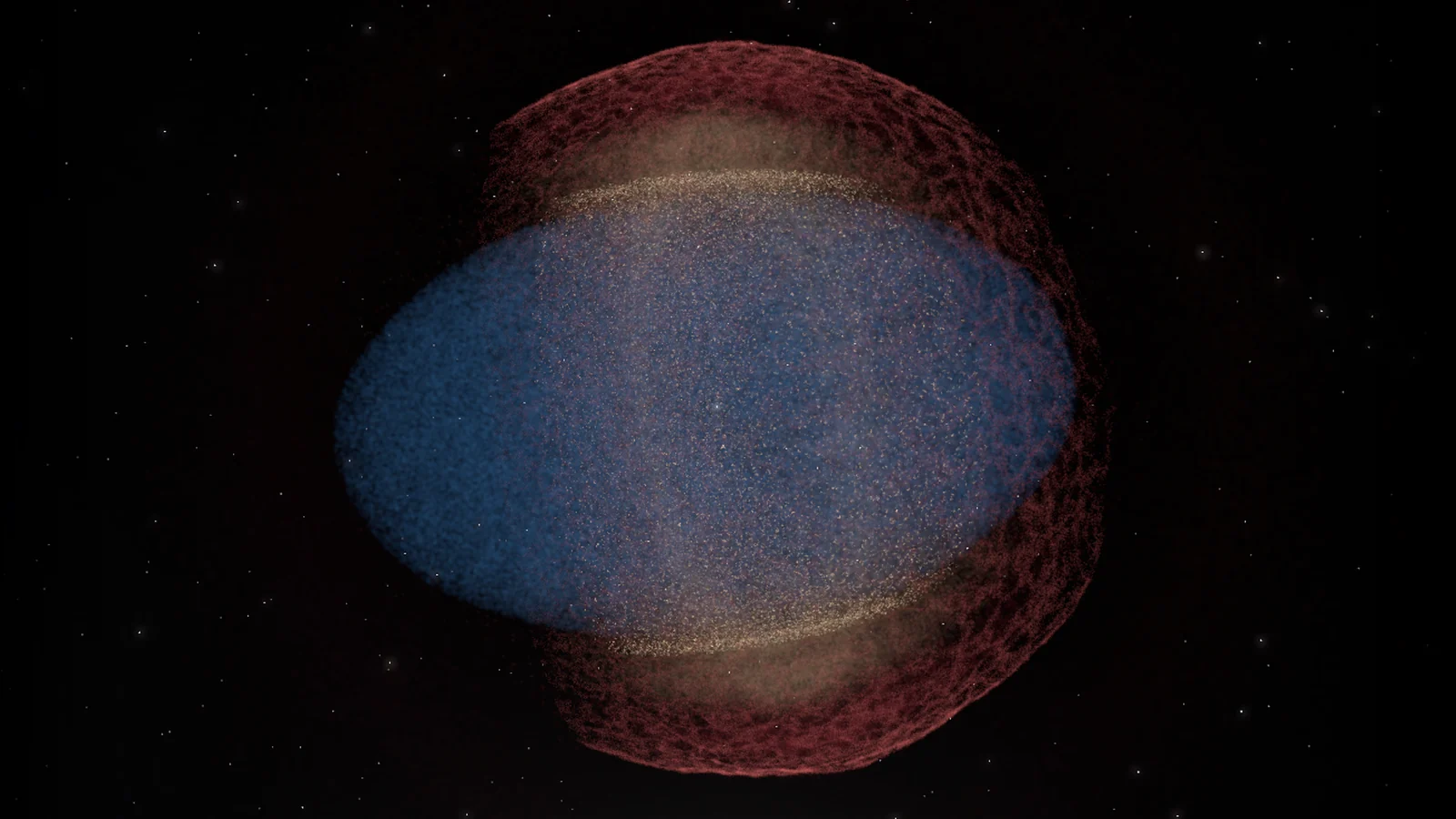
The Ring Nebula: the facts
| Also called | M57, Messier 57, NGC 6720 [2] |
|---|---|
| Distance | about 2,500 light-years [1] |
| Brightness | magnitude 8.8: a small telescope is needed [2] |
| Kind | a planetary nebula, the shed outer layers of a dying star [1] |
How do you find the Ring Nebula?
Start at Vega, the brilliant white star high overhead on northern summer evenings. Just south-east of it is a small parallelogram of stars, the body of Lyra. The Ring sits about halfway between the two stars at the far end of the parallelogram, Sheliak and Sulafat (Beta and Gamma Lyrae). At 50 to 100 times in a small telescope it's a small gray oval with a darker middle.
Will the Sun become a planetary nebula?
Probably, in about five billion years. When a star like the Sun runs out of hydrogen in its core, it swells into a red giant and sheds its outer layers in slow winds. The exposed core, a white dwarf hotter than 100,000 °C, floods the shed gas with ultraviolet light and makes it glow for a few tens of thousands of years before it fades. The name "planetary" is a historical accident: in small telescopes these round glows looked like planets' disks.
The James Webb Space Telescope photographed the Ring in 2023 and showed its shell is not a simple ring but a barrel seen end-on, edged with thousands of small dense knots and faint outer arcs.
Can you see the Ring Nebula in Everdust?
In Everdust's Night Sky on Apple Vision Pro, look at the Ring Nebula and pinch to fly there: you arrive beside its glowing shell, and its own slider replays how the dying star made it. On iPhone and iPad, tap the Ring Nebula in Night Sky to fly there.
Everdust is free on the App Store for Apple Vision Pro, iPhone and iPad. I make Everdust, so weigh that; a phone star map such as Stellarium or Sky Guide will find the Ring Nebula just as well.
Questions people ask
Can I see the Ring Nebula tonight? The Ring Nebula is best soon after dark, 64° up in the west at about 5:46 pm, and sinks out of view by about 10:46 pm. That's for New York on the night of November 7, 2026; this page works it out for your own location too.
When is the best time of year to see the Ring Nebula? From mid-northern latitudes (New York, London) it's high in the evening sky from July to October.
Can you see the Ring Nebula with binoculars? Not really: at magnitude 8.8 and only about an arcminute across, it looks like a faint star in binoculars. A small telescope at 50 times or more shows the ring.
Why is it shaped like a ring? It's thought to be a barrel or a squashed shell that we happen to see end-on, so we look through its thin middle and along its thick edges.
Sources
Positions, rise and set times, brightness, phases and distances on this page are computed with Astronomy Engine (Don Cross, MIT license), accurate to about an arcminute.