Omega Centauri: the biggest star cluster in the Milky Way
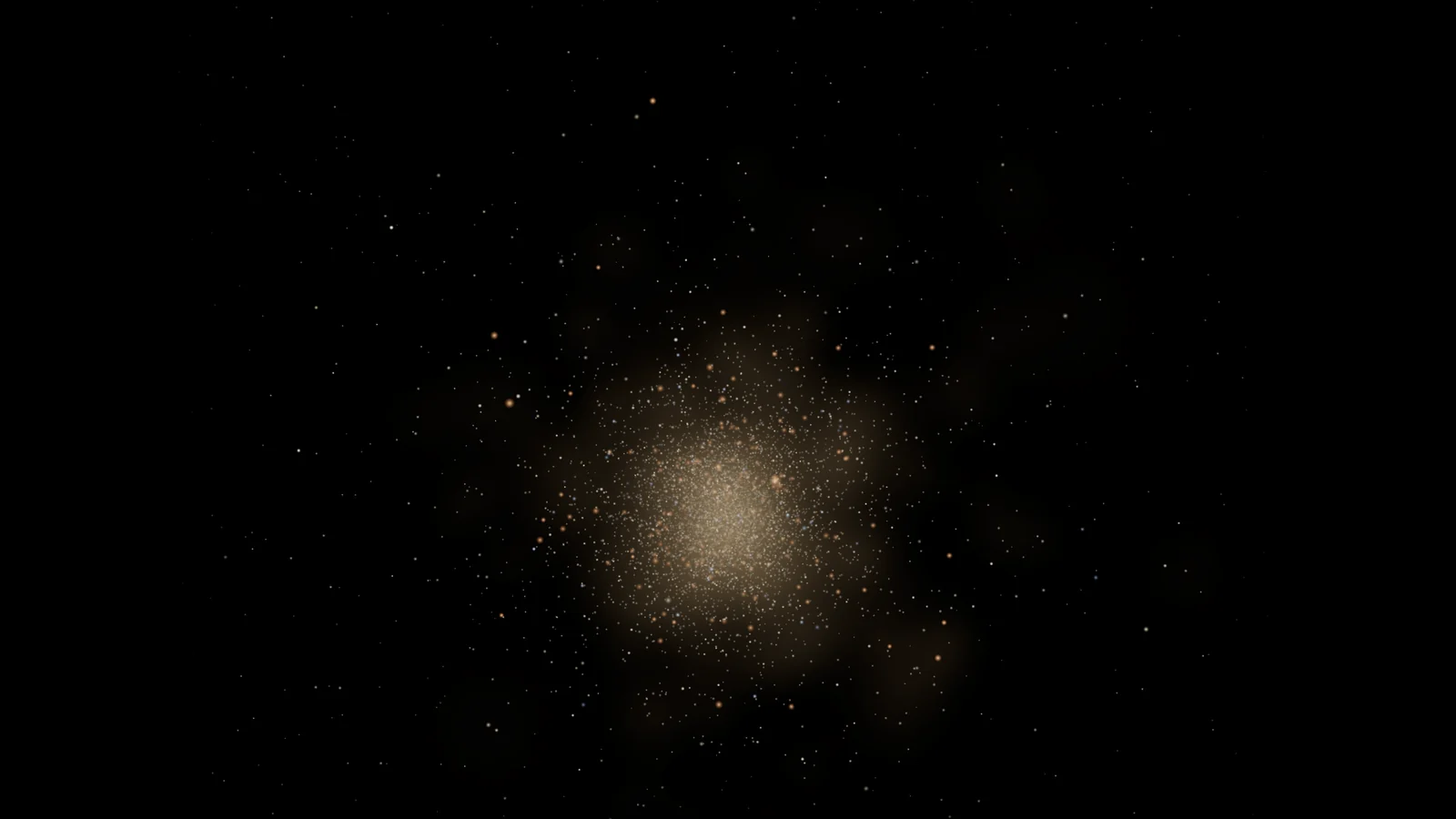
Omega Centauri is the biggest and brightest globular cluster in the Milky Way, a ball of millions of ancient stars about 17,000 light-years away. To the eye it's a fuzzy star; ancient astronomers cataloged it as one, which is how it got a star's name. It's a southern object: below is whether you can see it tonight from your location.
Tonight from where you are
Working it out for your time zone…
Computed in your browser.
Omega Centauri tonight from four cities
| City | Tonight |
|---|---|
| New York | never rises high enough |
| Los Angeles | never rises high enough |
| London | never rises high enough |
| Sydney | 3:38 am to 4:38 am; best 4:38 am, 19° up in the south-east |
Local times for the night of November 7, 2026, counted as “up” when at least 10° above the horizon after dark. Computed with Astronomy Engine when this page was built; it refreshes every hour.
At a glance
- In the constellation
- Centaurus
- High in the evening (9 pm)
- April to August from mid-southern latitudes
Omega Centauri: the facts
| Also called | NGC 5139, Caldwell 80 [1] |
|---|---|
| Distance | about 17,000 light-years [1] |
| Brightness | magnitude 3.9, a fuzzy star to the eye [1] |
| At its heart | fast stars that point to a black hole of at least 8,200 Suns [2] |
Where can you see Omega Centauri from?
It sits far south in the sky, in Centaurus, so it's best from the Southern Hemisphere, where it can pass nearly overhead. From the southern United States, northern Africa or southern Europe it skims low over the southern horizon on spring evenings; from much north of about 35° north it never rises far enough to see. The table below computes it for your place.
To the eye it looks like a slightly fuzzy star. Binoculars show a round glow as big as the full Moon, and a small telescope starts to break its edges into a swarm of separate stars.
Is Omega Centauri the core of a lost galaxy?
Probably. Ordinary globular clusters hold stars that all formed at about the same time; Omega Centauri has several generations of stars with different chemistry, and it's far more massive than the others. Many astronomers think it's the core of a small galaxy that the Milky Way swallowed long ago, its outer stars stripped away.
In 2024 a team using two decades of Hubble images found seven stars near its center moving too fast to stay unless something heavy holds them: a black hole of at least 8,200 times the Sun's mass. If confirmed, it's the best evidence yet for an intermediate-mass black hole, between stellar black holes and the giants in galaxy centers.
Can you see Omega Centauri in Everdust?
In Everdust's Night Sky on Apple Vision Pro, look at Omega Centauri and pinch to fly there: you arrive at the edge of the cluster, its old stars drifting round its center (sped up). On iPhone, iPad and Android, tap Omega Centauri in Night Sky to fly there.
Everdust is free on the App Store for Apple Vision Pro, iPhone and iPad, and on Google Play for Android. I make Everdust, so weigh that; a phone star map such as Stellarium or Sky Guide will find Omega Centauri just as well.
Questions people ask
Can I see Omega Centauri tonight? Omega Centauri never gets high enough to see from New York: it's too far south in the sky. That's for New York on the night of November 7, 2026; this page works it out for your own location too.
When is the best time of year to see Omega Centauri? From mid-southern latitudes (Sydney) it's high in the evening from April to August.
Can you see Omega Centauri from the United States? From the southern states, yes: low over the southern horizon on spring evenings, from about latitude 35° north and southward, given a clear flat horizon. From the northern states it never rises high enough.
What is a globular cluster? A tight, round ball of hundreds of thousands to millions of old stars, bound by their own gravity and orbiting the center of a galaxy. The Milky Way has well over a hundred of them; most formed over 10 billion years ago.
Sources
- NASA Hubble: Caldwell 80 (Omega Centauri)
- Häberle et al. 2024, Fast-moving stars around an intermediate-mass black hole in ω Centauri, Nature 631, 285
Positions, rise and set times, brightness, phases and distances on this page are computed with Astronomy Engine (Don Cross, MIT license), accurate to about an arcminute.