The Carina Nebula: the southern sky's great star nursery
The Carina Nebula is a vast cloud of glowing gas in the southern Milky Way, about 7,500 light-years away and larger in the sky than the Orion Nebula. It's bright enough to see with your eyes alone from the Southern Hemisphere, and it holds Eta Carinae, one of the most massive and unstable stars known. Below is whether you can see it tonight from your location.
Tonight from where you are
Working it out for your time zone…
Computed in your browser.
The Carina Nebula tonight from four cities
| City | Tonight |
|---|---|
| New York | never rises high enough |
| Los Angeles | never rises high enough |
| London | never rises high enough |
| Sydney | 11:18 pm to 4:38 am; best 4:38 am, 45° up in the south-east |
Local times for the night of November 7, 2026, counted as “up” when at least 10° above the horizon after dark. Computed with Astronomy Engine when this page was built; it refreshes every hour.
At a glance
- In the constellation
- Carina
- High in the evening (9 pm)
- February to June from mid-southern latitudes
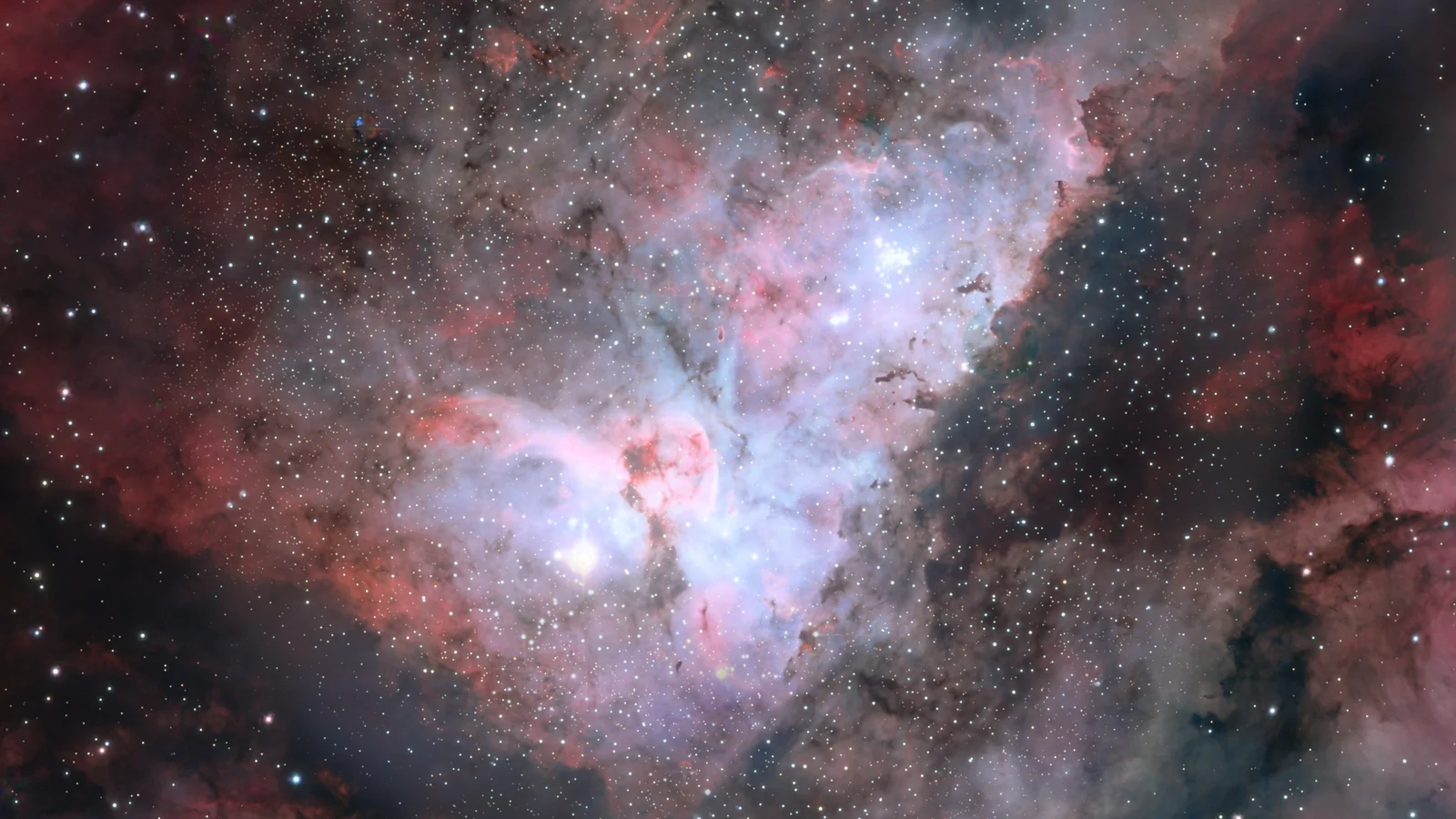
The Carina Nebula: the facts
| Also called | NGC 3372 [1] |
|---|---|
| Distance | about 7,500 light-years [2] |
| Brightest star | Eta Carinae, a pair of massive stars that erupted in the 1840s [3] |
| Sky | far south: best from the Southern Hemisphere [1] |
Where is the Carina Nebula in the sky?
In the constellation Carina, along the southern Milky Way, not far from the Southern Cross. From Australia, South America or southern Africa it's high in the evening sky in the southern autumn, a glowing patch you can see with your eyes alone from a dark site. From most of the Northern Hemisphere it never rises; the table below computes it for your place.
Binoculars show a bright glow cut by a dark V-shaped lane of dust, with orange Eta Carinae near its heart.
What is Eta Carinae, and will it explode?
A pair of very massive stars, the bigger one perhaps a hundred times the Sun's mass. In the 1840s it flared in the Great Eruption, briefly becoming the second-brightest star in the night sky, and threw off a double cloud of gas, the Homunculus, that Hubble has photographed in detail. Stars that massive end as supernovas, but nobody can say when; it could be tomorrow or in a hundred thousand years.
Can you see the Carina Nebula in Everdust?
In Everdust's Night Sky on Apple Vision Pro, look at the Carina Nebula and pinch to fly there: you arrive inside ESO's photograph of the nebula, given depth, with its wider clouds around you. On iPhone, iPad and Android, tap the Carina Nebula in Night Sky to fly there.
Everdust is free on the App Store for Apple Vision Pro, iPhone and iPad, and on Google Play for Android. I make Everdust, so weigh that; a phone star map such as Stellarium or Sky Guide will find the Carina Nebula just as well.
Questions people ask
Can I see the Carina Nebula tonight? The Carina Nebula never gets high enough to see from New York: it's too far south in the sky. That's for New York on the night of November 7, 2026; this page works it out for your own location too.
When is the best time of year to see the Carina Nebula? From mid-southern latitudes (Sydney) it's high in the evening from February to June.
Can you see the Carina Nebula with the naked eye? Yes, from the Southern Hemisphere under a dark sky: it's a bright glowing patch in the southern Milky Way. From mid-northern latitudes it never rises.
How big is the Carina Nebula? In the sky it spans about two degrees, four times the width of the full Moon, larger than the Orion Nebula.
Sources
- ESO eso0905: the Carina Nebula from the Wide Field Imager
- NASA Hubble: the Carina Nebula
- Chandra: Eta Carinae (2023)
Positions, rise and set times, brightness, phases and distances on this page are computed with Astronomy Engine (Don Cross, MIT license), accurate to about an arcminute.