Jupiter tonight: its four big moons and where to look
Jupiter is usually the brightest star-like point in the night sky after Venus, a steady white light. Hold binoculars still and you'll see up to four tiny moons lined up beside it, the same ones Galileo saw in 1610. Below: where it is tonight from your location, and which moon is which, computed live.
Tonight from where you are
Working it out for your time zone…
Computed in your browser.
Jupiter tonight from four cities
| City | Tonight | Rises / sets |
|---|---|---|
| New York | 12:44 am to 6:04 am; best 6:04 am, 62° up in the south | 11:45 pm / 1:27 pm |
| Los Angeles | 12:50 am to 5:50 am; best 5:50 am, 68° up in the south-east | 11:52 pm / 1:12 pm |
| London | 12:39 am to 6:29 am; best 6:29 am, 52° up in the south | 11:26 pm / 1:56 pm |
| Sydney | 3:06 am to 5:16 am; best 5:16 am, 32° up in the north-east | 2:09 am / 12:58 pm |
Local times for the night of November 7, 2026, counted as “up” when at least 10° above the horizon after dark. Computed with Astronomy Engine when this page was built; it refreshes every hour.
Right now
- In the constellation
- Leo
- Brightness
- magnitude -2.1 (lower is brighter)
- Distance from Earth
- 806.6 million km
- Its light takes
- 45 minutes to reach you
- Next opposition (closest and brightest)
- February 11, 2027
Jupiter’s moons, west to east, at 6:04 am New York time
IoCallisto (in front)JupiterEuropaGanymede
As seen in binoculars or a telescope with north up; many telescopes flip the view.
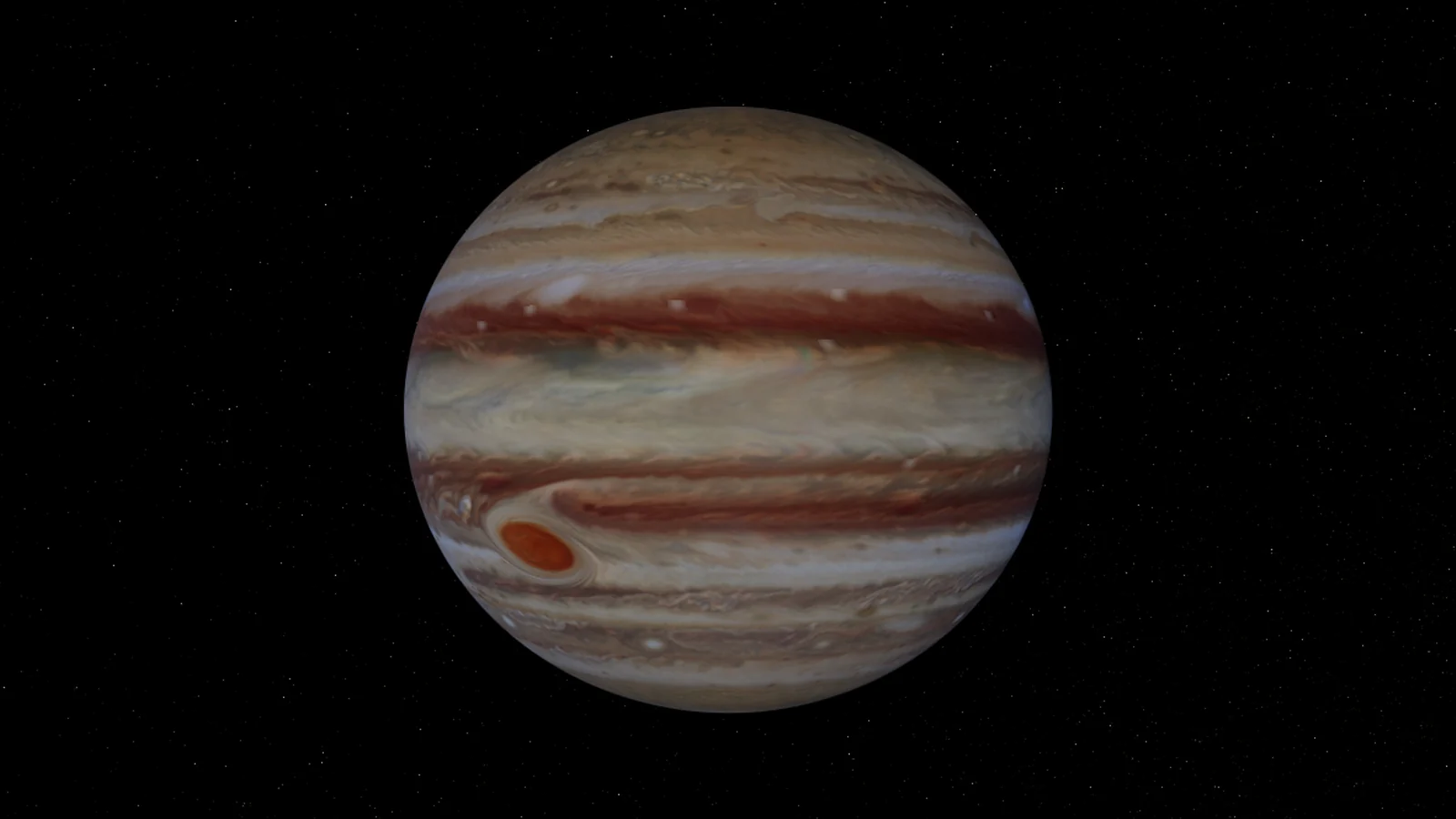
Jupiter: the facts
| Width | 142,984 km at the equator, about 11 Earths [1] |
|---|---|
| A day | 9 hours 56 minutes, the shortest of any planet [1] |
| A year | 11.9 Earth years [1] |
| Mass | more than twice all the other planets put together [2] |
| Great Red Spot | a storm wider than Earth, watched since the 1800s and slowly shrinking [3] |
How do you find Jupiter tonight?
Jupiter outshines every star, so when it's up it's hard to miss: a brilliant, steady, cream-white point. Only Venus (low in the twilight) and the Moon are brighter. Like every planet it stays near the path the Sun and Moon follow, and it takes about 12 years to circle the sky, so it spends about a year in each zodiac constellation.
The table below gives its direction and height tonight, computed for your location, and its magnitude: the more negative, the brighter.
Which of Jupiter's moons can you see tonight?
Io, Europa, Ganymede and Callisto are bright enough for steadily held binoculars: tiny star-like dots in a line either side of the planet. Galileo found them in January 1610, and watching them circle Jupiter helped convince him that not everything goes round the Earth.
They move fast enough to change places from hour to hour. Io goes round in under two days, Callisto in about 17. Sometimes one is missing because it's passing in front of Jupiter or hidden behind it. The diagram below shows their order tonight, computed from their orbits.
Is the Great Red Spot still there?
Yes. The Great Red Spot is a storm bigger than Earth that has been watched continuously since the 1800s. It's shrinking: observers in the late 1800s put it at about 41,000 km across, and in 2014 Hubble measured it at about 16,500 km, roughly 1.3 times Earth's width. Nobody knows yet whether it will vanish or settle at a smaller size.
You need a telescope of about 10 cm or more and steady air, and Jupiter has to be turned the right way: it spins in under ten hours, so the spot is on the side facing us for only a few hours at a time.
Can you see Jupiter in Everdust?
In Everdust's Night Sky on Apple Vision Pro, look at Jupiter and pinch to fly there. Jupiter as it is today wraps Hubble's latest map round the planet, with the four big moons where they are tonight and their names beside them. On iPhone and iPad, tap Jupiter in Night Sky to fly there.
Everdust is free on the App Store for Apple Vision Pro, iPhone and iPad; on Android, Tonight’s Sky in Everdust for Android (free on Google Play) shows where Jupiter is tonight from where you stand. I make Everdust, so weigh that; a phone star map such as Stellarium or Sky Guide will find Jupiter just as well.
Questions people ask
Can I see Jupiter tonight? Jupiter is up from about 12:44 am until dawn, climbing to 62° up in the south by about 6:04 am. That's for New York on the night of November 7, 2026; this page works it out for your own location too.
Where is Jupiter in the sky right now? Jupiter is in Leo, shining at magnitude -2.1. Its light takes 45 minutes to reach Earth.
Can you see Jupiter's moons with binoculars? Yes. Held steady, or on a tripod, ordinary binoculars show up to four of them, Io, Europa, Ganymede and Callisto, as tiny dots in a line beside the planet.
Why is Jupiter so bright? It's huge, about 11 times wider than Earth, and its pale clouds reflect sunlight well. Only the Moon and Venus outshine it in the night sky.
Can you see the Great Red Spot with a small telescope? Sometimes. It takes about 10 cm of aperture, steady air and the right hour, because Jupiter turns in under ten hours and the spot faces us for only part of that. It looks pale salmon or tan rather than red.
Sources
- NASA NSSDC: Jupiter fact sheet
- NASA: Jupiter facts
- NASA: Hubble shows Jupiter's Great Red Spot is smaller than ever measured (2014)
- Hubble OPAL (Outer Planet Atmospheres Legacy) program, STScI MAST
Positions, rise and set times, brightness, phases and distances on this page are computed with Astronomy Engine (Don Cross, MIT license), accurate to about an arcminute.