Mars tonight: where to find the red planet
Mars is the orange-red point of light that doesn't twinkle, and its brightness swings more than any other planet's: it's dazzling for a few weeks every two years or so, around opposition, and modest the rest of the time. Below is where it is tonight, computed for your location.
Tonight from where you are
Working it out for your time zone…
Computed in your browser.
Mars tonight from four cities
| City | Tonight | Rises / sets |
|---|---|---|
| New York | 12:34 am to 6:04 am; best 6:04 am, 65° up in the south | 11:27 pm / 1:24 pm |
| Los Angeles | 12:30 am to 5:50 am; best 5:50 am, 70° up in the south-east | 11:36 pm / 1:09 pm |
| London | 12:19 am to 6:29 am; best 6:29 am, 54° up in the south | 11:04 pm / 1:57 pm |
| Sydney | 3:06 am to 5:16 am; best 5:16 am, 32° up in the north-east | 2:05 am / 12:43 pm |
Local times for the night of November 7, 2026, counted as “up” when at least 10° above the horizon after dark. Computed with Astronomy Engine when this page was built; it refreshes every hour.
Right now
- In the constellation
- Leo
- Brightness
- magnitude 0.8 (lower is brighter)
- Distance from Earth
- 205.6 million km
- Its light takes
- 11 minutes to reach you
- Next opposition (closest and brightest)
- February 19, 2027
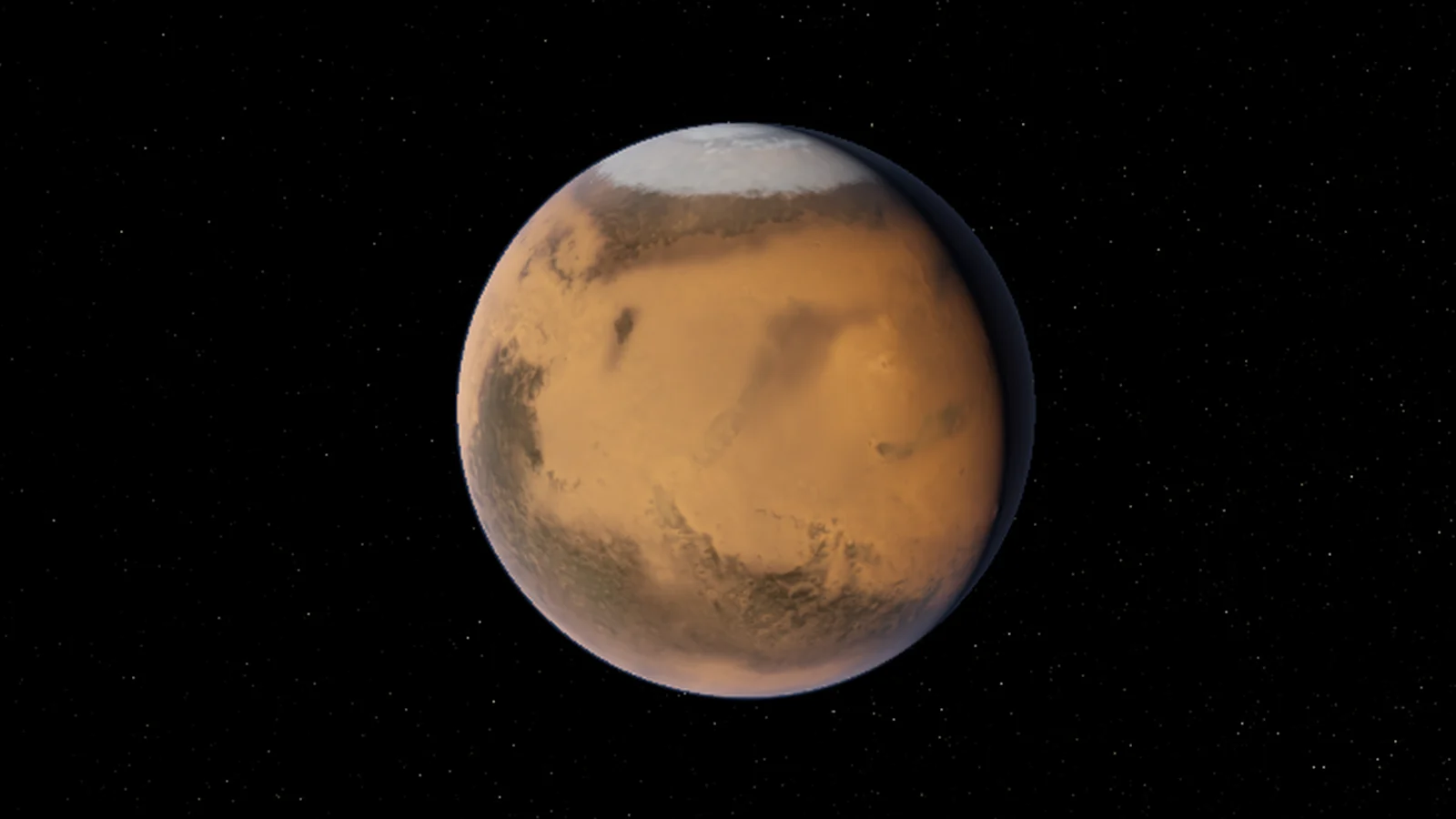
Mars: the facts
| Width | 6,792 km, about half of Earth's [1] |
|---|---|
| A day | 24 hours 37 minutes [1] |
| A year | 687 Earth days [1] |
| Average distance from the Sun | 228 million km (1.5 times Earth's) [1] |
| Moons | two small ones, Phobos and Deimos [1] |
How do you find Mars tonight?
Look along the path the Sun and Moon follow for a steady point with a clear orange tint; nothing else in the sky has that color except a few reddish stars, such as Antares and Aldebaran, which twinkle. The table below gives its direction and height tonight, computed for your location.
Earth laps Mars about every 26 months. When it does, Mars is opposite the Sun in our sky, up all night and at its closest and brightest: that's opposition. Between oppositions Mars drifts far away, to the other side of the Sun, and fades to an ordinary-looking star. Its next opposition is computed in the box below.
Why is Mars red?
Its surface is covered in fine dust rich in iron oxide, the same compound as rust. Winds lift the dust into the thin air, so even the sky on Mars is a butterscotch color by day. Every few Martian years, dust storms spread until they cover the whole planet and hide its markings from telescopes on Earth.
What can you see on Mars with a small telescope?
Only near opposition, when Mars is close: then a telescope of 10 cm or more shows a small orange disk with darker patches, such as Syrtis Major, and a white polar cap of frozen water and carbon dioxide that grows and shrinks with the Martian seasons. Mars turns once in a little over 24 hours, so on successive nights at the same hour you see almost the same face, slowly shifting.
Away from opposition Mars is only a few arcseconds across, too small to show much detail even in large backyard telescopes.
Can you see Mars in Everdust?
In Everdust's Night Sky on Apple Vision Pro, look at Mars and pinch to fly there. Mars Today shows the planet with this season's polar frost, clouds and haze, and Phobos and Deimos where they are tonight. On iPhone and iPad, tap Mars in Night Sky to fly there.
Everdust is free on the App Store for Apple Vision Pro, iPhone and iPad; on Android, Tonight’s Sky in Everdust for Android (free on Google Play) shows where Mars is tonight from where you stand. I make Everdust, so weigh that; a phone star map such as Stellarium or Sky Guide will find Mars just as well.
Questions people ask
Can I see Mars tonight? Mars is up from about 12:34 am until dawn, climbing to 65° up in the south by about 6:04 am. That's for New York on the night of November 7, 2026; this page works it out for your own location too.
Where is Mars in the sky right now? Mars is in Leo, shining at magnitude 0.8. Its light takes 11 minutes to reach Earth.
Why does Mars change brightness so much? Because its distance from Earth changes so much: from under 60 million km at a close opposition to about 400 million km when it's on the far side of the Sun. At its brightest it outshines everything but the Moon and Venus; at its faintest it looks like an ordinary star.
How long does it take to get to Mars? About seven months for a spacecraft. Missions launch when Earth and Mars line up, about every 26 months, and coast on a curved path round the Sun rather than flying straight.
Does Mars have moons? Two small ones, Phobos and Deimos, probably captured asteroids or debris from an ancient impact. Phobos is about 22 km across and Deimos about 12 km; both need a large telescope to see.
Sources
Positions, rise and set times, brightness, phases and distances on this page are computed with Astronomy Engine (Don Cross, MIT license), accurate to about an arcminute.