How to see the Andromeda Galaxy tonight
The Andromeda Galaxy is the most distant thing most people can see with their eyes alone: a faint oval glow about 2.5 million light-years away, a spiral galaxy a little larger than our own Milky Way. From a dark place in the Northern Hemisphere's autumn it's high overhead in the evening. Below is where it is tonight, computed for your location.
Tonight from where you are
Working it out for your time zone…
Computed in your browser.
The Andromeda Galaxy tonight from four cities
| City | Tonight |
|---|---|
| New York | 5:46 pm to 5:16 am; best 9:26 pm, 89° up in the north-east |
| Los Angeles | 5:50 pm to 4:40 am; best 9:30 pm, 83° up in the north |
| London | 5:39 pm to 5:49 am; best 9:39 pm, 80° up in the south |
| Sydney | 8:38 pm to 12:18 am; best 10:28 pm, 15° up in the north |
Local times for the night of November 7, 2026, counted as “up” when at least 10° above the horizon after dark. Computed with Astronomy Engine when this page was built; it refreshes every hour.
At a glance
- In the constellation
- Andromeda
- High in the evening (9 pm)
- September to January from mid-northern latitudes
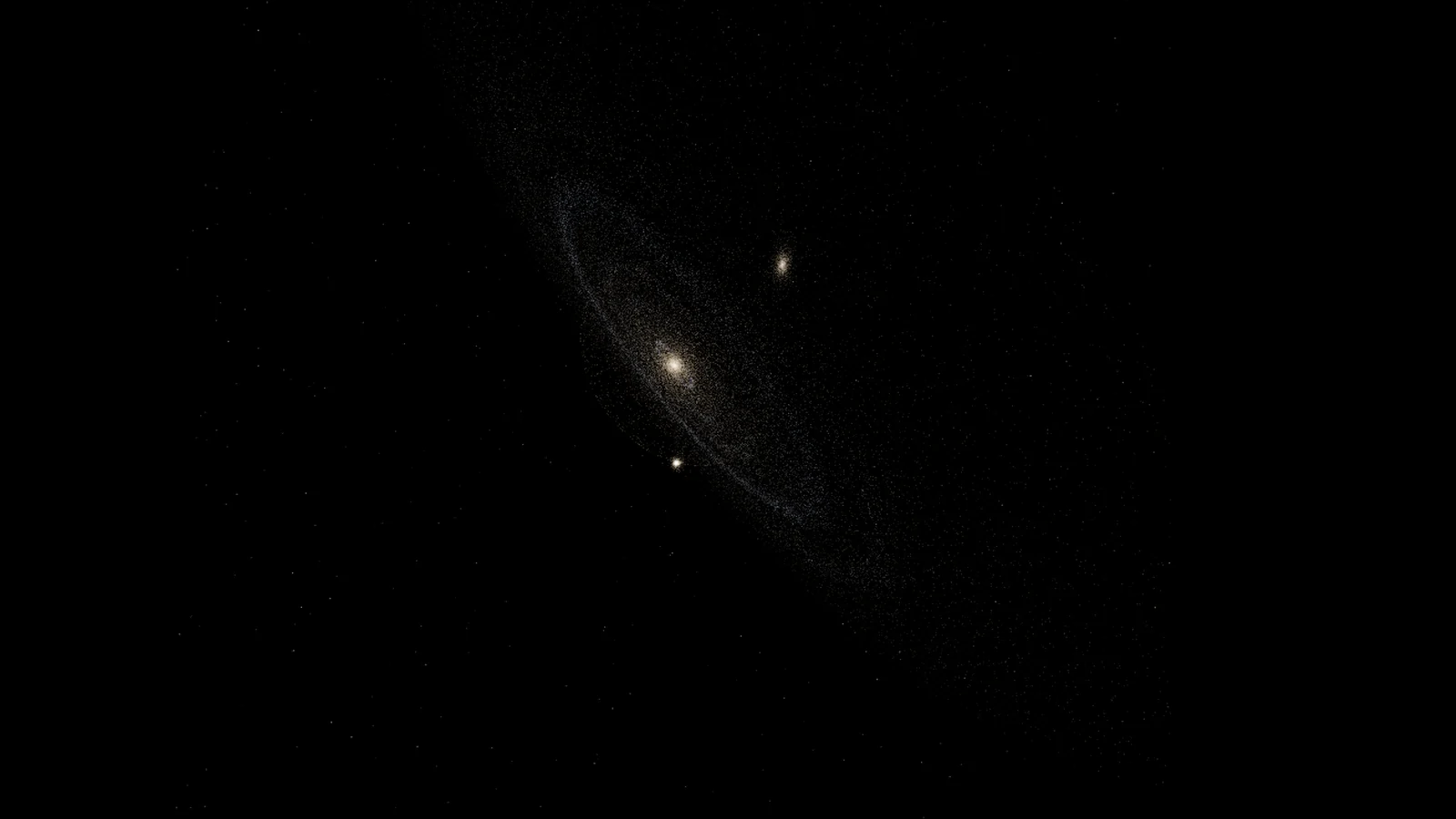
The Andromeda Galaxy: the facts
| Also called | M31, Messier 31, NGC 224 [2] |
|---|---|
| Distance | about 2.5 million light-years [1] |
| Size in the sky | about 3° long in long exposures, six full Moons side by side [2] |
| Brightness | magnitude 3.4, visible to the eye from a dark sky [1] |
| Heading our way | at about 110 km a second [3] |
How do you find the Andromeda Galaxy?
Find the W of Cassiopeia, or the Great Square of Pegasus. From the corner of the Square, follow the chain of stars that makes up Andromeda two stars along to Mirach, then turn north past a fainter star; just beyond it is a small elongated smudge. That's the galaxy's bright core. Look slightly to one side of it (averted vision) and it grows.
You need a dark sky away from city lights and no bright Moon. Binoculars show it easily as a long oval glow. Only long-exposure photographs show the spiral arms and dust lanes; to the eye it's never more than a soft gray haze.
Will the Andromeda Galaxy collide with the Milky Way?
Possibly, but it's less certain than it once seemed. Andromeda is approaching at about 110 km a second. In 2012, Hubble measurements of its sideways motion suggested a head-on collision in about four billion years. A 2025 study using newer Gaia and Hubble data, and the pull of the other galaxies nearby, put the chance of a merger within the next ten billion years at about even.
If they do merge, the stars themselves will almost never hit each other: the gaps between stars are enormous compared with the stars. Gravity will reshape both galaxies into long tidal tails and, eventually, one big elliptical galaxy. You can watch two galaxies do this in a galaxy collision simulator.
Can you see the Andromeda Galaxy in Everdust?
In Everdust's Night Sky on Apple Vision Pro, look at the Andromeda Galaxy and pinch to fly there. Andromeda today stands where it hangs in your sky, its disk turning at its measured rotation (sped up); a time slider jumps to the collision billions of years from now. On iPhone, iPad and Android, tap the Andromeda Galaxy in Night Sky to fly there.
Everdust is free on the App Store for Apple Vision Pro, iPhone and iPad, and on Google Play for Android. I make Everdust, so weigh that; a phone star map such as Stellarium or Sky Guide will find the Andromeda Galaxy just as well.
- What happens when the Milky Way and Andromeda collide
- Galaxy collision simulator, free in your browser
Questions people ask
Can I see the Andromeda Galaxy tonight? The Andromeda Galaxy is up from about 5:46 pm to 5:16 am, highest at about 9:26 pm, 89° up in the north-east. That's for New York on the night of November 7, 2026; this page works it out for your own location too.
When is the best time of year to see the Andromeda Galaxy? From mid-northern latitudes (New York, London) it's high in the evening sky from September to January.
Can you see the Andromeda Galaxy with the naked eye? Yes, from a dark site without moonlight: it's a faint oval smudge near the star Mirach in the constellation Andromeda. From a city it's usually invisible without binoculars.
How far away is the Andromeda Galaxy? About 2.5 million light-years. The light you see left it 2.5 million years ago, before modern humans existed.
Is the Andromeda Galaxy bigger than the Milky Way? Its disk is somewhat larger, but the two galaxies are thought to have broadly similar masses once their dark matter is counted; estimates differ.
Sources
- NASA Hubble: Messier 31 (the Andromeda Galaxy)
- SEDS Messier catalog: Messier 31
- NASA: Hubble shows Milky Way is destined for head-on collision (2012)
- Sawala et al. 2025, No certainty of a Milky Way–Andromeda collision, Nature Astronomy 9, 1206
- Courteau et al. 2011, The luminosity profile and structural parameters of the Andromeda galaxy, The Astrophysical Journal 739, 20
Positions, rise and set times, brightness, phases and distances on this page are computed with Astronomy Engine (Don Cross, MIT license), accurate to about an arcminute.