What the Orion Nebula looks like today
The Orion Nebula is a glowing cloud of gas about 1,350 light-years away where new stars and planets are forming right now. You can see it with your eyes alone: it's the fuzzy middle "star" in the sword that hangs below Orion's belt. Hubble's photographs show what it looks like today, in light that left it around the 7th century.
Tonight from where you are
Working it out for your time zone…
Computed in your browser.
The Orion Nebula tonight from four cities
| City | Tonight |
|---|---|
| New York | 9:36 pm to 5:26 am; best 2:26 am, 44° up in the south |
| Los Angeles | 9:30 pm to 5:20 am; best 2:20 am, 51° up in the south |
| London | 10:09 pm to 5:49 am; best 2:29 am, 33° up in the south |
| Sydney | 9:58 pm to 4:38 am; best 3:18 am, 62° up in the north |
Local times for the night of November 7, 2026, counted as “up” when at least 10° above the horizon after dark. Computed with Astronomy Engine when this page was built; it refreshes every hour.
At a glance
- In the constellation
- Orion
- High in the evening (9 pm)
- January to March, from either hemisphere
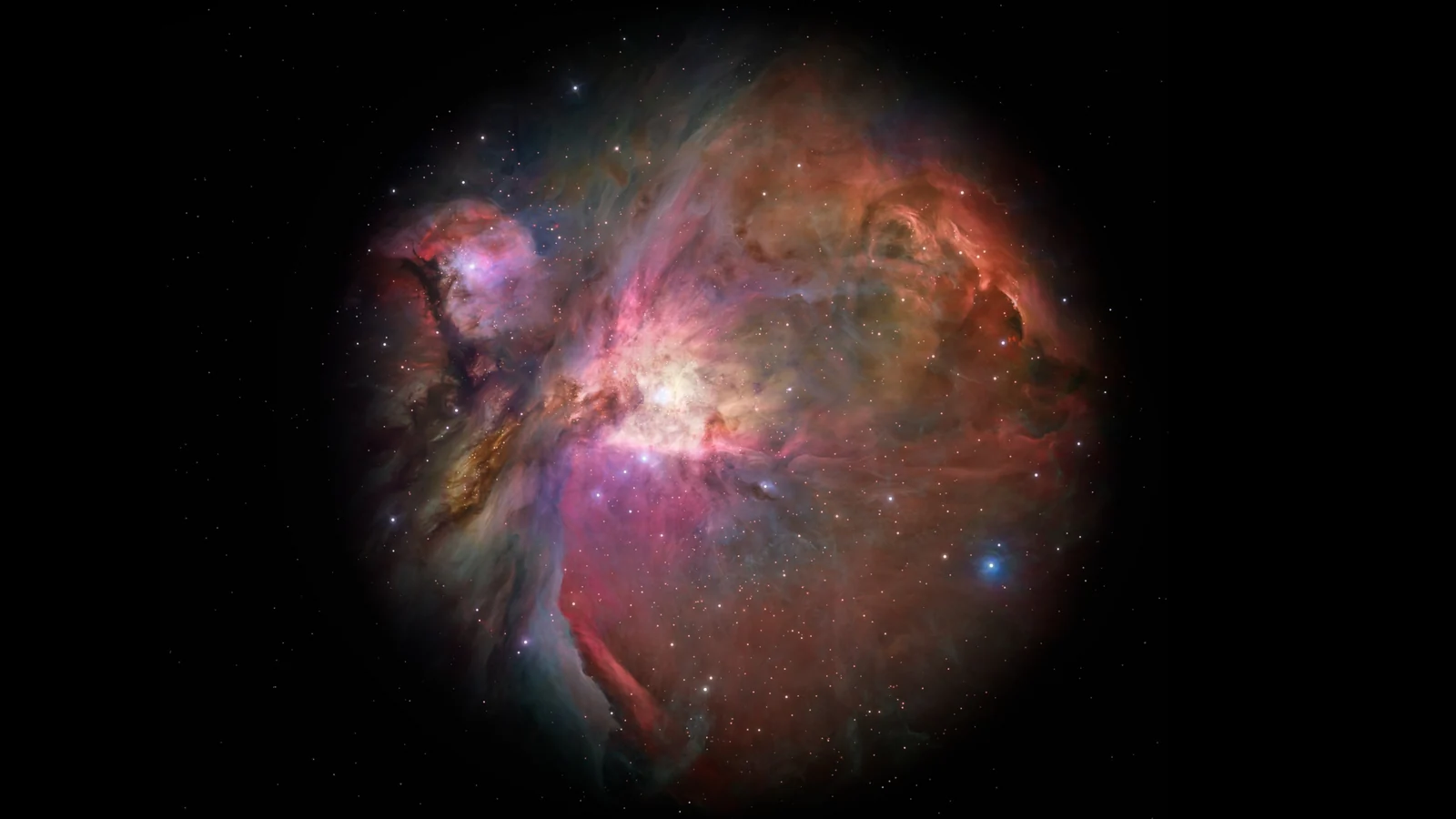
The Orion Nebula: the facts
| Also called | M42, Messier 42, NGC 1976 [1] |
|---|---|
| Distance | about 1,350 light-years (414 parsecs, measured by radio parallax) [4] |
| Size in the sky | about 85 by 60 arcminutes in long exposures, wider than two full Moons side by side [1] |
| Brightness | magnitude 4: visible to the eye from a dark sky [2] |
| Lit by | the Trapezium, a tight group of hot young stars at its heart [3] |
Where is the Orion Nebula in the sky?
Find Orion's belt, the three bright stars in a short straight row. Below the belt (south of it) hangs a fainter line of three stars, the sword. The middle one isn't a star at all: look closely, or with binoculars, and it's a small misty glow. That's the Orion Nebula.
Orion is a winter constellation in the Northern Hemisphere and a summer one in the Southern. From Australia or South America, Orion stands upside down, so the sword points up from the belt. The table below gives its direction and height tonight, computed for your location.
What are you actually seeing?
The nebula is the lit-up surface of a much larger dark cloud of gas and dust. A handful of massive young stars, the Trapezium, formed on its near side and flood it with ultraviolet light. That light strips electrons from hydrogen and oxygen atoms, and when they recombine they glow: hydrogen mostly red, oxygen blue-green. The stars have hollowed out a bowl in the cloud, and we look into it from the open side.
It's the nearest big star nursery to Earth, so it's where astronomers study how stars like the Sun are born. Hubble found many young stars there still wrapped in disks of dust and gas, which astronomers call proplyds (protoplanetary disks): planetary systems in the making. Most of the stars in the nebula's cluster are only a million or so years old, babies next to the Sun's 4.6 billion.
Can you see the Orion Nebula with binoculars or a small telescope?
Yes, and it's one of the best things to point them at. To the eye it's a fuzzy star. Binoculars show a soft glowing cloud with a brighter core. A small telescope at around 50 times shows the four stars of the Trapezium packed together at the center and the dark lane of dust that cuts into the glow.
Don't expect the pink of the photographs. At night your eyes switch to rod cells, which don't see color, so the nebula looks gray or faintly green-gray even in a big telescope. Cameras collect light for minutes at a time and record the red of hydrogen that the eye misses.
Can you see the Orion Nebula in Everdust?
In Everdust's Night Sky on Apple Vision Pro, look at the Orion Nebula and pinch to fly there: you arrive inside Hubble's photograph, given the nebula's depth, so you can lean in and look round the Trapezium. On iPhone, iPad and Android, tap the Orion Nebula in Night Sky to fly there.
Everdust is free on the App Store for Apple Vision Pro, iPhone and iPad, and on Google Play for Android. I make Everdust, so weigh that; a phone star map such as Stellarium or Sky Guide will find the Orion Nebula just as well.
Questions people ask
Can I see the Orion Nebula tonight? The Orion Nebula is up from about 9:36 pm to 5:26 am, highest at about 2:26 am, 44° up in the south. That's for New York on the night of November 7, 2026; this page works it out for your own location too.
When is the best time of year to see the Orion Nebula? It's high in the evening sky from January to March, from both hemispheres (checked for New York, London and Sydney at 9 pm).
How far away is the Orion Nebula? About 1,350 light-years (414 parsecs). Radio astronomers measured it by parallax in 2007, watching young stars in the nebula shift against far-off quasars as the Earth goes round the Sun. Older books and many web pages still give the earlier estimate of about 1,500 light-years.
Can you see the Orion Nebula with the naked eye? Yes, from a reasonably dark place. It's the fuzzy middle star of Orion's sword, below the three belt stars. Binoculars show it as a small glowing cloud.
Why does the Orion Nebula look pink in photos but gray through a telescope? Its glow is mostly red light from hydrogen. The eye's night vision doesn't see color, so through a telescope it looks gray or faintly green; a camera collects light for minutes and records the red.
Is the Orion Nebula where stars are being born? Yes. It's the nearest large star-forming region to Earth. Hubble has photographed young stars there still surrounded by the disks of gas and dust that planets form from.
Sources
- SEDS Messier catalog: Messier 42
- NASA Hubble: Messier 42 (the Orion Nebula)
- ESA/Hubble heic0601: Hubble's sharpest view of the Orion Nebula
- Menten et al. 2007, The distance to the Orion Nebula, Astronomy & Astrophysics 474, 515
- O'Dell & Wen 1994, Post-refurbishment Hubble images of the core of the Orion Nebula: proplyds, The Astrophysical Journal 436, 194
Positions, rise and set times, brightness, phases and distances on this page are computed with Astronomy Engine (Don Cross, MIT license), accurate to about an arcminute.