The Moon tonight: phase, moonrise and what you're seeing
The Moon's phase tells you when it's up: a full Moon rises at sunset and is up all night, a first quarter is high at sunset, a last quarter rises around midnight. Tonight's phase, moonrise and moonset for your location are computed live below.
Tonight from where you are
Working it out for your time zone…
Computed in your browser.
The Moon tonight from four cities
| City | Tonight | Rises / sets |
|---|---|---|
| New York | not up in the dark hours | 6:01 am / 4:01 pm |
| Los Angeles | not up in the dark hours | 5:51 am / 4:18 pm |
| London | not up in the dark hours | 6:23 am / 3:25 pm |
| Sydney | not up in the dark hours | 5:14 am / 7:37 pm |
Local times for the night of November 7, 2026, counted as “up” when at least 10° above the horizon after dark. Computed with Astronomy Engine when this page was built; it refreshes every hour.
Right now
- Phase
- waning crescent, 2% lit
- In the constellation
- Virgo
- Distance from Earth
- 394,025 km
- Next full Moon
- November 24, 2026, 2:54 pm UTC
- Next new Moon
- November 9, 2026, 7:02 am UTC
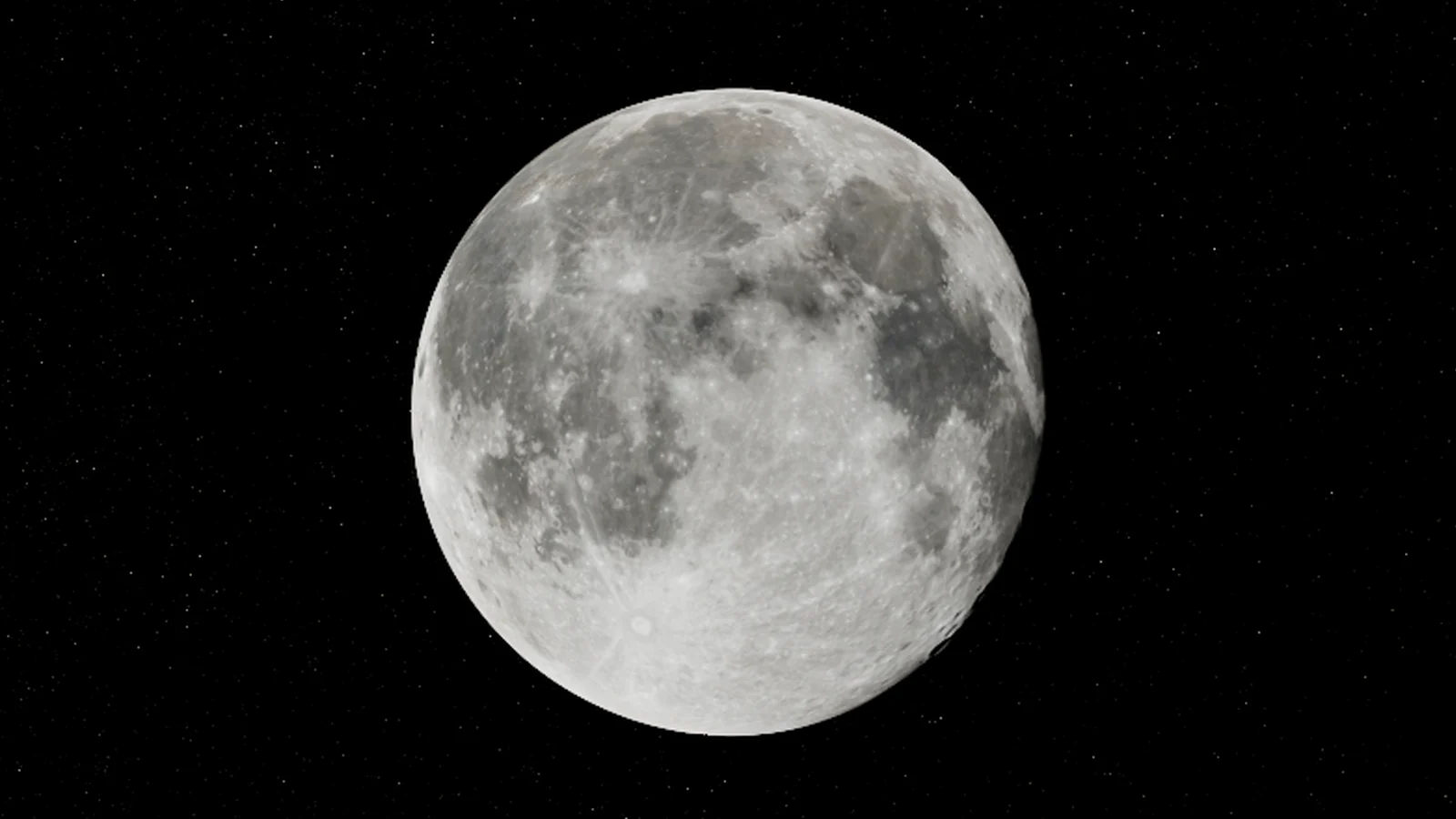
The Moon: the facts
| Width | 3,475 km, about a quarter of Earth's [1] |
|---|---|
| Average distance | 384,400 km [1] |
| Phase cycle | 29.5 days from one new Moon to the next [1] |
| Drifting away | about 3.8 cm a year, measured by bouncing lasers off reflectors left on the Moon by Apollo astronauts [2] |
Why does the Moon have phases?
The Sun always lights half of the Moon. As the Moon goes round the Earth, we see that lit half from different angles. When the Moon is between us and the Sun we see its dark side: a new Moon. A week later we see half the lit side, a first quarter. When the Moon is opposite the Sun we see all of the lit side: a full Moon.
That's also why the phase tells you the time it's up. A full Moon is opposite the Sun, so it rises as the Sun sets. A new Moon is next to the Sun, so it's up in the daytime, lost in the glare. The Moon rises about 50 minutes later each day because it moves about 13° along its orbit while the Earth turns once.
Why do we always see the same side of the Moon?
The Moon turns once on its axis in exactly the time it takes to go round the Earth, about 27.3 days, so the same face always points our way. Long ago it spun faster, but the Earth's gravity raised tides in its rock that braked it until it locked. Astronomers call this tidal locking.
We actually see a little more than half: about 59% over time. The Moon's orbit is slightly oval and tilted, so it seems to rock a little, a wobble called libration, showing a sliver round each edge.
What's the faint glow on the dark part of a crescent Moon?
Earthshine: sunlight reflected off the Earth onto the Moon's night side and back to your eyes. From the Moon, the Earth would be nearly full and very bright when the Moon is a thin crescent to us. Leonardo da Vinci worked this out about 500 years ago, in notes now known as the Codex Leicester.
Can you see the Moon in Everdust?
In Everdust's Night Sky on Apple Vision Pro, look at the Moon and pinch to fly there. The Moon Today shows it in tonight's real phase and tilt, with its craters and mountains in relief from NASA's Lunar Reconnaissance Orbiter. On iPhone and iPad, tap the Moon in Night Sky to fly there.
Everdust is free on the App Store for Apple Vision Pro, iPhone and iPad; on Android, Tonight’s Sky in Everdust for Android (free on Google Play) shows where the Moon is tonight from where you stand. I make Everdust, so weigh that; a phone star map such as Stellarium or Sky Guide will find the Moon just as well.
Questions people ask
Can I see the Moon tonight? The Moon isn't up during the dark hours tonight; it's above the horizon in daylight. That's for New York on the night of November 7, 2026; this page works it out for your own location too.
What phase is the Moon tonight? The Moon is a waning crescent, 2% lit (computed November 7, 2026). The next full Moon is on November 24, 2026 and the next new Moon on November 9, 2026 (UTC).
What time does the Moon rise tonight? It depends on where you are and the phase. This page computes moonrise and moonset for your location; the table gives them for New York, Los Angeles, London and Sydney. A full Moon rises around sunset; each night after that, about 50 minutes later.
Why does the Moon look bigger near the horizon? It isn't: photographs show the same size high and low. The Moon illusion happens in the brain, which judges the low Moon against trees and buildings and reads it as larger.
How far away is the Moon? On average 384,400 km. Its orbit is slightly oval, so the distance swings between roughly 356,000 and 407,000 km over each month; this page shows tonight's distance.
Sources
- NASA NSSDC: Moon fact sheet
- APOLLO lunar laser ranging (UC San Diego): the basics of lunar ranging
- NASA: Moon phases
- LRO Camera (LROC) WAC global mosaic, NASA / GSFC / Arizona State University
Positions, rise and set times, brightness, phases and distances on this page are computed with Astronomy Engine (Don Cross, MIT license), accurate to about an arcminute.