The Trifid Nebula: red, blue and split in three
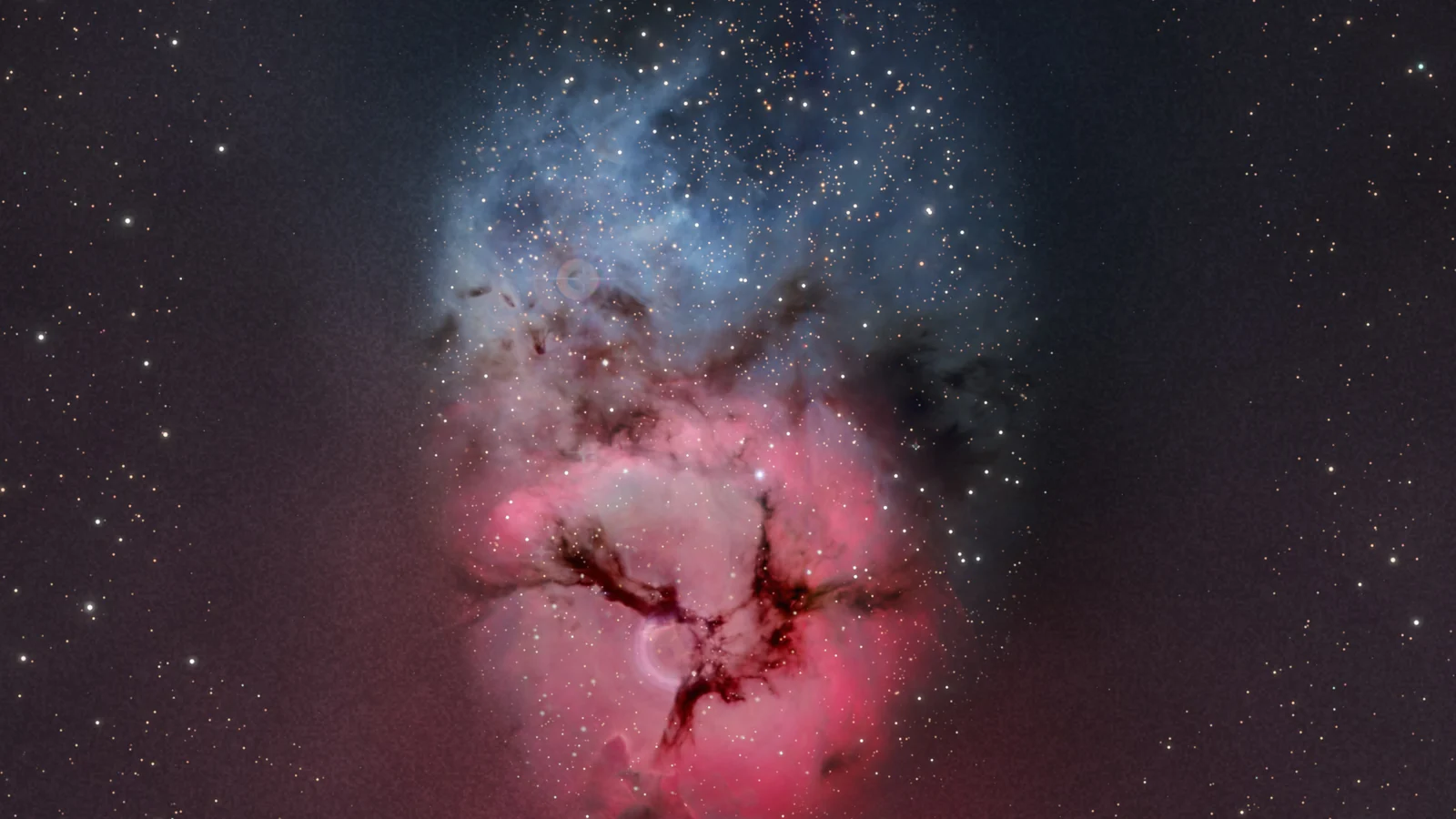
The Trifid Nebula is a star-forming cloud about 5,000 light-years away in Sagittarius, a little north of the Lagoon Nebula. Photographs show it in two colors at once, red glowing gas and a blue haze of reflecting dust, split into three lobes by dark lanes. Below is where it is tonight, computed for your location.
Tonight from where you are
Working it out for your time zone…
Computed in your browser.
The Trifid Nebula tonight from four cities
| City | Tonight |
|---|---|
| New York | 5:46 pm to 6:16 pm; best 5:46 pm, 15° up in the south-west |
| Los Angeles | 5:50 pm to 6:40 pm; best 5:50 pm, 18° up in the south-west |
| London | not up in the dark hours |
| Sydney | 8:28 pm to 9:58 pm; best 8:28 pm, 29° up in the west |
Local times for the night of November 7, 2026, counted as “up” when at least 10° above the horizon after dark. Computed with Astronomy Engine when this page was built; it refreshes every hour.
At a glance
- In the constellation
- Sagittarius
- High in the evening (9 pm)
- June to October from mid-southern latitudes
The Trifid Nebula: the facts
| Also called | M20, Messier 20, NGC 6514 [1] |
|---|---|
| Distance | about 5,000 light-years [1] |
| Brightness | about magnitude 6: binoculars or a small telescope [1] |
Why is the Trifid red and blue?
It's two kinds of nebula side by side. The red part is hydrogen glowing because a hot young star at its center lights it with ultraviolet: an emission nebula. The blue part, to the north, is dust that simply reflects starlight, and dust scatters blue light more than red, the same reason the daytime sky is blue: a reflection nebula. Dark lanes of thicker dust cross the red part and split it into three, which is how it got its name.
How do you find the Trifid Nebula?
Find the Lagoon Nebula above the Teapot's spout in Sagittarius, then move about a degree and a half north, roughly three full-Moon widths. In binoculars the Trifid is a small faint glow; a small telescope under a dark sky starts to show the dark lanes.
Can you see the Trifid Nebula in Everdust?
In Everdust's Night Sky on Apple Vision Pro, look at the Trifid Nebula and pinch to fly there: you arrive inside ESO's photograph of it, given depth. On iPhone, iPad and Android, tap the Trifid Nebula in Night Sky to fly there.
Everdust is free on the App Store for Apple Vision Pro, iPhone and iPad, and on Google Play for Android. I make Everdust, so weigh that; a phone star map such as Stellarium or Sky Guide will find the Trifid Nebula just as well.
Questions people ask
Can I see the Trifid Nebula tonight? The Trifid Nebula is best soon after dark, 15° up in the south-west at about 5:46 pm, and sinks out of view by about 6:16 pm. That's for New York on the night of November 7, 2026; this page works it out for your own location too.
When is the best time of year to see the Trifid Nebula? From mid-southern latitudes (Sydney) it's high in the evening from June to October.
Can you see the Trifid Nebula in a small telescope? Yes, as a faint glow round a bright star; the dark lanes need a dark sky and some aperture. Its colors show only in photographs.
How far away is the Trifid Nebula? About 5,000 light-years, in Sagittarius. In the sky it sits close to the Lagoon Nebula, and the two are at roughly similar distances from us.
Sources
- NASA Hubble: Messier 20 (the Trifid Nebula)
- ESO eso0930: the Trifid Nebula from the Wide Field Imager
Positions, rise and set times, brightness, phases and distances on this page are computed with Astronomy Engine (Don Cross, MIT license), accurate to about an arcminute.