Free space science games for Android: Everdust on Google Play
Everdust is free on Google Play for Android phones and tablets, with no ads and no account: space science games, narrated science stories and a particle universe simulator. What's free, what Everdust Plus adds and which devices it runs on.
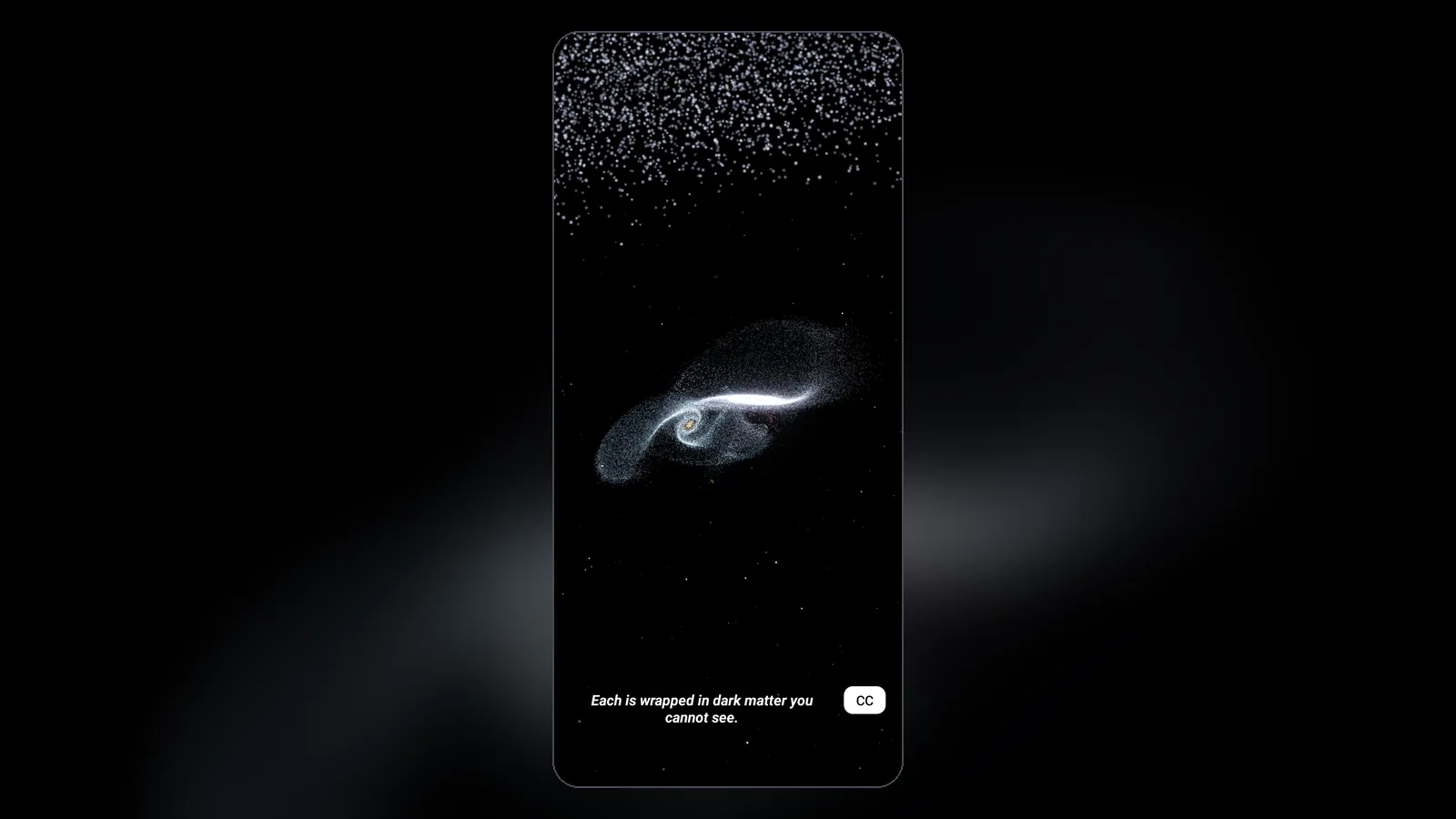
Everdust is now on Google Play for Android phones and tablets: a free download with no ads and no account, at Everdust on Google Play.
Update, November 7, 2026: version 1.0.8 brings Night Sky to Android. Hold up your phone to see the real sky over you, and fly into nebulae, galaxies, star clusters and black holes made from real telescope photographs. What's new in 1.0.8.
It's the same idea as everywhere else Everdust runs. Space science games, narrated science stories and a particle universe simulator, where every world is a live simulation, not a video. Stars, planets and galaxies are made of particles that move, glow and answer the moment you touch them.
What do you get on Android?
Games built on real physics. Feed the Black Hole, Lightfold, Orb Popper, Black Hole Golf, Fireworks on the Beat, Supernova Chain, Comet Rider, Orbit Architect and more. Feed a hungry black hole suns and comets, turn prisms and water drops until a sunbeam splits into a rainbow, or sink a shot around a black hole. The versus games, such as Black Hole Hockey and Jet Versus, let you play the bot or a friend on the same screen. Each game has levels, stars to earn and a free daily level.
Narrated science stories. River, Everdust's narrator, walks you through a big idea in chapters, from the first light after the Big Bang to a giant star collapsing and exploding as a supernova. Every chapter is a live simulation you can turn in your hands while River explains what you're seeing, with subtitles you can switch off. The Story of Everything, The Life of a Star, The Life of a Black Hole and more are inside.
A universe simulator. A galaxy collision of up to about a million stars, each one pulled by gravity, running live on your phone. Drag to orbit, pinch to zoom, and watch galaxies merge and black holes bend light. No goals and no timer.
Night Sky (since version 1.0.8, November 2026). Hold up your phone to see the real sky over you, with stars, planets and what's up tonight, then fly into nebulae, galaxies, star clusters and black holes made from real telescope photographs; each downloads the first time you visit it. Eclipses and transits, star cards and a passport of the wonders you've visited come with it.
Tonight's Sky and Point at the sky. What's up tonight where you are: the Moon, the planets, International Space Station passes, meteor showers, the chance of aurora and a cloud forecast for the night. Tap Point at the sky and hold your phone up: it shows the stars, planets and constellation figures behind it, where they really are, so it doubles as a simple constellation finder. Positions are worked out on your phone. Share your approximate location, or skip it and Everdust uses your time zone's city.
Calm. A sleep timer, a focus timer, guided breathing (box, 4-7-8 and coherent) and NSDR (non-sleep deep rest): River's voice guides a yoga-nidra-style rest for 10, 20 or 30 minutes, over a slow, dark particle scene. The sleep timer, the 10-minute NSDR session, box breathing and the standard focus timer are free.
Touch toys. Black Hole in Your Palm, Stir the Stars, Lightning in a Jar, Smoke Rings, Ink Marbling and more. Drag a finger and watch light pour, ripple and settle.
Music, if you want it. Every scene can move with music: the free Mixes inside the app (streamed from Audius, every track credited to its artist), a song on your phone, or the sound in the room. The sound is analyzed on your phone and never recorded or sent. The default is No sync, where scenes move on their own.
Make it yours. Set a scene as a live wallpaper for your home and lock screen, save a seamless silent loop of a scene to your gallery, or walk into paintings by Van Gogh, Monet and Hokusai rebuilt as 3D brush strokes. Everdust on Android speaks English, Japanese, German, Spanish and Korean.
What's free, and what does Everdust Plus add?
Free, for everyone, with no time limit:
- Every scene, every touch toy and every music source.
- The Story of Everything, in full, and the first chapters of every other Story.
- Each game's first levels (3 or more) and its daily level.
- Tonight's Sky.
- One full session of each Calm tool: the sleep timer, the 10-minute NSDR session, box breathing and the standard 25/5 focus timer.
Everdust Plus is optional. It unlocks every Story chapter, every game level and the longer Calm sessions. You can choose monthly, yearly or a one-time Lifetime purchase. In the US that's $4.99 a month, $29.99 a year (new subscribers get the first 7 days free) or $79.99 once; elsewhere Google Play shows the price in your currency. Subscriptions renew through Google Play until you cancel, and you manage them in Google Play under Payments & subscriptions.
There are no ads, in the free version or with Plus, and you never need an account.
Which devices does it run on?
Everdust needs Android 10 or later and a phone or tablet with Vulkan 1.1 graphics. Vulkan is the modern graphics interface Everdust uses to run its simulations on your device's graphics chip, and according to Google, every 64-bit Android device running Android 10 or later supports Vulkan 1.1, so most phones and tablets from the last several years qualify.
Google TV and Android TV aren't on Google Play yet. They're coming soon, with an Ambient mode for the living room.
Why does it need a graphics chip at all?
Because nothing in Everdust is a video. When two galaxies collide on your screen, every star is a particle whose path is worked out frame by frame from gravity. When you drag a finger through a nebula, the particles feel your finger and flow around it. A video could only show you one collision; a simulation gives you a new one every time, and it lets you push it.
The galaxy collision follows the method the astronomers Alar and Juri Toomre used in 1972 to explain the long tidal tails of real colliding galaxies: each star is pulled by both galaxy cores. You can try that one in a browser before you install anything, at everdust.ai/play/galaxy-collision.
A few things to try first
- Galaxy Collision. Pull two galaxies together and watch the tails form.
- The Story of Everything. Free in full on Android: put on headphones and let River start at the beginning.
- Feed the Black Hole. The quickest way to get a feel for gravity with your thumb.
- Tonight's Sky. Then go outside.
Everdust on other devices
- iPhone and iPad: Everdust on the App Store, free (Everdust on iPhone and iPad).
- Apple Vision Pro: the same App Store listing, free (Everdust on Apple Vision Pro; Night Sky in 1.1).
- Apple TV: the same App Store listing, free (Everdust on Apple TV).
- Meta Quest 3 and 3S: Everdust on the Meta Horizon Store, free (Everdust on Meta Quest).
- Mac: a free download from everdust.ai (version 1.0.1; macOS 14 Sonoma or later, Apple silicon (M1 or later)), signed and notarized by Apple. The Mac App Store version is in review.
- Any web browser: a free taste of the worlds at everdust.ai/play, including a black hole simulator game, a gravity simulator and a physics simulator game.
If something doesn't work on your device, tell us at everdust.ai/feedback and include the phone or tablet model.
Questions people ask
Are there free space science games for Android? Yes. Everdust on Google Play has space and science games built on real physics, including Feed the Black Hole, Black Hole Golf, Topple, Supernova Chain and Comet Rider. Each game's first levels and its daily level are free, with no ads; Everdust Plus unlocks every level.
Is there a free galaxy simulator for Android? Yes. Everdust is free on Google Play and its universe simulator runs a galaxy collision of up to about a million stars live on your phone, each star pulled by gravity. Drag to orbit, pinch to zoom, and watch the tidal tails form. There are no ads and no account.
Is there a black hole simulation app for Android? Everdust has several, all free to open: a binary black hole merger, a black hole that bends the light behind it, Black Hole in Your Palm (a touch toy), and games such as Feed the Black Hole and Black Hole Golf, where the black hole's gravity is the physics you play with.
Is there a free constellation finder in Everdust? Yes, as part of Tonight's Sky: tap Point at the sky, hold your phone up, and it shows the stars, planets and constellation figures behind it. It's a quick look at tonight; for a full star atlas or telescope control, a dedicated star map such as Stellarium or Sky Map goes deeper (see our honest guide to free astronomy apps for Android).
Is there a free NSDR app for Android? Everdust's Calm section includes NSDR (non-sleep deep rest), a guided yoga-nidra-style rest narrated by River. The 10-minute session is free; the 20- and 30-minute sessions come with Everdust Plus. Calm is for relaxation and wellbeing, not a medical treatment.
Does Everdust work offline? The simulations, games and touch toys run on your phone's graphics chip. Narrated Stories, the free Mixes and Tonight's cloud forecast need a connection.
Is Everdust on iPhone? Yes. Everdust for iPhone and iPad is on the App Store, free, since November 2, 2026 (what's in it), and it's on Apple Vision Pro and Apple TV there too.
Questions? Ask on r/everdust, Everdust's subreddit, where I answer them.
Sources
- Everdust: Space Science Games on Google Play (the listing's description, free tier and requirements).
- Android Developers, Vulkan overview (Vulkan 1.1 on 64-bit devices from Android 10).
- Toomre, A. and Toomre, J., Galactic Bridges and Tails, The Astrophysical Journal 178, 623 (1972).
Get Everdust on every device
- Apple Vision ProDownload on the App StoreEverdust 1.1 for Apple Vision Pro: Night SkyEverdust is on Apple Vision Pro
- iPhone and iPadDownload on the App StoreEverdust is on iPhone and iPad
- Apple TVDownload on the App StoreEverdust is on Apple TV
- Android phones and tabletsGet it on Google PlayFree space science games for Android: Everdust on Google Play
- Meta Quest 3 and 3SGet it on the Meta Horizon StoreEverdust is on Meta Quest
- MacDownload for MacFree. Mac App Store version in review.
- Any web browserTry the worlds free
Free to download on every store, with no ads. Everdust Plus is optional: what it costs and where.