Physics sandbox and simulation apps for Android (2026): an honest guide
The physics sandbox and simulation apps worth trying on Android in 2026, from gravity sandboxes like the ones people want instead of Universe Sandbox to The Powder Toy, rocket builders and classroom simulations. What each one simulates, what it costs and which have ads, each described from its own Google Play listing, by the maker of one of them.
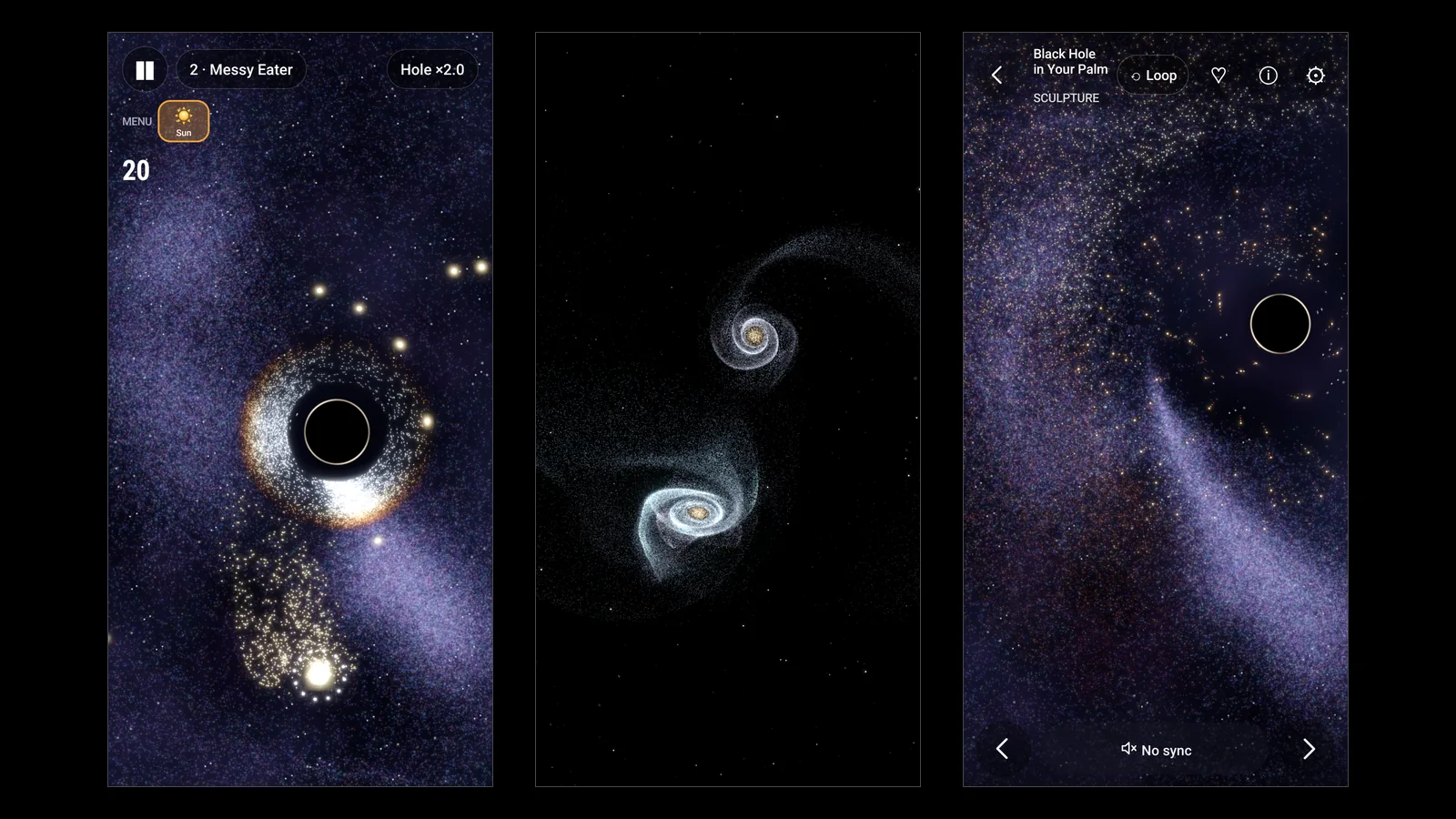
Universe Sandbox isn't on Android; the closest gravity sandboxes there are Solar System Simulator, Milky Way: Cosmic Playground and Pocket Galaxy. For smashing planets, try Space Crash Simulator or Solar Smash; for bending physics, Gravity Simulator; for falling sand, The Powder Toy; for rockets, Spaceflight Simulator; for studying, PhET and phyphox; and for ready-made galaxy collisions and black holes, Everdust.
I make Everdust, one of the apps below, so read this with that in mind. I've described every other app by what its own Google Play listing says it does and costs, and I say plainly where another app is the better pick. Prices are US prices, and store details were checked on October 27, 2026.
The short answer
- You want Universe Sandbox on your phone: it isn't on Android. The closest gravity sandboxes are Solar System Simulator, Milky Way: Cosmic Playground and Pocket Galaxy.
- You want to smash planets: Space Crash Simulator for the physics, Solar Smash for the spectacle.
- You want to bend the laws of physics themselves: Gravity Simulator by TestTubeGames.
- You want the classic falling-sand physics sandbox: The Powder Toy, or sand:box for something lighter.
- You want to build rockets and fly them into orbit: Spaceflight Simulator or Juno: New Origins; for planes, SimplePlanes.
- You're studying physics: PhET Simulations, and phyphox for real experiments with your phone's sensors.
- You want ready-made galaxy collisions, black holes and physics games, with nothing to build: Everdust.
Is Universe Sandbox on Android?
No. Universe Sandbox runs on Windows, macOS and Linux. It used to run in VR on a PC too, but its makers ended VR support with Update 35 in February 2025; only the older Update 34.1.1 still runs in a headset. Its own FAQ says a mobile version for phones and tablets is in the works, with no release date yet. Until then, these are the Android apps closest to it. For Vision Pro, see Universe Sandbox alternatives on Android and Vision Pro.
Gravity and space sandboxes
Solar System Simulator
Solar System Simulator by WPCons is, in its listing's words, a real-time gravity sandbox built on Newton's laws and real astronomical data. You add, move or destroy planets, moons, asteroids and comets, and every orbit is recalculated live. It also describes impact craters, particle rings shaped by gravity, a first-person view from any planet's surface and real eclipses. It's free, contains ads and offers in-app purchases.
Pick it if you want the closest thing to Universe Sandbox's solar-system side.
Milky Way: Cosmic Playground
Milky Way: Cosmic Playground (listed on Google Play as "Milky Way") says every star, planet and moon obeys Newtonian gravity and that collisions use smoothed particle hydrodynamics (SPH), a method astrophysicists use. Its listing describes planet collisions, meteor impacts, growing planets from a spinning disk, black holes, galaxy mergers and launching your own satellites. It's free with in-app purchases, and the listing doesn't show ads.
Pick it if you want one sandbox that covers impacts, orbits and galaxies.
Space Crash Simulator
Space Crash Simulator, also by WPCons, focuses on planetary collisions. Its listing says each planet is made of interacting particles (SPH), so every impact is computed rather than animated, with molten impact zones that cool into crust. You set each body's size, density, spin and velocity in a setup mode. It's free, contains ads and offers in-app purchases.
Pick it if watching two worlds splash and re-form is the point.
Pocket Galaxy
Pocket Galaxy: Space Sandbox by Pocket Labs Ltd lets you spawn planets and stars under real gravity, then heat, freeze or smash them. It costs $2.49, and the listing shows no ads and no in-app purchases. A free version, Pocket Galaxy: Cosmos Sandbox, contains ads. More on it, and on other galaxy and black hole apps, in our guide to galaxy and black hole simulator apps for Android.
Gravity Simulator
Gravity Simulator by TestTubeGames LLC lets you launch stars and planets and watch the orbits unfold. It's distinctive because you can change the law of gravity itself: try a force that falls off a little faster than 1/r², or something stranger, or switch on General Relativity. It costs $3.99, and the listing shows no ads or in-app purchases.
Pick it if you want to ask "what if gravity worked differently?"
Solar Smash
Solar Smash by Paradyme Games is a hugely popular planet destruction game. Most of its listing is about weapons, from lasers and meteors to black holes. A second mode, Solar System Smash, lets you build star systems, set orbits and experiment with collisions. It's free, contains ads and offers in-app purchases.
Pick it if you want spectacle first and physics second.
Matter sandboxes
The Powder Toy
The Powder Toy, by its maintainer jacob1, is the official Android version of the long-running falling-sand game. Its listing says it simulates air pressure and velocity, heat, gravity and the interactions between many substances, with building materials, liquids, gases and electronic parts to build machines from. Saves are compatible with the PC version, and the community has shared a great many. It's free with no ads or in-app purchases, and it's open source. The listing warns that it's demanding and works best on a powerful phone or a tablet.
Pick it if you want the deepest physics sandbox on this list.
sand:box
sand:box by SmellyMoo is a lighter, relaxing particle sandbox: draw with dozens of materials and watch them interact. Its listing says it has no ads, and it offers in-app purchases.
Pick it if you want falling-sand fun without the learning curve.
Build it and fly it
Spaceflight Simulator
Spaceflight Simulator is about building a rocket from parts and flying it. Its listing describes realistic orbital mechanics, realistically scaled planets, and reaching orbit or landing on the Moon or Mars. It's free with in-app purchases, and the listing doesn't show ads.
Pick it if you want to learn orbital mechanics by doing.
Juno: New Origins
Juno: New Origins by Jundroo is a 3D aerospace sandbox: build rockets, planes and cars from customizable parts and test them in realistic physics across land, sea, air and space, with a career mode and tech tree. The free version contains ads and sells its remaining content in the app. Juno: New Origins Complete Ed. costs $6.99, with no ads.
SimplePlanes
SimplePlanes, also by Jundroo, lets you design an airplane part by part, shape its wings and see how it flies. It costs $5.99, and the listing shows no ads or in-app purchases.
For learning
PhET Simulations
PhET Simulations by the University of Colorado Boulder packages the PhET interactive simulations, widely used in classrooms, for offline use, covering topics from forces and energy to atoms. It costs $0.99. Its listing was last updated in July 2024; the same simulations also run free in a browser at phet.colorado.edu.
phyphox
phyphox by RWTH Aachen University isn't a simulation at all: it turns your phone's sensors into a lab, with ready-made experiments such as using the phone as a pendulum to measure gravity, plus raw data export. It's free with no ads or in-app purchases.
Pick it if you want to measure real physics, not simulate it.
Everdust
Everdust is the one I make, published by Decosa, Inc. It isn't a sandbox: you don't place every object. It's ready-made live simulations, not videos, that you turn, push and play with.
- Galaxy collisions, where each star is pulled by the galaxies' gravity, using the method astronomers used to explain tidal tails. A merger version adds dark matter halos so the galaxies really merge. Here's how galaxy simulations work.
- Black holes: a binary black hole merger, a black hole that bends the light behind it, and Black Hole in Your Palm, a touch toy.
- Physics games, including Feed the Black Hole, Black Hole Golf, where you sink a shot around a black hole, and Topple, where you knock down towers under the gravity of Earth, Mars or the Moon. Each game's first levels and its daily level are free.
- Narrated stories, where every chapter is a live simulation. The Story of Everything is free in full.
It's free, with no ads and no account. Everdust Plus is an optional in-app purchase that unlocks every story chapter and game level. It needs Android 10 or later and a phone or tablet with Vulkan 1.1 graphics. You can try the galaxy collision and a physics simulator game in your browser first.
Pick it if you want to watch galaxies merge and play with black holes without building anything.
How to choose
Ask what you want to do with the physics.
- Build worlds and break them: Solar System Simulator, Milky Way: Cosmic Playground, Space Crash Simulator or Pocket Galaxy.
- Change the rules: Gravity Simulator.
- Mix materials and build machines: The Powder Toy.
- Engineer and fly: Spaceflight Simulator, Juno: New Origins or SimplePlanes.
- Study or measure: PhET Simulations and phyphox.
- Watch and play with ready-made cosmic physics: Everdust.
Most are free to try, so install two or three and keep the one you open again.
For a quick particle toy with no install, turn any photo into living particles in your browser and stir them with a finger.
Questions people ask
What are the best apps like Universe Sandbox for Android? Universe Sandbox itself isn't on Android. The closest gravity sandboxes on Google Play are Solar System Simulator, Milky Way: Cosmic Playground and Pocket Galaxy, all of which let you build systems and collide worlds. Space Crash Simulator focuses on planetary collisions, and Gravity Simulator lets you change the law of gravity.
What is the best free physics sandbox for Android? The Powder Toy is free, with no ads or in-app purchases, and simulates heat, pressure, gravity and the interactions between many materials. sand:box is a lighter free option with no ads.
Is there a black hole physics game for Android? Yes. Everdust has Feed the Black Hole and Black Hole Golf, where the black hole's gravity is the physics you play with, free to start with no ads. For a detailed black hole visualization, see BlackHole - Physics Simulator in our galaxy and black hole guide.
Is there a rocket physics simulator for Android? Spaceflight Simulator is free and built around orbital mechanics. Juno: New Origins is a deeper aerospace sandbox, free with ads or paid as the Complete Edition.
Are there physics simulations for students on Android? PhET Simulations packages the University of Colorado Boulder's interactive simulations for offline use for $0.99, and the same simulations run free in a browser. phyphox, from RWTH Aachen University, is free and runs real experiments with your phone's sensors.