The Story of Everything: from the Big Bang to you, in nine live chapters
The Story of Everything is the history of the universe told in nine short chapters, each one a live simulation you can turn, zoom and play with while River, the narrator, explains what you are looking at. It starts 13.8 billion years ago in the glowing fog after the Big Bang and ends with the lights of eight billion people on the night side of Earth.
In between it follows the matter in you: sound waves freezing into the first pattern in the sky, dark matter pulling gas into a cosmic web, galaxies merging, a giant star exploding, the Sun and its planets forming from the wreckage, a collision that made the Moon and four billion years of Earth squeezed into under a minute. It is the way into Everdust, and every chapter of it is free.
At a glance
- Chapters
- 9, each a live simulation
- Length
- about 7 minutes played straight through
- Narrator
- River, with subtitles
- Free or Plus
- Free: all 9 chapters
- Where
- Everdust on iPhone and iPad, Android, Apple Vision Pro, Mac, Apple TV and Meta Quest 3 and 3S
 IFirst Light
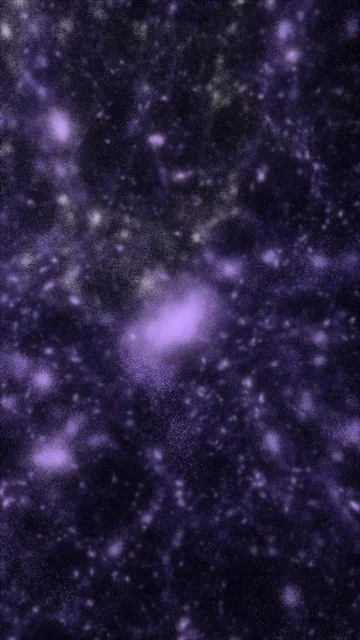 IIThe Cosmic Web
 IIIGalaxies Collide
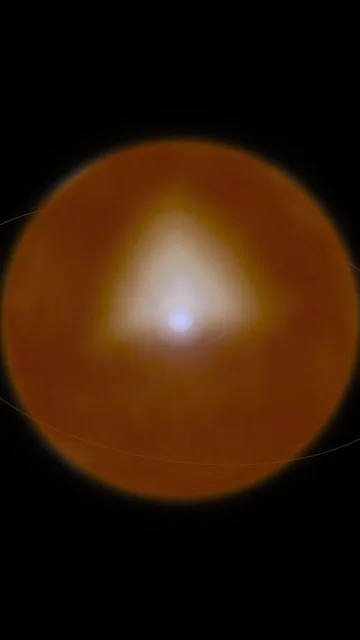 IVA Star Dies
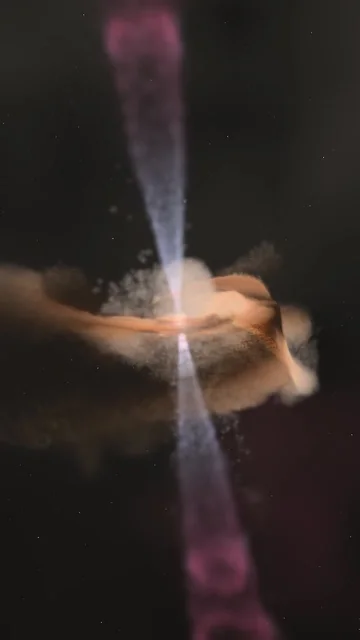 VThe Sun Is Born
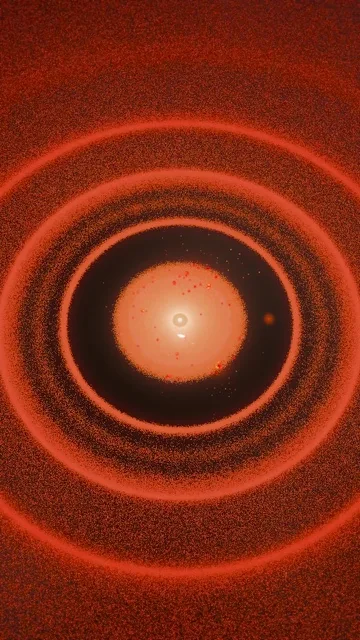 VIPlanets
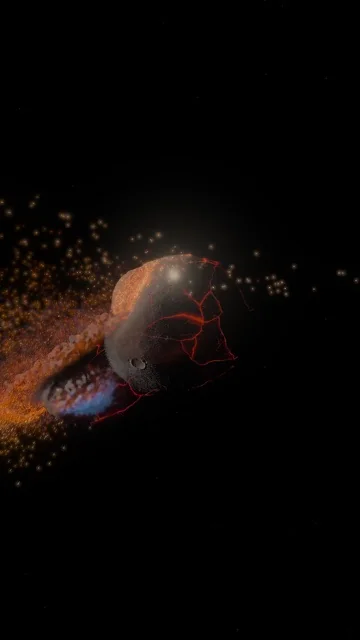 VIITheia
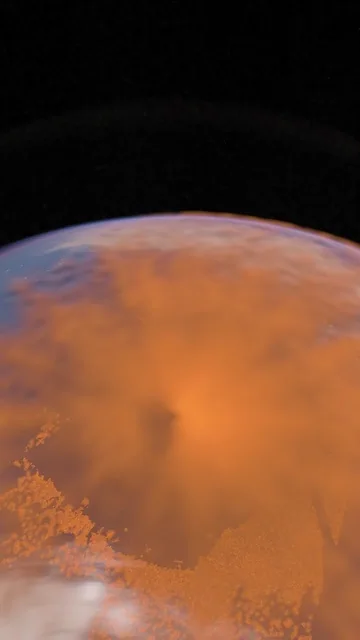 VIIIFour Billion Years
 IXHome
Chapter by chapter
Chapter I First Light
13.8 billion years ago, the hot plasma of the Big Bang cools until light runs free.
You float inside the young universe, when space was a hot, glowing fog of light and matter. Bright seeds send out rings: sound waves rippling through the plasma at more than half the speed of light. As space expands the fog cools and the rings spread, until after about 380,000 years atoms form, light runs free and the pattern freezes.
That frozen pattern is real and measured. It is printed on the cosmic microwave background, the oldest light there is, mapped in detail by ESA's Planck satellite, which also gives the universe its age of 13.8 billion years [1]. The same sound waves left a faint preferred spacing between galaxies, found in 2005 in the Sloan Digital Sky Survey [2]. The bounce and the burst of inflation at the very start of the chapter are drawn as ideas, not simulated.
Chapter II The Cosmic Web
Gravity pulls dark matter into filaments, and the first stars ignite in its knots.
The universe is dark and almost perfectly smooth, but tiny ripples are enough. Gravity pulls matter into sheets and long threads with great empty voids between them, and where threads cross, knots grow: the seeds of galaxies. In the densest knots the first stars switch on and blow glowing bubbles in the gas around them.
About 85 percent of the matter in the universe is dark matter, which neither shines nor absorbs light; its gravity builds the web and ordinary gas follows it [1]. Large simulations of structure growth produce exactly this web of filaments, sheets and voids, and it matches the way galaxies are spread across the sky [3]. The first stars probably lit up around 100 to 200 million years after the Big Bang, an estimate rather than a measurement [4].
Chapter III Galaxies Collide
Two galaxies pass and merge, and their stars almost never touch.
Two galaxies, each with billions of stars and wrapped in dark matter, fall together and pass straight through each other. Almost no stars collide: the space between them is simply too vast. Gravity flings long tails of stars out into space, the galaxies fall back, and their two hearts merge while squeezed gas bursts into new stars.
Tidal tails like these were first explained in 1972 by Alar and Juri Toomre, who showed that gravity alone, in a close pass, pulls out the bridges and tails seen in pairs such as the Antennae and the Mice [5]. Our own galaxy grew this way: stars left by a dwarf galaxy that merged with the Milky Way about ten billion years ago still move through its halo [6].
Chapter IV A Star Dies
A star about 20 times the Sun's mass collapses and explodes as a supernova.
A giant star is cut open so you can see its layers, with iron at its heart. Iron gives no energy when it fuses, so the core collapses in under a second, rebounds, and the star blows itself apart as a supernova, throwing out the oxygen, silicon and iron it made.
This is a core-collapse supernova, the death of a star of roughly eight or more times the Sun's mass. The bounce alone usually stalls; the leading explanation for what revives the explosion is heating by the flood of neutrinos from the collapsed core [7]. The chapter alternates a star of about 20 Suns, which leaves a neutron star behind, and one of about 35, which leaves a black hole; it is a simplified picture of the explosion, not a full model of the gas. The elements it scatters are the ones planets, and people, are made of.
Chapter V The Sun Is Born
4.6 billion years ago, a cloud of gas and dust collapses into the young Sun.
There is no Sun yet, only a cold, slowly turning cloud of gas and dust. Gravity wins and the cloud falls in on itself; its spin flattens the falling gas into a wide disk, a star switches on at the center, and twin jets shoot from its poles as it feeds.
The oldest solids in meteorites date the Sun's birth to 4.567 billion years ago [8]. Jets like these are seen around young stars today. In the simulation gravity and spin are real, but the jets follow a simple launch rule rather than the magnetic fields that power real ones. For more on how stars form, see How a star is born.
Chapter VI Planets
Dust around the young Sun gathers into rings, then into planets.
Every planet you know started as dust like this. Drag from the gas herds the dust around the newborn Sun into bright rings; each young planet sweeps a dark gap along its orbit, dust piles up at the edges, and pebbles grow into worlds.
Telescopes see rings just like these around other young stars. The ALMA array's 2014 image of HL Tauri showed a disk striped with rings and gaps [9], and the DSHARP survey found the same patterns around many more stars [10]. In the simulation the gas drag runs about four times faster than nature's so the rings form in seconds.
Chapter VII Theia
A Mars-sized world strikes the young Earth, and the debris becomes the Moon (leading theory).
The young Earth is not alone. Theia, a world about the size of Mars, strikes it; rock melts in an instant, a long arm of molten rock swings out into orbit, and the iron hearts of the two worlds sink together. From that debris, we think, the Moon was made.
This is the giant-impact theory, first proposed in 1975 and still the leading explanation for the Moon [11][12]. Recent simulations with far more particles suggest the Moon could even have formed within hours of the impact [13]. The chapter says "we think" on purpose: it is a theory, and in the simulation the debris doesn't settle into a Moon before the replay.
Chapter VIII Four Billion Years
Oceans, life, oxygen and drifting continents, until the asteroid 66 million years ago.
Four billion years go by in under a minute. A magma ocean cools into a crust; oceans and continents appear; microbes fill the air with oxygen; the planet freezes over and thaws, and the land turns green. Then a mountain-sized asteroid falls, debris rains back down and the age of the dinosaurs ends.
Each step is dated by the rocks. Tiny zircon crystals show liquid water on Earth about 4.4 billion years ago [14]; oxygen rose in the Great Oxidation around 2.4 billion years ago [15]; the Snowball Earth glaciations covered the planet between about 717 and 635 million years ago [16]; land plants spread from around 470 million years ago [17]. In 1980 Luis and Walter Alvarez and colleagues traced the end of the dinosaurs to an asteroid about 10 kilometers across [18], and the Chicxulub crater in Mexico is now firmly tied to that extinction 66 million years ago [19]. The continents on the globe are today's map revealed piece by piece, not where they really were.
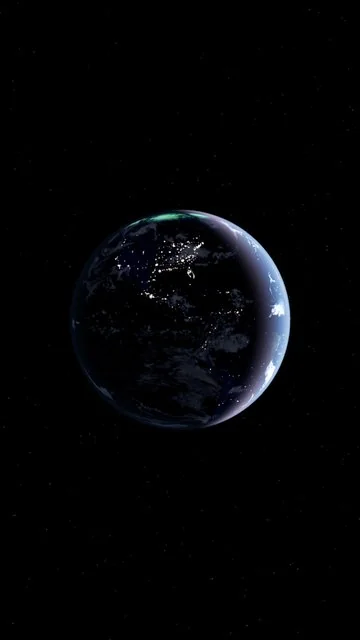
Chapter IX Home
Today, then out past the Moon, the Sun and the Milky Way to the cosmic web.
This is tonight: the lights of eight billion people. Then the camera pulls back past the Moon, 384,000 kilometers away, the inner planets circling the Sun, the Sun's neighbors among the stars, the Milky Way, Andromeda and the Local Group, and finally the cosmic web where the story began.
Every scale is real: the world's population passed 8.2 billion in 2024 [20], the Moon's average distance is 384,400 kilometers [21], the planets sit where they were on 1 October 2026, and every point of light near the Sun is a real star at its real position. The nearby galaxies are drawn larger than life so you can see them.
What’s simulated, and what isn’t
Each chapter is a live simulation with real physics at its core: gravity between the stars of the colliding galaxies, spin and gravity in the cloud that becomes the Sun, gas drag sorting the dust into rings, every particle pulling on every other in Theia's impact. Where a chapter shows an idea that can't be simulated, such as the bounce and inflation at the start of time, or speeds a process up, such as the dust drag in Chapter VI, the narration and the About cards say so. It is simulated live, not generated video.
Watch The Story of Everything in Everdust
The Story of Everything is in the Everdust app on iPhone and iPad, Android, Apple Vision Pro, Mac, Apple TV and Meta Quest 3 and 3S. Open Everdust, choose Stories, then The Story of Everything. Free: all 9 chapters.
Everdust on the App Store (iPhone, iPad, Apple Vision Pro, Mac, Apple TV)Everdust on Google Play (Android)Everdust on the Meta Horizon Store (Quest 3 and 3S)
Everdust is free to download, with no ads and no account. Every chapter of The Story of Everything is free on iPhone, iPad, Android, Apple Vision Pro, Mac and Apple TV (on Meta Quest, which chapters are free can differ).
Questions people ask
Is The Story of Everything free? Yes. All nine chapters are free in the Everdust app on iPhone, iPad, Android, Apple Vision Pro, Mac and Apple TV, with no ads and no account.
How long is The Story of Everything? About seven and a half minutes if you let the narration run, but every chapter is a live simulation, so you can stay in any one of them as long as you like.
Who narrates it? River, a stock voice from ElevenLabs, reads a script written for each chapter. You can turn the voice or the subtitles off, or choose Voice only to stop the music and keep the narration.
Sources
- Planck Collaboration (2020). Planck 2018 results. VI. Cosmological parameters. Astronomy & Astrophysics 641, A6.
- Eisenstein, D. J. et al. (2005). Detection of the baryon acoustic peak in the large-scale correlation function of SDSS luminous red galaxies. The Astrophysical Journal 633, 560.
- Springel, V. et al. (2005). Simulations of the formation, evolution and clustering of galaxies and quasars. Nature 435, 629.
- Bromm, V. & Larson, R. B. (2004). The first stars. Annual Review of Astronomy and Astrophysics 42, 79.
- Toomre, A. & Toomre, J. (1972). Galactic bridges and tails. The Astrophysical Journal 178, 623.
- Helmi, A. et al. (2018). The merger that led to the formation of the Milky Way's inner stellar halo and thick disk. Nature 563, 85.
- Janka, H.-T. (2012). Explosion mechanisms of core-collapse supernovae. Annual Review of Nuclear and Particle Science 62, 407.
- Connelly, J. N. et al. (2012). The absolute chronology and thermal processing of solids in the solar protoplanetary disk. Science 338, 651.
- ALMA Partnership et al. (2015). The 2014 ALMA Long Baseline Campaign: first results from high angular resolution observations toward the HL Tau region. The Astrophysical Journal Letters 808, L3.
- Andrews, S. M. et al. (2018). The Disk Substructures at High Angular Resolution Project (DSHARP). I. Motivation, sample, calibration, and overview. The Astrophysical Journal Letters 869, L41.
- Hartmann, W. K. & Davis, D. R. (1975). Satellite-sized planetesimals and lunar origin. Icarus 24, 504.
- Canup, R. M. & Asphaug, E. (2001). Origin of the Moon in a giant impact near the end of the Earth's formation. Nature 412, 708.
- Kegerreis, J. A. et al. (2022). Immediate origin of the Moon as a post-impact satellite. The Astrophysical Journal Letters 937, L40.
- Wilde, S. A. et al. (2001). Evidence from detrital zircons for the existence of continental crust and oceans on the Earth 4.4 Gyr ago. Nature 409, 175.
- Lyons, T. W., Reinhard, C. T. & Planavsky, N. J. (2014). The rise of oxygen in Earth's early ocean and atmosphere. Nature 506, 307.
- Hoffman, P. F. et al. (2017). Snowball Earth climate dynamics and Cryogenian geology-geobiology. Science Advances 3, e1600983.
- Wellman, C. H., Osterloff, P. L. & Mohiuddin, U. (2003). Fragments of the earliest land plants. Nature 425, 282.
- Alvarez, L. W. et al. (1980). Extraterrestrial cause for the Cretaceous-Tertiary extinction. Science 208, 1095.
- Schulte, P. et al. (2010). The Chicxulub asteroid impact and mass extinction at the Cretaceous-Paleogene boundary. Science 327, 1214.
- United Nations, Department of Economic and Social Affairs, Population Division (2024). World Population Prospects 2024.
- NASA Goddard Space Flight Center. Moon Fact Sheet (NSSDCA).
Earth and Moon imagery in Chapter IX: NASA. Stars in Chapter IX: HYG Database v4.0, David Nash / astronexus, CC BY-SA 4.0, modified. Chapter stills: Everdust, from each chapter’s live simulation. The Story’s script was written for Everdust from the sources above; River reads it. This page retells it in its own words.
More Stories
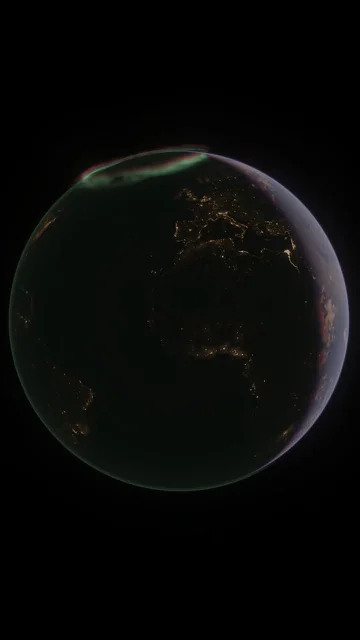
The Future of Everything
From Earth's lights tonight to the last black hole, following the physics forward.
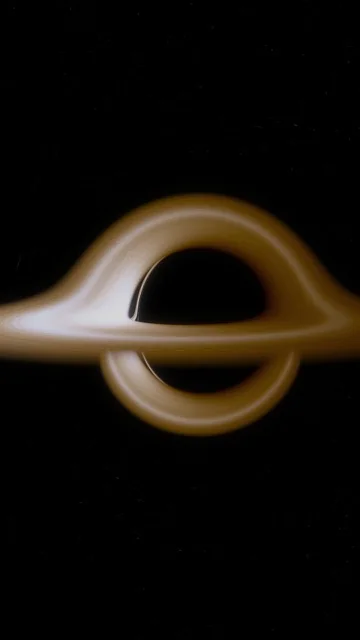
The Life of a Black Hole
Birth, feeding, a shredded star, a merger and the long fade, with light bent by real geometry.
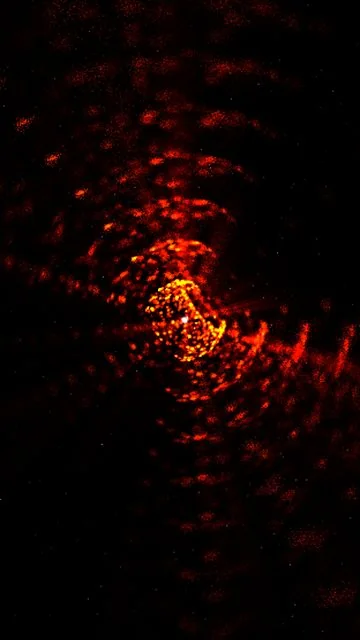
Death of a Giant Star
Betelgeuse, Wolf-Rayet dust spirals, Supernova 1987A and the neutron star at the end.
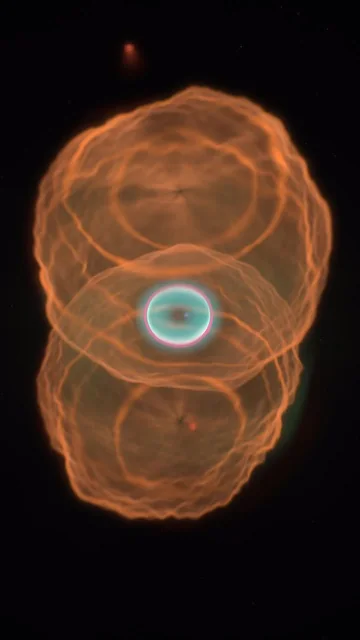
How the Hourglass Nebula Formed
A red giant sheds its skin, and a fast wind carves what is left into an hourglass.