The Future of Everything: from tonight to the end of time, in nine live chapters
The Future of Everything starts where The Story of Everything ends, with Earth's night side tonight, and runs the clock forward to the end of time. Each of its nine chapters is a live simulation you can look around while River, the narrator, explains what the physics predicts and how sure anyone can be.
No one can forecast what people will do, so after a few thousand years the story follows only nature: a brightening Sun that boils the oceans, Andromeda falling toward us, the Sun swelling into a red giant, the last stars going out and black holes evaporating into an empty universe. Every step is a projection, and the chapters say how firm each one is.
At a glance
- Chapters
- 9, each a live simulation
- Length
- about 9 minutes played straight through
- Narrator
- River, with subtitles
- Free or Plus
- Free: chapters I–II. Everdust Plus: chapters III–IX
- Where
- Everdust on iPhone and iPad, Android, Apple Vision Pro, Mac, Apple TV and Meta Quest 3 and 3S
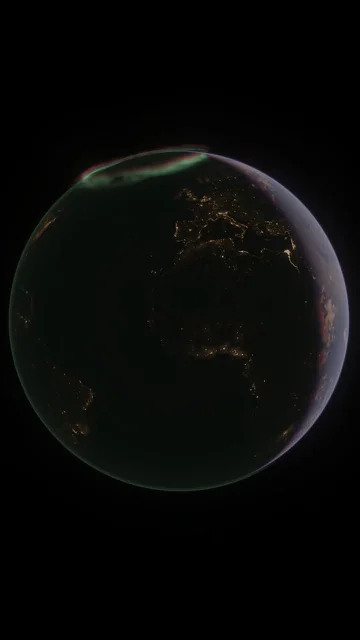 ITonight
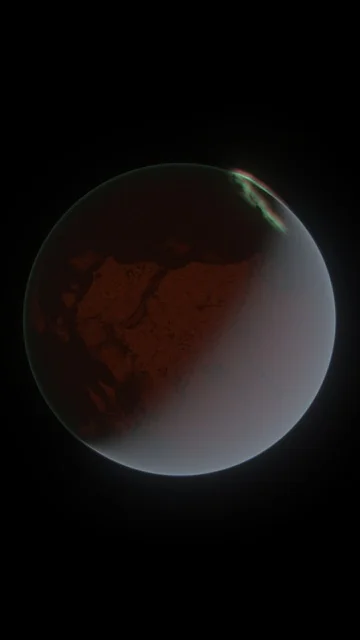 IIThe Brightening Sun
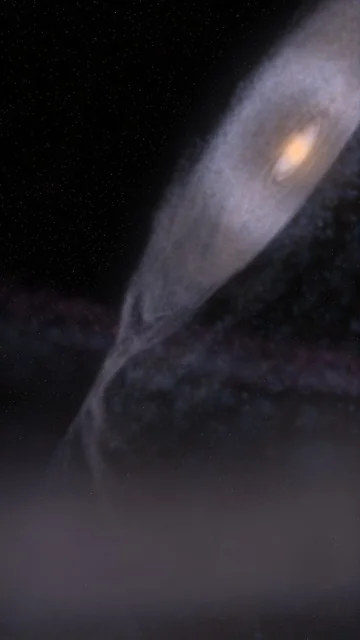 IIIMilkomeda
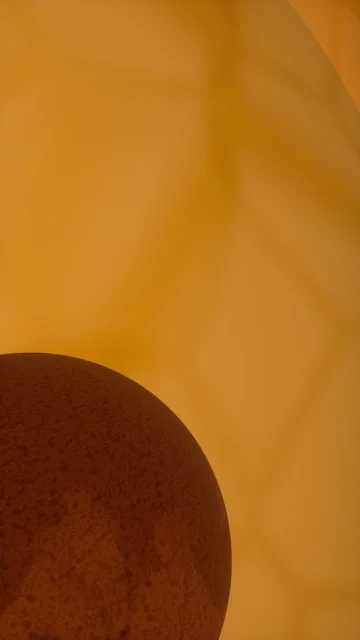 IVThe Red Giant
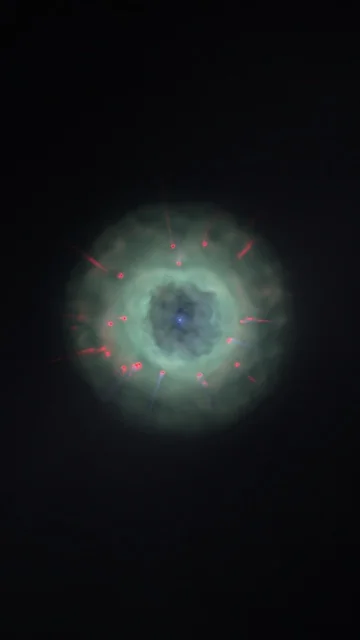 VThe Last Breath
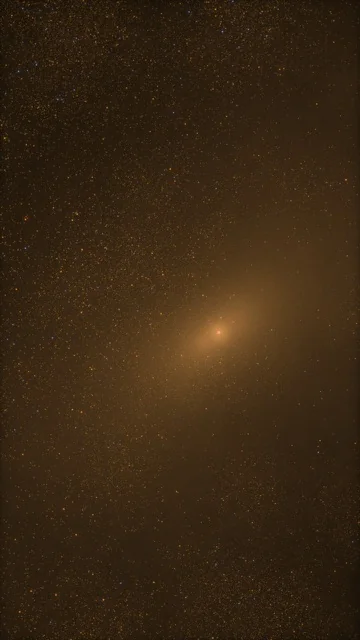 VIThe Last Stars
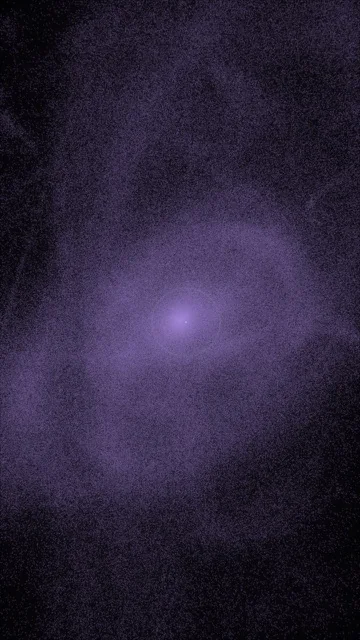 VIIThe Dark Era
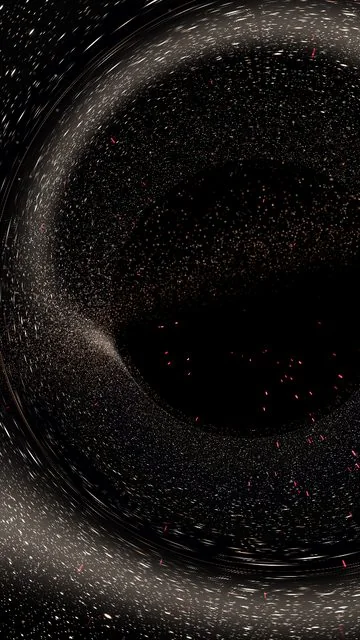 VIIIBlack Holes
 IXAfter Everything
Chapter by chapter
Chapter I Tonight Free
Earth's night side tonight: city lights and the aurora, as the clock starts.
You float in front of Earth's night side as it is tonight: city lights, clouds and the aurora curling around the poles, among the real stars. Then a clock starts, each second covering more years than the last. Within a few thousand years the lights fade, because nothing in physics can forecast what people will do. An ice age grows and melts, and after ten million years even the constellations have changed shape.
The ice age is the chapter's surest step. Studies of Earth's coming climate suggest the present warm spell will last unusually long, with the next ice age roughly 50,000 to 100,000 years away, depending partly on how much carbon dioxide is in the air [1][2]. The stars shift because each follows its own path around the galaxy.
Chapter II The Brightening Sun Free
The Sun brightens about 10 % every billion years, and the oceans boil away (projection).
Now the clock covers three billion years. As the Sun brightens, plants die back, the ice melts and the oceans begin to boil. You watch the sea level fall through the real shape of today's sea floor, until the planet is dry and even its night side glows with heat.
The Sun is slowly getting brighter, by roughly 10 percent every billion years [3][4]. Rocks pull carbon dioxide out of the air, and within about a billion years most plants could starve [5]. Climate models find that once sunlight is about 10 percent stronger, water vapor high in the air is split by sunlight and its hydrogen escapes to space, and at about 40 percent stronger the greenhouse runs away and the oceans evaporate [6]. That puts the end of Earth's oceans one to a few billion years away [3][7]. All of it is a projection.
Chapter III Milkomeda Plus
Andromeda may swing past the Milky Way in about 4 billion years and merge with it into Milkomeda some 2 billion years later.
You ride at the heart of the Milky Way, its disk a band of stars all around you, as Andromeda falls toward you. It swings past and fills the sky, tails of stars sweep overhead, and the two galaxies fall back together and merge into one great ball of stars, nicknamed Milkomeda. A gold star marks the Sun, flung out to the outskirts. Almost no stars collide.
Andromeda is closing in at about 110 kilometers a second [8]. Models from 2012 put the first close pass about 4 billion years from now and the merger about 6 billion [9]. A 2025 study with newer Gaia and Hubble data and the pull of the Large Magellanic Cloud found the odds of a merger within 10 billion years are only about even [10]. If it happens, the Sun will most likely end up farther from the center than it is now [9][11]. More in When will the Milky Way collide with Andromeda?
Chapter IV The Red Giant Plus
The Sun's core runs out of hydrogen in about 5 billion years, and the Sun swells into a red giant that swallows Mercury and Venus.
In about five billion years the Sun's core runs out of hydrogen, and instead of fading the Sun grows. Its outer layers swell and cool into a red giant with a boiling surface while Mercury, Venus, Earth and Mars circle it. Mercury is swallowed, then Venus, and Earth probably follows; farther out, Mars survives. Then helium ignites in the core, and the giant pulses and throws off shells of dust.
In one detailed model the Sun is at its largest about 7.6 billion years from now, 256 times its present radius, a little beyond Earth's orbit today [4]. By then it has lost about a third of its mass, so the planets' orbits widen. Whether Earth escapes depends on that mass loss against the drag of the tides Earth raises on the giant Sun: an earlier model has Earth escaping [3], a later one with tides has it swallowed [4]. The chapter computes the orbits live with both effects, and says "probably".
Chapter V The Last Breath Plus
The Sun sheds its outer layers, perhaps lit as a faint planetary nebula, and leaves a white dwarf.
The dying Sun lets go of its outer layers. They drift away in a slow, dusty wind, then a fast, hot wind from the bare core sweeps them into a thin shell, and you are inside it. The shell breaks into knots, teal on its inner face and red on its outer one: teal marks oxygen, red hydrogen. At the center sits the Sun's exposed core, a white dwarf, whose ultraviolet light makes the cloud glow.
This is a planetary nebula. The chapter follows the interacting-winds model proposed in 1978, in which a fast wind from the hot core plows into the slow wind the giant shed earlier [12]. Whether the Sun itself makes a bright one is uncertain: a 2008 model found it would produce no regular nebula [4], while newer models predict a faint one [13].
Chapter VI The Last Stars Plus
No new stars are born, and around 100 trillion years the last one goes out (estimate).
Ten billion years from now the clock speeds up again. You stand inside Milkomeda while other galaxies redden and slip out of sight, carried off by expanding space. The gas runs out and no new stars are born. The biggest stars die first and the sky turns gold, then red. Around a hundred trillion years from now, the last star goes out.
Because the universe's expansion is speeding up, everything beyond our own neighborhood of galaxies will eventually be carried out of view, leaving future astronomers what looks like a lone island of stars [14]. The smallest stars are thrifty: models of stars under a quarter of the Sun's mass find they can burn for about 10 trillion years, growing brighter and bluer rather than swelling into red giants [15]. The hundred trillion years is an estimate [16].
Chapter VII The Dark Era Plus
Dead stars cool into black dwarfs, and close encounters fling them out of the galaxy.
Every star is dead. In truth this sky would be black, so the chapter lights the cold remains in false color: black dwarfs, neutron stars and brown dwarfs drifting through what is left of the galaxy. When two pass close, one is flung out, and one by one the galaxy evaporates. A few fall into the black hole at the center, which bends the light behind it, and now and then two dead stars collide and flare.
Physicists call this the degenerate era. Over roughly a 1 followed by 19 or 20 zeros, in years, close encounters fling most of the remains out of the galaxy, while a few percent sink into the central black hole [16]. Each star's fate in the chapter is a random draw from those published odds. Protons may decay over even longer times, but no experiment has seen it, so that part is a hypothesis [16].
Chapter VIII Black Holes Plus
Only black holes remain, slowly evaporating by Hawking radiation (predicted).
Only black holes remain. A giant sits at the heart of what was Milkomeda, its shadow and ring of light bending the dead galaxy behind it into arcs. Even black holes do not last forever: this one slowly evaporates, glowing hotter and brighter as it shrinks, faster and faster, until its final second ends in a flash of gamma rays.
In 1974 Stephen Hawking showed that quantum effects should make a black hole glow faintly and lose mass, and that the smaller it gets the hotter it becomes, so the evaporation speeds up to a final burst [17][18]. Hawking radiation is predicted but has never been observed; from a black hole as heavy as a star it is far too faint to detect.
Chapter IX After Everything Plus
Heat death, a Big Rip, a Big Crunch or a new beginning: the possible endings.
This is the most likely ending: almost perfect emptiness. A few last particles circle each other on orbits wider than today's observable universe. Then the chapter turns to one bold idea. The empty universe forgets how big it is, and its end becomes a new beginning: a fresh plasma ringing with sound, just like the first chapter of The Story of Everything.
An ever-expanding, ever-cooling universe running down to this heat death is the leading expectation [16]. The last electrons and positrons may pair up on unimaginably wide orbits and take at least a 1 followed by 116 zeros, in years, to annihilate [19]. The new beginning is Roger Penrose's conformal cyclic cosmology, a hypothesis [20]. Its authors have reported marks of an earlier universe in the oldest light in the sky [21], but a reanalysis found no statistically significant signal [22]. The chapter illustrates the idea; it does not simulate it.
What’s simulated, and what isn’t
Real physics runs live at the core of several chapters: the sea falls through the measured shape of today's sea floor, the planets' orbits widen and decay as the giant Sun loses mass and raises tides, a fast stellar wind sweeps up a slow one, and light near the black holes is bent by their real geometry. Much else is compressed or illustrated: time runs at wildly different speeds, the dead stars of Chapter VII are lit in false color, and the new universe at the end illustrates a hypothesis. The narration says which steps are projections, estimates or guesses.
Watch The Future of Everything in Everdust
The Future of Everything is in the Everdust app on iPhone and iPad, Android, Apple Vision Pro, Mac, Apple TV and Meta Quest 3 and 3S. Open Everdust, choose Stories, then The Future of Everything. Free: chapters I–II. Everdust Plus: chapters III–IX.
Everdust on the App Store (iPhone, iPad, Apple Vision Pro, Mac, Apple TV)Everdust on Google Play (Android)Everdust on the Meta Horizon Store (Quest 3 and 3S)
Everdust is free to download, with no ads and no account. Everdust Plus, an optional subscription, opens every chapter of every Story on iPhone, iPad, Android, Apple Vision Pro, Mac and Apple TV (on Meta Quest, which chapters are free can differ).
Questions people ask
Will the Sun swallow the Earth? Probably, but it is a close call. In one detailed model the Sun swells past Earth's present orbit about 7.6 billion years from now; its mass loss widens Earth's orbit, but tides should drag Earth in [4].
Will the Milky Way collide with Andromeda? Maybe. Andromeda is approaching at about 110 kilometers a second, but the most recent study puts the odds of a merger within 10 billion years at about even [8][10].
Sources
- Berger, A. & Loutre, M. F. (2002). An exceptionally long interglacial ahead? Science 297, 1287.
- Ganopolski, A., Winkelmann, R. & Schellnhuber, H. J. (2016). Critical insolation–CO2 relation for diagnosing past and future glacial inception. Nature 529, 200.
- Sackmann, I.-J., Boothroyd, A. I. & Kraemer, K. E. (1993). Our Sun. III. Present and future. The Astrophysical Journal 418, 457.
- Schröder, K.-P. & Smith, R. C. (2008). Distant future of the Sun and Earth revisited. Monthly Notices of the Royal Astronomical Society 386, 155.
- Caldeira, K. & Kasting, J. F. (1992). The life span of the biosphere revisited. Nature 360, 721.
- Kasting, J. F. (1988). Runaway and moist greenhouse atmospheres and the evolution of Earth and Venus. Icarus 74, 472.
- Goldblatt, C. & Watson, A. J. (2012). The runaway greenhouse: implications for future climate change, geoengineering and planetary atmospheres. Philosophical Transactions of the Royal Society A 370, 4197.
- van der Marel, R. P. et al. (2012). The M31 velocity vector. II. Radial orbit toward the Milky Way and implied Local Group mass. The Astrophysical Journal 753, 8.
- van der Marel, R. P. et al. (2012). The M31 velocity vector. III. Future Milky Way M31–M33 orbital evolution, merging, and fate of the Sun. The Astrophysical Journal 753, 9.
- Sawala, T. et al. (2025). No certainty of a Milky Way–Andromeda collision. Nature Astronomy 9, 1206.
- Cox, T. J. & Loeb, A. (2008). The collision between the Milky Way and Andromeda. Monthly Notices of the Royal Astronomical Society 386, 461.
- Kwok, S., Purton, C. R. & Fitzgerald, P. M. (1978). On the origin of planetary nebulae. The Astrophysical Journal 219, L125.
- Gesicki, K. et al. (2018). The mysterious age invariance of the planetary nebula luminosity function bright cut-off. Nature Astronomy 2, 580.
- Krauss, L. M. & Scherrer, R. J. (2007). The return of a static universe and the end of cosmology. General Relativity and Gravitation 39, 1545.
- Laughlin, G., Bodenheimer, P. & Adams, F. C. (1997). The end of the main sequence. The Astrophysical Journal 482, 420.
- Adams, F. C. & Laughlin, G. (1997). A dying universe: the long-term fate and evolution of astrophysical objects. Reviews of Modern Physics 69, 337.
- Hawking, S. W. (1974). Black hole explosions? Nature 248, 30.
- Page, D. N. (1976). Particle emission rates from a black hole: massless particles from an uncharged, nonrotating hole. Physical Review D 13, 198.
- Page, D. N. & McKee, M. R. (1981). Matter annihilation in the late universe. Physical Review D 24, 1458.
- Penrose, R. (2006). Before the Big Bang: an outrageous new perspective and its implications for particle physics. Proceedings of EPAC 2006, Edinburgh, 2759.
- An, D., Meissner, K. A., Nurowski, P. & Penrose, R. (2020). Apparent evidence for Hawking points in the CMB sky. Monthly Notices of the Royal Astronomical Society 495, 3403.
- Jow, D. L. & Scott, D. (2020). Re-evaluating evidence for Hawking points in the CMB. Journal of Cosmology and Astroparticle Physics 2020(03), 021.
Stars in Chapter I: HYG Database v4.0, David Nash / astronexus (CC BY-SA 4.0). Earth, clouds and city lights: NASA Blue Marble and Black Marble. Sea floor relief in Chapter II: PALEOMAP PaleoDEM, C. R. Scotese and N. M. Wright (2018), CC BY 4.0. Chapter stills: Everdust, from each chapter’s live simulation. The Story’s script was written for Everdust from the sources above; River reads it. This page retells it in its own words.
More Stories
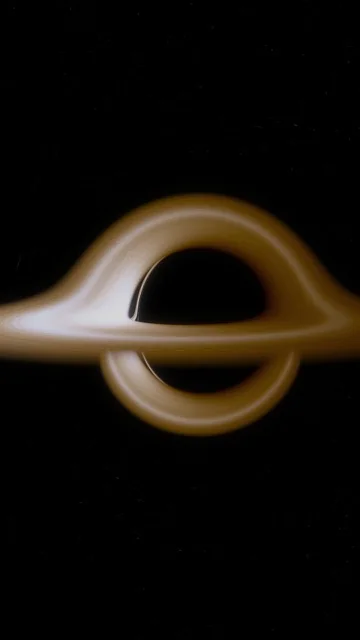
The Life of a Black Hole
Birth, feeding, a shredded star, a merger and the long fade, with light bent by real geometry.
The Story of Everything
13.8 billion years, from the first light to the lights of Earth tonight. Free in full.
Death of a Giant Star
Betelgeuse, Wolf-Rayet dust spirals, Supernova 1987A and the neutron star at the end.
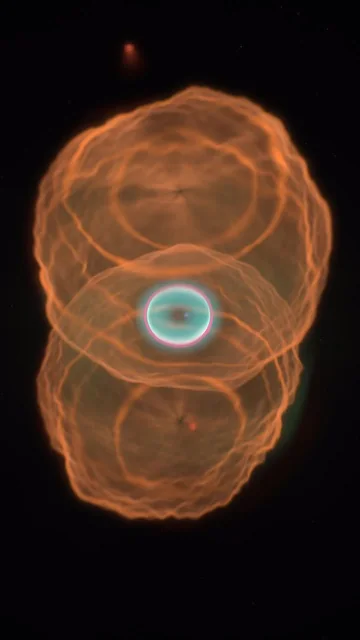
How the Hourglass Nebula Formed
A red giant sheds its skin, and a fast wind carves what is left into an hourglass.