The Life of a Star: from a cold cloud to a white dwarf or a supernova, in six live chapters
The Life of a Star follows a star from a cold, dark cloud to its last light in six live simulations. Most of it is the life of a star like the Sun: its birth in a spinning disk, the family of sister stars it is born with, the long calm middle, the red giant and the gentle end as a white dwarf. The last chapter shows the other way to die, when a star many times heavier explodes.
Each chapter borrows a scene from another Everdust Story and gives it new lines, read by River, the narrator, so you see the same physics from a star's point of view. Along the way the narration says what is measured, what is modeled and what is sped up.
At a glance
- Chapters
- 6, each a live simulation
- Length
- about 5 minutes played straight through
- Narrator
- River, with subtitles
- Free or Plus
- Free: chapters I–III and VI. Everdust Plus: chapters IV–V
- Where
- Everdust on iPhone and iPad, Android, Apple Vision Pro, Mac, Apple TV and Meta Quest 3 and 3S
Chapter by chapter
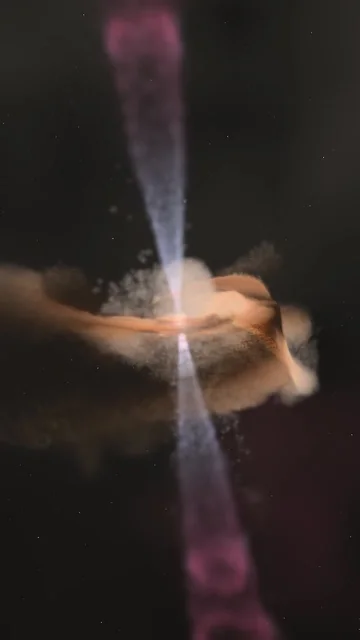
Chapter I A Star Is Born Free
A cold cloud collapses, spins into a disk, and a protostar lights at its heart.
Every star begins as a cold, dark cloud of gas and dust. Gravity pulls it in, and the middle falls first. Jets fire from the poles of the newborn star at the heart, each bright knot a burst of feeding, while the cloud's slow spin flattens the falling gas into a disk. The young star glows hot and bright, but it is not burning yet: it shines from the heat of falling.
Stars form when the densest parts of cold molecular clouds collapse under their own gravity, with turbulence and magnetic fields shaping where and how fast [1]. The collapse runs from the inside out, the center first, as Frank Shu showed in 1977 [2]. Young stars throw out jets and winds whose knots show that feeding comes in bursts [3]. The main feeding stage lasts something like a hundred thousand years [4], squeezed here into seconds. Gravity and spin are simulated, but the jets follow a simple launch rule rather than the magnetic fields that drive real ones. More in How a star is born.
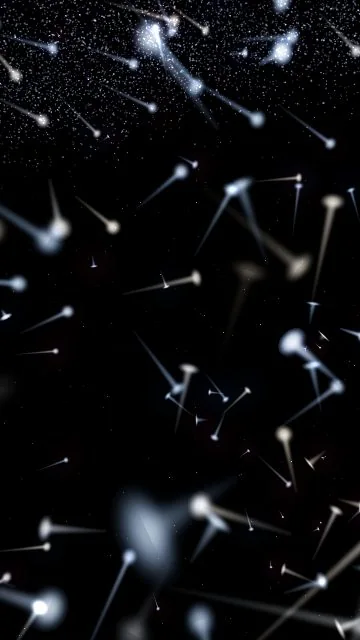
Chapter II Born Together Free
Stars are born in families: clumps of young stars fall together under their own gravity.
Stars are rarely born alone: one cloud can make thousands. You float among clumps of young stars falling toward each other, and slowly they merge into one turning swarm. Every star pulls on every other and nothing else steers them, so the collapse and the spin come from gravity alone. The hottest, heaviest stars shine blue.
Most stars form in embedded clusters, still wrapped in their birth cloud; in nearby clouds 70 to 90 percent of new stars form this way [5]. Few of these families last: fewer than 4 to 7 percent of embedded clusters survive as bound clusters to the age of the Pleiades [5]. The Sun was very likely born in such a group, and its brothers and sisters have long since drifted apart [6].
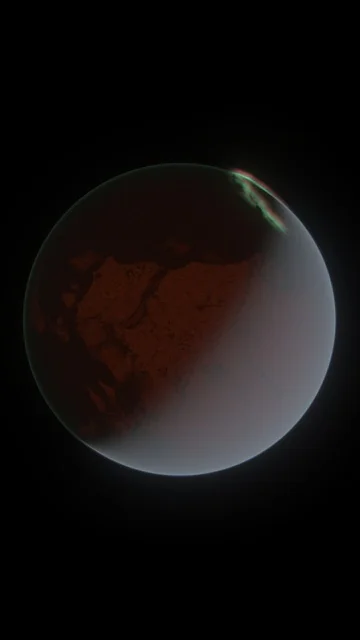
Chapter III The Long Middle Free
A star like the Sun spends most of its life fusing hydrogen, and slowly grows brighter.
Most of a star's life is calm: it fuses hydrogen into helium in its core. Here you watch Earth while a brightening Sun runs on at sixty million years a second. The sea ice and the plants go, the land ice melts, the oceans boil away and even Earth's night side glows with heat, and still the Sun has not begun to die.
The Sun turns about 4.3 million tonnes of its own mass into energy every second [7]. It is 4.57 billion years old, dated by the oldest solids in meteorites [8], and about halfway through its hydrogen-burning life [9]. As helium builds up, its core slowly contracts and heats, so the Sun brightens by roughly 10 percent every billion years [10][11]. In a billion years or so that should start driving Earth's oceans away, a projection from climate models [12][11]. The sea level falls through the real shape of today's sea floor.
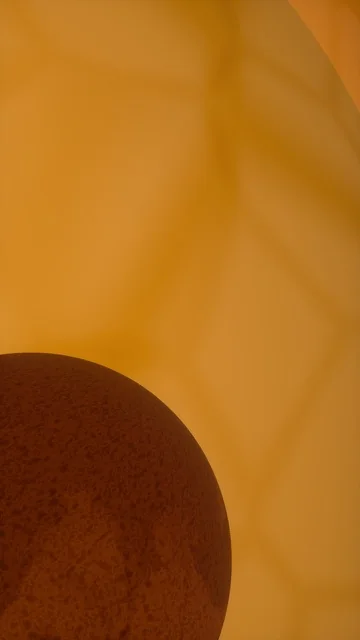
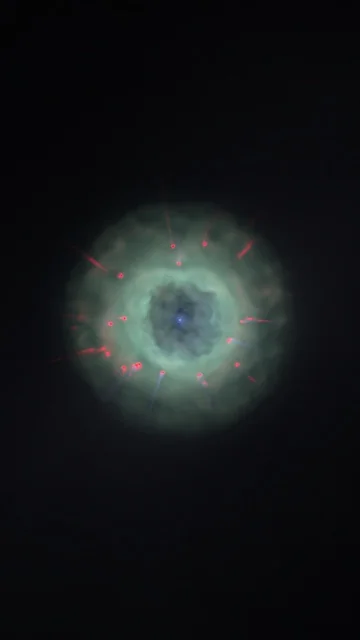
Chapter IV The Red Giant Plus
Its core's hydrogen spent, the Sun swells into a red giant, then helium ignites.
Billions of years later the hydrogen in the core runs out. The core shrinks and heats, the outer layers swell, and the star grows huge, cool and red. Mercury is swallowed, then Venus, and in this model Earth does not escape. Then helium ignites in the core and the giant shrinks back, swells again with helium and hydrogen burning in shells, pulses and throws off shells of gas and dust. Mars survives.
In one detailed model the Sun reaches 256 times its present radius about 7.6 billion years from now, and tides drag Earth into it despite the Sun's mass loss; an earlier model without tides had Earth escape [9][11]. That is why the narration says "in this model". After helium ignites, the Sun enters its second giant phase, the asymptotic giant branch, when shells of helium and hydrogen burn around the core and the star pulses and sheds mass heavily [13]. The planets' orbits are computed live with the mass loss and tides. More in Will the Sun swallow the Earth?
Chapter V The Gentle End Plus
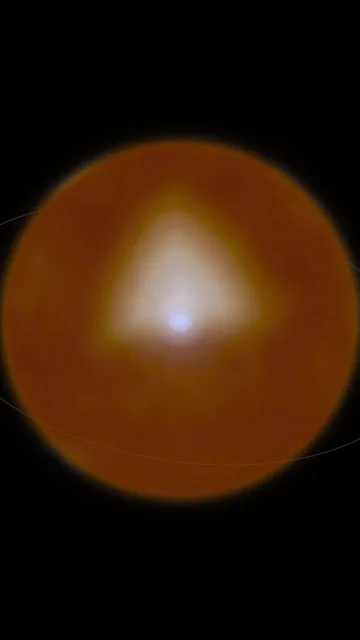
A Sun-like star sheds its outer layers as a glowing nebula; its core is left as a white dwarf.
A star like the Sun ends gently. It lets go of its outer layers, and a fast wind from the bare core sweeps them into a shell that you watch from inside, teal for oxygen and red for hydrogen and nitrogen. It is called a planetary nebula, though despite the name it has nothing to do with planets. At the center is the core: a white dwarf, about the size of Earth.
The shell forms as a fast wind from the exposed core plows into the slow, dusty wind the giant shed before, the interacting-winds model proposed in 1978 [14]. A typical white dwarf packs about half the Sun's mass into a ball only slightly bigger than Earth, at a density around a billion kilograms per cubic meter [15], so a teaspoonful would weigh about five tonnes, as much as an elephant. The nebula's glow fades long before the white dwarf does, which goes on cooling for far longer than the universe's present age [16].
Chapter VI The Big Ones Free
A star many times the Sun's mass burns down to iron, collapses and explodes.
A star many times the Sun's mass is built layer on layer, with iron at its heart. Iron cannot fuel the star, so the core collapses in under a second, rebounds, and the star blows itself apart as a supernova. What is left is a neutron star as wide as a city, or, from some of the heaviest stars, a black hole.
Stars of more than about eight Suns are never held up by the pressure that supports white dwarfs: their centers fuse ever heavier elements until a core of iron forms, and its collapse to a neutron star releases far more energy than the explosion needs [17]. The shock is most likely revived by heating from the flood of neutrinos [18]. Massive stars and their supernovae made most of the oxygen you breathe [19][20]. A neutron star is about 20 kilometers across [21], but where the line between a neutron star and a black hole falls is uncertain [22], so the chapter names both. The explosion is an honest approximation, not a full simulation of the gas.
What’s simulated, and what isn’t
The physics at each chapter's core runs live: gravity and spin in the collapsing cloud, every star pulling on every other in the young cluster, Earth's sea level falling through the measured shape of today's sea floor as the Sun brightens, the planets' orbits widening and decaying around the red giant, and a fast wind sweeping up a slow one into a nebula. Some parts are simpler than nature: the jets follow a launch rule rather than magnetic fields, the supernova is an approximation, and every chapter compresses time, from a hundred thousand years into seconds to sixty million years a second.
Watch The Life of a Star in Everdust
The Life of a Star is in the Everdust app on iPhone and iPad, Android, Apple Vision Pro, Mac, Apple TV and Meta Quest 3 and 3S. Open Everdust, choose Stories, then The Life of a Star. Free: chapters I–III and VI. Everdust Plus: chapters IV–V.
Everdust on the App Store (iPhone, iPad, Apple Vision Pro, Mac, Apple TV)Everdust on Google Play (Android)Everdust on the Meta Horizon Store (Quest 3 and 3S)
Everdust is free to download, with no ads and no account. Everdust Plus, an optional subscription, opens every chapter of every Story on iPhone, iPad, Android, Apple Vision Pro, Mac and Apple TV (on Meta Quest, which chapters are free can differ).
Questions people ask
How long do stars live? It depends on their mass. The Sun will spend about 10 billion years fusing hydrogen in its core [9]; the smallest red dwarfs last trillions of years, and stars of more than about eight Suns only a few million to tens of millions [23][17].
What will happen to the Sun when it dies? It will swell into a red giant, shed its outer layers and leave behind a white dwarf of a little over half its present mass [11][9].
What is a white dwarf? The exposed core of a star like the Sun after it sheds its outer layers: typically about half the Sun's mass in a ball only slightly bigger than Earth [15].
Sources
- McKee, C. F. & Ostriker, E. C. (2007). Theory of star formation. Annual Review of Astronomy and Astrophysics 45, 565.
- Shu, F. H. (1977). Self-similar collapse of isothermal spheres and star formation. The Astrophysical Journal 214, 488.
- Bally, J. (2016). Protostellar outflows. Annual Review of Astronomy and Astrophysics 54, 491.
- Evans, N. J. et al. (2009). The Spitzer c2d Legacy results: star-formation rates and efficiencies; evolution and lifetimes. The Astrophysical Journal Supplement Series 181, 321.
- Lada, C. J. & Lada, E. A. (2003). Embedded clusters in molecular clouds. Annual Review of Astronomy and Astrophysics 41, 57.
- Adams, F. C. (2010). The birth environment of the Solar System. Annual Review of Astronomy and Astrophysics 48, 47.
- NASA Goddard Space Flight Center. Sun Fact Sheet (NSSDCA).
- Connelly, J. N. et al. (2012). The absolute chronology and thermal processing of solids in the solar protoplanetary disk. Science 338, 651.
- Schröder, K.-P. & Smith, R. C. (2008). Distant future of the Sun and Earth revisited. Monthly Notices of the Royal Astronomical Society 386, 155.
- Gough, D. O. (1981). Solar interior structure and luminosity variations. Solar Physics 74, 21.
- Sackmann, I.-J., Boothroyd, A. I. & Kraemer, K. E. (1993). Our Sun. III. Present and future. The Astrophysical Journal 418, 457.
- Kasting, J. F. (1988). Runaway and moist greenhouse atmospheres and the evolution of Earth and Venus. Icarus 74, 472.
- Herwig, F. (2005). Evolution of asymptotic giant branch stars. Annual Review of Astronomy and Astrophysics 43, 435.
- Kwok, S., Purton, C. R. & Fitzgerald, P. M. (1978). On the origin of planetary nebulae. The Astrophysical Journal 219, L125.
- NASA Goddard Space Flight Center, HEASARC. Imagine the Universe: White Dwarf Stars.
- Adams, F. C. & Laughlin, G. (1997). A dying universe: the long-term fate and evolution of astrophysical objects. Reviews of Modern Physics 69, 337.
- Woosley, S. E., Heger, A. & Weaver, T. A. (2002). The evolution and explosion of massive stars. Reviews of Modern Physics 74, 1015.
- Janka, H.-T. (2012). Explosion mechanisms of core-collapse supernovae. Annual Review of Nuclear and Particle Science 62, 407.
- Woosley, S. E. & Weaver, T. A. (1995). The evolution and explosion of massive stars. II. Explosive hydrodynamics and nucleosynthesis. The Astrophysical Journal Supplement Series 101, 181.
- Kobayashi, C., Karakas, A. I. & Lugaro, M. (2020). The origin of elements from carbon to uranium. The Astrophysical Journal 900, 179.
- Özel, F. & Freire, P. (2016). Masses, radii, and the equation of state of neutron stars. Annual Review of Astronomy and Astrophysics 54, 401.
- Sukhbold, T., Ertl, T., Woosley, S. E., Brown, J. M. & Janka, H.-T. (2016). Core-collapse supernovae from 9 to 120 solar masses based on neutrino-powered explosions. The Astrophysical Journal 821, 38.
- Laughlin, G., Bodenheimer, P. & Adams, F. C. (1997). The end of the main sequence. The Astrophysical Journal 482, 420.
Earth imagery in Chapter III: NASA Blue Marble and Black Marble. Sea floor relief in Chapter III: PALEOMAP PaleoDEM, C. R. Scotese and N. M. Wright (2018), CC BY 4.0. Chapter stills: Everdust, from each chapter’s live simulation. The Story’s script was written for Everdust from the sources above; River reads it. This page retells it in its own words.
More Stories
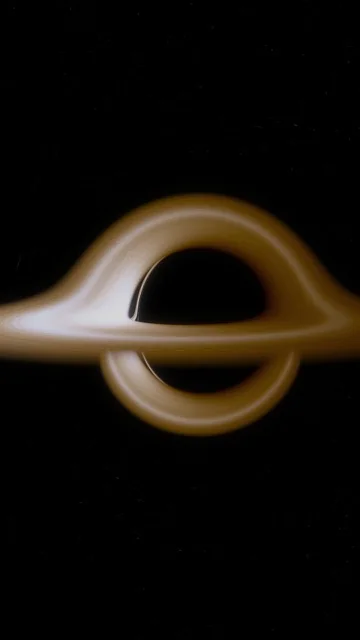
The Life of a Black Hole
Birth, feeding, a shredded star, a merger and the long fade, with light bent by real geometry.
The Story of Everything
13.8 billion years, from the first light to the lights of Earth tonight. Free in full.
The Future of Everything
From Earth's lights tonight to the last black hole, following the physics forward.
Death of a Giant Star
Betelgeuse, Wolf-Rayet dust spirals, Supernova 1987A and the neutron star at the end.