The Life of a Black Hole: from a dying star's collapse to whatever lies beyond, in nine live chapters
The Life of a Black Hole follows one of nature's strangest objects from birth to its last breath in nine live chapters. It starts with a dying star collapsing until even light cannot escape and ends with what might lie inside, while River, the narrator, keeps a clear line between what has been measured and what is still a guess.
In between, a newborn black hole bends the starlight around it, gas spirals in and blazes, a star is torn apart, two black holes merge, a quasar blows out its galaxy's gas, you fall through the horizon, and at the end of time the hole evaporates. Nearly every ray of light is traced through the geometry Einstein's theory predicts.
At a glance
- Chapters
- 9, each a live simulation
- Length
- about 11 minutes played straight through
- Narrator
- River, with subtitles
- Free or Plus
- Free: chapters I–II. Everdust Plus: chapters III–IX
- Where
- Everdust on iPhone and iPad, Android, Apple Vision Pro, Mac, Apple TV and Meta Quest 3 and 3S
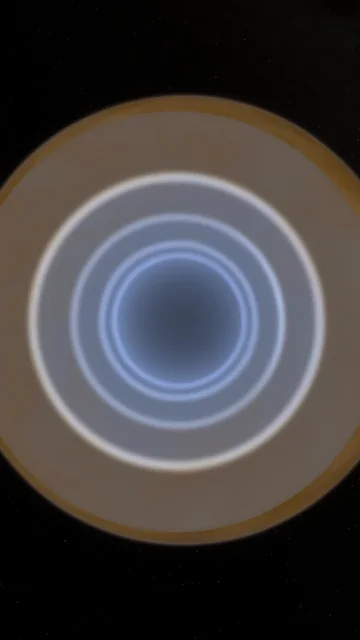 ICollapse
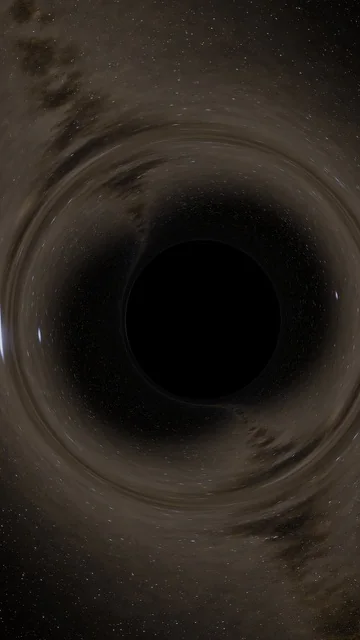 IIThe Newborn
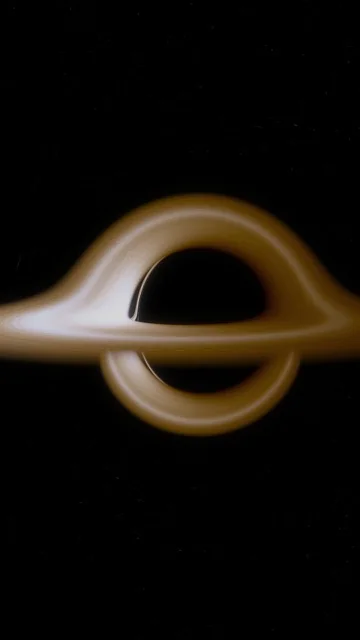 IIIFeeding
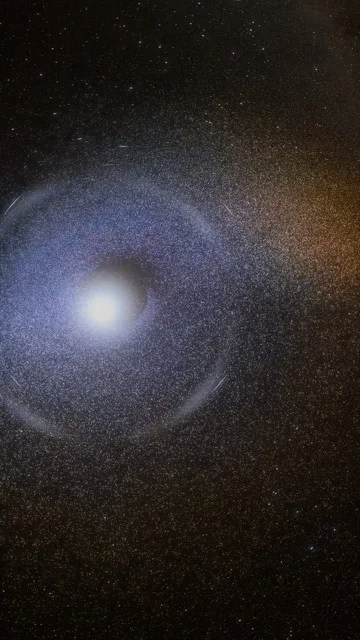 IVA Star Is Shredded
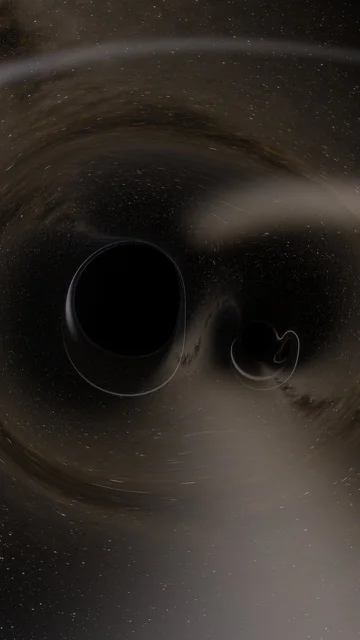 VMerger
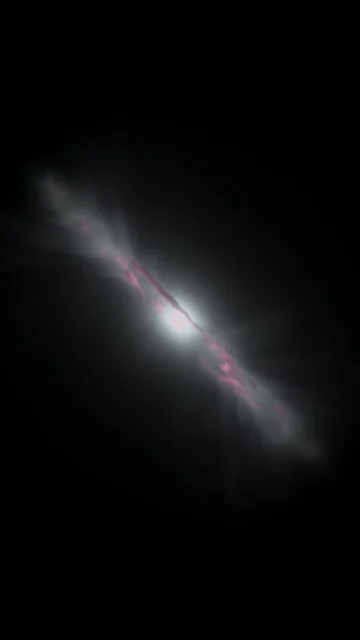 VIThe Quasar
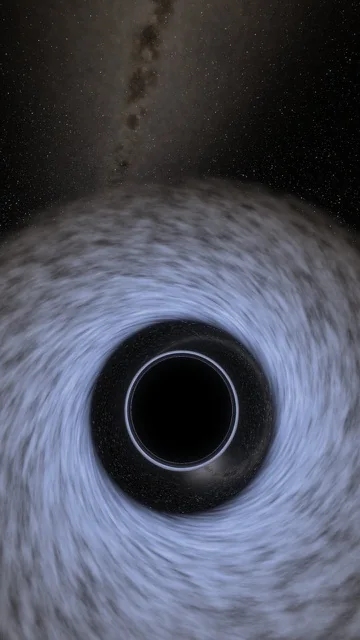 VIIFalling In
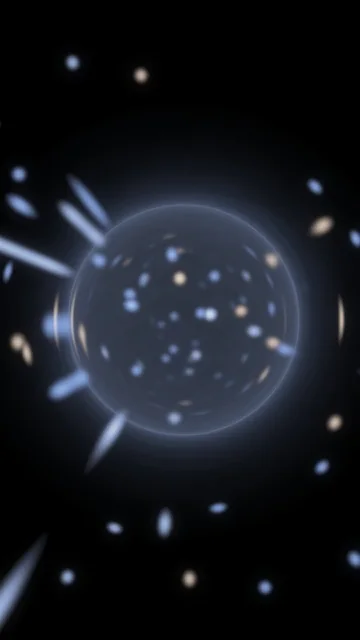 VIIIThe Long Dark
 IXBeyond
Chapter by chapter
Chapter I Collapse Free
A massive star's iron core collapses, and sometimes the whole star falls in.
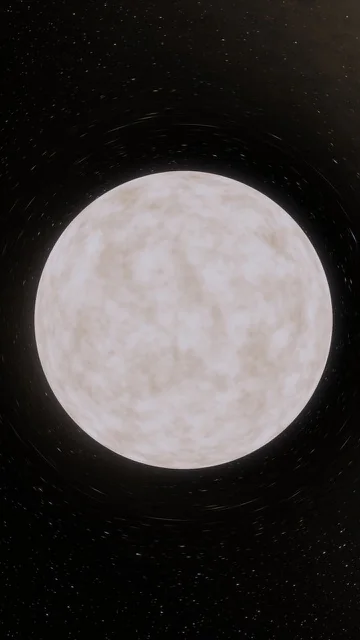
A massive star has run out of fuel, and nothing holds it up. Straight ahead of you it falls in on itself, shrinking, reddening and dimming as its gravity stretches the light that reaches you. You never see it cross the edge: its image seems to freeze and fade, leaving a last ring of light and then only a shadow.
This is the collapse J. Robert Oppenheimer and Hartland Snyder worked out in 1939 for a star with no pressure left: seen from far away, the surface creeps toward its gravitational radius ever more slowly, its light reddened and escaping through a narrower and narrower range of angles [1]. Every ray is traced through that geometry; the surface pattern and the sky are drawn. The real collapse of a core like this takes a few thousandths of a second, slowed here about ten thousand times.
Chapter II The Newborn Free
The newborn hole's shadow and photon ring, with starlight bent around it.
A newborn black hole hangs alone in space, its dark shadow ringed by the starry sky bent into arcs. One bright star drifting behind it appears twice, once on each side, and as it lines up its two images nearly close into a ring. Right at the shadow's edge the whole sky appears again, mirrored.
A mass lined up in front of a star can bend its light into a ring, as Albert Einstein calculated in 1936 [2]. Every direction in the chapter is a light ray traced around a spinning black hole, so the lensing is real; the sky itself is drawn. The spin makes the shadow slightly lopsided. A dark shadow inside a ring of light is what the Event Horizon Telescope saw around the black hole in the galaxy M87, as general relativity predicts [3].
Chapter III Feeding Plus
Gas spirals in through a thin, hot accretion disk and plunges in past its last stable orbit.
A black hole is invisible until it eats. Gas spirals in and heats up into a thin, glowing disk. The side rushing toward you shines brighter and bluer, and the far side appears above the shadow, bent up by gravity, so you are seeing behind the hole. Inside the disk's inner edge, the last stable orbit, gas plunges straight in.
Where that last stable orbit lies, and how much energy gas gives up reaching it, depend on how fast the black hole spins [4]. For this one, at 90 percent of the maximum spin, gas near the edge circles at more than half the speed of light, and falling in turns about 15 percent of its mass into light. That is how a feeding black hole can shine as a quasar. The disk's colors follow its temperature and motion; its turbulence is drawn.
Chapter IV A Star Is Shredded Plus
A star that strays too close is torn apart by tides.
A star has wandered too close to a black hole, and the hole's gravity stretches it into a long, thin stream. About half escapes into space: the blue half. The red and amber half is caught and falls back, the deepest red first because it is the most tightly bound, and the returning stream crosses itself.
This is a tidal disruption event: close in, the difference in the hole's pull across a star beats the star's own gravity, and the half of the debris that stays bound falls back to power a flare lasting months to years [5][6]. Collisions where the stream crosses itself may help light it [7]; one survey found 33 such flares in three years [8]. The chapter's star holds itself together by its own gravity; it is scaled down, sped up and has no gas pressure.
Chapter V Merger Plus
GW150914: two black holes merge, the first gravitational waves ever detected.
Two black holes circle each other, closer and faster, while a sheet of dust below you ripples with the gravitational waves they send out. Then they merge into one. The real event's last fraction of a second plays about 58 times slower, and the waves are drawn enormously larger than life.
This is GW150914, the first gravitational waves ever detected, caught by LIGO on 14 September 2015. Black holes of about 36 and 29 times the Sun's mass merged into one of about 62, turning about three Suns' worth of mass into gravitational waves [9]. The source lay some 1.3 billion light-years away, and when the ripple passed Earth it stretched space by only about one part in a thousand billion billion [9]. The chapter follows the event's real waveform.
Chapter VI The Quasar Plus
A feeding giant black hole outshines its galaxy as a quasar and drives a wind.
A whole galaxy surrounds you, with a giant black hole at its heart. It starts to feed and blazes as a quasar, and two bubbles of gas blow out above and below the disk as its light pushes the gas away: the thick disk shields itself, and the thin gas gives way first. The colors are invented, to show which gas is pushed.
In a model Andrew King proposed in 2003, a quasar's outflow pushes on its galaxy's gas like a wind blowing a bubble, which would explain the link between a black hole's mass and the speeds of the stars around it [10]. Radiation, winds and jets from feeding black holes can clear a galaxy's gas and stop it making stars, though for the quasar's push the evidence is still being gathered [11]. The chapter is a toy model of that push.
Chapter VII Falling In Plus
What general relativity predicts you would see falling through the event horizon.
This time, you fall in, straight through the middle of the glowing disk. Light from ahead turns blue while the sky behind you reddens and dims, and soon you are falling at nearly the speed of light. You cross the horizon and nothing marks the spot, but no path leads back out. Deeper down our best theories stop working, so the fall stops too.
Everything you see is what general relativity predicts from your own falling point of view, including that nothing special happens at the horizon itself. A spinning black hole also has an inner horizon, where calculations suggest space-time becomes so curved that the classical theory breaks down [12]. The fall is a time-lapse: into a black hole of ten Suns it would take milliseconds, and into the one at the Milky Way's center, about four million Suns [13], most of an hour.
Chapter VIII The Long Dark Plus
Over unimaginable times black holes evaporate by Hawking radiation (predicted).
A black hole sits alone in the dark with nothing left to eat, slowly leaking away; each spark is a particle escaping. A countdown starts at a 1 followed by seventy zeros, in years. As the hole shrinks it gets hotter and its glow changes color, until it is hot enough to make electrons and then heavier particles. Its last second ends in a flash. Then, nothing.
Stephen Hawking predicted that a black hole's temperature rises as its mass falls, so it evaporates ever faster [14]. Detailed calculations give the rate and the particles it sends out, from massless ones while it is cool to quarks and gluons once it is hot enough [15][16]. The glow is far too faint to detect: no one has ever observed Hawking radiation, and the chapter's colors are false.
Chapter IX Beyond Plus
What lies inside is unknown: white holes, new universes, a bounce (hypotheses).
What happens inside a black hole? No one knows, so the chapter shows three ideas, none of them proven: a white hole, a black hole run backward in time, where a star bursts out; black holes giving birth to new universes, each a little different from its parent; and a collapse that bounces into a new expanding universe.
In 1992 Lee Smolin proposed that black holes bounce into new universes whose constants vary slightly, so that universes making the most black holes come to dominate, a kind of natural selection [17]. In 2010 Nikodem Popławski suggested that torsion, a twisting of space-time by spinning matter, would halt a collapse and make it bounce, so our Big Bang could be a bounce inside a black hole in another universe [18]. Both are shown as toy models with invented rules. White holes are allowed by Einstein's equations, but none has ever been seen.
What’s simulated, and what isn’t
Most chapters trace light through the exact geometry general relativity predicts around a black hole, so the shadows, arcs, rings and color shifts are real, and the merger follows the measured waveform of GW150914. Much else is simplified or illustrated: the shredded star is scaled down and sped up, the quasar is a toy model in invented colors, the Hawking glow has false colors and a compressed countdown, the skies are drawn, and the last chapter's ideas are toy models of real proposals. The narration says so each time.
Watch The Life of a Black Hole in Everdust
The Life of a Black Hole is in the Everdust app on iPhone and iPad, Android, Apple Vision Pro, Mac, Apple TV and Meta Quest 3 and 3S. Open Everdust, choose Stories, then The Life of a Black Hole. Free: chapters I–II. Everdust Plus: chapters III–IX.
Everdust on the App Store (iPhone, iPad, Apple Vision Pro, Mac, Apple TV)Everdust on Google Play (Android)Everdust on the Meta Horizon Store (Quest 3 and 3S)
Everdust is free to download, with no ads and no account. Everdust Plus, an optional subscription, opens every chapter of every Story on iPhone, iPad, Android, Apple Vision Pro, Mac and Apple TV (on Meta Quest, which chapters are free can differ).
Questions people ask
How does a black hole form? Black holes the mass of stars form when the core of a massive star runs out of fuel and collapses under its own weight, a collapse first worked out by Oppenheimer and Snyder in 1939 [1].
What was the first black hole merger ever detected? GW150914, caught by LIGO on 14 September 2015: black holes of about 36 and 29 Suns merged into one of about 62 [9].
Do black holes last forever? Probably not. Hawking predicted they slowly evaporate, faster as they shrink, though the effect is far too faint to have been observed [14].
Sources
- Oppenheimer, J. R. & Snyder, H. (1939). On continued gravitational contraction. Physical Review 56, 455.
- Einstein, A. (1936). Lens-like action of a star by the deviation of light in the gravitational field. Science 84, 506.
- Event Horizon Telescope Collaboration (2019). First M87 Event Horizon Telescope results. I. The shadow of the supermassive black hole. The Astrophysical Journal Letters 875, L1.
- Bardeen, J. M., Press, W. H. & Teukolsky, S. A. (1972). Rotating black holes: locally nonrotating frames, energy extraction, and scalar synchrotron radiation. The Astrophysical Journal 178, 347.
- Rees, M. J. (1988). Tidal disruption of stars by black holes of 10^6–10^8 solar masses in nearby galaxies. Nature 333, 523.
- Gezari, S. (2021). Tidal disruption events. Annual Review of Astronomy and Astrophysics 59, 21.
- Piran, T. et al. (2015). Disk formation versus disk accretion: what powers tidal disruption events? The Astrophysical Journal 806, 164.
- Yao, Y. et al. (2023). Tidal disruption event demographics with the Zwicky Transient Facility: volumetric rates, luminosity function, and implications for the local black hole mass function. The Astrophysical Journal Letters 955, L6.
- Abbott, B. P. et al. (LIGO Scientific Collaboration and Virgo Collaboration) (2016). Observation of gravitational waves from a binary black hole merger. Physical Review Letters 116, 061102.
- King, A. (2003). Black holes, galaxy formation, and the M_BH–σ relation. The Astrophysical Journal Letters 596, L27.
- Fabian, A. C. (2012). Observational evidence of active galactic nuclei feedback. Annual Review of Astronomy and Astrophysics 50, 455.
- Poisson, E. & Israel, W. (1990). Internal structure of black holes. Physical Review D 41, 1796.
- Event Horizon Telescope Collaboration (2022). First Sagittarius A* Event Horizon Telescope results. I. The shadow of the supermassive black hole in the center of the Milky Way. The Astrophysical Journal Letters 930, L12.
- Hawking, S. W. (1974). Black hole explosions? Nature 248, 30.
- Page, D. N. (1976). Particle emission rates from a black hole: massless particles from an uncharged, nonrotating hole. Physical Review D 13, 198.
- MacGibbon, J. H. & Webber, B. R. (1990). Quark- and gluon-jet emission from primordial black holes: the instantaneous spectra. Physical Review D 41, 3052.
- Smolin, L. (1992). Did the universe evolve? Classical and Quantum Gravity 9, 173.
- Popławski, N. J. (2010). Cosmology with torsion: an alternative to cosmic inflation. Physics Letters B 694, 181.
The GW150914 waveform in Chapter V: LIGO Scientific Collaboration and Virgo Collaboration, via the Gravitational Wave Open Science Center (gwosc.org), a service of the LIGO Scientific Collaboration, the Virgo Collaboration and KAGRA (CC BY 4.0). Chapter stills: Everdust, from each chapter’s live simulation. The Story’s script was written for Everdust from the sources above; River reads it. This page retells it in its own words.
More Stories
Anatomy of a Thought
Follow one prompt through a small language model, from words to its answer: Rome.
The Story of Everything
13.8 billion years, from the first light to the lights of Earth tonight. Free in full.
The Future of Everything
From Earth's lights tonight to the last black hole, following the physics forward.
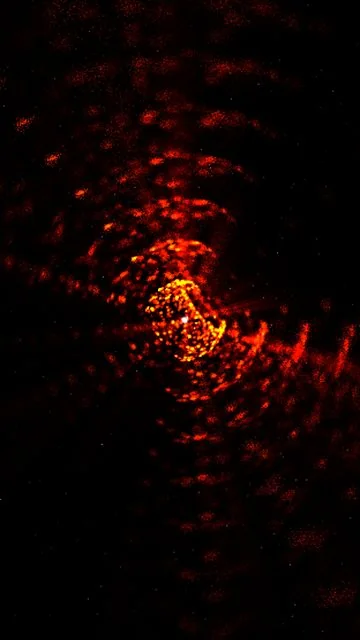
Death of a Giant Star
Betelgeuse, Wolf-Rayet dust spirals, Supernova 1987A and the neutron star at the end.