What is a tidal disruption event? How a black hole tears a star apart
A tidal disruption event is what happens when a star strays too close to a giant black hole: the hole's tides stretch the star into a long stream and tear it apart. About half the wreckage escapes into space and the rest falls back toward the hole, setting off a flare that can shine for months to years from the heart of a galaxy that was otherwise quiet. Astronomers now catch these flares every year, and they are one of the best ways to find the dormant black holes at the centers of galaxies.
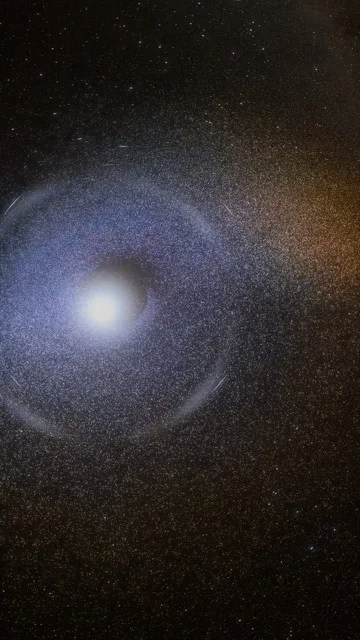
How tides tear a star apart
Gravity weakens with distance, so a black hole pulls harder on the near side of a star than on the far side. Far away the difference is tiny. But inside a certain distance, called the tidal radius, the difference in pull across the star is stronger than the star's own gravity holding it together, and the star is pulled apart [1]. For a star like the Sun and a black hole of a million Suns, the tidal radius works out to about 100 times the Sun's radius, roughly half the distance from Earth to the Sun.
The star does not vanish into the hole at once. It is stretched along its path into a long, thin stream of gas, and its pieces carry on around the black hole on orbits of their own.
Too big a black hole swallows the star whole
A black hole's event horizon grows in step with its mass, while the tidal radius grows more slowly. So for the very biggest black holes the horizon lies outside the tidal radius, and a star crosses it before the tides can tear it apart: it is swallowed whole, with no flare. For a Sun-like star the limit is about 100 million times the Sun's mass for a black hole that does not spin, rising to about 700 million for one spinning as fast as possible [1].
Surveys see exactly this cut-off. In the largest complete sample of these events, flares become much rarer around black holes heavier than about 30 million Suns, as expected if stars there are being captured whole [2].
Half escapes, half comes back
Once the star is torn apart, its pieces carry a spread of orbital energies. Roughly half the debris is flung out of the system for good, and the other half stays bound on long, stretched orbits [1][3]. The bound gas returns to the black hole, the most tightly bound first, at a rate that falls steadily with time; in the simplest theory it drops as time to the power minus five-thirds [1]. That returning gas, worked out in theory in 1988 and 1989, is what powers the flare [4][5], and the light fades over months to years [1].
What makes the light?
Exactly how the returning gas becomes light is still argued over. The simple picture has it settling into a hot disk that feeds the black hole. But the black hole's warped space-time twists each orbit, so the returning stream swings around and crosses itself, and where streams collide, shocks heat the gas [1][6]. Some astronomers think the energy released as the debris settles, rather than the feeding itself, powers the visible glow [3]. For one nearby event, AT2019qiz, the early light was dominated by gas blown outward from the debris [7].
One clue points to the collisions. The region glowing in visible light is around a hundred times larger than the expected disk, and close to the size of the place where the streams cross [1].
How astronomers find them
The idea goes back to the 1970s, when massive black holes were first suspected at the centers of galaxies [1]. The first real candidates turned up in the 1990s as bright, soft X-ray outbursts from galaxies with no other sign of an active black hole, found by the ROSAT satellite's survey of the whole sky, and optical surveys that scan the sky night after night have since made discoveries routine [1][8]. A 2021 review counted 56 known events [1], and the Zwicky Transient Facility found 33 in a complete sample over three years [2].
A few launch jets of matter near the speed of light. In 2011 NASA's Swift satellite caught one of these, Swift J1644+57, whose X-rays had brightened at least 10,000-fold since 1990 [9].
How often does it happen?
In any one galaxy, rarely. The survey counts give about one event every 30,000 years in a typical galaxy of around ten billion Suns' worth of stars [2], in line with theoretical estimates of one every 10,000 to 100,000 years [1].
Our own galaxy's central black hole, Sagittarius A*, has about four million times the Sun's mass [10], far below the swallow-whole limit. A star that wandered too close to it would be torn apart, and the center of the Milky Way would light up with its flare.
Watch it in Everdust
A Star Is Shredded is Chapter IV of The Life of a Black Hole. A star that holds itself together by its own gravity falls past the black hole and is torn into a stream. About half its mass flies off, drawn in blue, while the bound half, amber to deep red, swings back and crosses itself; that split comes out of gravity alone. The scene is scaled down so the black hole is only a thousand times the star's mass, sped up after the first pass and has no gas pressure, and the glowing ring that tracks the returning debris is schematic. In reality all this takes months or years.
Watch it in Everdust
The Life of a Black Hole is in the Everdust app on iPhone and iPad, Android, Apple Vision Pro, Mac, Apple TV and Meta Quest 3 and 3S. Open Everdust, choose Stories, then The Life of a Black Hole; A Star Is Shredded is chapter 4. Free: chapters I–II. Everdust Plus: chapters III–IX.
Everdust on the App Store (iPhone, iPad, Apple Vision Pro, Mac, Apple TV)Everdust on Google Play (Android)Everdust on the Meta Horizon Store (Quest 3 and 3S)
Everdust is free to download, with no ads and no account. Everdust Plus, an optional subscription, opens every chapter of every Story on iPhone, iPad, Android, Apple Vision Pro, Mac and Apple TV (on Meta Quest, which chapters are free can differ).
The rest of the Story, chapter by chapter: The Life of a Black Hole.
Questions people ask
How often do tidal disruption events happen? In a typical galaxy about once every 30,000 years, by one survey's count; across the sky that survey found 33 in three years [2].
Can a black hole swallow a star whole? Yes, if it is big enough. Above about 100 million Suns, a Sun-like star crosses the event horizon before the tides can tear it apart, so there is no flare [1].
What is spaghettification? A nickname for tidal stretching: near a black hole the pull on the near side of an object is stronger than on the far side, so it is stretched out along the line to the hole. For a whole star, that is a tidal disruption event [1].
Sources
- Gezari, S. (2021). Tidal disruption events. Annual Review of Astronomy and Astrophysics 59, 21.
- Yao, Y. et al. (2023). Tidal disruption event demographics with the Zwicky Transient Facility: volumetric rates, luminosity function, and implications for the local black hole mass function. The Astrophysical Journal Letters 955, L6.
- Piran, T. et al. (2015). Disk formation versus disk accretion: what powers tidal disruption events? The Astrophysical Journal 806, 164.
- Rees, M. J. (1988). Tidal disruption of stars by black holes of 10^6–10^8 solar masses in nearby galaxies. Nature 333, 523.
- Evans, C. R. & Kochanek, C. S. (1989). The tidal disruption of a star by a massive black hole. The Astrophysical Journal 346, L13.
- Shiokawa, H. et al. (2015). General relativistic hydrodynamic simulation of accretion flow from a stellar tidal disruption. The Astrophysical Journal 804, 85.
- Nicholl, M. et al. (2020). An outflow powers the optical rise of the nearby, fast-evolving tidal disruption event AT2019qiz. Monthly Notices of the Royal Astronomical Society 499, 482.
- Komossa, S. (2015). Tidal disruption of stars by supermassive black holes: status of observations. Journal of High Energy Astrophysics 7, 148.
- Burrows, D. N. et al. (2011). Relativistic jet activity from the tidal disruption of a star by a massive black hole. Nature 476, 421.
- Event Horizon Telescope Collaboration (2022). First Sagittarius A* Event Horizon Telescope results. I. The shadow of the supermassive black hole in the center of the Milky Way. The Astrophysical Journal Letters 930, L12.