Death of a Giant Star: how a star twenty times the Sun's mass lives, swells, explodes and what it leaves behind
Death of a Giant Star follows a star twenty times the Sun's mass through the last stages of its short life, in eight live simulations: the fuels it burns one after another, the boiling red supergiant it becomes, the companion that strips its skin, the soot spirals blown by its winds, and the collapse, explosion and remnant at the end.
River, the narrator, ties each chapter to real stars: Betelgeuse in Orion and its Great Dimming, the dusty Wolf-Rayet pairs WR 140 and Apep imaged by the James Webb Space Telescope, and Supernova 1987A, whose neutrinos were caught on Earth. Where a chapter is illustrated or simplified rather than simulated, it says so.
At a glance
- Chapters
- 8, each a live simulation
- Length
- about 7 minutes played straight through
- Narrator
- River, with subtitles
- Free or Plus
- Free: chapters I–II. Everdust Plus: chapters III–VIII
- Where
- Everdust on iPhone and iPad, Android, Apple Vision Pro, Mac, Apple TV and Meta Quest 3 and 3S
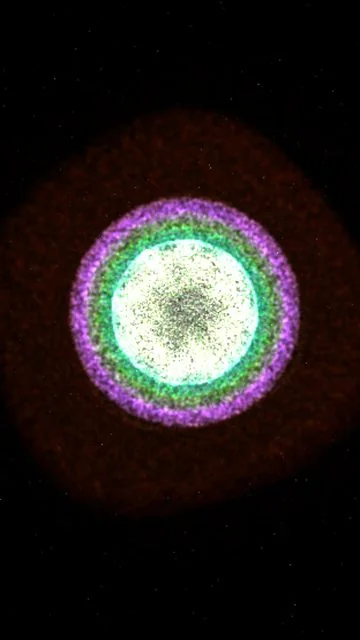 IThe Onion
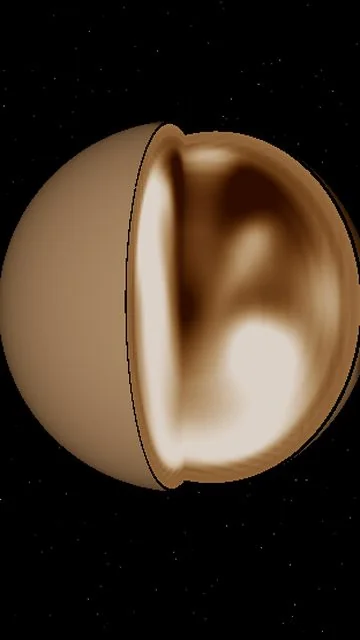 IIThe Red Supergiant
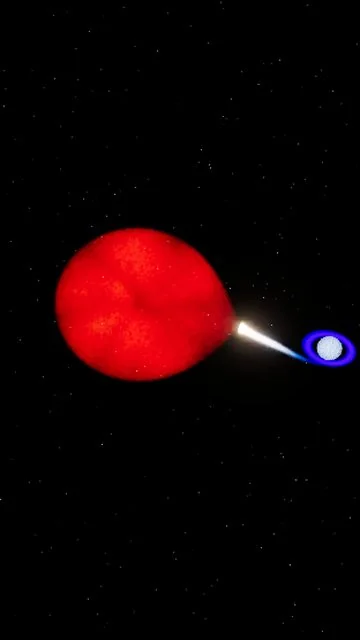 IIILosing Its Skin
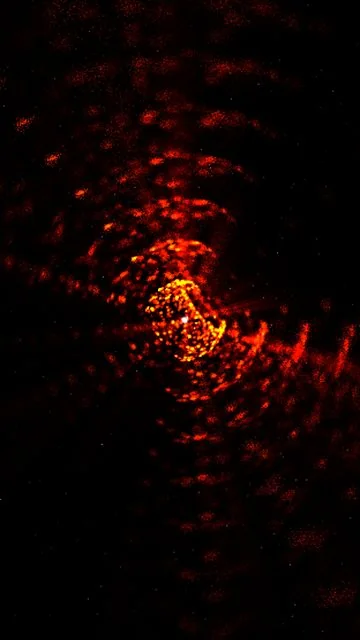 IVDust Spirals
 VApep
 VICollapse
 VIIThe Blast
 VIIIWhat's Left
Chapter by chapter
Chapter I The Onion Free
A massive star burns one fuel after another, faster and faster, until its core is iron.
A star twenty times the Sun's mass is cut open toward you, so its layers show as rings. Fuel after fuel lights at its heart, each burning faster than the last: hydrogen, then helium as the star swells into a red supergiant, then carbon, neon, oxygen and silicon, until the core is iron. Iron cannot release energy by fusing, and the furnace has nothing left.
The burning times come from a published model of a star of 20 solar masses: hydrogen for about 8 million years, helium for 1.2 million, carbon for about a thousand years, neon and oxygen for about a year each, and silicon for just 11 days. The clock races because in the late stages neutrinos carry the core's heat straight out into space [1]. The colors mark what each layer is made of; the layer sizes are illustrative and the radius is drawn on a log scale.
Chapter II The Red Supergiant Free
A red supergiant like Betelgeuse boils in a few giant cells; in 2019 dust veiled half of it.
This is a red supergiant like Betelgeuse in Orion, so big that set in place of the Sun it would reach beyond the orbit of Mars. Its whole envelope boils: a wedge opens so you can watch hot plumes rise and cool sheets sink, with only a handful of giant cells across the whole star. Then a dark veil of dust spreads over the half facing you, and within months it thins again.
Betelgeuse is about 764 times the Sun's radius in one recent estimate [2], and red supergiants have long been expected to churn in just a few huge cells [3]. Between late 2019 and early 2020 Betelgeuse dimmed to a historic low, and images showed its southern half ten times darker than usual; the leading explanation is that gas thrown off the star cooled into a cloud of dust over a cool patch on its surface [4][5]. In the chapter the contrast is stretched so the cells show, and months are compressed into seconds.
Chapter III Losing Its Skin Plus
A companion strips the giant's hydrogen, leaving a bare, blazing Wolf-Rayet core.
Most massive stars have a close companion. As this one swells, it overflows its share of space, and gas spills through the gap between the two stars, swirls into a disk around the companion and falls onto it. When the hydrogen envelope runs out, the star shrinks to its bare core, a Wolf-Rayet star, blowing a fierce wind. The wind's violet is the chapter's color, not the star's.
A 2012 survey of massive young stars found that more than 70 percent will exchange mass with a companion, and a third of those will merge with it [6]. A bare, hot core shining through a dense wind is a Wolf-Rayet star, typically 10 to 25 times the Sun's mass, with winds of thousands of kilometers a second [7]. The share of space each star controls and the gas's path through the gap follow the real geometry of two orbiting stars; the disk's stickiness is a stand-in, and about 10,000 years are compressed into seconds.
Chapter IV Dust Spirals Plus
WR 140's colliding winds make one shell of soot every eight-year orbit.
These rings are made of soot, around a pair of stars called WR 140. Every eight years the two swing close together, their winds collide, and for a few months carbon turns to dust that coasts outward. There is one shell for each orbit, nested like the rings of a tree. Then the view turns to show how the shells are tilted as we see them from Earth, and another close pass makes another shell.
WR 140 is a Wolf-Rayet star and a massive O-type companion on a long, stretched orbit, with a close pass in 2016 [8]. Its dust forms around each close pass, every 7.93 years, and the James Webb Space Telescope has imaged more than 17 shells made over about the past 130 years [9]. At that rhythm the next close pass after late 2024 is due in 2032. Real dust glows in infrared light, so the chapter's colors show its heat, and the pair of stars is drawn far larger than to scale.
Chapter V Apep Plus
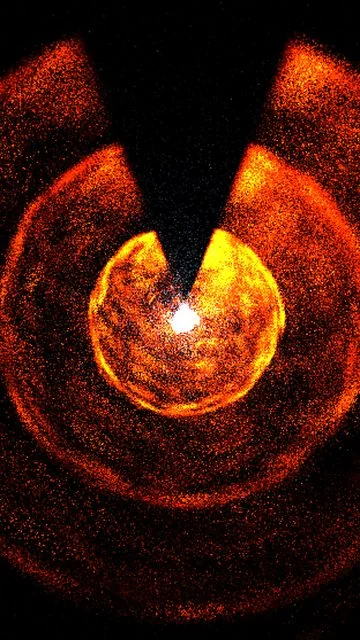
Apep: two Wolf-Rayet stars, a 190-year orbit, and a distance nobody has settled.
Apep is the extreme case: two Wolf-Rayet stars circling each other inside great shells of dust. A third star, a blue supergiant, carves a gap through every shell, and the stars' wind races out past the dust. Then comes a puzzle. The winds blow at thousands of kilometers a second, but the dust seems to drift outward far more slowly, unless Apep is much farther away than we think.
Named for the Egyptian god of chaos, Apep takes about 190 years to complete one orbit and makes dust for about 25 years of each; Webb's image shows four shells, some 700 years of activity [10][11]. Years of images show the third star slicing a cavity through the dust, proof that it is bound to the pair [11]. The slow dust, against winds of about 3,400 kilometers a second, once suggested lopsided winds from a fast-spinning star, a possible source of gamma-ray bursts [12]; new measurements favor a greater distance instead, which shrinks the mismatch [13]. No one has settled it yet.
Chapter VI Collapse Plus
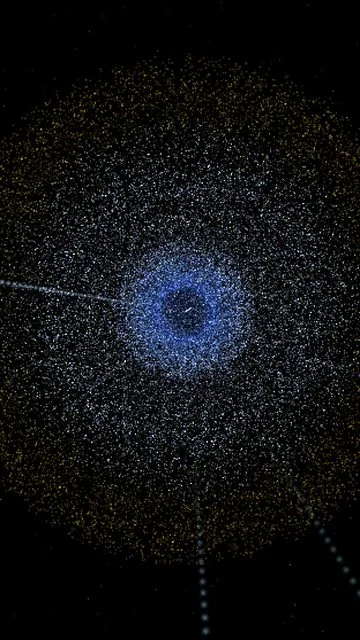
The iron core collapses in a fraction of a second, bounces, and floods space with neutrinos.
The iron core grows heavier than its electrons can hold up and falls in on itself. The whole collapse takes a fraction of a second, so the clock slows more and more to let you follow it. The inner core falls at up to a sixth of the speed of light, reaches the density of an atomic nucleus and bounces. The bounce launches a shock, but it stalls a few hundred kilometers out, and almost all the energy pours away as neutrinos.
Reviving that stalled shock is the central problem of supernova theory, and nearly all the energy released by the collapse leaves as neutrinos [14]. The chapter ends with real data: on 23 February 1987 detectors in Japan, the United States and Russia caught about two dozen neutrinos from Supernova 1987A, in the Large Magellanic Cloud, within about 13 seconds and before the explosion's light was seen [15][16][17]. They replay at their measured times; the neutrino streaks before them are illustrative.
Chapter VII The Blast Plus
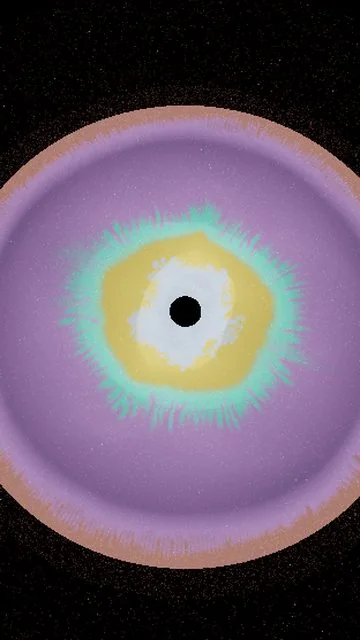
The revived shock tears the star apart, and its layers break into fingers.
Something revives the shock, and it tears out through the layers of the star. The explosion starts lopsided, and where heavy layers push on lighter ones they break into fingers: oxygen and helium reach out into the hydrogen, until the shock bursts through the surface and the star is torn apart. The colors show the elements: oxygen teal, silicon gold, iron blue.
The leading explanation for the revival is heating by neutrinos from the newborn neutron star, helped by violent churning of the gas, and real explosions are expected to be lopsided [14]. The fingers come from the Rayleigh-Taylor instability, which grows wherever a heavy fluid pushes on a lighter one, and Supernova 1987A showed heavy elements mixed far out into its hydrogen, much as the chapter shows [14]. This is a live simulation of the gas in a two-dimensional slice; the layers, the lopsided start and the seeds of the fingers are illustrative, and there is no gravity or cooling.
Chapter VIII What's Left Plus
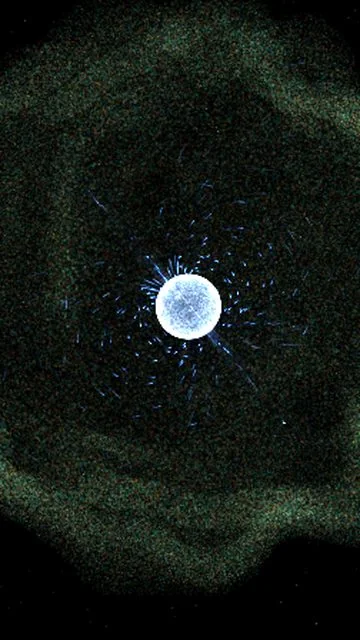
What's left: a city-sized neutron star, or, when the explosion fails, a black hole.
What's left depends on whether the explosion works. Models say a star born like this one usually explodes, leaving a neutron star heavier than the Sun and the size of a city, its magnetic field sweeping beams across space as it spins. For heavier stars the explosion often fails: the star falls in on itself and leaves a black hole instead. Which stars do which is still uncertain, and models disagree.
A 2016 survey of models found that many massive stars fail to explode and become black holes, and that the stars that do explode form islands of mass rather than one simple range; their neutron stars average about 1.4 times the Sun's mass, and the black holes about 9 to 14 [18]. X-ray timing of pulsars with NASA's NICER telescope puts a neutron star's radius at about 12 kilometers, so it is some 25 kilometers across [19][20]. In the chapter sizes are to scale, the spin is slowed down and light bending is not drawn.
What’s simulated, and what isn’t
Several chapters are live simulations of real physics: gas spilling between two orbiting stars along the true geometry of their gravity, the boiling of a supergiant's envelope, and the explosion's gas in a two-dimensional slice. Others replay published models and data: the burning stages of a 20-solar-mass star, the measured orbits of WR 140 and Apep, a model of a collapsing core and the real arrival times of the 1987 neutrinos. The narration and the About cards say what is drawn instead: layer sizes, the dust's false colors, the violet wind, the neutrino streaks, and time compressed from years or millennia into seconds.
Watch Death of a Giant Star in Everdust
Death of a Giant Star is in the Everdust app on iPhone and iPad, Android, Apple Vision Pro, Mac, Apple TV and Meta Quest 3 and 3S. Open Everdust, choose Stories, then Death of a Giant Star. Free: chapters I–II. Everdust Plus: chapters III–VIII.
Everdust on the App Store (iPhone, iPad, Apple Vision Pro, Mac, Apple TV)Everdust on Google Play (Android)Everdust on the Meta Horizon Store (Quest 3 and 3S)
Everdust is free to download, with no ads and no account. Everdust Plus, an optional subscription, opens every chapter of every Story on iPhone, iPad, Android, Apple Vision Pro, Mac and Apple TV (on Meta Quest, which chapters are free can differ).
Questions people ask
When will Betelgeuse explode? No one knows. It is a red supergiant in its helium-burning stage, so models put the explosion far in the future on human timescales [2]. Its Great Dimming of 2019–2020 was a dust cloud, not a sign of the end [4].
What is a Wolf-Rayet star? The bare, hot core of a massive star that has lost its outer hydrogen, often to a companion, shining through a dense, fast wind; most weigh 10 to 25 times the Sun [7][6].
Does every giant star leave a neutron star? No. Models find that many massive stars fail to explode and collapse into black holes, and which ones do is still uncertain [18].
Sources
- Heger, A., Woosley, S. E., Fryer, C. L. & Langer, N. (2003). Massive star evolution through the ages. In From Twilight to Highlight: The Physics of Supernovae, ESO Astrophysics Symposia, 3.
- Joyce, M. et al. (2020). Standing on the shoulders of giants: new mass and distance estimates for Betelgeuse through combined evolutionary, asteroseismic, and hydrodynamic simulations with MESA. The Astrophysical Journal 902, 63.
- Schwarzschild, M. (1975). On the scale of photospheric convection in red giants and supergiants. The Astrophysical Journal 195, 137.
- Montargès, M. et al. (2021). A dusty veil shading Betelgeuse during its Great Dimming. Nature 594, 365.
- Dupree, A. K. et al. (2022). The Great Dimming of Betelgeuse: a surface mass ejection and its consequences. The Astrophysical Journal 936, 18.
- Sana, H. et al. (2012). Binary interaction dominates the evolution of massive stars. Science 337, 444.
- Crowther, P. A. (2007). Physical properties of Wolf-Rayet stars. Annual Review of Astronomy and Astrophysics 45, 177.
- Thomas, J. D. et al. (2021). The orbit and stellar masses of the archetype colliding-wind binary WR 140. Monthly Notices of the Royal Astronomical Society 504, 5221.
- Lau, R. M. et al. (2022). Nested dust shells around the Wolf–Rayet binary WR 140 observed with JWST. Nature Astronomy 6, 1308.
- Space Telescope Science Institute (2025). Webb first to show 4 dust shells 'spiraling' Apep, limits long orbit. News release 2025-132.
- White, R. M. T. et al. (2025). The serpent eating its own tail: dust destruction in the Apep colliding wind nebula. The Astrophysical Journal 994, 121.
- Callingham, J. R. et al. (2018). Anisotropic winds in a Wolf–Rayet binary identify a potential gamma-ray burst progenitor. Nature Astronomy 3, 82.
- Han, Y. et al. (2025). The formation and evolution of dust in the colliding-wind binary Apep revealed by JWST. The Astrophysical Journal 994, 122.
- Janka, H.-T. (2012). Explosion mechanisms of core-collapse supernovae. Annual Review of Nuclear and Particle Science 62, 407.
- Hirata, K. et al. (1987). Observation of a neutrino burst from the supernova SN1987A. Physical Review Letters 58, 1490.
- Bionta, R. M. et al. (1987). Observation of a neutrino burst in coincidence with supernova 1987A in the Large Magellanic Cloud. Physical Review Letters 58, 1494.
- Loredo, T. J. & Lamb, D. Q. (2002). Bayesian analysis of neutrinos observed from supernova SN 1987A. Physical Review D 65, 063002.
- Sukhbold, T., Ertl, T., Woosley, S. E., Brown, J. M. & Janka, H.-T. (2016). Core-collapse supernovae from 9 to 120 solar masses based on neutrino-powered explosions. The Astrophysical Journal 821, 38.
- Riley, T. E. et al. (2021). A NICER view of the massive pulsar PSR J0740+6620 informed by radio timing and XMM-Newton spectroscopy. The Astrophysical Journal Letters 918, L27.
- Miller, M. C. et al. (2021). The radius of PSR J0740+6620 from NICER and XMM-Newton data. The Astrophysical Journal Letters 918, L28.
Chapter stills: Everdust, from each chapter’s live simulation. The Story’s script was written for Everdust from the sources above; River reads it. This page retells it in its own words.
More Stories
The Life of a Black Hole
Birth, feeding, a shredded star, a merger and the long fade, with light bent by real geometry.
The Story of Everything
13.8 billion years, from the first light to the lights of Earth tonight. Free in full.
The Future of Everything
From Earth's lights tonight to the last black hole, following the physics forward.
How the Hourglass Nebula Formed
A red giant sheds its skin, and a fast wind carves what is left into an hourglass.