The Veil Nebula
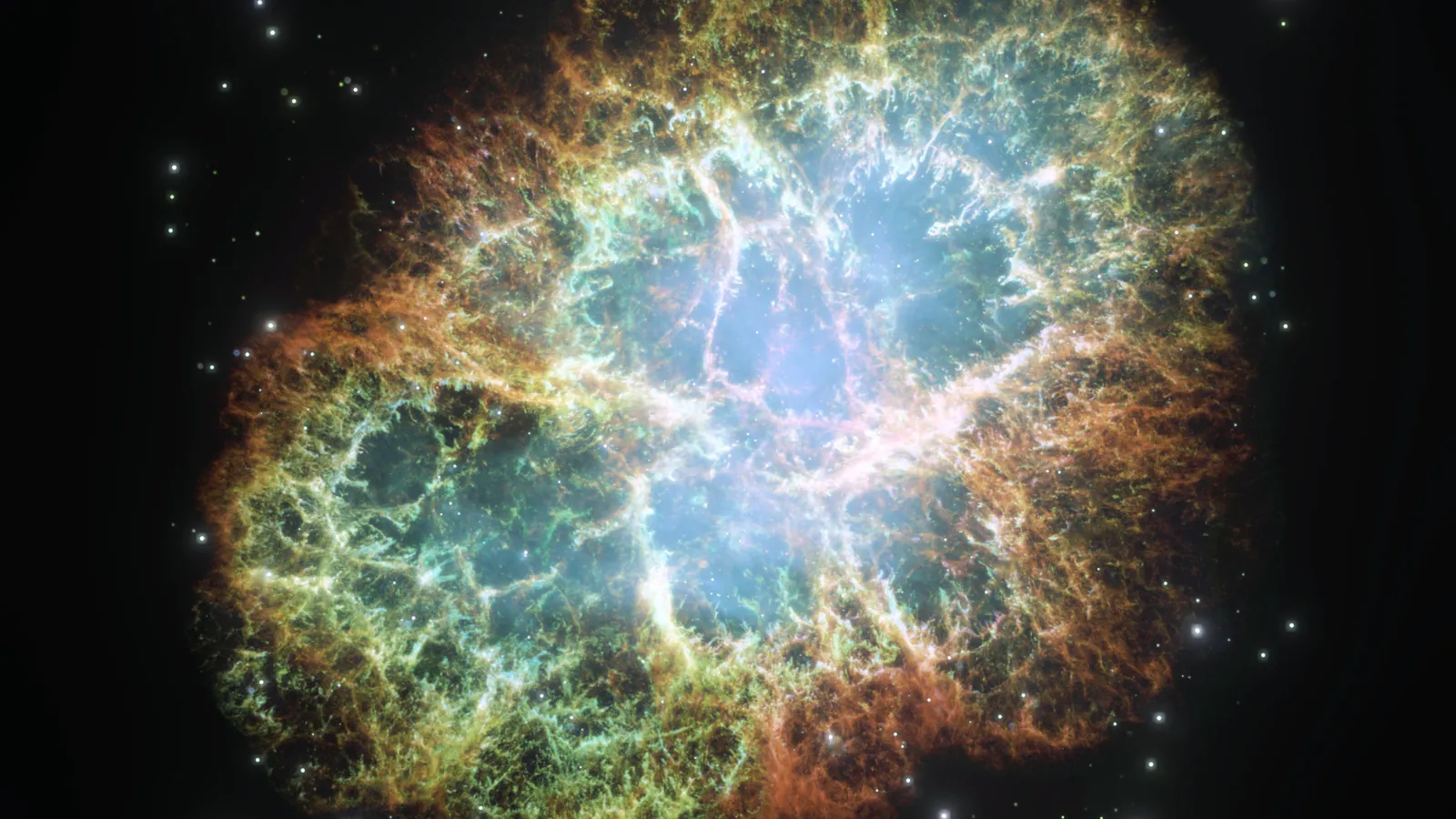
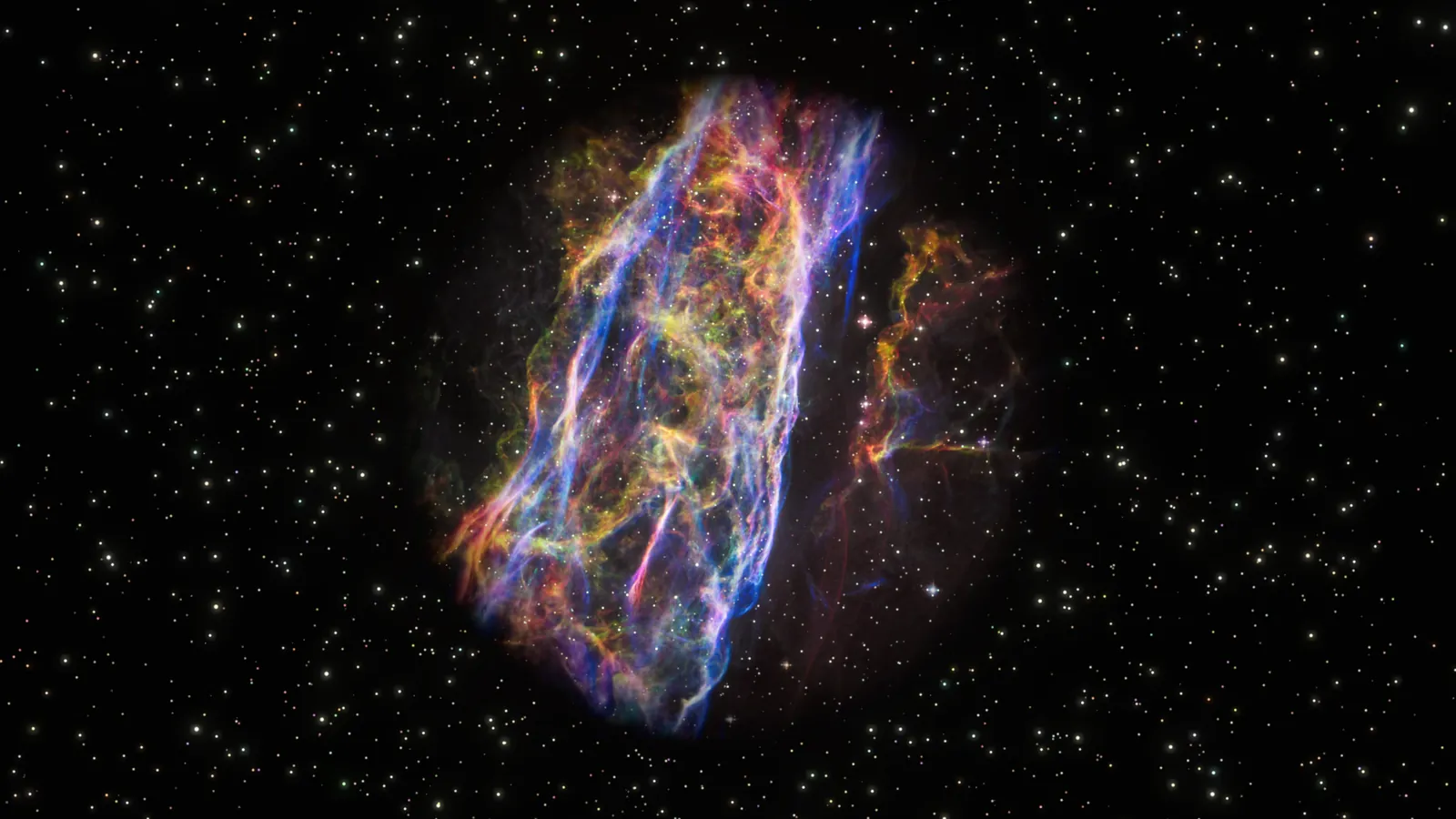
The Veil Nebula is the remains of a star about 20 times as massive as the Sun that exploded roughly 10,000 years ago. Its shock front is still racing outward, and its glowing filaments, about 2,400 light-years away in Cygnus, would span about six full Moons side by side if your eyes could see them. With a nebula filter, binoculars and small telescopes can.
When to see it
Best evenings: August to November (northern hemisphere).
Seen from north of about 49° S. Choose your city for tonight’s times and where to look.
“Up” means at least 10° above the horizon while the Sun is at least 12° below it (dark enough for faint nebulae and galaxies). Your location, if you share it, stays on this device.
At a glance
- Distance
- 2,400 light-years [1]
- The light you see left it
- around 400 BCE
- Constellation
- Cygnus
- Position (J2000)
- RA 20h 51m 00s, Dec +30° 42′
- Visible from
- north of about 49° S (farther south it never climbs 10° above the horizon)
- High in the evening (9 pm)
- August to November from mid-northern latitudes
- How to see it
- With binoculars
The Veil Nebula tonight from four cities
| City | Tonight |
|---|---|
| New York | Up now until 12:30 am, best around 11:30 pm, look north-west.best 11:30 pm, 20° up, north-west |
| Los Angeles | Up now until 12:10 am, best around 8:30 pm, look west.best 8:30 pm, 53° up, west |
| London | Not visible from here tonight; best in September.not tonight; best in September |
| Sydney | Up after dark until 9:50 pm, best around 8:30 pm, look north-west.best 8:30 pm, 20° up, north-west |
Tonight in each city’s local time, computed November 8, 2026 with Astronomy Engine (the page refreshes every hour). For your own city, choose it above.
The Veil Nebula: the facts
| Also called | the Cygnus Loop; its western arc is NGC 6960 (the Witch's Broom), the eastern NGC 6992 [2] |
|---|---|
| The star that exploded | roughly 20 times the Sun's mass, about 10,000 years ago [1] |
| Size on the sky | about six full Moons wide [1] |
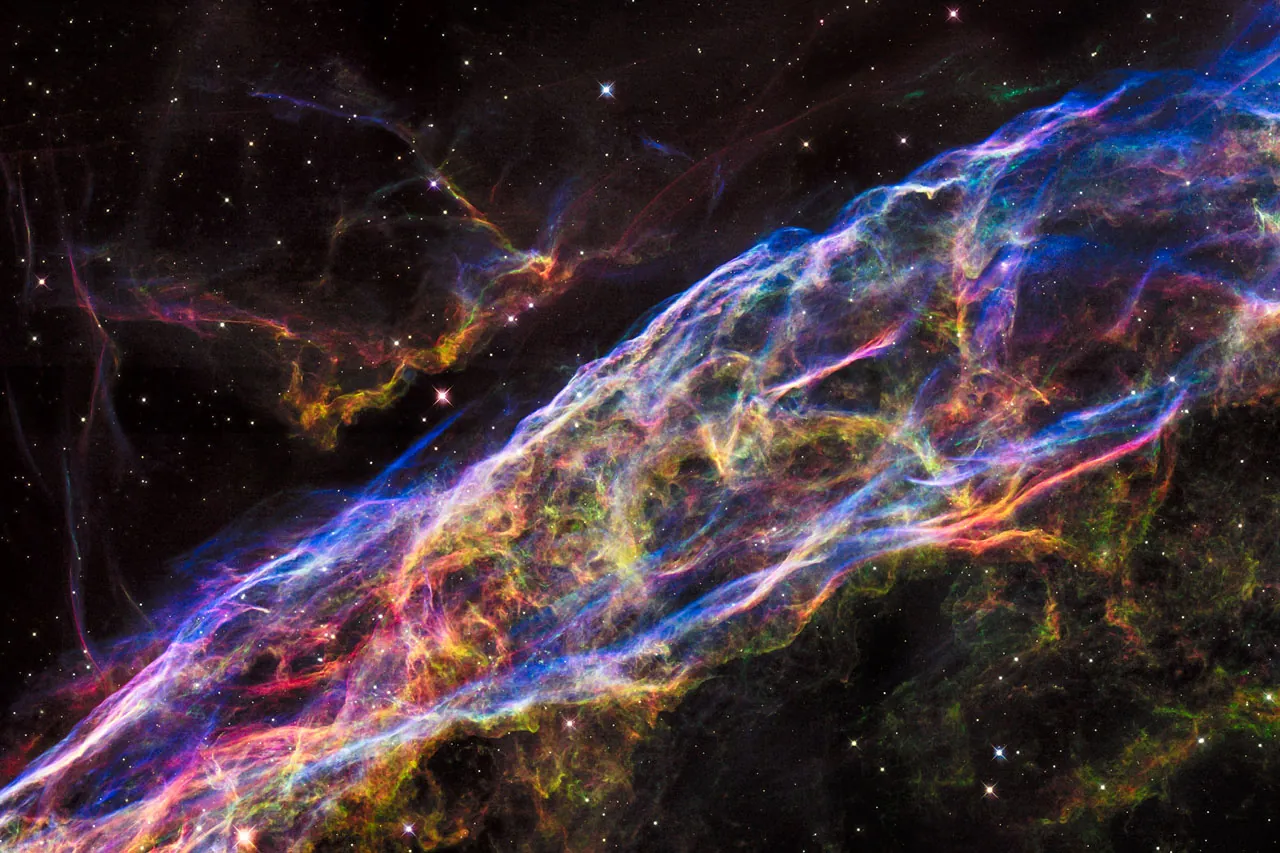
| The colors in Hubble's view | hydrogen, sulfur and oxygen glowing behind the shock [1] |
What are the Veil Nebula's filaments?
When the star exploded, its blast wave swept up the thin gas round it into a vast, rippled shell. Where the shock runs into denser gas it heats it until it glows: oxygen just behind the shock front, then sulfur and hydrogen as the gas cools. We see a bright filament wherever the thin, wrinkled sheet lies edge-on to us, like the folds in a curtain, which is how it got its name.
Hubble photographed parts of it in 1994, 1997, 2015 and again recently; comparing the images shows individual knots and filaments moving outward over the decades.
Step inside the Veil Nebula in Everdust
In Everdust’s Night Sky, look at the Veil Nebula and pinch to fly there on Apple Vision Pro, or tap it on iPhone, iPad and Android. What you arrive in, in the app’s own words: “The Veil Nebula as it is today: Hubble's photograph of its western edge, given depth, with the whole loop round you.”
Everdust on the App Store for iPhone, iPad and Vision ProEverdust on Google Play for Android
Everdust is free on the App Store for Apple Vision Pro, iPhone and iPad, and on Google Play for Android; Night Sky flies to the Veil Nebula on all of them. It is also free on Apple TV, with other worlds. I make Everdust, so weigh that; a star-map app such as Stellarium or SkySafari will find the Veil Nebula just as well.
Questions people ask
Can I see the Veil Nebula tonight? It depends on where you are. It can be seen from north of about 49° S, and it is best in the evening sky August to November from mid-northern latitudes. Choose your city on this page for tonight's times and where to look. With binoculars: From a dark site, binoculars or a small telescope with an oxygen-III filter show its arcs; the western arc runs right past the star 52 Cygni.
Where is the Veil Nebula in the sky? In the constellation Cygnus, at right ascension 20h 51m 00s and declination +30° 42′ (J2000). It can be seen from north of about 49° S (farther south it never climbs 10° above the horizon).
Can you see the Veil Nebula without a filter? Barely, from a very dark site. An oxygen-III (O III) filter on binoculars or a small telescope makes a huge difference, because most of its visible light is in that one green-blue color.
When did the Veil Nebula supernova happen? About 10,000 years ago (NASA); estimates range up to about 20,000 years.
Sources
- Distance: “the Veil Nebula is situated about 2,400 light-years away” (science.nasa.gov, the figure Everdust uses)
- ESA/Hubble heic1520a: Revisiting the Veil Nebula
Distance and position: the deep-sky catalog in Everdust’s Night Sky (read November 1, 2026), each figure quoted from the source above. Constellation, seasons and tonight are computed with Astronomy Engine (Don Cross, MIT license). More: Wikipedia.