The Crab Nebula
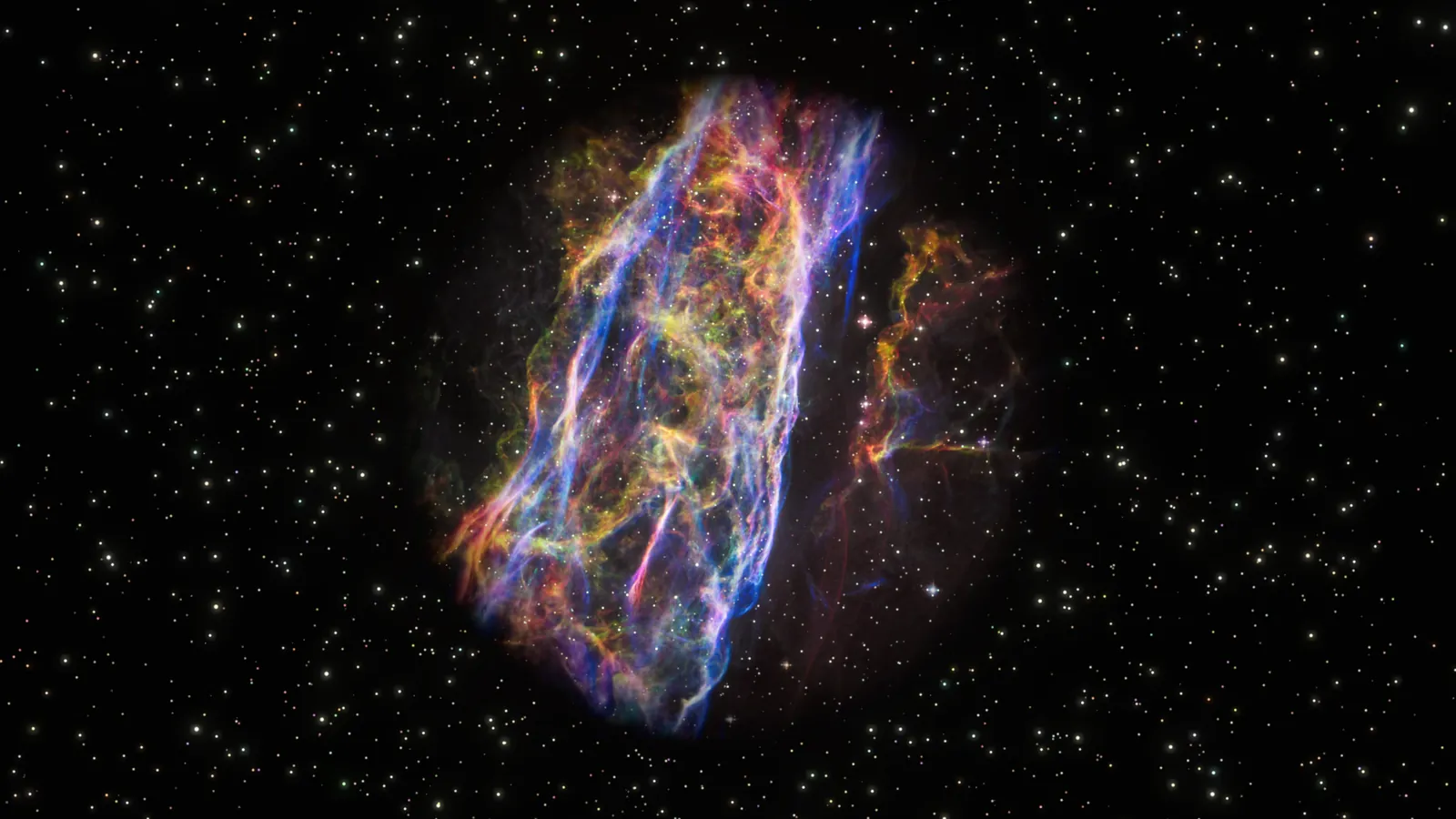
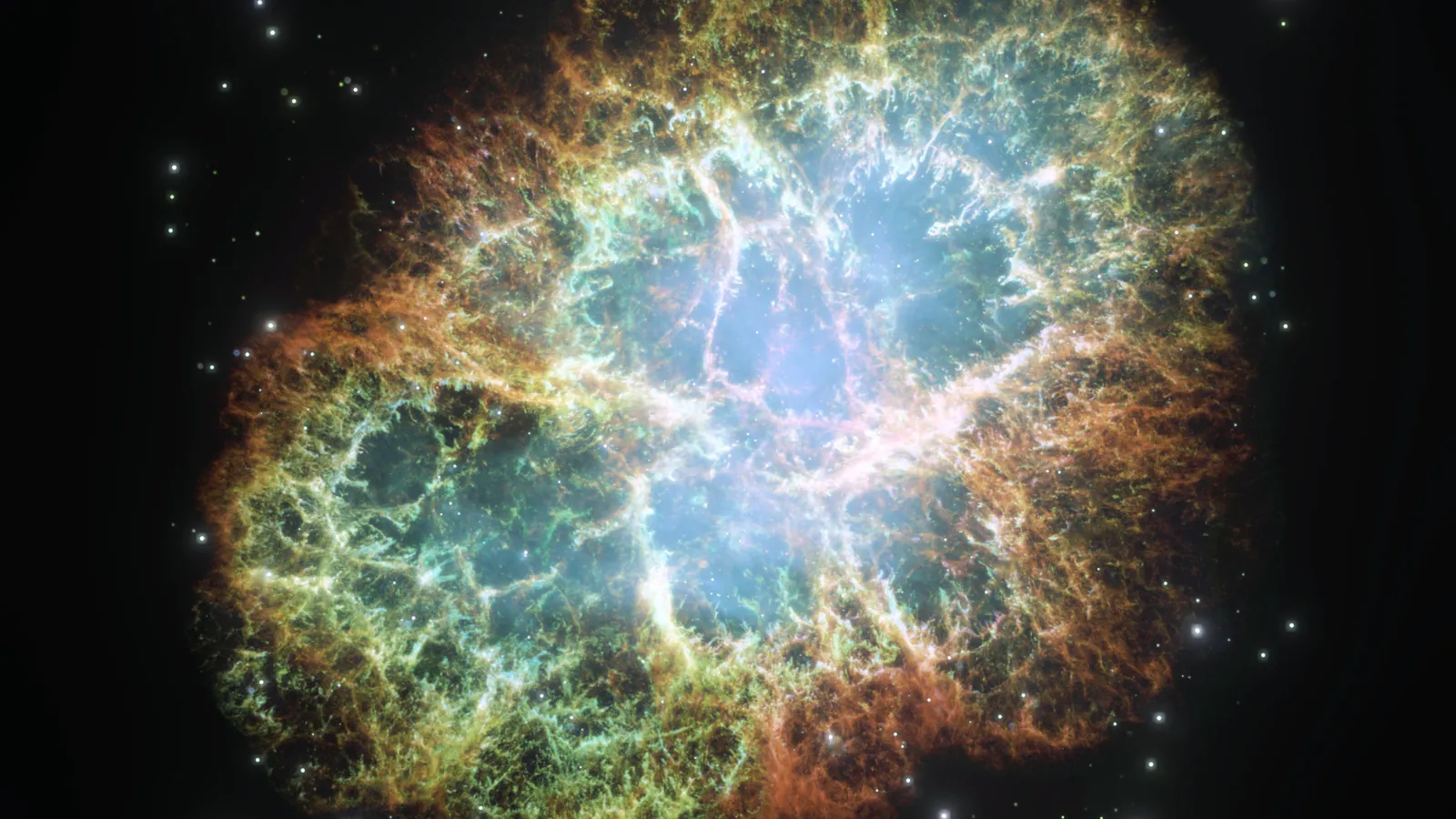
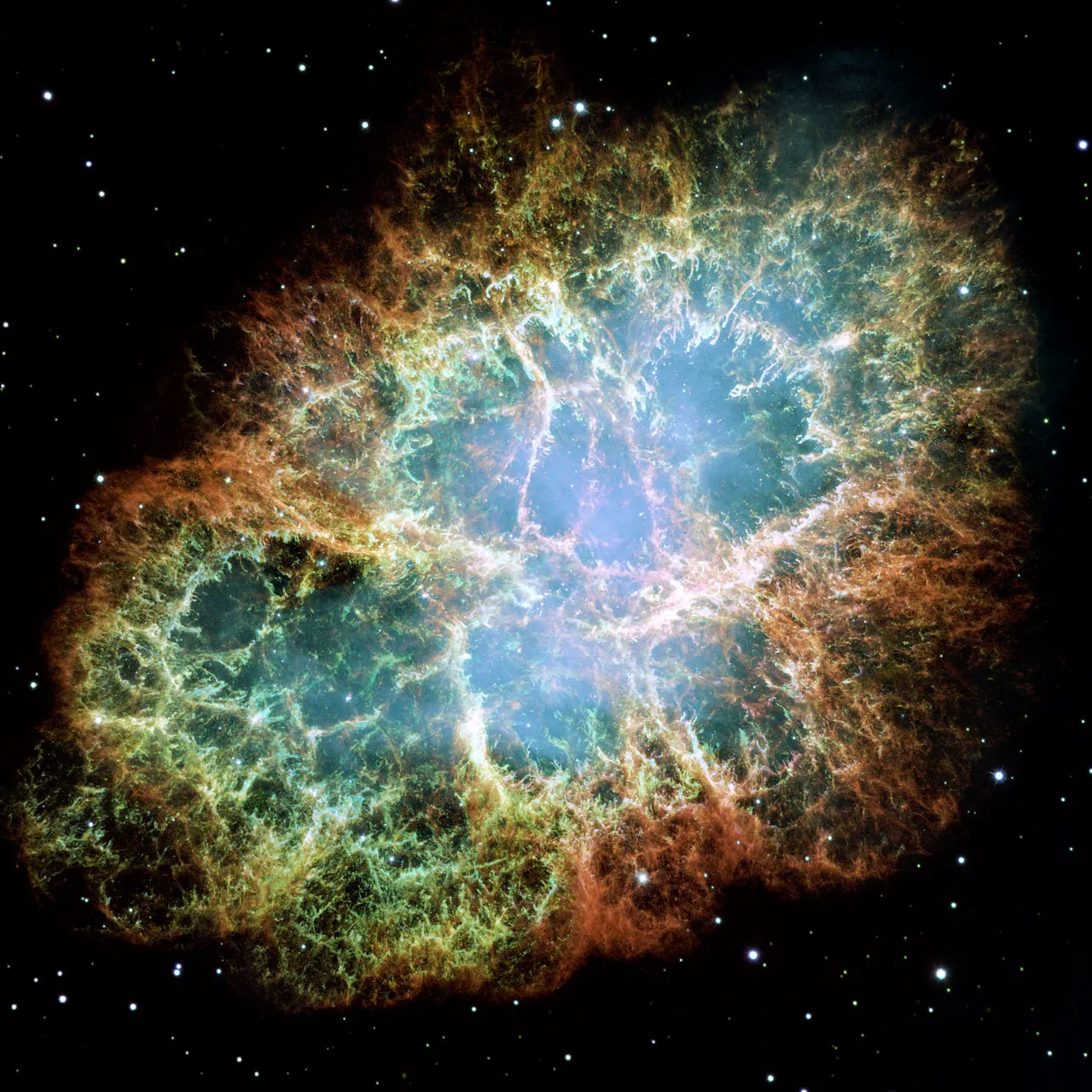
The Crab Nebula is the expanding wreck of a star whose explosion astronomers in China and Japan recorded in July 1054, when a new star appeared in Taurus, bright enough to see by day for 23 days. It is about 6,500 light-years away, and at its center spins a pulsar, the collapsed core of the star, 30 times a second. A small telescope shows it as a faint oval glow.
When to see it
Best evenings: December to April.
Seen from north of about 58° S. Choose your city for tonight’s times and where to look.
“Up” means at least 10° above the horizon while the Sun is at least 12° below it (dark enough for faint nebulae and galaxies). Your location, if you share it, stays on this device.
At a glance
- Distance
- 6,500 light-years [1]
- The light you see left it
- around 4,500 BCE
- Constellation
- Taurus
- Position (J2000)
- RA 5h 34m 32s, Dec +22° 01′
- Visible from
- north of about 58° S (farther south it never climbs 10° above the horizon)
- High in the evening (9 pm)
- December to April from mid-northern latitudes; February from mid-southern latitudes
- How to see it
- With a small telescope
The Crab Nebula tonight from four cities
| City | Tonight |
|---|---|
| New York | Up now and all night, best around 2:15 am, look south.best 2:15 am, 71° up, south |
| Los Angeles | Up now and all night, best around 2:15 am, look almost straight up.best 2:15 am, 78° up, overhead |
| London | Up now and all night, best around 4:30 am, look south-west.best 4:30 am, 52° up, south-west |
| Sydney | Up after 11:20 pm, best around 3:15 am, look north.best 3:15 am, 34° up, north |
Tonight in each city’s local time, computed November 8, 2026 with Astronomy Engine (the page refreshes every hour). For your own city, choose it above.
The Crab Nebula: the facts
| Also called | M1, the first object in Charles Messier's catalog; NGC 1952 [3] |
|---|---|
| The explosion | seen in July 1054; visible in daylight for 23 days [1] |
| At its center | a pulsar spinning 30 times a second [1] |
| Its debris | flying outward at about 1,500 km/s [1] |
| Named | in 1844, when Lord Rosse drew its claw-like filaments [1] |
What is the Crab Nebula?
When a massive star runs out of fuel its core collapses and the rest of the star is blown apart: a supernova. The Crab is what that explosion left. Its tangle of filaments is the star's debris, still flying outward; inside them, a bluish glow comes from electrons spiralling at nearly the speed of light in the magnetic field of the pulsar's wind.
Its growth is measured. Webb's 2023 photograph is 2.6% larger than Hubble's of 1999–2000, which, run back at today's speed, traces the debris to a point around the year 1110. The pulsar's wind has sped the expansion up since 1054, which explains the gap.
Step inside the Crab Nebula in Everdust
In Everdust’s Night Sky, look at the Crab Nebula and pinch to fly there on Apple Vision Pro, or tap it on iPhone, iPad and Android. What you arrive in, in the app’s own words: “The Crab Nebula as it is today: Hubble's photograph brought to today along its measured expansion, a shell of debris round its pulsar, in depth. Slide back to 1054.”
Everdust on the App Store for iPhone, iPad and Vision ProEverdust on Google Play for Android
Everdust is free on the App Store for Apple Vision Pro, iPhone and iPad, and on Google Play for Android; Night Sky flies to the Crab Nebula on all of them. It is also free on Apple TV, with other worlds. I make Everdust, so weigh that; a star-map app such as Stellarium or SkySafari will find the Crab Nebula just as well.
Questions people ask
Can I see the Crab Nebula tonight? It depends on where you are. It can be seen from north of about 58° S, and it is best in the evening sky December to April from mid-northern latitudes and February from mid-southern latitudes. Choose your city on this page for tonight's times and where to look. With a small telescope: A small telescope (or good binoculars from a dark site) shows a faint oval glow near the star Zeta Tauri, the tip of the bull's southern horn.
Where is the Crab Nebula in the sky? In the constellation Taurus, at right ascension 5h 34m 32s and declination +22° 01′ (J2000). It can be seen from north of about 58° S (farther south it never climbs 10° above the horizon).
When did the Crab Nebula supernova happen? Its light reached Earth in July 1054, when astronomers in China and Japan recorded a 'guest star' in Taurus. The star itself exploded about 6,500 years before that, since its light took that long to reach us.
Where is the Crab Nebula in the sky? In Taurus, about a degree from Zeta Tauri, the star at the tip of the bull's lower (southern) horn. It's highest in the evening in winter in the Northern Hemisphere.
Sources
- Distance: “The Crab Nebula ... 6500 light years” (esawebb.org, the figure Everdust uses)
- ESA/Hubble heic0515a: Most detailed image of the Crab Nebula
- Wikipedia: Crab Nebula
Distance and position: the deep-sky catalog in Everdust’s Night Sky (read November 1, 2026), each figure quoted from the source above. Constellation, seasons and tonight are computed with Astronomy Engine (Don Cross, MIT license). More: Wikipedia.