The Horsehead Nebula
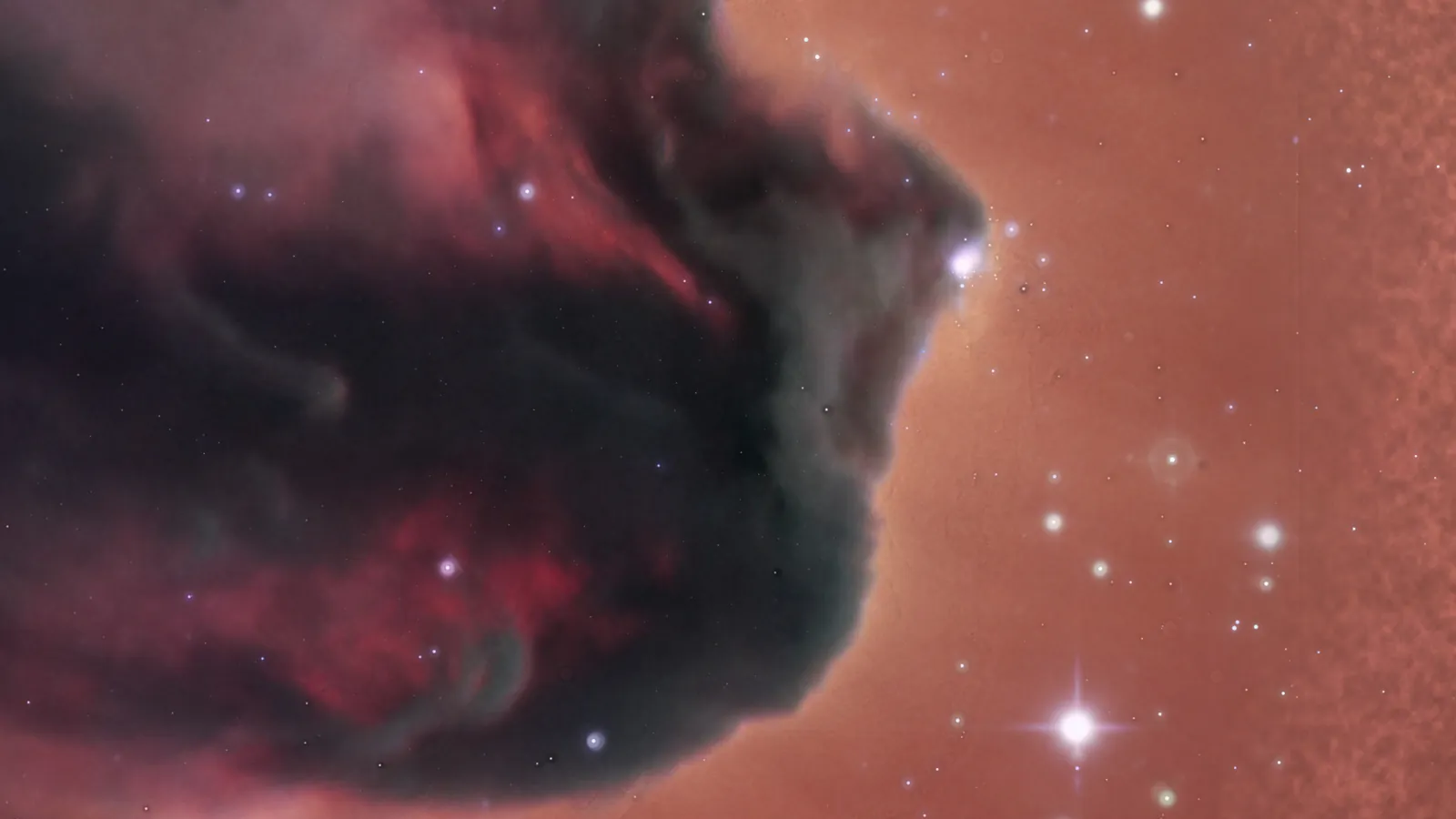
The Horsehead Nebula is a cloud of cold gas and dust shaped like a horse's head, about 1,300 light-years away in Orion. It is dark: you see it as a silhouette against the red glow of hydrogen behind it. It sits just south of Alnitak, the easternmost star of Orion's belt, but it is famously hard to see through a telescope; photographs show it best.
When to see it
Best evenings: January to March.
Seen from south of about 78° N. Choose your city for tonight’s times and where to look.
“Up” means at least 10° above the horizon while the Sun is at least 12° below it (dark enough for faint nebulae and galaxies). Your location, if you share it, stays on this device.
At a glance
- Distance
- 1,300 light-years [1]
- The light you see left it
- around the year 700
- Constellation
- Orion
- Position (J2000)
- RA 5h 40m 59s, Dec −2° 27′
- Visible from
- south of about 78° N (farther north it never climbs 10° above the horizon)
- High in the evening (9 pm)
- December to March from mid-northern latitudes; January to March from mid-southern latitudes
- How to see it
- With a large telescope or a camera
The Horsehead Nebula tonight from four cities
| City | Tonight |
|---|---|
| New York | Up now and all night, best around 2:30 am, look south.best 2:30 am, 47° up, south |
| Los Angeles | Up after 9:30 pm, best around 2:30 am, look south.best 2:30 am, 54° up, south |
| London | Up now and all night, best around 4:30 am, look south-west.best 4:30 am, 30° up, south-west |
| Sydney | Up after 10:10 pm, best around 3:30 am, look north.best 3:30 am, 59° up, north |
Tonight in each city’s local time, computed November 8, 2026 with Astronomy Engine (the page refreshes every hour). For your own city, choose it above.
The Horsehead Nebula: the facts
| Also called | Barnard 33 [1] |
|---|---|
| Part of | the Orion B molecular cloud [1] |
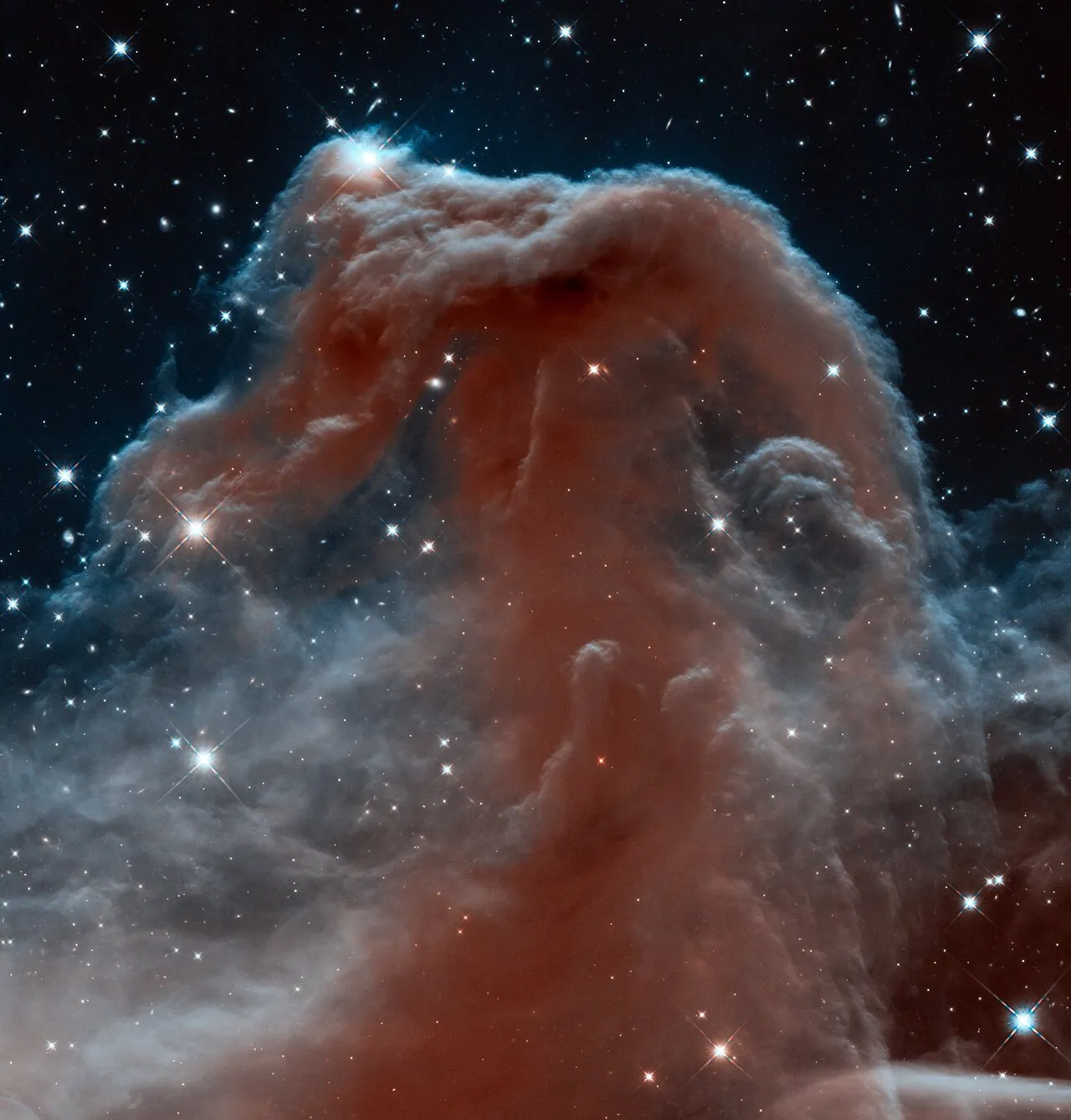
| What it is | a pillar of dense gas and dust that resists erosion, lit at its edge by a nearby hot star [1] |
| Time left | about five million years before it too disintegrates [1] |
Where is the Horsehead Nebula?
Find Orion's belt, the three bright stars in a row. The Horsehead lies about half a degree south of Alnitak, the belt star at the eastern end (the left-hand one as seen from the Northern Hemisphere). The red glow it stands against, IC 434, runs in a long strip south from Alnitak; the horse's head juts into it from the east.
Why does the Horsehead look so different in infrared?
In visible light the head is opaque, a black shape against glowing gas. Infrared light passes through thinner dust, so Hubble's infrared photograph sees into the head: it looks delicate and translucent, made of folds of gas. Webb's 2024 close-up of its top edge shows a photodissociation region, where ultraviolet light from young, massive stars turns the cloud's surface into warm, mostly neutral gas.
Step inside the Horsehead Nebula in Everdust
In Everdust’s Night Sky, look at the Horsehead Nebula and pinch to fly there on Apple Vision Pro, or tap it on iPhone, iPad and Android. What you arrive in, in the app’s own words: “The Horsehead Nebula as it is today: the dark horse against the red glow, given depth. The panel sees through the dust with Hubble and Webb.”
Everdust on the App Store for iPhone, iPad and Vision ProEverdust on Google Play for Android
Everdust is free on the App Store for Apple Vision Pro, iPhone and iPad, and on Google Play for Android; Night Sky flies to the Horsehead Nebula on all of them. It is also free on Apple TV, with other worlds. I make Everdust, so weigh that; a star-map app such as Stellarium or SkySafari will find the Horsehead Nebula just as well.
Questions people ask
Can I see the Horsehead Nebula tonight? It depends on where you are. It can be seen from south of about 78° N, and it is best in the evening sky December to March from mid-northern latitudes and January to March from mid-southern latitudes. Choose your city on this page for tonight's times and where to look. With a large telescope or a camera: A hard target: it needs a medium-to-large telescope, a hydrogen-beta filter and a dark sky. Any long camera exposure shows it.
Where is the Horsehead Nebula in the sky? In the constellation Orion, at right ascension 5h 40m 59s and declination −2° 27′ (J2000). It can be seen from south of about 78° N (farther north it never climbs 10° above the horizon).
Can you see the Horsehead Nebula with binoculars? No. Even many telescopes struggle: it needs a large aperture, a hydrogen-beta filter and a dark sky. It shows clearly in long-exposure photographs, even from a camera on a tripod with a telephoto lens and tracking.
Will the Horsehead Nebula last forever? No. Astronomers estimate it has about five million years left before the light of nearby stars wears it away, as it has the gas round it (ESA/Webb).
Sources
- Distance: “Barnard 33, which resides roughly 1300 light-years away” (esawebb.org, the figure Everdust uses)
- ESA/Hubble heic1307a: New infrared view of the Horsehead Nebula — Hubble’s 23rd anniversary image
Distance and position: the deep-sky catalog in Everdust’s Night Sky (read November 1, 2026), each figure quoted from the source above. Constellation, seasons and tonight are computed with Astronomy Engine (Don Cross, MIT license). More: Wikipedia.