The Pillars of Creation
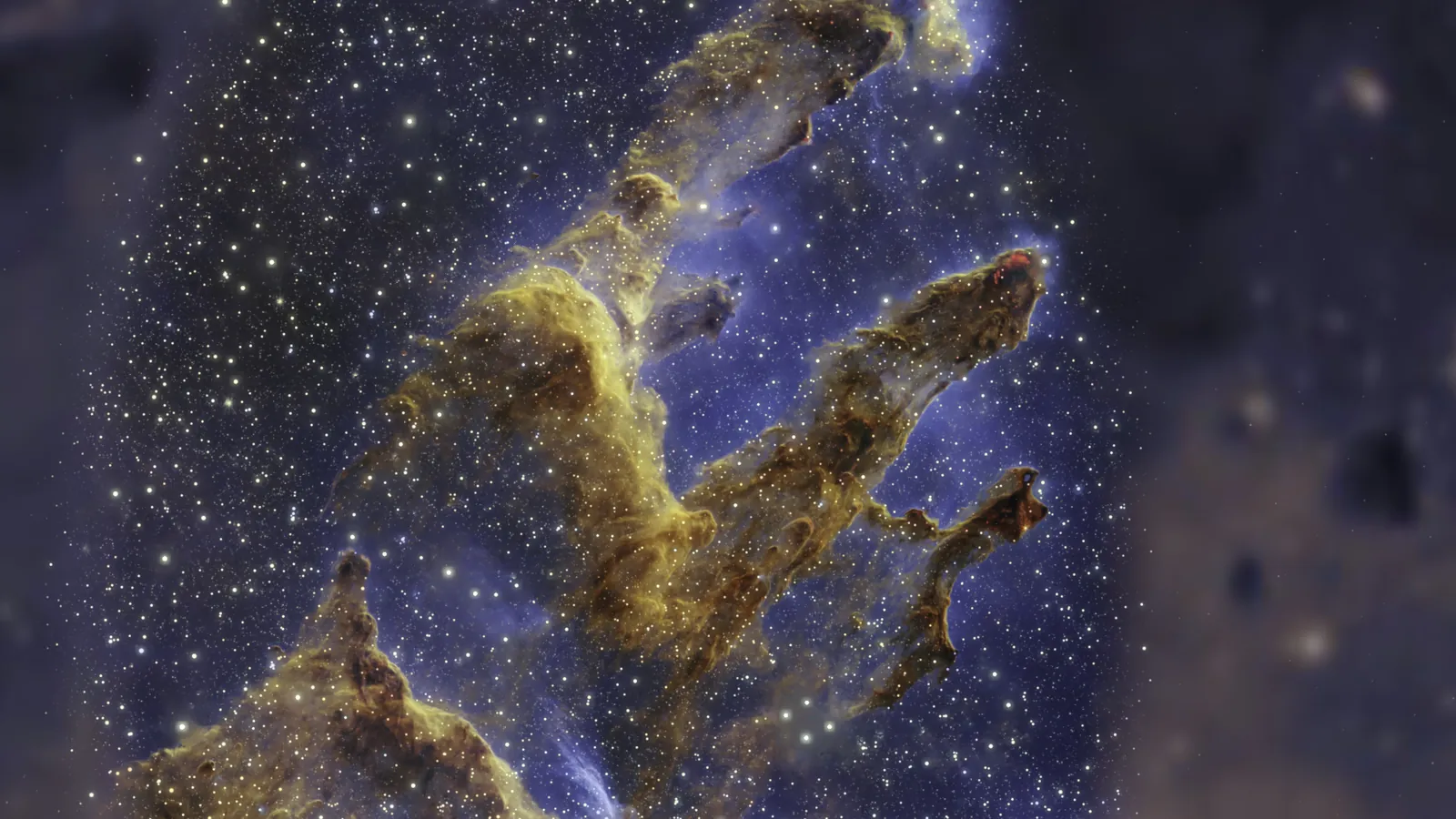
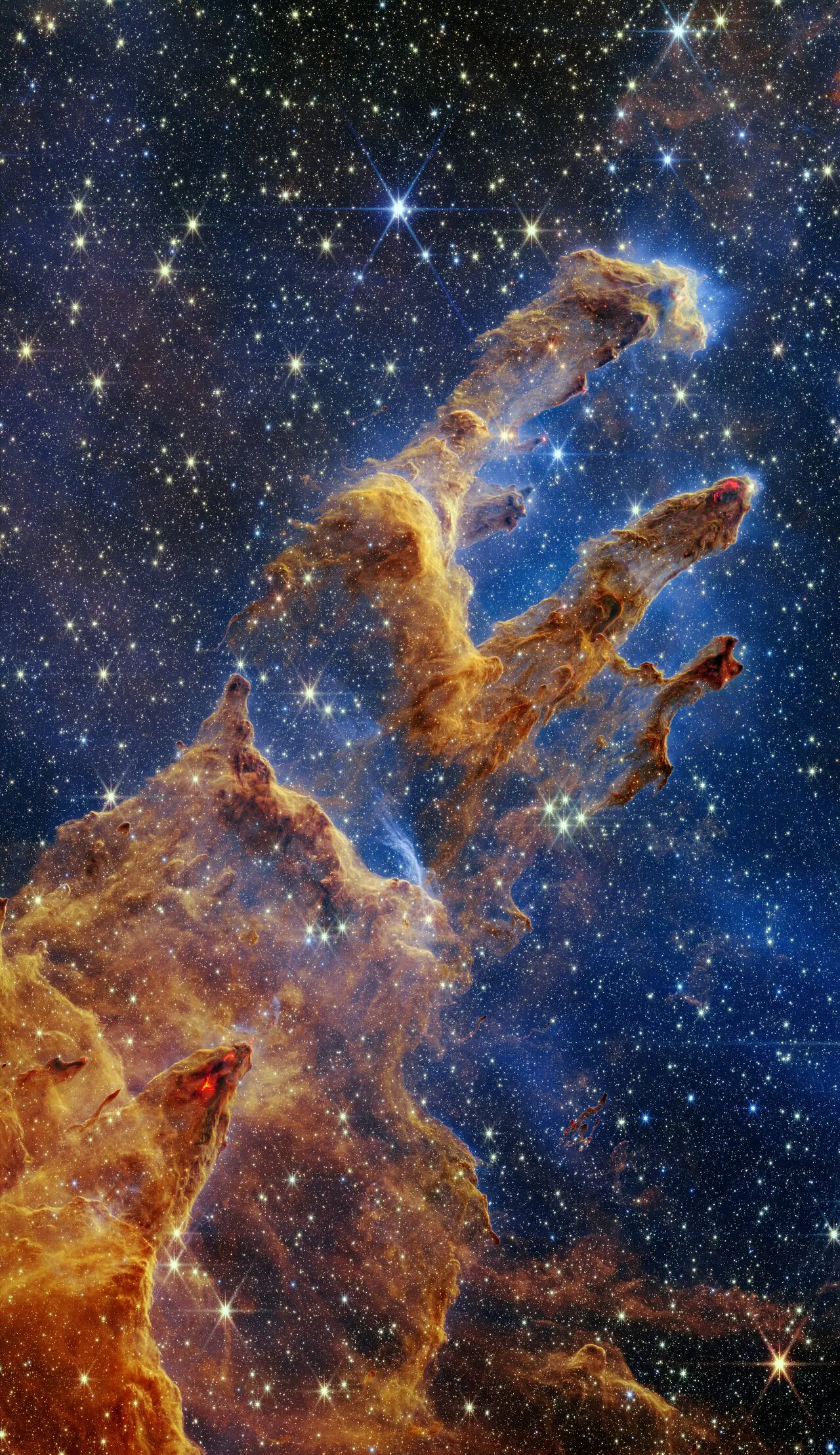
The Pillars of Creation are three towering columns of cold gas and dust inside the Eagle Nebula (M16), where new stars are forming right now. They are a tiny part of a much larger glowing cloud about 6,500 light-years away in the constellation Serpens. Your eyes can't pick out the pillars, but binoculars show the Eagle Nebula as a faint haze round a small cluster of stars, and the Webb and Hubble photographs show the pillars themselves.
When to see it
Best evenings: June to October.
Seen from south of about 66° N. Choose your city for tonight’s times and where to look.
“Up” means at least 10° above the horizon while the Sun is at least 12° below it (dark enough for faint nebulae and galaxies). Your location, if you share it, stays on this device.
At a glance
- Distance
- 6,500 light-years [1]
- The light you see left it
- around 4,500 BCE
- Constellation
- Serpens
- Position (J2000)
- RA 18h 18m 48s, Dec −13° 48′
- Visible from
- south of about 66° N (farther north it never climbs 10° above the horizon)
- High in the evening (9 pm)
- August to September from mid-northern latitudes; June to October from mid-southern latitudes
- How to see it
- With a large telescope or a camera
The Pillars of Creation tonight from four cities
| City | Tonight |
|---|---|
| New York | Not visible from here tonight; best in June.not tonight; best in June |
| Los Angeles | Not visible from here tonight; best in June.not tonight; best in June |
| London | Not visible from here tonight; best in June.not tonight; best in June |
| Sydney | Up after dark until 9:50 pm, best around 8:30 pm, look west.best 8:30 pm, 28° up, west |
Tonight in each city’s local time, computed November 8, 2026 with Astronomy Engine (the page refreshes every hour). For your own city, choose it above.
The Pillars of Creation: the facts
| Part of | the Eagle Nebula (M16, also called NGC 6611 for its star cluster) [1] |
|---|---|
| What they are | columns of cool interstellar gas and dust, semi-transparent in near-infrared light [1] |
| Inside them | protostars a few hundred thousand years old, still forming [1] |
| Made famous by | Hubble's 1995 photograph; Webb photographed them in 2022 [3] |
What are the Pillars of Creation?
They are the densest leftovers of the cloud the Eagle Nebula's stars were born from. Hot young stars above the pillars (off the top of the famous photographs) flood the region with ultraviolet light and winds, which boil away the thinner gas. Only the thickest clumps survive, and they stand like columns, their tips pointing toward the stars that are eroding them.
Inside the columns, knots dense enough to collapse under their own gravity are turning into stars. In Webb's near-infrared view these protostars are the bright red points, some with eight-pointed spikes, and the wavy lines along the pillars' edges are jets from stars still forming, slamming into the gas round them.
Why does Webb's picture look different from Hubble's?
Hubble's famous photographs were taken mostly in visible light, where the dust is opaque and the pillars look solid and dark-edged. Webb sees near-infrared light, which passes through thinner dust, so the pillars look translucent and far more young stars show. Neither shows the colors your eye would see: the colors stand for different wavelengths and gases.
Step inside the Pillars of Creation in Everdust
In Everdust’s Night Sky, look at the Pillars of Creation and pinch to fly there on Apple Vision Pro, or tap it on iPhone, iPad and Android. What you arrive in, in the app’s own words: “The Pillars of Creation as they are today: Webb's photograph of them, given depth.”
Everdust on the App Store for iPhone, iPad and Vision ProEverdust on Google Play for Android
Everdust is free on the App Store for Apple Vision Pro, iPhone and iPad, and on Google Play for Android; Night Sky flies to the Pillars of Creation on all of them. It is also free on Apple TV, with other worlds. I make Everdust, so weigh that; a star-map app such as Stellarium or SkySafari will find the Pillars of Creation just as well.
Questions people ask
Can I see the Pillars of Creation tonight? It depends on where you are. It can be seen from south of about 66° N, and it is best in the evening sky August to September from mid-northern latitudes and June to October from mid-southern latitudes. Choose your city on this page for tonight's times and where to look. With a large telescope or a camera: Binoculars or a small telescope show the Eagle Nebula's star cluster and a faint glow from a dark site; the pillars themselves need a large telescope, a nebula filter or a camera.
Where are the Pillars of Creation in the sky? In the constellation Serpens, at right ascension 18h 18m 48s and declination −13° 48′ (J2000). It can be seen from south of about 66° N (farther north it never climbs 10° above the horizon).
How far away are the Pillars of Creation? About 6,500 light-years, in the Eagle Nebula in Serpens (ESA/Webb's figure).
Can you see the Pillars of Creation with a telescope? Not easily. Binoculars and small telescopes show the Eagle Nebula's cluster and a faint glow. The pillars need a large telescope with a nebula filter under a dark sky, or a long camera exposure.
Sources
- Distance: “the vast Eagle Nebula, which lies 6,500 light-years away” (esawebb.org, the figure Everdust uses)
- ESA/Webb weic2216b: Webb Takes a Stunning, Star-Filled Portrait of the Pillars of Creation (Full View)
- Wikipedia: Pillars of Creation
Distance and position: the deep-sky catalog in Everdust’s Night Sky (read November 1, 2026), each figure quoted from the source above. Constellation, seasons and tonight are computed with Astronomy Engine (Don Cross, MIT license). More: Wikipedia.