How the Hourglass Nebula formed: from a red giant to MyCn 18, in eight live chapters
The Hourglass Nebula, MyCn 18, is a shell of glowing gas blown off by a dying star in the southern constellation Musca. Hubble's 1996 picture of it showed two lobes pinched at a narrow waist, their walls etched with fine rings, around a bright eye at the center [1]. This Story builds the nebula from the beginning in eight short chapters. Each one is a live simulation you can turn, step inside and play forward through time while River, the narrator, explains what you are seeing.
It starts with a red giant losing its outer layers in a slow, dusty wind. Then come a last, heavy superwind that leaves a dense waist, a bare and fiercely hot core whose fast wind carves the hourglass out of the old gas, and the moment the star grows hot enough to make it all glow. It ends with the nebula as it looks today. Every chapter opens held at its moment, so you can look around before you press play.
At a glance
- Chapters
- 8, each a live simulation
- Length
- about 6 minutes played straight through
- Narrator
- River, with subtitles
- Free or Plus
- Free: chapters I–II. Everdust Plus: chapters III–VIII
- Where
- Everdust on iPhone and iPad, Android, Apple Vision Pro, Mac, Apple TV and Meta Quest 3 and 3S
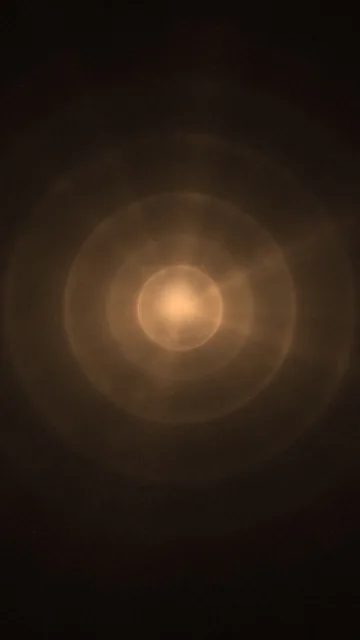 IThe red giant's pulses
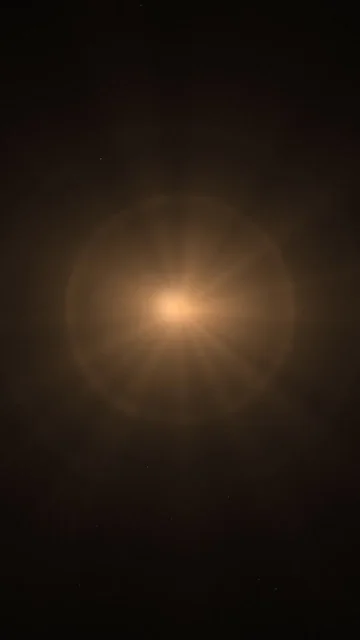 IIThe superwind
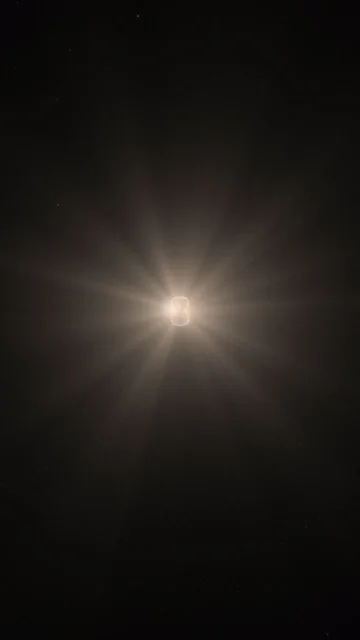 IIIThe core is exposed
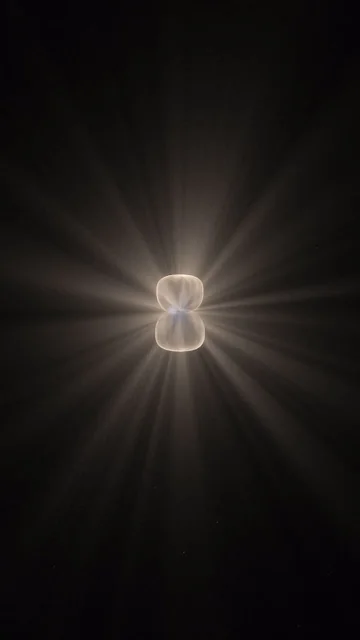 IVLit by starlight
 VThe blast
 VIThe nebula lights up
 VIIOxygen, the eye and the rings
 VIIIToday
Chapter by chapter
Chapter I The red giant's pulses Free
The giant's dusty cloud, 12,000 years before the fast wind.
Long before there is a nebula, there is a red giant: a star near the end of its life, swollen to hundreds of times the width of the Sun. You see it inside a faint cloud of dust, laid down in shells as its outer layers drift away. The cloud has no light of its own. It shows only where dust scatters the star's light toward you.
Stars at this stage are on what astronomers call the asymptotic giant branch. Their surfaces are cool, around 3,000 degrees, and their outer layers are so loosely held that a slow wind of about 10 to 15 kilometers a second carries them off, with dust forming in the cooling gas [2]. Each shell in the chapter stands for a burst of heavier shedding, but their timing is the Story's guess, and the time axis is squeezed, so this is a picture of the process rather than a measured history of MyCn 18.
Chapter II The superwind Free
2,000 years before the fast wind: the cloud flattens toward the equator.
Near the end the giant sheds gas faster and faster. Astronomers call this the superwind, and it strips away most of what is left of the star's envelope. The cloud changes shape: it grows thicker around its waist than at its poles. That dense belt of gas will pinch everything that comes after.
Why a waist? Most likely because of a second star. In 2018 astronomers found that MyCn 18's central star has a small companion, about a fifth of the Sun's mass, that circles it every 18.15 days [3]. An orbit that tight means the companion was once swallowed by the giant's swollen outer layers, a stage called a common envelope, and the team suggests that episode helped shape the nebula's inner parts [3]. Close companions are now thought to sculpt many planetary nebulae [4]. The companion isn't simulated here: extra gas at the equator stands in for it.
Chapter III The core is exposed Plus
The star has just left the giant phase, and the cavity starts to open.
The giant's outer layers are nearly gone, and its hot core is laid bare. The core shrinks and heats, its color shifting from orange toward white, and it begins to blow a new wind: thin, invisible and about a hundred times faster than the old one. That wind escapes most easily through the poles, where the old gas is thinnest, and starts to hollow out a cavity.
Once a star leaves the giant stage, its exposed core heats up at almost constant brightness, from about 3,500 degrees to tens of thousands, over a few hundred to a few thousand years [5]. The new wind it blows runs at more than 1,000 kilometers a second [6]. Such a wind is invisible in real images; the faint streaks here only show you where it flows.
Chapter IV Lit by starlight Plus
A pale two-lobed shell inside the dusty cloud, before any gas glows.
A pale, two-lobed shell has opened inside the dusty cloud, but nothing in it shines yet. The young nebula is cold and dark, and you see it only because its dust scatters the star's light. That light escapes through the cleared poles like a pair of searchlights, while the dusty waist stays dark. The star is still too cool to make the gas itself glow.
Real nebulae caught at this moment are called pre-planetary nebulae. The Egg Nebula is the classic example, its lobes lit by starlight scattered off dust [7]. Hubble surveys of these young objects find that none of them is round: their lopsided, often two-lobed shapes are already in place before the gas starts to glow [8]. In the chapter the exact pattern of the searchlight beams is made up.
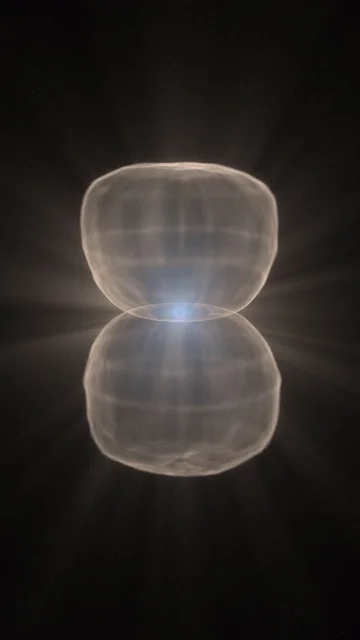
Chapter V The blast Plus
The fast wind sweeps up the old wind: press play to watch the shell grow.
Press play and the shell grows. The fast wind sweeps the slow old wind into a thin shell ahead of it, like a snowplow. Where the old gas is thin, at the poles, the shell races ahead; at the dense waist it is held back. That pinch is what makes the hourglass, and every bit of gas in its walls was once the giant's own wind.
This is the interacting-winds picture of how planetary nebulae get their shapes: a fast wind running into a slower wind that is densest around the equator naturally blows two lobes, as calculations and simulations show [9][10][11]. Measurements of MyCn 18 today find its walls moving outward at tens of kilometers a second, fastest toward the tips of the lobes [12]. The shell's growth in the chapter follows that picture on a squeezed timeline; the gust you can blow through it with a swipe is a ripple, not real gas flow.
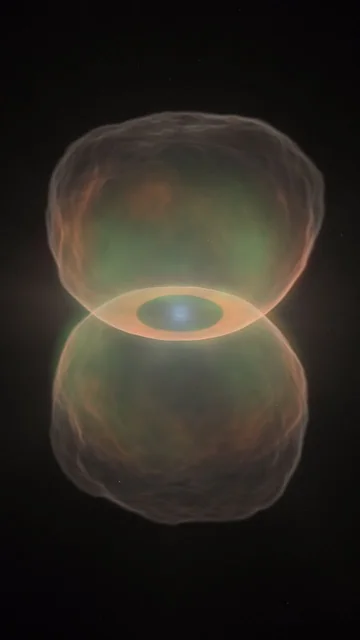
Chapter VI The nebula lights up Plus
The walls light up orange, inner parts first: try the Hα and O III filters.
Now the star is hot enough to light the gas from within. Its ultraviolet light strips electrons from hydrogen atoms, a front of light runs outward through the walls, and they begin to glow, the inner parts first. From here on, astronomers call the object a planetary nebula. Try the filters to see the hydrogen glow on its own, then the oxygen.
A planetary nebula shines because its central star is hot enough to ionize the gas it once shed: atoms stripped of electrons by the ultraviolet light catch electrons again and give off light in colors that belong to each element [13]. The colors here follow Hubble's filters for this nebula, with nitrogen shown in red, hydrogen in green and oxygen in blue [1], so they are not what your eye would see. The front of light itself is simplified.
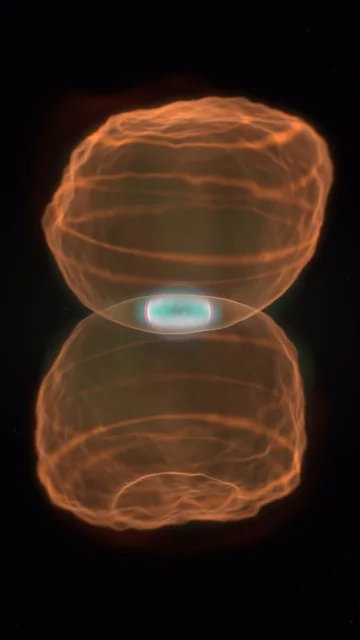
Chapter VII Oxygen, the eye and the rings Plus
The eye, the rings and the knots in place: switch to O III for the oxygen.
Hotter still, the star makes oxygen glow in the innermost gas; switch to the O III filter to see it alone. Around the star sits a bright eye, the waist of a second, smaller hourglass thrown off later. Fine rings are etched across the lobes, and knots of gas shoot out along the axis.
Modeling of the nebula's shape and motions suggests the inner hourglass left the star roughly 950 years after the main one, an estimate [12]. Its knots fly at 500 kilometers a second or more [14], and its jets, at 630 kilometers a second, are the fastest seen in any planetary nebula [3]. The etched rings are still a puzzle. They may record pulses in the star's shedding, or ripples that grew in the flow itself [15][16]. No one is sure.
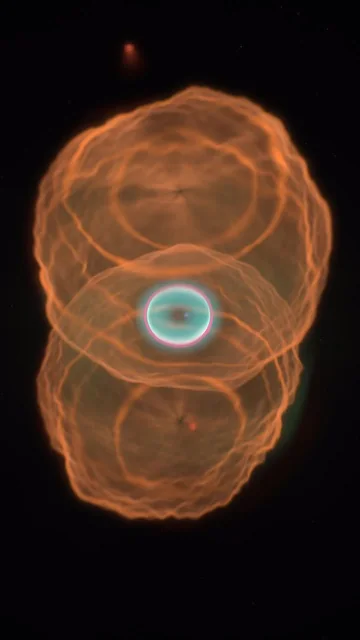
Chapter VIII Today Plus
MyCn 18 today: turn it pole-on to see the rings, or step inside.
This is the Hourglass today, close to the way Hubble photographed it: two rippled lobes with a bright eye at the waist. Turn it to look down a pole and see the rings, or step inside it. The real star is cooler than the one shown here, about 50,000 degrees.
Hubble's release put MyCn 18 about 8,000 light-years away [1]; other estimates are larger, and the Story says roughly ten thousand, so treat the distance as uncertain. Astronomers date the nebula by timing its expansion [12]. Its star, at around 50,000 degrees [3], will cool into a white dwarf. The glowing shell won't last: the whole planetary nebula stage takes only about 20,000 years [17].
What’s simulated, and what isn’t
Each chapter is a live simulation of the nebula at one moment of its history, opened held so you can turn it, step inside and play it on to today. The time axis is squeezed and labeled, not to scale. The shapes follow the interacting-winds picture: a dense waist left by the superwind, then a fast wind sweeping the old wind into a thin shell. Some things are illustrated rather than simulated. The companion star isn't drawn, and extra gas at the equator stands in for it; the timing of the dust shells, the pattern of the searchlight beams and the front of light are simplified; the streaks of the fast wind only show where an invisible wind flows; the colors are Hubble's filter colors; and the gust you blow with a swipe is a ripple, not real gas flow. By the last chapter the star is drawn hotter than the real one.
Watch How the Hourglass Nebula Formed in Everdust
How the Hourglass Nebula Formed is in the Everdust app on iPhone and iPad, Android, Apple Vision Pro, Mac, Apple TV and Meta Quest 3 and 3S. Open Everdust, choose Stories, then How the Hourglass Nebula Formed. Free: chapters I–II. Everdust Plus: chapters III–VIII.
Everdust on the App Store (iPhone, iPad, Apple Vision Pro, Mac, Apple TV)Everdust on Google Play (Android)Everdust on the Meta Horizon Store (Quest 3 and 3S)
Everdust is free to download, with no ads and no account. Everdust Plus, an optional subscription, opens every chapter of every Story on iPhone, iPad, Android, Apple Vision Pro, Mac and Apple TV (on Meta Quest, which chapters are free can differ).
Questions people ask
What is the Hourglass Nebula? A young planetary nebula, MyCn 18: the shell of gas thrown off by a dying Sun-like star in the southern constellation Musca. Hubble's 1996 image revealed its hourglass shape and the fine 'etchings' in its walls [1].
How far away is the Hourglass Nebula? About 8,000 light-years, by the figure in Hubble's release [1], but the distance is uncertain and some estimates are larger. Our Hourglass Nebula page shows where it sits in the sky.
Why is the Hourglass Nebula shaped like an hourglass? A dense belt of gas around the dying star's waist, probably shaped with help from a close companion star, held back the star's later fast wind, which broke out through the poles as two lobes [3][11].
What is a planetary nebula? The glowing shell a dying Sun-like star leaves behind once its exposed, hot core lights up the gas it shed. Despite the name, it has nothing to do with planets [13], and the stage is short, lasting only about 20,000 years [17].
Sources
- NASA/ESA Hubble (1996). The Hourglass Nebula (image opo9607a; credit R. Sahai and J. Trauger, JPL, the WFPC2 science team, and NASA/ESA).
- Höfner, S. & Olofsson, H. (2018). Mass loss of stars on the asymptotic giant branch. The Astronomy and Astrophysics Review 26, 1.
- Miszalski, B. et al. (2018). SALT HRS discovery of the binary nucleus of the Etched Hourglass Nebula MyCn 18. Publications of the Astronomical Society of Australia 35, e027.
- Jones, D. & Boffin, H. M. J. (2017). Binary stars as the key to understanding planetary nebulae. Nature Astronomy 1, 0117.
- Miller Bertolami, M. M. (2016). New models for the evolution of post-asymptotic giant branch stars and central stars of planetary nebulae. Astronomy & Astrophysics 588, A25.
- Kastner, J. H. et al. (2012). The Chandra X-ray Survey of Planetary Nebulae (ChanPlaNS): probing binarity, magnetic fields, and wind collisions. The Astronomical Journal 144, 58.
- Sahai, R. et al. (1998). The structure of the prototype bipolar protoplanetary nebula CRL 2688 (Egg Nebula): broadband, polarimetric, and H2 line imaging with NICMOS on the Hubble Space Telescope. The Astrophysical Journal 492, L163.
- Sahai, R. et al. (2007). Preplanetary nebulae: a Hubble Space Telescope imaging survey and a new morphological classification system. The Astronomical Journal 134, 2200.
- Kahn, F. D. & West, K. A. (1985). Shapes of planetary nebulae. Monthly Notices of the Royal Astronomical Society 212, 837.
- Mellema, G. (1995). Radiation gasdynamics of planetary nebulae. VI. The evolution of aspherical planetary nebulae. Monthly Notices of the Royal Astronomical Society 277, 173.
- Balick, B. & Frank, A. (2002). Shapes and shaping of planetary nebulae. Annual Review of Astronomy and Astrophysics 40, 439.
- Clyne, N. et al. (2014). VLT observations of the asymmetric Etched Hourglass Nebula, MyCn 18. Astronomy & Astrophysics 569, A50.
- Kwok, S. (2000). The Origin and Evolution of Planetary Nebulae. Cambridge University Press.
- Bryce, M. et al. (1997). A bipolar, knotty outflow with velocities of 500 kilometers per second or above from the Engraved Hourglass planetary nebula MyCn 18. The Astrophysical Journal 487, L161.
- Sahai, R. et al. (1999). The Etched Hourglass Nebula MyCn 18. I. Hubble Space Telescope observations. The Astronomical Journal 118, 468.
- Dayal, A. et al. (2000). The Etched Hourglass Nebula MyCn 18. II. A spatio-kinematic model. The Astronomical Journal 119, 315.
- ESA/Webb (2025). Webb investigates complex heart of a cosmic butterfly (release weic2517).
Chapter stills: Everdust, from each chapter’s live simulation. The Story’s script was written for Everdust from the sources above; River reads it. This page retells it in its own words.
More Stories
How the Butterfly Nebula Formed
A dusty belt, a long pause, then one eruption that threw out the wings.
The Story of Everything
13.8 billion years, from the first light to the lights of Earth tonight. Free in full.
The Future of Everything
From Earth's lights tonight to the last black hole, following the physics forward.
The Life of a Black Hole
Birth, feeding, a shredded star, a merger and the long fade, with light bent by real geometry.