How the Butterfly Nebula formed: one eruption, 2,250 years ago, in eight live chapters
The Butterfly Nebula, NGC 6302, is a dying star's last outburst: two torn wings of glowing gas, more than two light-years across, on either side of a dark lane of dust [1]. Hubble's measurements of how fast its gas is moving trace the wings back to a single eruption about 2,250 years ago [2]. This Story follows how it got there, in eight short chapters you can hold, turn and step inside while River, the narrator, explains what you are seeing.
It begins 7,500 years ago with a red giant laying down a thick belt of gas and dust around its waist. Then comes a strange quiet of about six hundred years, the blast itself, a run of smaller outbursts, and the moment the star becomes hot enough to make the whole nebula glow. It ends with the Butterfly as it looks today, its star still hidden behind the belt it made.
At a glance
- Chapters
- 8, each a live simulation
- Length
- about 6 minutes played straight through
- Narrator
- River, with subtitles
- Free or Plus
- Free: chapters I–IV. Everdust Plus: chapters V–VIII
- Where
- Everdust on iPhone and iPad, Android, Apple Vision Pro, Mac, Apple TV and Meta Quest 3 and 3S
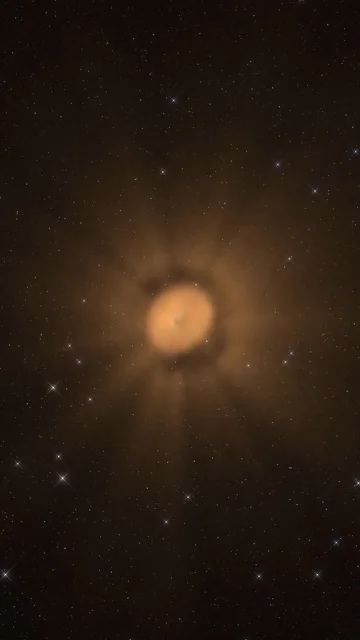 IThe red giant and its early wind
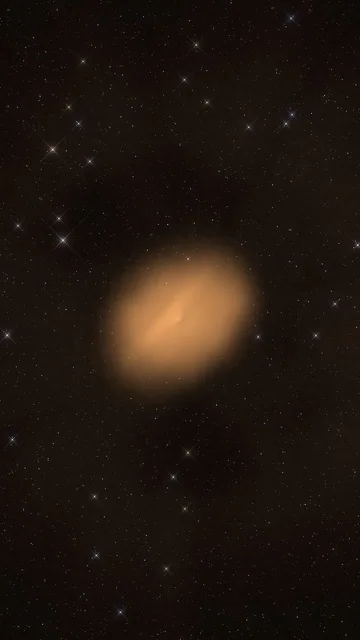 IIThe belt
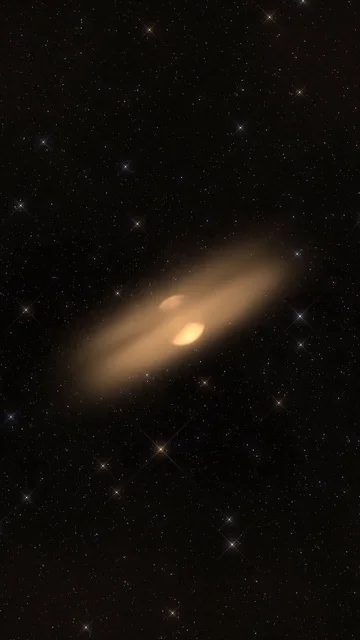 IIIThe last of the belt: grains grow
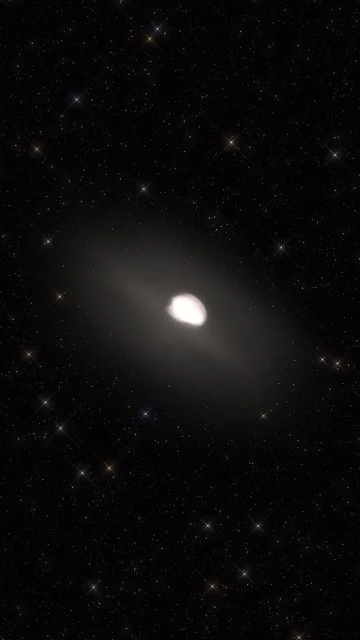 IVSix hundred quiet years
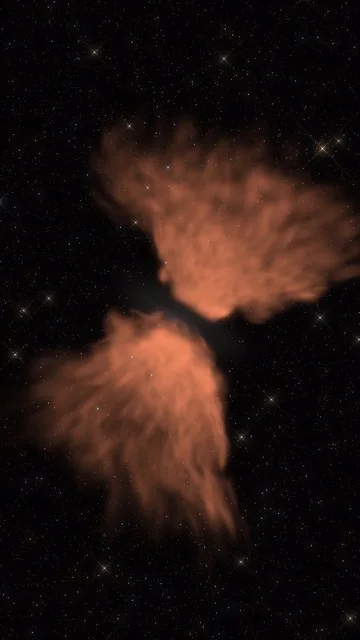 VThe blast
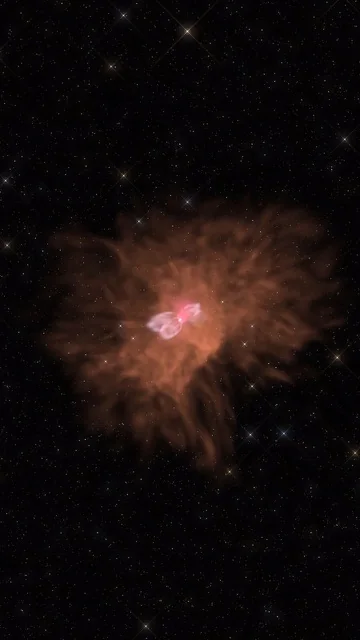 VIAftershocks
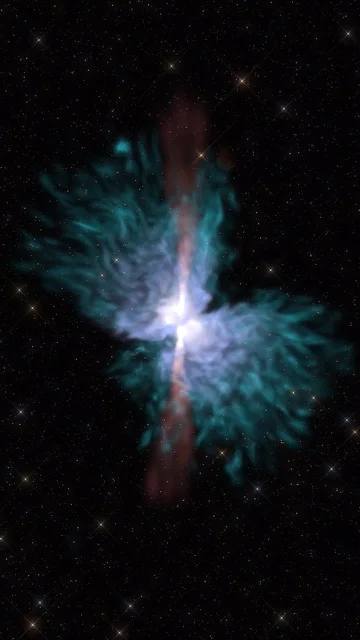 VIIThe light
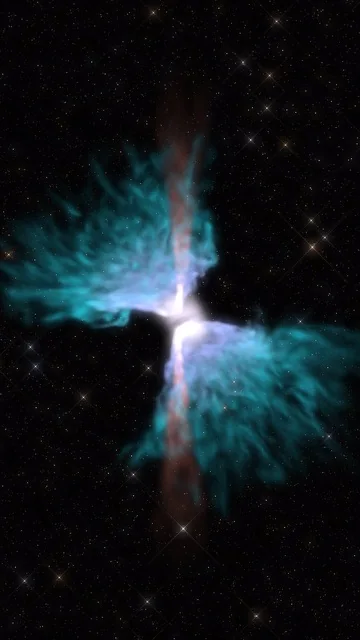 VIIIToday
Chapter by chapter
Chapter I The red giant and its early wind Free
7,500 years ago: a red giant in its slow, round, dusty wind.
Seventy-five centuries ago, the Butterfly's star had swollen into a red giant. It was probably born four or five times heavier than the Sun. You see it inside a slow, round cloud of dust that glows only by the starlight it reflects. Then something changes: gas begins to pile up around the star's waist instead of drifting out evenly.
Red giants lose their outer layers in slow, dusty winds [3], and a round wind like this is typical, though it hasn't been measured for this star; the halo in the chapter is a visualization. Estimates of the star's birth mass range from about 3.7 to 5.5 Suns [4][5][6]. Why the gas gathers at the waist is probably a hidden companion star: the way the belt was shed points to two stars interacting, and one study predicts a partner on an orbit of less than a month [7]. No one has seen it, so the chapter doesn't draw one.
Chapter II The belt Free
Thousands of years lay down a thick belt of gas and dust round the waist.
Over thousands of years the giant sheds a thick belt of gas and dust. It builds up in rings, and starlight catches the belt's inner rim while its outer part sits in shadow. The belt drifts outward slowly and steadily, so the oldest dust always lies farthest out. This belt will shape everything that follows.
Radio telescopes measure the belt today. It holds about two Suns' worth of material, give or take one, and it is expanding at about 8 kilometers a second; from its size and speed it was shed between about 7,500 and 2,900 years ago, at roughly five ten-thousandths of a Sun's mass every year [7]. The rings in the chapter stand for bursts of heavier shedding, but how many there were and when is the Story's guess.
Chapter III The last of the belt: grains grow Free
The last of the belt: dust grains grow, the dark lane deepens.
The last and densest part of the belt is laid down. Inside it, dust grains grow large, about a thousandth of a millimeter across, and many of them are crystals. As the grains grow, they scatter every color of light alike, so the belt's glow turns grayer. By now the giant's outer layers are nearly gone.
The James Webb Space Telescope found that the belt is made largely of these big, micron-sized silicate grains, with crystalline minerals like quartz among them [8][9]. Crystals like that take time to grow, and the Webb team describes the belt as long-lived, with enough material for dust to form slowly [8]. The Story shows only what bigger grains would do to the view, more shadow and a grayer glow, not the grains themselves.
Chapter IV Six hundred quiet years Free
Six hundred quiet years while the bare core shrinks and heats.
And then, for about six hundred years, nothing more is thrown out. The star's bare core shrinks and heats, from orange toward white. Leftover gas waits inside the belt, lit by the star. The view turns until you see the belt side-on, as a dark lane across that glow. Everything is quiet, but it won't stay that way.
Astronomers call this pause the jet lag. The belt stopped growing about 2,900 years ago, and the wings weren't thrown out until about 600 years later, which tells us the two came from separate events with different causes [2]. How fast the core heated during the pause hasn't been measured. Where the gas that became the wings sat before the eruption isn't known either: the glowing cocoon inside the belt is the Story's choice.
Chapter V The blast Plus
One eruption: gas bursts out of both poles at once, in a Hubble flow.
Then the star erupts. Gas bursts out of both poles at once. The belt blocks the waist, so the blast escapes above and below it. The fastest gas flies farthest, so speed grows in step with distance, and if you trace any clump backward it points straight at the star. The rust color marks shock-heated gas, and it is the Story's choice of color, not a photograph.
That pattern, every clump's speed in proportion to its distance, is exactly what Hubble finds in the Butterfly's wings: their motions point back to the central star and date the eruption to 2,250 years ago, give or take 35 years [10][2]. The fastest gas moves at about 600 kilometers a second [6]. The energy of all that motion is so large that only processes driven by gravity, such as two stars merging or matter falling onto the star, seem able to supply it [6]. That is an interpretation, which is why the narration says "we think."
Chapter VI Aftershocks Plus
Aftershocks: inner lobes and a fast off-axis flow in an S of iron.
The eruption was not the end. Smaller bubbles of gas burst out again and again, each pair pointing a different way. Then a narrow flow streams out, faster still, and its newest gas glows with iron in an S shape.
Eleven years of Hubble images reveal at least four pairs of inner lobes, thrown out at different times over the past two thousand years, and a pair of flows off the main axis moving at a steady 760 kilometers a second, give or take 100 [6]. Their iron glow traces an S that repeats on opposite sides of the star [5], and Webb sees a pair of opposite jets of iron and nickel [9]. An S like that suggests a source that wobbles, perhaps nudged by a companion, but that is a guess [6]. The dates and tilts of the lobes in the chapter are the Story's best guess too.
Chapter VII The light Plus
A 220,000 K star lights the wings from the inside out.
Meanwhile the core has become one of the hottest stars known. Its ultraviolet light floods the gas, a front of light runs outward, and behind it the gas glows by itself. The most energetic glow stays closest to the star.
The Butterfly's central star is about 220,000 degrees, one of the hottest central stars of any planetary nebula in our galaxy [9][8]. Webb's maps show its effect in layers: the atoms that take the most energy to strip of electrons sit near the center, and those that need less lie farther out [9]. The colors follow Hubble's filters, not what an eye would see. In reality the star heated up during the centuries of aftershocks; the Story shows it afterward so each stage stays clear.
Chapter VIII Today Plus
NGC 6302 today, about 3,400 light-years away.
This is the Butterfly today: two torn wings around a dark lane. Turn it and the lane shifts; step inside to stand among the wings. The fast flow still streams out, reshaping them from within, and the star stays hidden behind the dark belt.
The nebula lies about 3,400 light-years away in Scorpius, by the Webb team's figure [9]; Hubble's 2009 release said about 3,800 [1]. Its wings stretch more than two light-years [1]. Finding the star has been hard: a candidate spotted in 2009 [11] turned out to be an unrelated star in front of the nebula [5], and in 2025 Webb pinned down the real one from the warm dust it heats [9]. The planetary nebula stage lasts only about 20,000 years [9], so the glow will probably fade within ten or twenty thousand years, and the star will cool for billions of years as a white dwarf.
What’s simulated, and what isn’t
Each chapter is a live simulation of one stretch of the Butterfly's history, on a squeezed time axis, magnified so you can see it, with a time slider and ▶ to run it on. The dates, masses and speeds come from the measurements cited here, and the shapes follow them: a belt that coasts outward, a single blast whose speed grows with distance, faster flows after it. Several things are illustrated rather than measured. The early round halo, the timing of the belt's rings, the glowing cocoon before the blast and the dates and tilts of the later lobes are the Story's best guesses; the companion star isn't drawn; the rust color of shocked gas and Hubble's filter colors are not what an eye would see; the front of light is a smooth sweep rather than a full calculation of light through gas; the star's heating is shown after the aftershocks instead of during them; and the gust you blow with a swipe is a ripple, not real gas flow.
Watch How the Butterfly Nebula Formed in Everdust
How the Butterfly Nebula Formed is in the Everdust app on iPhone and iPad, Android, Apple Vision Pro, Mac, Apple TV and Meta Quest 3 and 3S. Open Everdust, choose Stories, then How the Butterfly Nebula Formed. Free: chapters I–IV. Everdust Plus: chapters V–VIII.
Everdust on the App Store (iPhone, iPad, Apple Vision Pro, Mac, Apple TV)Everdust on Google Play (Android)Everdust on the Meta Horizon Store (Quest 3 and 3S)
Everdust is free to download, with no ads and no account. Everdust Plus, an optional subscription, opens every chapter of every Story on iPhone, iPad, Android, Apple Vision Pro, Mac and Apple TV (on Meta Quest, which chapters are free can differ).
Questions people ask
How far away is the Butterfly Nebula? About 3,400 light-years, in the constellation Scorpius, by the figure the Webb team uses [9]; Hubble's 2009 release gave about 3,800 [1]. Our Butterfly Nebula page shows where it sits in the sky.
How hot is the Butterfly Nebula's central star? About 220,000 degrees, which makes it one of the hottest known central stars of a planetary nebula in our galaxy [9].
Why can't you see the star in the Butterfly Nebula? It is hidden behind the thick, dusty belt we see side-on as the dark lane. Webb located it in 2025 by the glow of warm dust it heats around itself [9].
How old is the Butterfly Nebula? Its wings were thrown out in one eruption about 2,250 years ago, while the dusty belt is older, shed between about 7,500 and 2,900 years ago [2][7].
Sources
- NASA/ESA Hubble (2009). Butterfly emerges from stellar demise in planetary nebula NGC 6302 (image heic0910h).
- Szyszka, C., Zijlstra, A. A. & Walsh, J. R. (2011). The expansion proper motions of the planetary nebula NGC 6302 from Hubble Space Telescope imaging. Monthly Notices of the Royal Astronomical Society.
- Höfner, S. & Olofsson, H. (2018). Mass loss of stars on the asymptotic giant branch. The Astronomy and Astrophysics Review 26, 1.
- Wright, N. J. et al. (2011). A 3D photoionization model of the extreme planetary nebula NGC 6302. Monthly Notices of the Royal Astronomical Society 418, 370.
- Kastner, J. H. et al. (2022). Panchromatic HST/WFC3 imaging studies of young, rapidly evolving planetary nebulae. I. NGC 6302. The Astrophysical Journal 927, 100.
- Balick, B. et al. (2023). NGC 6302: the tempestuous life of a butterfly. The Astrophysical Journal 957, 54.
- Peretto, N. et al. (2007). The massive expanding molecular torus in the planetary nebula NGC 6302. Astronomy & Astrophysics 473, 207.
- Matsuura, M. et al. (2025). The JWST/MIRI view of the planetary nebula NGC 6302 – I. A UV-irradiated torus and a hot bubble triggering PAH formation. Monthly Notices of the Royal Astronomical Society 542, 1287.
- ESA/Webb (2025). Webb investigates complex heart of a cosmic butterfly (release weic2517).
- Meaburn, J. et al. (2008). Hubble-type outflows of the high-excitation poly-polar planetary nebula NGC 6302 – from expansion proper motions. Monthly Notices of the Royal Astronomical Society 385, 269.
- Szyszka, C. et al. (2009). Detection of the central star of the planetary nebula NGC 6302. The Astrophysical Journal 707, L32.
Chapter stills: Everdust, from each chapter’s live simulation. The Story’s script was written for Everdust from the sources above; River reads it. This page retells it in its own words.
More Stories
Chaos: The Attractor We Found
From Lorenz's rounding error to a strange attractor our own search turned up.
The Story of Everything
13.8 billion years, from the first light to the lights of Earth tonight. Free in full.
The Future of Everything
From Earth's lights tonight to the last black hole, following the physics forward.
The Life of a Black Hole
Birth, feeding, a shredded star, a merger and the long fade, with light bent by real geometry.