Chaos: The Attractor We Found, from Lorenz's butterfly to a new strange attractor
Chaos: The Attractor We Found tells the story of chaos theory in eight live simulations, from a weather model that went its own way around 1961 to a strange attractor that Everdust's own search turned up. River, the narrator, explains each one while you turn it and watch.
It begins with Edward Lorenz's rounding error and the butterfly effect, shows how chaos stretches and folds without flying apart, and tours famous strange attractors and a four-dimensional flow that stretches two ways at once. Then it follows the search itself: random equations tested one after another, hidden attractors you can only find by falling in, and the Conch, a small and honest find.
At a glance
- Chapters
- 8, each a live simulation
- Length
- about 7 minutes played straight through
- Narrator
- River, with subtitles
- Free or Plus
- Free: all 8 chapters
- Where
- Everdust on iPhone and iPad, Android, Apple Vision Pro, Mac, Apple TV and Meta Quest 3 and 3S
 IThe rounding error
 IIThe butterfly effect
 IIIStretching and folding
 IVThe zoo
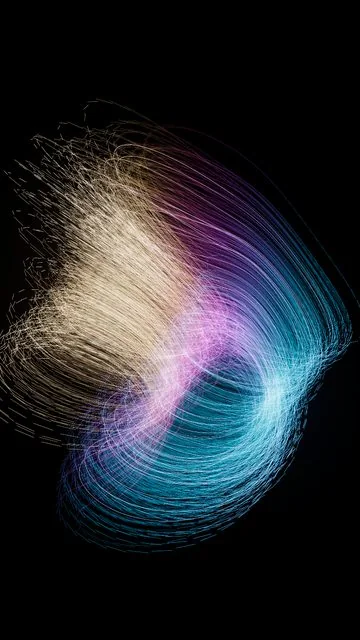 VTwo directions of chaos
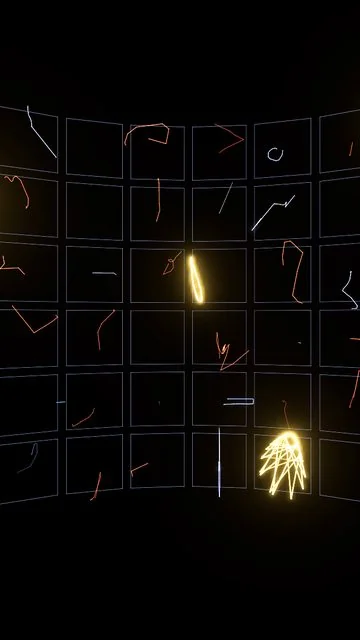 VIThe search
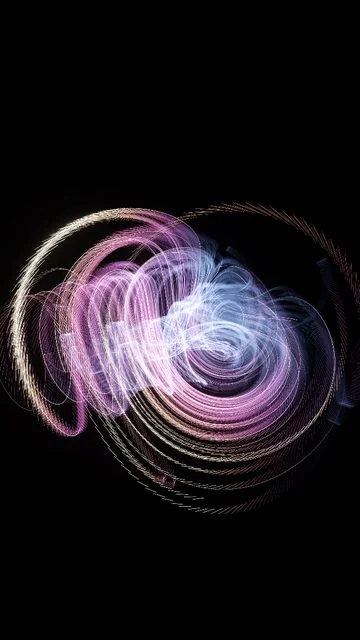 VIIHidden attractors
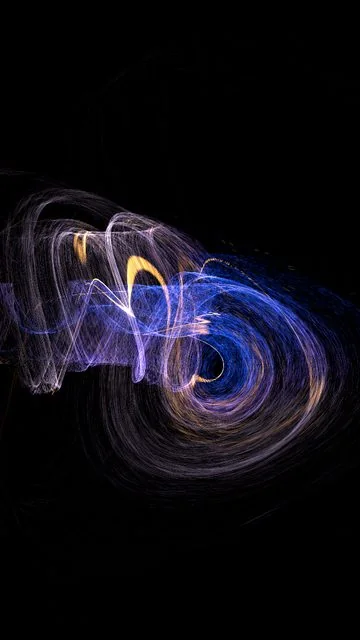 VIIIThe Conch
Chapter by chapter
Chapter I The rounding error
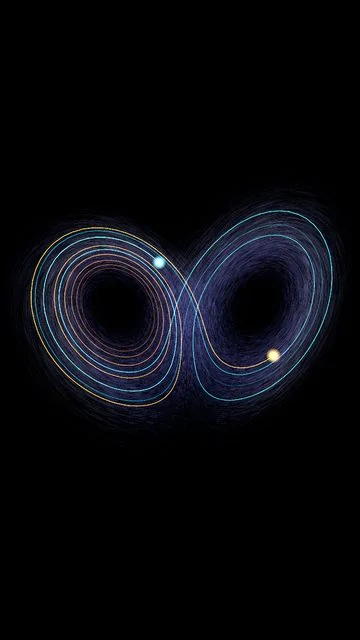
Around 1961: Lorenz restarts his weather model from a printout rounded to three decimals.
Two glowing threads, one gold and one cyan, trace the two-winged shape of Lorenz's flow. They start as one run; at a set moment the run is printed to three decimals and restarted from the printout. For a while the two still run together, then they drift apart, and the chart below splits into two different lines.
Around 1961 (the exact date is uncertain) Edward Lorenz was running a simplified 12-variable weather model on his first computer. He restarted a run by typing in numbers from a printout rounded to three decimals. The new run matched the old one, then the differences more or less doubled every four days of model weather, until all resemblance disappeared somewhere in the second month [1]. There was no randomness anywhere: the only difference was the rounding, smaller than a thousandth. The chapter repeats the restart on his simpler three-variable equations of 1963 [2]; the digits on screen are this run's, not his.
Chapter II The butterfly effect
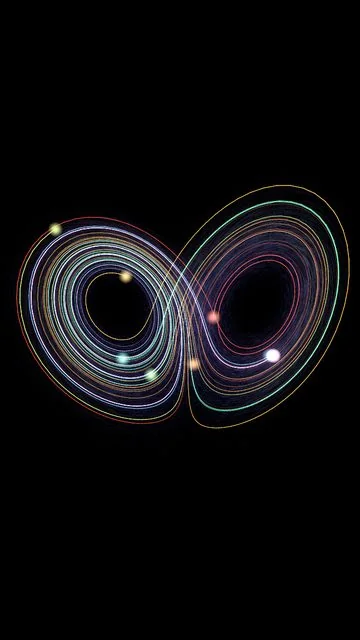
Ten starts, a thousandth to a trillionth apart: each extra digit buys the same short time.
Ten colored threads start on top of a gold one, from a thousandth to a trillionth of a unit away, and peel off it one by one. On the chart, each run's distance from the original climbs as a straight line, all ten side by side.
Straight, parallel lines on that chart mean every gap grows exponentially, at the same rate. In Lorenz's equations each tenfold better start buys only about two and a half more time units of agreement, and a billion times better measurement only about twenty-three; the units are Lorenz's own, not days. This is the butterfly effect: forecasts fade, however good the data. The name comes from a 1972 talk Lorenz titled "Predictability: Does the flap of a butterfly's wings in Brazil set off a tornado in Texas?" [1]. In his 1963 writing the creature was a sea gull [3].
Chapter III Stretching and folding
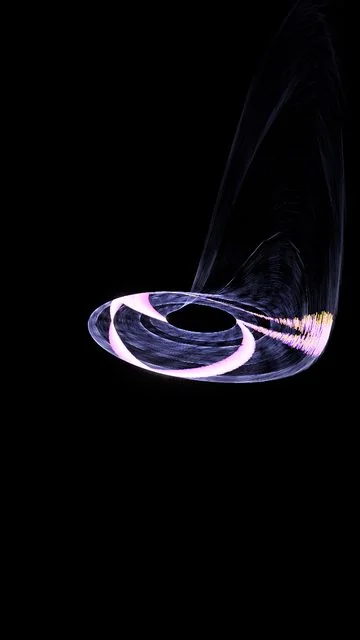
Why chaos stays in one place yet never repeats: a drop of dye, stretched and folded.
A striped drop of dye rides a different flow, Rössler's. The flow pulls the drop into a long ribbon, lifts it and lays it back over itself, again and again, while a white loop drawn through the drop grows longer with every turn.
This answers a puzzle: if chaos pulls nearby states apart, why doesn't everything fly off forever? Because the flow stretches and then folds, like a baker kneading dough [1]. Stephen Smale turned that picture into mathematics with his horseshoe in 1967 [4]. Repeat it and the stripes become ever thinner layers that never repeat, while the dye's volume shrinks toward zero: the attractor is a fractal, more than a surface but with no volume. Otto Rössler published this flow in 1976 as a simpler cousin of Lorenz's, with a single fold [5]. The drop is drawn far wider than a truly nearby set of states, and the stripes are colored for the eye.
Chapter IV The zoo
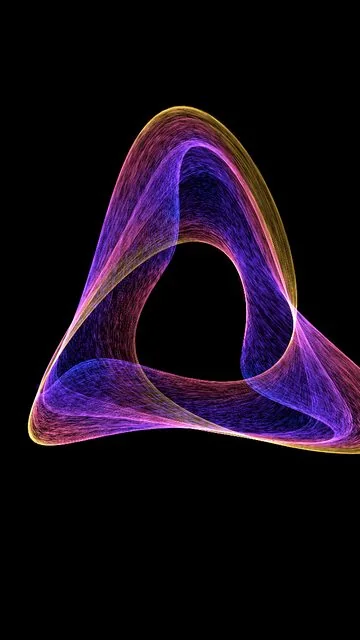
Lorenz was not alone: eight famous strange attractors, flowing one into the next.
A cloud of streaming points holds one famous shape, then every point flies to its place on the next: Lorenz, Rössler, Aizawa, Thomas, Halvorsen, Chen, Dadras and Chen–Lee. Each flows along its own published equations for a few seconds before the cloud moves on.
These are strange attractors: shapes a flow settles onto, bounded, never repeating, and magnifying tiny differences. Lorenz was not alone. René Thomas showed in 1999 that a flow built from simple sine terms knots itself into a three-fold chaotic shape [6], and Guanrong Chen and Tetsushi Ueta published another relative of Lorenz's system the same year [7]. Some names are popular labels rather than formal papers, and Halvorsen's flow, at a setting often used in pictures, turned out in this Story's own checks to be a simple loop, not chaos: turn its dial and the chaos stops. The flights between shapes are drawn, not a real in-between flow. More in What is a strange attractor?
Chapter V Two directions of chaos
Hyperchaos: a four-dimensional flow that stretches in two directions at once.
A dense glowing cloud, laced with threads, weaves a shape that keeps turning itself inside out. Two seeds start a hair apart, one mint and one white, and you watch them drift apart. Color shows depth in a fourth dimension: warm is near, cool is far.
Lorenz's flow stretches nearby states apart in one direction. This one, a four-variable relative of Lorenz's equations, stretches them in two independent directions at once, which is called hyperchaos. A smooth flow needs at least four dimensions to do it, and Otto Rössler found the first hyperchaotic flow in 1979 [8]. What you see is the three-dimensional shadow of a four-dimensional motion, turned slowly through the fourth axis, and each thread is one real path of the equations.
Chapter VI The search
How we searched: random equations tested live; gold means chaos.
A wall of small tiles, each drawing the path of a random equation. Most lines fly off and fade, a few settle down or loop, and now and then one turns gold and stays.
This is how Everdust's own search for new attractors worked, following a recipe J. C. Sprott published in 1993: write random equations in three variables with simple squared terms, run each one, and keep it only if it stays bounded while its nearby paths pull apart [9]. Gold means a flow passed that first test, which about one in three hundred does. The first search tried about 1.6 million flows, the second about 2.5 billion. Passing once is not proof: some flows look chaotic for a long time and then escape, and two early picks failed that way. Every keeper was re-checked far more carefully, over much longer runs.
Chapter VII Hidden attractors
Attractors with no resting point to start beside: you find them only by falling in.
Four chaotic flows appear one after another as glowing clouds laced with threads: NE16, SE8, the Conch and NE17, each brightest where it moves fastest. Seeds drop into a ring around each one. A seed takes the shape's color if the chaos catches it, turns gold if it settles on SE8's still point, and fades if it flies away.
Most strange attractors circle resting points, places where the flow would stop, and the usual way to find chaos is to start beside an unstable one and nudge. Hidden attractors have no such door: their pull reaches no small neighborhood of any resting point, so you find them only by falling in [10]. Some have no resting point at all; in 2013 Jafari, Sprott and Golpayegani listed seventeen simple flows like that, NE1 to NE17 [11]. Others, like SE8, have one resting point that is stable, so it pulls nearby seeds in instead of throwing them onto the chaos [12]. When the Conch was trimmed to seven terms, its resting points vanished.
Chapter VIII The Conch
The Conch: seven terms, no resting point anywhere, found by our own search.
A shell of streaming light: the Conch. Amber knots appear on it one after another, and the flow draws each one out into a thread that wraps the whole shell.
The Conch is the strange attractor Everdust's search turned up, pruned to seven terms. Nowhere does its flow come to rest, yet none of the thousands of starting points we tried escapes it, and it never repeats. Compared with 89 known chaotic systems by features that survive any shifting or stretching of the axes, such as resting points and symmetry, it matches none; NE16 is its closest cousin. So it is probably new. It is not simpler than known examples, which manage with five or six terms, and it has not met the proposed standard for publishing a new chaotic system, so it is not proven new [13]. Colors show speed, and time is sped up.
What’s simulated, and what isn’t
Every shape is a real flow: the points and threads follow their published equations, computed live as you watch, and the numbers in the narration (how fast the gaps grow, the search's pass rate, the Conch's checks) are the Story's own measurements. Some things are drawn rather than simulated: the flights between shapes in the zoo, the size and stripes of the dye drop, the fourth dimension shown as color and a slow turn, and the colors that mark speed. Lorenz's original model had twelve variables; the Story replays his restart on his later three-variable equations, with this run's digits. Time is sped up. It is simulated live, not video.
Watch Chaos: The Attractor We Found in Everdust
Chaos: The Attractor We Found is in the Everdust app on iPhone and iPad, Android, Apple Vision Pro, Mac, Apple TV and Meta Quest 3 and 3S. Open Everdust, choose Stories, then Chaos: The Attractor We Found. Free: all 8 chapters.
Everdust on the App Store (iPhone, iPad, Apple Vision Pro, Mac, Apple TV)Everdust on Google Play (Android)Everdust on the Meta Horizon Store (Quest 3 and 3S)
Everdust is free to download, with no ads and no account. Every chapter of Chaos: The Attractor We Found is free on iPhone, iPad, Android, Apple Vision Pro, Mac and Apple TV (on Meta Quest, which chapters are free can differ).
Questions people ask
What is the butterfly effect? The idea that tiny differences in a starting state can grow until they change everything, so forecasts fade however good the data. The name comes from Edward Lorenz's 1972 talk asking whether a butterfly's wings in Brazil could set off a tornado in Texas [1].
What is the Lorenz attractor? The two-winged shape traced by the three equations Edward Lorenz published in 1963 as a simplified model of the weather's churning air. Its paths never repeat and never settle, yet always stay on the same shape [2].
What is a hidden attractor? A chaotic attractor whose pull reaches no small neighborhood of any resting point of its equations, so the usual method, starting next to an unstable resting point, never finds it [10].
Sources
- Motter, A. E. & Campbell, D. K. (2013). Chaos at fifty. Physics Today 66(5), 27.
- Lorenz, E. N. (1963). Deterministic nonperiodic flow. Journal of the Atmospheric Sciences 20, 130.
- Lorenz, E. N. (1963). The predictability of hydrodynamic flow. Transactions of the New York Academy of Sciences 25, 409.
- Smale, S. (1967). Differentiable dynamical systems. Bulletin of the American Mathematical Society 73, 747.
- Rössler, O. E. (1976). An equation for continuous chaos. Physics Letters A 57, 397.
- Thomas, R. (1999). Deterministic chaos seen in terms of feedback circuits: analysis, synthesis, "labyrinth chaos". International Journal of Bifurcation and Chaos 9, 1889.
- Chen, G. & Ueta, T. (1999). Yet another chaotic attractor. International Journal of Bifurcation and Chaos 9, 1465.
- Rössler, O. E. (1979). An equation for hyperchaos. Physics Letters A 71, 155.
- Sprott, J. C. (1993). Automatic generation of strange attractors. Computers & Graphics 17, 325.
- Leonov, G. A. & Kuznetsov, N. V. (2013). Hidden attractors in dynamical systems. From hidden oscillations in Hilbert–Kolmogorov, Aizerman, and Kalman problems to hidden chaotic attractor in Chua circuits. International Journal of Bifurcation and Chaos 23, 1330002.
- Jafari, S., Sprott, J. C. & Golpayegani, S. M. R. H. (2013). Elementary quadratic chaotic flows with no equilibria. Physics Letters A 377, 699.
- Molaie, M., Jafari, S., Sprott, J. C. & Golpayegani, S. M. R. H. (2013). Simple chaotic flows with one stable equilibrium. International Journal of Bifurcation and Chaos 23, 1350188.
- Sprott, J. C. (2011). A proposed standard for the publication of new chaotic systems. International Journal of Bifurcation and Chaos 21, 2391.
Chapter stills: Everdust, from each chapter’s live simulation. The Story’s script was written for Everdust from the sources above; River reads it. This page retells it in its own words.
More Stories
The Story of Everything
13.8 billion years, from the first light to the lights of Earth tonight. Free in full.
Clockwork to Chaos
Three hundred years of perfect clockwork, undone by one more hinge.
Hidden Patterns
Fireflies, starlings, sand, magnets and light, each making a pattern no one designed.
Why Things Glow
Glowworms, fireflies, glowing seas, blue ice and molten rock: seven rivers of light.