Hidden Patterns: fireflies, starlings, sand, magnets and light, each making order no one designed
Hidden Patterns is seven short chapters about order that nobody designs: fireflies that flash together, a flock that moves like one animal, sand that draws on a ringing plate, spikes on a magnetic liquid, spots that grow out of chemistry, plankton that light up the surf and stress you can see in clear gel. Each is a live simulation, with River, the narrator, explaining it as you watch.
One idea ties them together. In every chapter each piece follows a small local rule, a firefly nudging its clock, a bird watching its neighbors, a grain of sand bouncing off whatever moves, and the pattern appears on its own. Nobody conducts and nothing draws the picture: the pattern comes from the crowd.
At a glance
- Chapters
- 7, each a live simulation
- Length
- about 6 minutes played straight through
- Narrator
- River, with subtitles
- Free or Plus
- Free: all 7 chapters
- Where
- Everdust on iPhone and iPad, Android, Apple Vision Pro, Mac, Apple TV and Meta Quest 3 and 3S
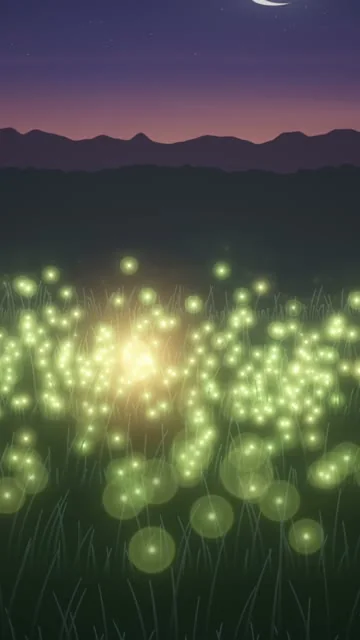 IFireflies in Step
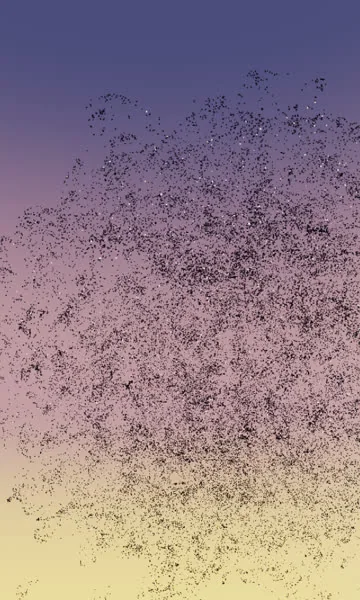 IIThe Flock
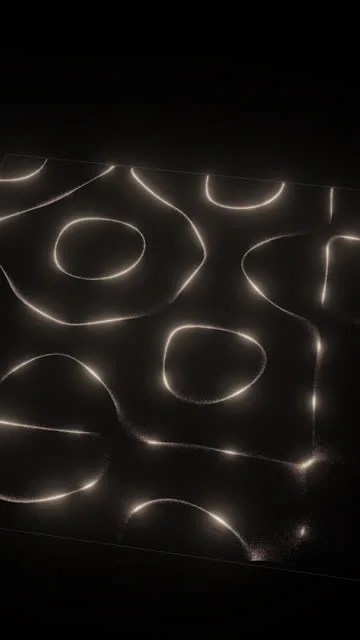 IIISand That Listens
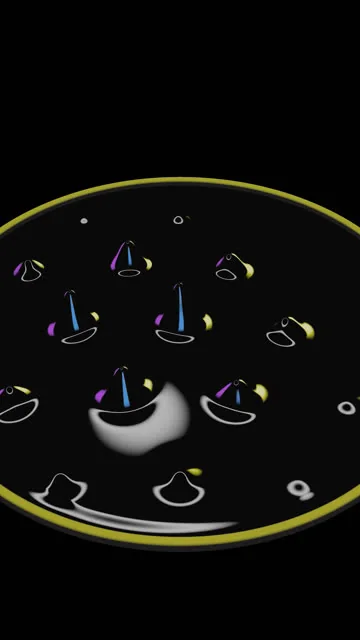 IVSpikes from a Magnet
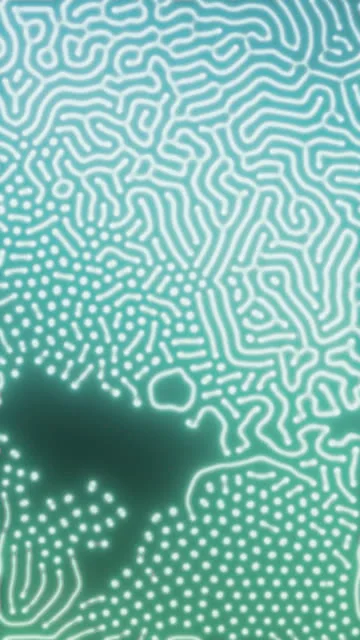 VTuring's Spots
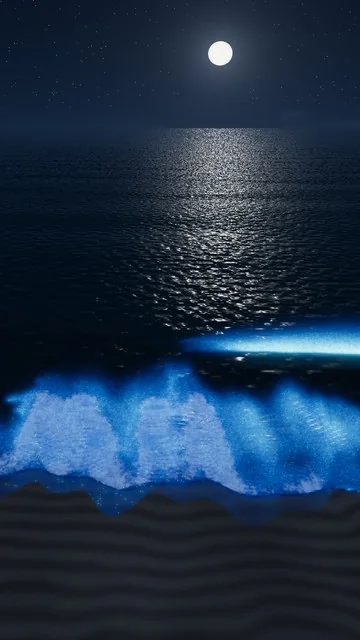 VIThe Glowing Tide
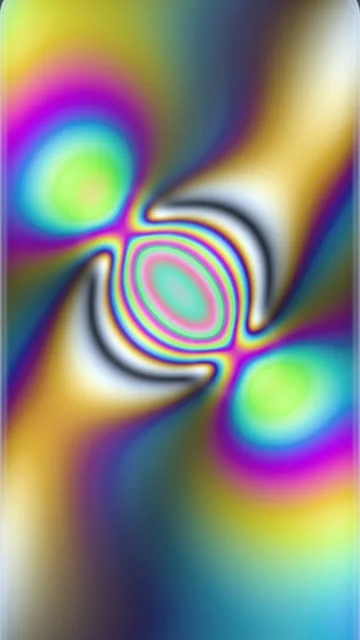 VIIStress in Glass
Chapter by chapter
Chapter I Fireflies in Step
Hundreds of fireflies, each on its own clock, fall into step with no one leading.
A summer meadow at dusk is full of fireflies, each flashing on its own clock. At first the flashes are random and no one is in charge. Then patches fall into step, order spreads across the grass in ripples, and soon the whole meadow flashes as one. Hold a finger down to hang a lantern, and the fireflies around it fall in step with it first.
Each firefly here is a tiny clock that hurries a little whenever it sees a neighbor flash. In 1990 Renato Mirollo and Steven Strogatz proved that a population of identical clocks nudging each other this way almost always ends up firing together; their model grew out of Charles Peskin's 1975 model of the pacemaker cells that keep a heart in time [1]. Real fireflies do it: Pteroptyx males flash in unison in trees along rivers in Southeast Asia [2], and swarms of Photinus carolinus flash in synchronized bursts in the Great Smoky Mountains [3].
Chapter II The Flock
Tens of thousands of starlings fold into one shape, each following a few local rules.
At dusk, tens of thousands of starlings fold into liquid shapes against a sunset sky, and none of them leads. When music is playing, its beat sends a hawk diving through, and the flock bursts open around it and closes again.
Each bird follows three local rules: match your neighbors' direction, stay close, don't collide. Craig Reynolds showed in 1987 that rules like these, and nothing else, produce flocking [4]. Real starlings keep track of about six or seven nearest neighbors, however far away those are [5], and a change in one bird's flight is felt across the whole flock, however large it grows [6]. A citizen-science study of murmurations counted about 30,000 birds on average and up to 750,000, and concluded that they are mainly a defense against predators such as hawks [7]. No bird sees the shape; only the flock makes it.
Chapter III Sand That Listens
Sand on a vibrating plate gathers on the lines that stay still: Chladni figures.
Sand lies on a vibrating steel plate. Some parts of the plate shake hard; along certain lines it keeps still. The sand bounces off the moving parts and settles on the still lines, drawing a sharp geometric figure. When music is playing, its beat strikes the plate and every few bars picks a new note and a new figure.
Waves crossing the plate reflect from its edges and add up into a standing wave. Along its nodal lines, where the waves cancel, the plate doesn't move, and that is where the sand collects. Ernst Chladni made these figures famous in 1787 by bowing thin plates with a violin bow [8]. Higher notes give more nodal lines and finer figures, and violin makers use the same patterns to tune the wooden plates of their instruments [9]. In the chapter, settled sand glows warm gold and bouncing grains a dim blue-violet.
Chapter IV Spikes from a Magnet
A magnetic liquid jumps into a honeycomb of spikes when the field is strong enough.
A black pool of liquid shines like a mirror under colored studio lights. A hidden magnet below heaps it into a mound and then into a lattice of needle-sharp spikes. Here the magnet follows the bass of whatever music is playing, so in silence the pool lies flat.
Ferrofluid is a real magnetic liquid: grains of iron oxide about ten billionths of a meter across, each coated so they don't clump, floating in a carrier liquid [10]. In a real fluid nothing happens until the field passes a critical strength; then the flat surface breaks into spikes packed in a hexagonal pattern, like a honeycomb, where the magnet's pull balances gravity and surface tension [11]. The chapter's spikes grow smoothly with the field instead of jumping at a threshold. Ferrofluid was invented at NASA in the early 1960s by Steve Papell, to move rocket fuel in weightlessness [12]. Try it in Ferrofluid in Your Hand.
Chapter V Turing's Spots
Two reacting chemicals grow spots and stripes on their own, as Alan Turing proposed.
Two chemicals spread across a glossy ring and react. From a few drops, spots and stripes grow on their own: here spots split in two like cells, there they join into coral-like mazes, and the patterns keep sliding from one kind to another.
One chemical feeds on the other and makes more of itself as it goes, while both spread out. Alan Turing predicted in 1952 that reactions like this can build stable patterns from an almost uniform start [13]. The chapter's recipe is the Gray–Scott reaction, and in 1993 John Pearson showed that it gives spots, self-dividing spots, stripes and mazes depending on how fast it is fed and drained [14]. Biologists think Turing-type chemistry paints the stripes on some fish: an angelfish's stripes shift and rearrange as it grows [15], and zebrafish pigment cells interact just as the theory needs [16]. The colors here are invented; the shapes come from the chemistry.
Chapter VI The Glowing Tide
Plankton flash blue wherever the sea is jolted, drawing the water's hidden motion in light.
A moonlit beach at night, and the sea is full of tiny living lights. Wherever the water is jolted it flashes electric blue: in the breaking waves, in the wash running up the sand, in the wake of your finger. Each patch flashes, fades and needs a few seconds before it can glow again.
The lights are dinoflagellates, single-celled plankton, most smaller than a grain of sand, and a flash lasts about a tenth of a second [17]. They flash when the water around them is sheared, pulled and stretched by the flow; it is the shear, not the jolt's acceleration, that sets them off [18]. The chapter's flash fades more slowly than a real one, for the eye. Why flash at all? One idea, the burglar-alarm hypothesis, is that the light calls in bigger hunters that eat whatever is grazing on the plankton; experiments support it, but it is still a hypothesis [19].
Chapter VII Stress in Glass
Crossed polarising filters turn the stress inside a clear slab into rings of colour.
A slab of clear gel sits on a light box between two polarizing filters. Press it and rainbow rings bloom around your fingertip; squeeze it between two fingers and the whole slab shifts color. Left alone, a gentle ghost press wanders across it.
Squeezing a clear material makes it split light into two rays that travel at slightly different speeds, as David Brewster discovered in 1816 [20]. Between crossed polarizing filters the two rays interfere and turn into color, so each colored ring is a line of equal stress (strictly, of equal difference between the two main stresses), and the more rings, the bigger the stress. Engineers call this photoelasticity and use it on clear models to see where parts and structures will strain [21]. Try it at home: many laptop and phone screens give off polarized light, so a clear plastic fork held against one and viewed through polarized sunglasses shows the colors [22].
What’s simulated, and what isn’t
Each chapter simulates the real rule behind its pattern: fireflies as clocks nudged by their neighbors' flashes, birds following three local rules, sand on a standing wave, two reacting chemicals, a shallow sea that flashes where it is sheared, and light through stressed gel with colors in the real interference sequence. Some things are simplified. The ferrofluid's spikes grow smoothly instead of jumping at a threshold, the colors of Turing's spots are invented, the plankton's flash fades more slowly than a real one, and the hawk, the plate's new figures and the magnet follow music only when it plays. It is simulated live, not video.
Watch Hidden Patterns in Everdust
Hidden Patterns is in the Everdust app on iPhone and iPad, Android, Apple Vision Pro, Mac, Apple TV and Meta Quest 3 and 3S. Open Everdust, choose Stories, then Hidden Patterns. Free: all 7 chapters.
Everdust on the App Store (iPhone, iPad, Apple Vision Pro, Mac, Apple TV)Everdust on Google Play (Android)Everdust on the Meta Horizon Store (Quest 3 and 3S)
Everdust is free to download, with no ads and no account. Every chapter of Hidden Patterns is free on iPhone, iPad, Android, Apple Vision Pro, Mac and Apple TV (on Meta Quest, which chapters are free can differ).
Questions people ask
Why do fireflies flash in sync? Each male adjusts the timing of its next flash toward the flashes it sees, so local nudges spread into one rhythm with no leader [1]. Females of at least one species respond more readily to synchronized flashing [23].
What is a Chladni figure? The pattern sand makes on a vibrating plate as it gathers along the lines that stay still. Ernst Chladni made them famous in 1787 [8].
What makes the sea glow blue at night? Usually single-celled plankton called dinoflagellates, which flash blue when the water around them is disturbed [17][18].
Sources
- Mirollo, R. E. & Strogatz, S. H. (1990). Synchronization of pulse-coupled biological oscillators. SIAM Journal on Applied Mathematics 50, 1645.
- Buck, J. (1988). Synchronous rhythmic flashing of fireflies. II. The Quarterly Review of Biology 63, 265.
- Sarfati, R., Hayes, J. C. & Peleg, O. (2021). Self-organization in natural swarms of Photinus carolinus synchronous fireflies. Science Advances 7, eabg9259.
- Reynolds, C. W. (1987). Flocks, herds and schools: a distributed behavioral model. ACM SIGGRAPH Computer Graphics 21, 25.
- Ballerini, M. et al. (2008). Interaction ruling animal collective behavior depends on topological rather than metric distance: evidence from a field study. Proceedings of the National Academy of Sciences 105, 1232.
- Cavagna, A. et al. (2010). Scale-free correlations in starling flocks. Proceedings of the National Academy of Sciences 107, 11865.
- Goodenough, A. E. et al. (2017). Birds of a feather flock together: insights into starling murmuration behaviour revealed using citizen science. PLOS ONE 12, e0179277.
- Ullmann, D. (2007). Life and work of E.F.F. Chladni. The European Physical Journal Special Topics 145, 25.
- Hutchins, C. M. (1981). The acoustics of violin plates. Scientific American 245(4), 170.
- Rosensweig, R. E. (1987). Magnetic fluids. Annual Review of Fluid Mechanics 19, 437.
- Cowley, M. D. & Rosensweig, R. E. (1967). The interfacial stability of a ferromagnetic fluid. Journal of Fluid Mechanics 30, 671.
- NASA. Novel Rocket Fuel Spawned Ferrofluid Industry (NASA History).
- Turing, A. M. (1952). The chemical basis of morphogenesis. Philosophical Transactions of the Royal Society of London B 237, 37.
- Pearson, J. E. (1993). Complex patterns in a simple system. Science 261, 189.
- Kondo, S. & Asai, R. (1995). A reaction–diffusion wave on the skin of the marine angelfish Pomacanthus. Nature 376, 765.
- Nakamasu, A. et al. (2009). Interactions between zebrafish pigment cells responsible for the generation of Turing patterns. Proceedings of the National Academy of Sciences 106, 8429.
- Haddock, S. H. D., Moline, M. A. & Case, J. F. (2010). Bioluminescence in the sea. Annual Review of Marine Science 2, 443.
- Latz, M. I. et al. (2004). Hydrodynamic stimulation of dinoflagellate bioluminescence: a computational and experimental study. Journal of Experimental Biology 207, 1941.
- Abrahams, M. V. & Townsend, L. D. (1993). Bioluminescence in dinoflagellates: a test of the burgular alarm hypothesis. Ecology 74, 258.
- Brewster, D. (1816). On the communication of the structure of doubly refracting crystals to glass, muriate of soda, fluor spar, and other substances, by mechanical compression and dilatation. Philosophical Transactions of the Royal Society of London 106, 156.
- Ramesh, K. & Sasikumar, S. (2020). Digital photoelasticity: recent developments and diverse applications. Optics and Lasers in Engineering 135, 106186.
- Fakhruddin, H. (2008). Some activities with polarized light from a laptop LCD screen. The Physics Teacher 46, 229.
- Moiseff, A. & Copeland, J. (2010). Firefly synchrony: a behavioral strategy to minimize visual clutter. Science 329, 181.
Chapter stills: Everdust, from each chapter’s live simulation. The Story’s script was written for Everdust from the sources above; River reads it. This page retells it in its own words.
More Stories
The Story of Everything
13.8 billion years, from the first light to the lights of Earth tonight. Free in full.
Clockwork to Chaos
Three hundred years of perfect clockwork, undone by one more hinge.
Chaos: The Attractor We Found
From Lorenz's rounding error to a strange attractor our own search turned up.
Why Things Glow
Glowworms, fireflies, glowing seas, blue ice and molten rock: seven rivers of light.