Why Things Glow: glowworms, fireflies, glowing seas, blue ice and molten rock, and why each one shines
Why Things Glow is a night journey down seven rivers of light, each a live ride after a real kind of place: the glowworm caves of New Zealand and Australia, a mangrove bay full of glowing plankton, rivers lined with synchronous fireflies, a tunnel under a glacier, a cenote in Mexico's Yucatán and a lava tube in Hawaii. River, the narrator, explains why each one shines.
The first four glows are alive: chemistry that insects, plankton and fungi use as a trap, an alarm or a signal. Then the Story turns to light without life, sunlight turned blue by ice and filtered by water, and ends with rock hot enough to glow by itself. Every light along the way comes from chemistry or from heat.
At a glance
- Chapters
- 7, each a live simulation
- Length
- about 6 minutes played straight through
- Narrator
- River, with subtitles
- Free or Plus
- Free: all 7 chapters
- Where
- Everdust on iPhone and iPad, Android, Apple Vision Pro, Mac, Apple TV and Meta Quest 3 and 3S
Chapter by chapter
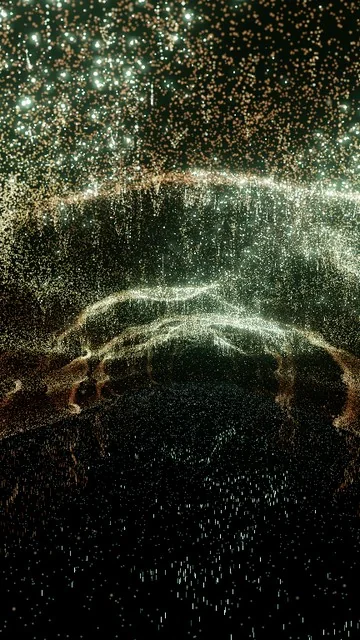
Chapter I Lures in the Dark
An underground river under a ceiling of glowworms, each hanging sticky threads.
You drift down a dark underground river through a limestone cave. Thousands of tiny blue-green lights hang from the ceiling on beaded silk threads, stalactites hang over the water, and the still river mirrors it all. The cave is lit only by the glowworms above it, the way the glowworm caves of New Zealand and Australia are.
Glowworms are not worms at all, but the larvae of a fungus gnat, a small fly. In New Zealand and Australia, Arachnocampa larvae hang vertical silk threads coated with sticky droplets and lure small flying insects into them with their blue-green light; the light alone draws the prey, and the larval stage can last up to a year [1]. The light comes from a chemical reaction at the larva's tail: an enzyme called luciferase makes a molecule called luciferin react with oxygen and give off light. In 2018 chemists found that the New Zealand glowworm's luciferase belongs to the same family as the firefly's, but its luciferin is entirely new [2]. Living light can be a trap, a signal or a disguise.
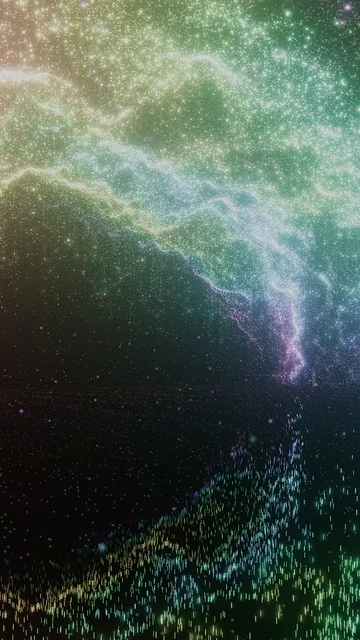
Chapter II Living Light
A glowworm cathedral, its colonies turned to every colour.
A silent boat slips through a low tunnel into a cathedral of glowworm light: a dome twelve meters high whose ceiling is a galaxy of colonies, with curtains of beaded threads hanging meters long, all mirrored in black water. Here the colonies shift through every color. Real glowworms shine only blue-green, so the rainbow is the ride's own. The ride loops, with the same lights in the same places every lap.
Living things have invented light at least 94 separate times, from bacteria and fungi to insects, squid and fish [3]. Most of it is in the sea. In 17 years of video surveys off California, from the surface down to 3,900 meters, 76 percent of the animals seen were able to make light [4]. Most sea light is blue, the color that travels farthest through seawater [5]. And all of it is cold light, made by chemistry rather than by heat.
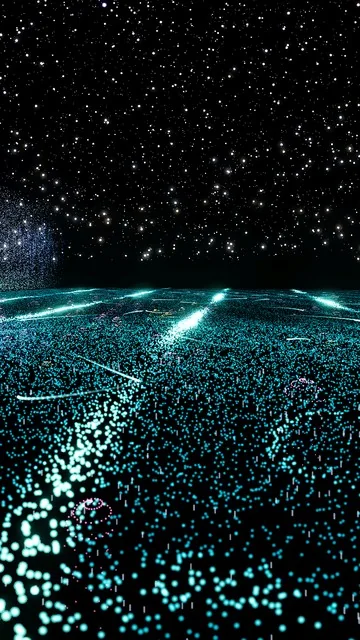
Chapter III The Glowing Sea
A mangrove channel where the water lights up wherever it moves.
A mangrove channel at night, after the bioluminescent bays of Puerto Rico and the Maldives. The black water lights up wherever something moves: the bow wave and wake, each paddle stroke, darting fish, rain rings. Roots hang from the canopy studded with glowing fungi, jellyfish pulse under the surface, and the channel opens into a lagoon under the Milky Way.
Each spark is a single-celled dinoflagellate, a plankton too small to see; Puerto Rico's glowing bays, such as Bahía Fosforescente at La Parguera, are lit by them [6]. Push the water and a cell flashes for about a tenth of a second: the flow deforms the cell and sets off luciferin and luciferase in tiny packets called scintillons [5][7]. Why flash? One idea, the burglar alarm, is that the light calls in bigger hunters that eat whatever is eating the plankton [8]. Glowing fungi run on a daily clock, brightest at night, and green lights shaped like mushrooms draw insects that may spread their spores [9]. And a glowing jellyfish, Aequorea victoria, gave biology the green fluorescent protein, GFP, honored with the 2008 Nobel Prize in Chemistry [10].
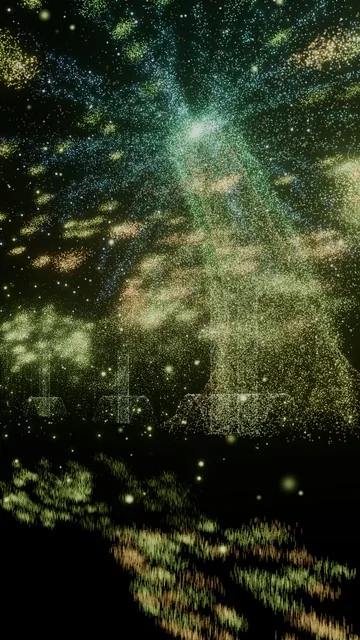
Chapter IV In Step
Mangroves where whole trees of fireflies flash together.
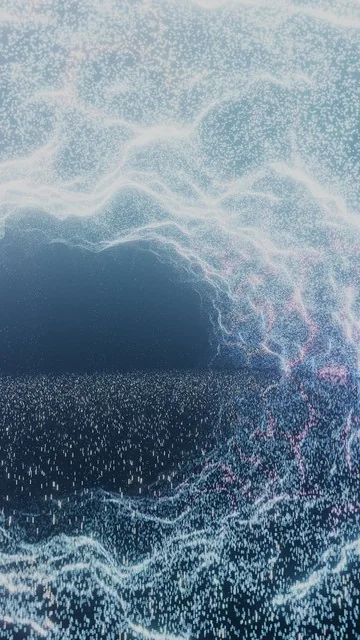
You drift down a river at night between mangroves full of fireflies. Whole trees flash together, the light rolling along the bank in slow waves; a bend reveals a giant firefly tree, then the branches close over the river in a tunnel of light. The ride is after the mangrove rivers of Malaysia and Thailand, but here the trees keep time with your music instead of their own.
In those rivers, males of Pteroptyx fireflies gather in display trees and flash in unison [11]. No firefly leads: each nudges its next flash toward the flashes it sees, and nudges like these are enough to lock a whole population in step [12]. A firefly's light comes from luciferin, oxygen and the cell's energy molecule, ATP, joined by the enzyme luciferase; about 41 percent of the reactions give off a photon [13], and the light comes with little heat. Each species has its own flash pattern, which the fireflies use to find and recognize each other [14]. More in Why fireflies flash in sync.
Chapter V Blue Ice
Under a glacier, where the ice glows blue and light bends into caustics.
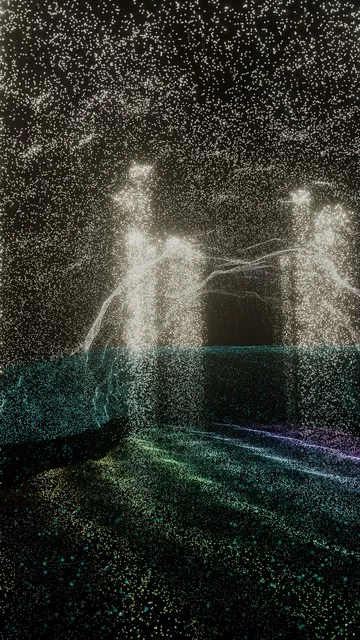
Meltwater carries the boat under a glacier, after the ice caves of Iceland and Alaska. Walls of translucent blue ice glow around you with moving patterns of light, crystals grow from the walls of a vast hall, and at a moulin, a shaft melted down through the glacier, daylight pours in from the open sky. From here on nothing glows by itself: this is sunlight, coming through ice. The ride lets the ice go rainbow; real ice keeps to blue.
Glacier ice is blue because water itself absorbs a little red light. The absorption comes from the way water molecules vibrate, and it is weak, so you see it only through a long path: through deep, clear ice the red is gone and blue is left [15]. Snow and new ice look white because their trapped air bubbles scatter every color back out, while the weight of a glacier squeezes the bubbles out of the deep ice [16]. The moving patterns are caustics, light bent and focused by curved surfaces, like the bright net on the floor of a pool.
Chapter VI Two Waters
A sunlit sinkhole and the shimmering line where fresh water lies on salt.
A cave passage opens into a cenote, a round sinkhole open to the sky, after the flooded caves of Mexico's Yucatán. Sunbeams fall through turquoise water onto white sand, and roots hang down through the opening. Then the boat dips under the surface into a flooded hall of stalactites above a shimmering, mirror-like layer, and rises again.
Cenotes are sinkholes in the Yucatán's limestone, where the roof of a cave has collapsed into the water below. There, a layer of fresh rainwater floats on denser salt water that seeps in from the sea [17]; divers call the sharp boundary between them the halocline, and swimming through it blurs the world. Water drinks red light first, so the deeper water turns blue-green [15]. And a ring of cenotes traces the buried rim of the Chicxulub crater, left by the asteroid impact that ended the age of the dinosaurs [18].
Chapter VII Red Hot
A molten river in a basalt tube, glowing from its own heat.
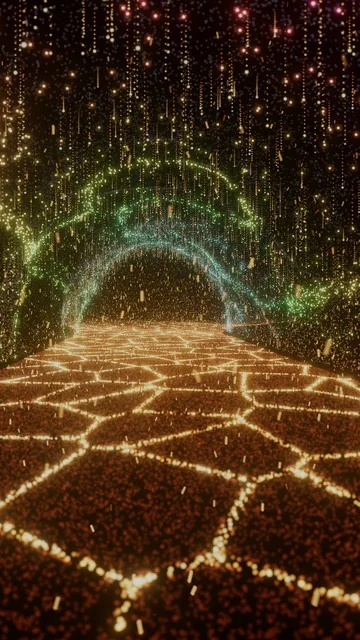
The last river is molten rock, after the lava tubes of Hawaii and Iceland. It runs through a black basalt tube with crusted plates drifting over glowing cracks, sparks and embers rising and molten drops hanging from the roof. A hall opens around a lava fall pouring from a high ledge, then a gallery of glowing veins whose sulfur, copper and cobalt colors are the ride's own.
Lava glows because it is hot. Anything hot enough gives off visible light, called incandescence. Kīlauea's lava erupts at about 1,170 °C [19], and as it cools its glow shifts from yellow, at about 1,000–1,200 °C, to orange and then red, at about 600–800 °C [20], until the crust turns black. A lava tube forms when the surface of a lava river crusts over into a roof, which insulates the stream inside so it stays fluid and keeps flowing beneath [21]. Glowworms, plankton and fireflies make light with chemistry and little heat; lava makes light with heat alone.
What’s simulated, and what isn’t
Each chapter is a live ride you drift through, and each is after a real kind of place, but the rides are not maps of particular caves or rivers. Their colors are not always nature's: real glowworms shine only blue-green, real glacier ice keeps to blue, and the mineral colors in the lava tube are invented, as the narration says. The lights also move with your music, so the firefly trees flash once a bar, gently and never as a strobe, rather than in their own rhythm. The science in the narration holds wherever the boat is.
Watch Why Things Glow in Everdust
Why Things Glow is in the Everdust app on iPhone and iPad, Android, Apple Vision Pro, Mac, Apple TV and Meta Quest 3 and 3S. Open Everdust, choose Stories, then Why Things Glow. Free: all 7 chapters.
Everdust on the App Store (iPhone, iPad, Apple Vision Pro, Mac, Apple TV)Everdust on Google Play (Android)Everdust on the Meta Horizon Store (Quest 3 and 3S)
Everdust is free to download, with no ads and no account. Every chapter of Why Things Glow is free on iPhone, iPad, Android, Apple Vision Pro, Mac and Apple TV (on Meta Quest, which chapters are free can differ).
Questions people ask
Why do glowworms glow? New Zealand and Australian glowworms are the larvae of a small fly. They glow blue-green to lure flying insects into sticky silk threads [1].
Why is glacier ice blue? Water absorbs a little red light, so through a long path of dense, bubble-free ice the red is removed and blue is left [15][16].
Why does lava glow? Because it is hot: anything hot enough gives off visible light. Hawaiian lava erupts at about 1,170 °C and fades from yellow through orange and red as it cools [19][20].
What makes a bioluminescent bay glow? Single-celled plankton called dinoflagellates, which flash blue for about a tenth of a second whenever the water around them is disturbed [5][6].
Sources
- Meyer-Rochow, V. B. (2007). Glowworms: a review of Arachnocampa spp. and kin. Luminescence 22, 251.
- Watkins, O. C., Sharpe, M. L., Perry, N. B. & Krause, K. L. (2018). New Zealand glowworm (Arachnocampa luminosa) bioluminescence is produced by a firefly-like luciferase but an entirely new luciferin. Scientific Reports 8, 3278.
- Lau, E. S. & Oakley, T. H. (2020). Multi-level convergence of complex traits and the evolution of bioluminescence. Biological Reviews 96, 673.
- Martini, S. & Haddock, S. H. D. (2017). Quantification of bioluminescence from the surface to the deep sea demonstrates its predominance as an ecological trait. Scientific Reports 7, 45750.
- Haddock, S. H. D., Moline, M. A. & Case, J. F. (2010). Bioluminescence in the sea. Annual Review of Marine Science 2, 443.
- Soler-Figueroa, B. M. & Otero, E. (2014). The influence of rain regimes and nutrient loading on the abundance of two dinoflagellate species in a tropical bioluminescent bay, Bahía Fosforescente, La Parguera, Puerto Rico. Estuaries and Coasts 38, 84.
- Valiadi, M. & Iglesias-Rodriguez, D. (2013). Understanding bioluminescence in dinoflagellates: how far have we come? Microorganisms 1, 3.
- Abrahams, M. V. & Townsend, L. D. (1993). Bioluminescence in dinoflagellates: a test of the burgular alarm hypothesis. Ecology 74, 258.
- Oliveira, A. G. et al. (2015). Circadian control sheds light on fungal bioluminescence. Current Biology 25, 964.
- The Royal Swedish Academy of Sciences (2008). The Nobel Prize in Chemistry 2008: press release (Shimomura, Chalfie and Tsien, for the green fluorescent protein, GFP).
- Buck, J. (1988). Synchronous rhythmic flashing of fireflies. II. The Quarterly Review of Biology 63, 265.
- Mirollo, R. E. & Strogatz, S. H. (1990). Synchronization of pulse-coupled biological oscillators. SIAM Journal on Applied Mathematics 50, 1645.
- Ando, Y. et al. (2007). Firefly bioluminescence quantum yield and colour change by pH-sensitive green emission. Nature Photonics 2, 44.
- National Park Service, Great Smoky Mountains National Park. Firefly Flash Patterns.
- Braun, C. L. & Smirnov, S. N. (1993). Why is water blue? Journal of Chemical Education 70, 612.
- Woods Hole Oceanographic Institution. Why is glacier ice blue?
- Bauer-Gottwein, P. et al. (2011). Review: the Yucatán Peninsula karst aquifer, Mexico. Hydrogeology Journal 19, 507.
- Hildebrand, A. R. et al. (1995). Size and structure of the Chicxulub crater revealed by horizontal gravity gradients and cenotes. Nature 376, 415.
- U.S. Geological Survey. How hot is a Hawaiian volcano? (FAQ).
- U.S. Geological Survey, Hawaiian Volcano Observatory (2017). Volcano Watch: Remotely measuring the temperature of Kīlauea lava.
- Peterson, D. W., Holcomb, R. T., Tilling, R. I. & Christiansen, R. L. (1994). Development of lava tubes in the light of observations at Mauna Ulu, Kilauea Volcano, Hawaii. Bulletin of Volcanology 56, 343.
Chapter stills: Everdust, from each chapter’s live simulation. The Story’s script was written for Everdust from the sources above; River reads it. This page retells it in its own words.
More Stories
Our Solar System
The Sun's family at its real sizes and distances, and which planets are up tonight.
Clockwork to Chaos
Three hundred years of perfect clockwork, undone by one more hinge.
Chaos: The Attractor We Found
From Lorenz's rounding error to a strange attractor our own search turned up.
Hidden Patterns
Fireflies, starlings, sand, magnets and light, each making a pattern no one designed.