Our Solar System: the Sun, eight planets, the belts and the moons at their true sizes and distances
Our Solar System is a tour of the Sun's family at its true sizes and distances, in eight chapters: the Sun beside Earth, the rocky planets shrunk to fit a room, the asteroid belt, the four giants, Saturn's rings, the moons that rival planets, the icy edge, and the planets where they stand tonight.
The sizes and distances are NASA's, scaled down together, so when River, the narrator, says Earth is a grain of dust 1.7 meters from a marble-sized Sun, that is the real proportion. It is the quickest way to feel how big, and how empty, the Solar System is.
At a glance
- Chapters
- 8, each a live simulation
- Length
- about 7 minutes played straight through
- Narrator
- River, with subtitles
- Free or Plus
- Free: all 8 chapters
- Where
- Everdust on iPhone and iPad, Android, Apple Vision Pro, Mac, Apple TV and Meta Quest 3 and 3S
Chapter by chapter
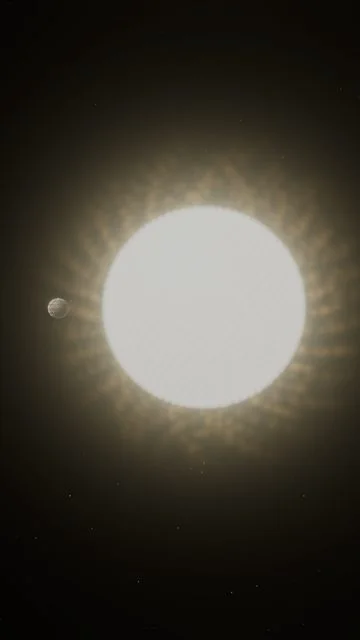
Chapter I Our Star
The Sun beside Earth and then Jupiter, at their true sizes.
Our solar system has one star, and everything else circles it. Here is the Sun beside Earth, both at their true sizes, and then beside Jupiter, the biggest planet. Even Jupiter is dwarfed. Deep inside, the Sun turns hydrogen into helium, and that is where sunlight comes from.
The Sun is 1,391,400 kilometers across, 109 times wider than Earth [1] and about 9.7 times wider than Jupiter, which measures 142,984 kilometers [2]. Its light, crossing the 149.6 million kilometers to Earth, takes about 8 minutes and 20 seconds to arrive [2]. The planets are what was left over when the Sun formed: the young Sun was ringed by a disk of gas and dust, like the disks telescopes now see around other newborn stars [3].
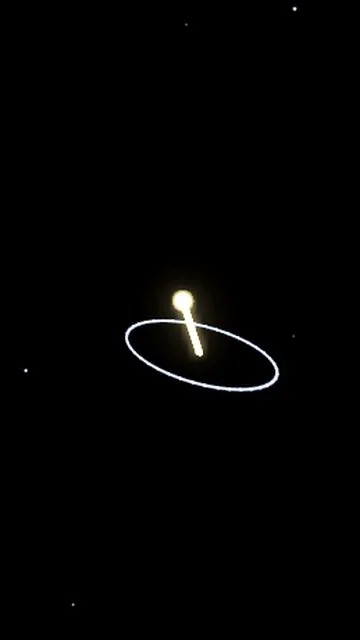
Chapter II Four Rocky Worlds
A marble-sized Sun, and the four rocky planets at true size and distance.
Close to the Sun are four small worlds of rock and iron. Here the Sun is shrunk to a marble and every distance shrinks with it. Mercury, the smallest planet, circles the Sun in 88 days. Venus is nearly Earth's twin in size, hidden under burning clouds. Earth is a grain of dust 1.7 meters from the Sun, with the Moon just 4.4 millimeters away, and Mars, half as wide as Earth, is 2.6 meters out. All four would fit inside a small room.
The numbers are NASA's, scaled down together. With a Sun 1.6 centimeters across, Earth's 12,756 kilometers become 0.15 millimeters and its 149.6 million kilometers from the Sun become 1.7 meters [1][2]. Venus is 12,104 kilometers across, 95 percent of Earth's width, and its thick atmosphere traps so much heat that the surface is about 467 degrees Celsius, hot enough to melt lead [2][4]. Mars is 6,792 kilometers across, a little over half Earth's width [2].
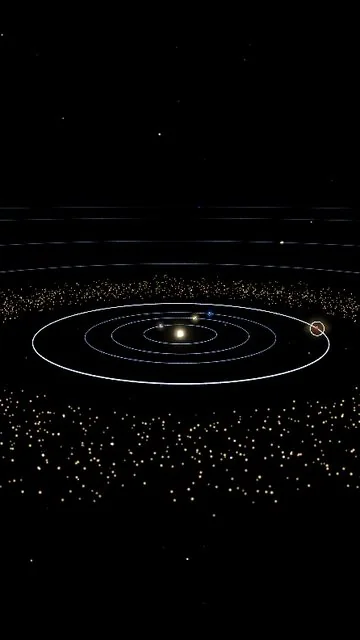
Chapter III The Asteroid Belt
The room at true distances out to Jupiter, with the belt of rocks between Mars and Jupiter.
Now the inner solar system fits in your room at true distances. Past Mars there is a wide gap, and it is not empty: millions of rocks circle here in the asteroid belt. The grains you see only show where the belt is; they are not real rocks. The real ones are so far apart that spacecraft fly right through. Beyond the belt, the giants begin.
Most known asteroids orbit between Mars and Jupiter, and NASA estimates the belt holds 1.1 to 1.9 million asteroids more than a kilometer across, plus millions of smaller ones [5]. Early in the Solar System's history the gravity of newly formed Jupiter brought planet-building in this region to an end, which is why the rocks never gathered into one world [5]. In the chapter the planets are drawn far bigger than true so you can see them; their distances are real.
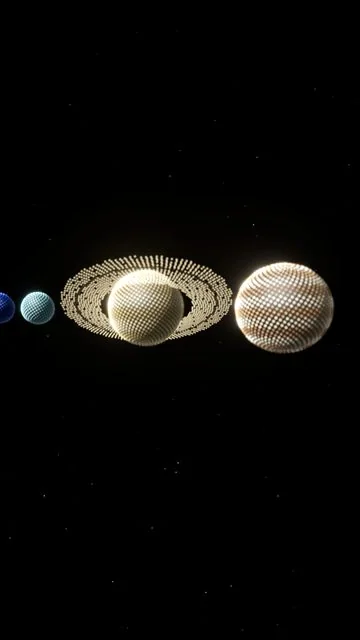
Chapter IV The Giants
Jupiter, Saturn, Uranus and Neptune beside Earth at their true sizes.
Beyond the belt are four giants, and Earth is the speck beside them. Jupiter is 11 times wider than Earth, and more than a thousand Earths could fit inside it. Saturn is nearly as wide, yet lighter for its size than water. Uranus and Neptune are ice giants, each about four Earths across. Then Jupiter's Great Red Spot appears beside Earth: a storm wider than our whole planet.
Jupiter is 142,984 kilometers across, Saturn 120,536, Uranus 51,118 and Neptune 49,528, against Earth's 12,756, and Saturn's average density, 687 kilograms per cubic meter, is less than water's [2][6]. Uranus and Neptune are the Solar System's two ice giants [7]. The Great Red Spot has been watched for more than 150 years and is steadily shrinking [8], but it is still a storm bigger than Earth [9].
Chapter V Rings
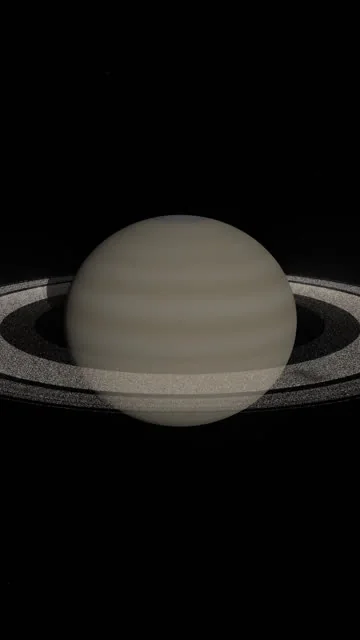
Saturn and its rings at their real proportions, on a slow pass.
Saturn's rings are countless pieces of ice, from dust to boulders, shown here at their true proportions on a slow pass. End to end they would reach 71 percent of the way to our Moon, yet most of the rings are thinner than a house is tall. The dark lane is the Cassini Division, and at the north pole a six-sided storm turns: the hexagon.
The main rings run from 74,658 to 136,780 kilometers from Saturn's center [10], so they span about 273,000 kilometers, against the Moon's average distance of 384,400 [2]. They are more than 95 percent water ice [11] and typically only about 10 meters thick; the Cassini Division is 4,700 kilometers wide, and the hexagon is a six-sided jet stream first seen by the Voyager spacecraft [6]. The Cassini spacecraft caught ring material falling into Saturn [11], and its measurements of the rings' mass suggest they may be only 10 to 100 million years old [12], though others argue they could be as old as the Solar System [13].
Chapter VI Moons
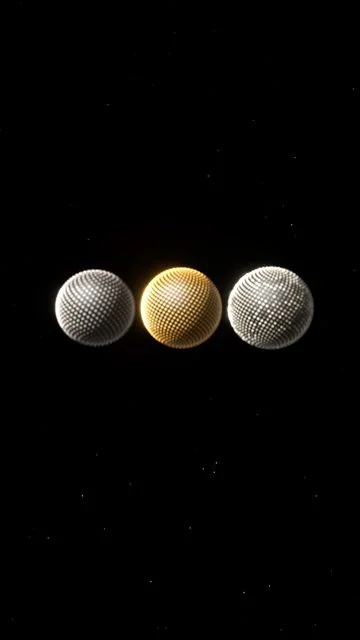
Our Moon beside Earth, two moons bigger than Mercury, and Europa.
Most planets have moons. Ours is 27 percent as wide as Earth, and it probably formed when a world crashed into the young Earth. Some moons are bigger than a planet: Ganymede, Jupiter's largest, is wider than Mercury, and Titan, Saturn's biggest, has a thick sky and lakes of liquid methane. Europa is a little smaller than our Moon, but under its ice there is probably an ocean.
The Moon is 3,475 kilometers across and Mercury 4,879 [2]; Ganymede is 5,262 kilometers and Europa 3,122 [14], and Titan 5,150 [15]. The Moon most likely formed from the debris of a giant impact with a Mars-sized body [16]. Cassini found lakes on Titan [17], filled with liquid methane [6]. Europa's ocean, under an ice shell 15 to 25 kilometers thick, may hold twice as much water as all of Earth's oceans, which makes it one of the most promising places to look for life beyond Earth [18]. More in How the Moon formed.
Chapter VII The Edge
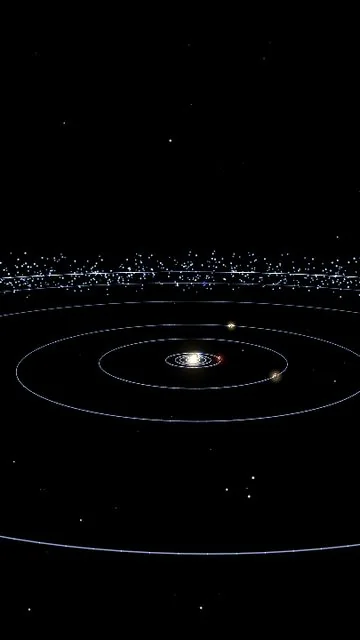
Out past Neptune: the Kuiper belt, Pluto, and the Oort cloud beyond.
Neptune is the last planet, 30 times farther from the Sun than Earth, and sunlight takes more than four hours to get there. Beyond it lies the Kuiper belt, a wide ring of icy worlds, and Pluto lives here, a dwarf planet smaller than our Moon. Farther still, we think, a vast shell of comets surrounds everything: the Oort cloud. In this room it would begin 89 meters away and end 4.5 kilometers away.
Neptune orbits 4,515 million kilometers from the Sun [2], so the sunlight reaching it is about 4.2 hours old. The Kuiper belt begins at Neptune's orbit, about 30 times Earth's distance from the Sun, and its main part ends around 50 [19]. Pluto, 2,376 kilometers across [2], was reclassified as a dwarf planet by the International Astronomical Union in 2006 [20]. The Oort cloud's inner edge is thought to lie 2,000 to 5,000 times Earth's distance from the Sun and its outer edge 10,000 to 100,000 times; Jan Oort proposed it in 1950 to explain where long-period comets come from, and it has never been seen directly [21].
Chapter VIII Up Tonight
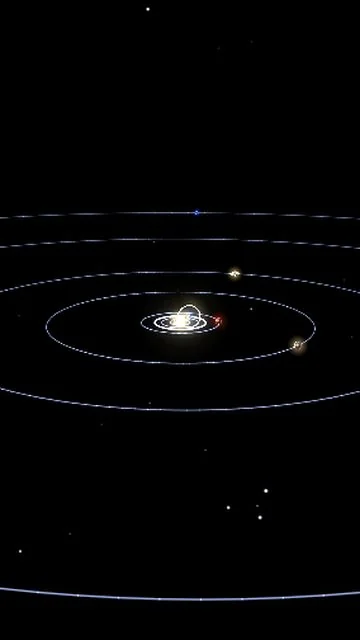
The planets where they are today, and which of them you can see tonight.
These are the planets as they stand today, close to their real places, and every night we look out from Earth across these orbits. Five planets are bright enough to see without a telescope, and some of them are up tonight, wherever you are. Look for a point that shines steadily, without twinkling. Tonight's Sky shows you which ones are up, and where to look.
Each planet is placed at its average position along its orbit for today's date, from formulas published by NASA's Jet Propulsion Laboratory, which is why the narration says "close to" [22]. The five planets you can see with your eyes alone are Mercury, Venus, Mars, Jupiter and Saturn [23]. A steady light is a good rule of thumb, because a planet shows a tiny disk rather than a point of light, though planets low in the sky twinkle too. For tonight's view from where you are, see What's in my sky tonight.
What’s simulated, and what isn’t
The sizes and distances are real: NASA's fact-sheet numbers scaled down together, so the Sun, planets and moons keep their true proportions and the belts sit at their true distances. Some things are drawn so you can see them: the grains of the asteroid and Kuiper belts only mark where the belts are, the planets are drawn far larger than true in the room views, and the planets' places today are averages along their orbits, close to but not exactly where they are. Saturn's rings are shown at their real radii, with the gaps, the planet's shadow and the polar hexagon spacecraft photographed.
Watch Our Solar System in Everdust
Our Solar System is in the Everdust app on iPhone and iPad, Android, Apple Vision Pro, Mac, Apple TV and Meta Quest 3 and 3S. Open Everdust, choose Stories, then Our Solar System. Free: all 8 chapters.
Everdust on the App Store (iPhone, iPad, Apple Vision Pro, Mac, Apple TV)Everdust on Google Play (Android)Everdust on the Meta Horizon Store (Quest 3 and 3S)
Everdust is free to download, with no ads and no account. Every chapter of Our Solar System is free on iPhone, iPad, Android, Apple Vision Pro, Mac and Apple TV (on Meta Quest, which chapters are free can differ).
Questions people ask
How big is the Sun compared to Earth? About 109 times wider: 1,391,400 kilometers across against Earth's 12,756 [1][2].
How many planets can you see without a telescope? Five: Mercury, Venus, Mars, Jupiter and Saturn [23].
Is Pluto a planet? Not anymore. The International Astronomical Union reclassified Pluto as a dwarf planet in 2006; it orbits in the Kuiper belt beyond Neptune [20].
How old are Saturn's rings? No one knows for sure. Cassini's measurements of their mass suggest 10 to 100 million years [12], but others argue they could be as old as the Solar System [13].
Sources
- NASA Goddard Space Flight Center. Sun Fact Sheet (NSSDCA).
- NASA Goddard Space Flight Center. Planetary Fact Sheet (NSSDCA).
- ALMA Partnership et al. (2015). The 2014 ALMA Long Baseline Campaign: first results from high angular resolution observations toward the HL Tau region. The Astrophysical Journal Letters 808, L3.
- NASA Science. Venus: Facts.
- NASA Science. Asteroid Facts.
- NASA Science. Saturn: Facts.
- NASA Science. Uranus: Facts.
- Simon, A. A. et al. (2018). Historical and contemporary trends in the size, drift, and color of Jupiter's Great Red Spot. The Astronomical Journal 155, 151.
- NASA Science. Jupiter Facts.
- NASA Goddard Space Flight Center. Saturnian Rings Fact Sheet (NSSDCA).
- Hsu, H.-W. et al. (2018). In situ collection of dust grains falling from Saturn's rings into its atmosphere. Science 362, eaat3185.
- Iess, L. et al. (2019). Measurement and implications of Saturn's gravity field and ring mass. Science 364, eaat2965.
- Crida, A. et al. (2019). Are Saturn's rings actually young? Nature Astronomy 3, 967.
- NASA Goddard Space Flight Center. Jovian Satellite Fact Sheet (NSSDCA).
- NASA Goddard Space Flight Center. Saturnian Satellite Fact Sheet (NSSDCA).
- Canup, R. M. & Asphaug, E. (2001). Origin of the Moon in a giant impact near the end of the Earth's formation. Nature 412, 708.
- Stofan, E. R. et al. (2007). The lakes of Titan. Nature 445, 61.
- NASA Science. Europa: Facts.
- NASA Science. Kuiper Belt: Facts.
- NASA Science. Pluto: Facts.
- NASA Science. Oort Cloud: Facts.
- NASA Jet Propulsion Laboratory, Solar System Dynamics. Approximate Positions of the Planets.
- NASA Science. Planetary Alignments and Planet Parades.
Chapter stills: Everdust, from each chapter’s live simulation. The Story’s script was written for Everdust from the sources above; River reads it. This page retells it in its own words.
More Stories
The Story of Everything
13.8 billion years, from the first light to the lights of Earth tonight. Free in full.
The Future of Everything
From Earth's lights tonight to the last black hole, following the physics forward.
The Life of a Black Hole
Birth, feeding, a shredded star, a merger and the long fade, with light bent by real geometry.
Death of a Giant Star
Betelgeuse, Wolf-Rayet dust spirals, Supernova 1987A and the neutron star at the end.