How the Moon formed: Theia and the giant impact
The Moon most likely formed from the wreckage of a collision. About 4.5 billion years ago a world roughly the size of Mars, which scientists call Theia, struck the young Earth; molten and vaporized rock was thrown into orbit, and the Moon gathered from it. This giant-impact theory explains more about the Moon than any rival, but some of its details are still argued over.
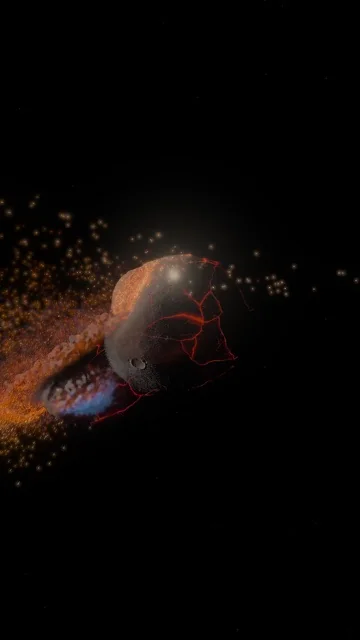
What the giant-impact theory says
William Hartmann and Donald Davis proposed in 1975 that a body the size of a small planet hit the young Earth and that the Moon formed from the debris [1]. In 2001 Robin Canup and Erik Asphaug showed in simulations that a glancing blow from an impactor of about Mars's mass, late in Earth's growth, could put enough material into orbit to make the Moon and give the Earth–Moon pair the spin and orbital motion they have today [2].
In that picture the two worlds' iron cores merge into Earth's, while lighter rock from their mantles is flung into a disk around the planet. The Moon forms from that disk, which is why it is mostly rock with very little iron.
The evidence for it
The Moon is light for its size. Its average density is about 3.3 grams per cubic centimeter, against Earth's 5.5, because it has only a small iron core [3]. A Moon built from the rocky outer layers of two colliding worlds should look exactly like that.
The Moon was once molten on the outside. Its pale highlands are made of rock that floated to the top of a global ocean of magma, which takes a lot of heat, the kind a giant impact provides [4]. Zircon crystals brought back by Apollo 17 crystallized 4.46 billion years ago, so the Moon is at least that old [5].
Apollo samples also show that the Moon's rocks and Earth's have nearly identical oxygen isotopes, a chemical fingerprint that differs from one body to another in the Solar System [6][7]. That match is both the theory's strongest clue and its biggest puzzle.
The puzzle: why is the Moon so like Earth?
In the classic version of the impact, most of the Moon comes from Theia, so it should carry Theia's fingerprint, not Earth's. Yet the two are the same to within a few parts per million [7]. Scientists have offered several ways out. Theia and Earth may have mixed thoroughly in a very violent collision [7]. A fast-spinning young Earth may have been hit in a way that threw out mostly Earth's own rock [8]. The impact may have turned the planet into a spinning, partly vaporized doughnut of rock, called a synestia, inside which the Moon condensed [9]. Or the Moon may have been built from several smaller impacts rather than one [10].
None of these has displaced the others yet. What they share is a giant collision, which is why astronomers still call the giant impact the leading explanation rather than a settled fact.
How fast did the Moon form?
It may have been quick. Simulations run at far higher resolution than earlier ones found that a giant impact can place a Moon-sized body, with a Moon-like low iron content, directly into orbit within a few hours, rather than over months or years from a debris disk [11].
Where is Theia now?
Most of Theia would be inside Earth and the Moon. A 2023 study proposed that two continent-sized regions of unusually dense rock deep in Earth's mantle, near the core, are remnants of Theia's mantle that sank after the impact [12]. It is a new idea, not yet tested as thoroughly as the impact itself.
Watch it in Everdust
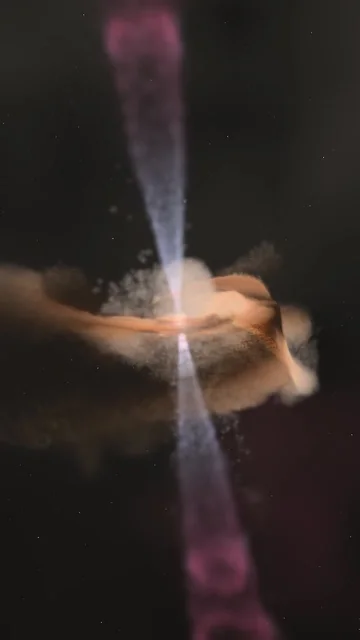
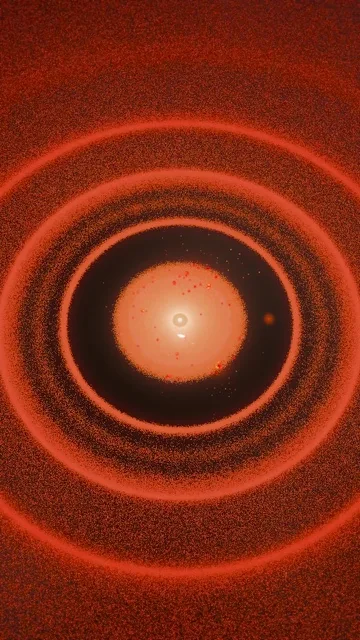
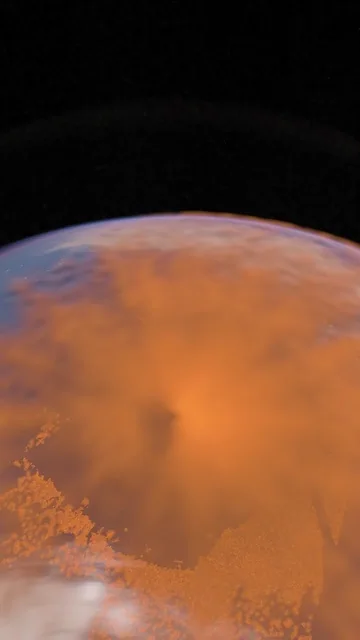
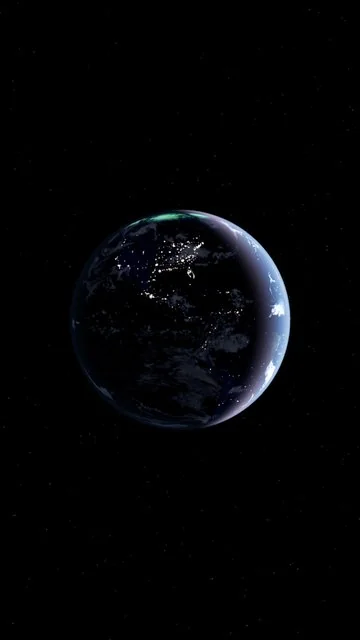
Theia is Chapter VII of The Story of Everything. In the live simulation every particle pulls on every other: Theia strikes, rock melts, a long arm of molten rock swings out into orbit and the two iron hearts sink together. The debris doesn't settle into a Moon before the scene replays, so the narration says "we think" the Moon came from this debris, as the science does.
Watch it in Everdust
The Story of Everything is in the Everdust app on iPhone and iPad, Android, Apple Vision Pro, Mac, Apple TV and Meta Quest 3 and 3S. Open Everdust, choose Stories, then The Story of Everything; Theia is chapter 7. Free: all 9 chapters.
Everdust on the App Store (iPhone, iPad, Apple Vision Pro, Mac, Apple TV)Everdust on Google Play (Android)Everdust on the Meta Horizon Store (Quest 3 and 3S)
Everdust is free to download, with no ads and no account. Every chapter of The Story of Everything is free on iPhone, iPad, Android, Apple Vision Pro, Mac and Apple TV (on Meta Quest, which chapters are free can differ).
The rest of the Story, chapter by chapter: The Story of Everything.
Questions people ask
When did Theia hit the Earth? About 4.5 billion years ago, early in the Solar System's history. Apollo zircons show the Moon existed at least 4.46 billion years ago [5].
How big was Theia? In the classic simulations it was about the mass of Mars, roughly a tenth of Earth's mass [2]. Other versions of the theory use a larger or a faster impactor.
Is the giant-impact theory proven? It is the leading explanation, supported by the Moon's small iron core, its early magma ocean and the Earth–Moon system's spin, but the near-identical chemistry of Earth and Moon is still being worked out [7].
Sources
- Hartmann, W. K. & Davis, D. R. (1975). Satellite-sized planetesimals and lunar origin. Icarus 24, 504.
- Canup, R. M. & Asphaug, E. (2001). Origin of the Moon in a giant impact near the end of the Earth's formation. Nature 412, 708.
- NASA Goddard Space Flight Center. Moon Fact Sheet (NSSDCA).
- Warren, P. H. (1985). The magma ocean concept and lunar evolution. Annual Review of Earth and Planetary Sciences 13, 201.
- Greer, J. et al. (2023). 4.46 Ga zircons anchor chronology of lunar magma ocean. Geochemical Perspectives Letters 27, 49.
- Wiechert, U. et al. (2001). Oxygen isotopes and the Moon-forming giant impact. Science 294, 345.
- Young, E. D. et al. (2016). Oxygen isotopic evidence for vigorous mixing during the Moon-forming giant impact. Science 351, 493.
- Ćuk, M. & Stewart, S. T. (2012). Making the Moon from a fast-spinning Earth: a giant impact followed by resonant despinning. Science 338, 1047.
- Lock, S. J. et al. (2018). The origin of the Moon within a terrestrial synestia. Journal of Geophysical Research: Planets 123, 910.
- Rufu, R., Aharonson, O. & Perets, H. B. (2017). A multiple-impact origin for the Moon. Nature Geoscience 10, 89.
- Kegerreis, J. A. et al. (2022). Immediate origin of the Moon as a post-impact satellite. The Astrophysical Journal Letters 937, L40.
- Yuan, Q. et al. (2023). Moon-forming impactor as a source of Earth's basal mantle anomalies. Nature 623, 95.