The Secret Life of Fluids: a soap bubble, rain on glass, the sea and the storms of Jupiter
The Secret Life of Fluids is five chapters about the rules that move water and air, from a soap film a few hundred nanometers thick to storms wider than Earth. Each is a live simulation of a fluid, with River, the narrator, explaining what you are seeing.
It climbs in size: a bubble whose colors measure its own thickness, raindrops on a window where surface tension still beats gravity, a tank of water that sloshes as you tilt it, the open sea seen from seven meters down, and the bands of Jupiter curling into spirals. The same few rules hold at every scale.
At a glance
- Chapters
- 5, each a live simulation
- Length
- about 4 minutes played straight through
- Narrator
- River, with subtitles
- Free or Plus
- Free: all 5 chapters
- Where
- Everdust on Android now, and coming to iPhone, iPad and Apple Vision Pro
Chapter by chapter
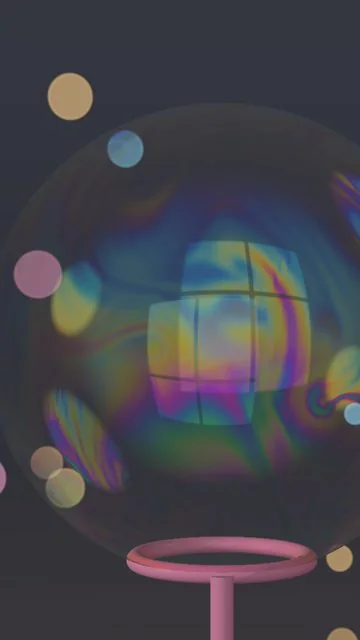
Chapter I Rainbow Skin
A soap film hundreds of times thinner than a hair, coloured by its own thickness.
A soap bubble hangs on a wand, its skin swirling with rainbow colors. The colors shift as the film drains, the top turns black, and the bubble pops, with the burst slowed about sixty times so you can watch the rim race around. Drag to swirl the film, or stab fast to pop it.
Every color on a soap bubble is a measurement of its thickness. Light reflects from the film's front and back surfaces and the two reflections meet: at each thickness some colors reinforce and others cancel, and where the film becomes far thinner than a wavelength of light the reflections cancel and it looks black [1]. Colored films are a few hundred nanometers thick (this one starts at about 230–610), while a human hair is about 80,000–100,000 nanometers wide [2], so the skin is hundreds of times thinner than a hair. Gravity drains the film, so the top thins fastest [3]. A real bubble bursts in thousandths of a second, its rim racing open at meters to tens of meters a second [4][5]. Physicists even heat half soap bubbles to grow long-lived vortices whose strengthening follows a relation that also fits hurricanes [6][7].
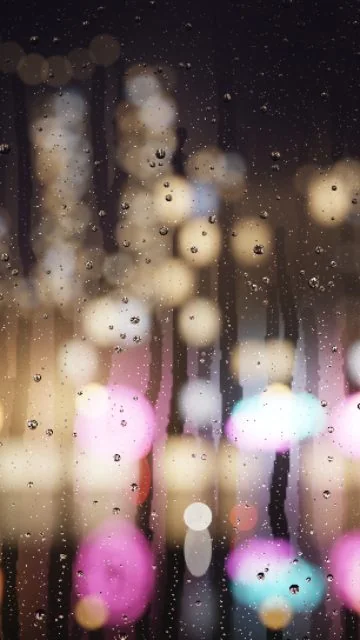
Chapter II Rain That Clings
Raindrops on a night window hold on, let go, merge and carry the city upside down.
Rain runs down a tall window at night. Drops grow, merge and slide, leaving clear streaks that slowly mist over again, and each drop holds a tiny upside-down city, traffic and neon included.
Surface tension, about 72 millinewtons per meter for water at room temperature [8], pulls each small drop into a dome, and each dome is a lens that turns the city upside down. A drop stays pinned to the glass until its weight beats the force holding its edges, and only then slides [9]. As it runs it swallows the drops in its path and speeds up, and a fast runner leaves a trail that breaks into a string of tiny beads, called pearling [10]. Below about 2.7 millimeters, water's capillary length, surface tension beats gravity [11]. The drops are a real simulation of rain on glass, each one drawn as a lens with true refraction.
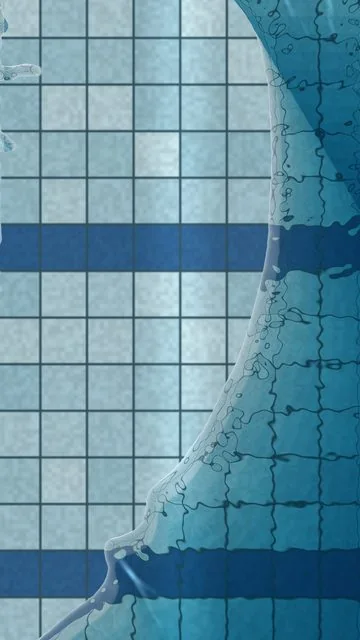
Chapter III A Sea in Your Hand
A slice of sea in a glass tank that feels your phone's real gravity.
A slice of sea in a glass tank fills the screen, and the tilt of the device in your hand is its gravity. Tilt it and the water runs downhill, overshoots and swings back; shake it and it sloshes into foam and spray; drag a finger through it to stir. Light bent by the curving surface dances on the tiles behind. Held perfectly still, the water settles flat within a few seconds.
Water barely squeezes, so when one side falls the other must rise [12]. The back-and-forth that follows is a wave with gravity as its spring. This water moves as it would in a tank a meter wide, though it is drawn hand-sized. Whole lakes slosh like this: a standing wave in an enclosed basin is called a seiche, its swings typically take three hours or more, and Lake Erie is known for them [13].
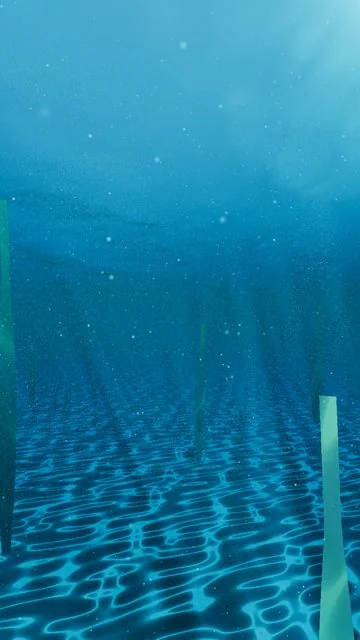
Chapter IV Light Under the Waves
Seven metres down, the waves overhead draw nets of sunlight on the sand.
You float seven meters under the open ocean among kelp. The surface heaves overhead and sunlight draws moving nets of light across the sand. Look up, and the whole sky is squeezed into one bright circle, with a mirror all around it. Drifting specks sway with every passing wave.
The waves above act as lenses, focusing sunlight into the bright moving lines on the floor, called caustics. These waves follow a spectrum fitted to measured, fully developed seas in the North Atlantic [14]. Looking up from under calm water, the whole sky is compressed into a cone about 97 degrees across, called Snell's window, and outside it the surface reflects like a mirror [15]. The drifting specks are marine snow, a shower of organic material falling from the upper waters to the deep [16]. And a wave is not water traveling: the water moves in circles as energy passes through it [17], down to about half a wavelength below the surface [18].
Chapter V Storms on Jupiter
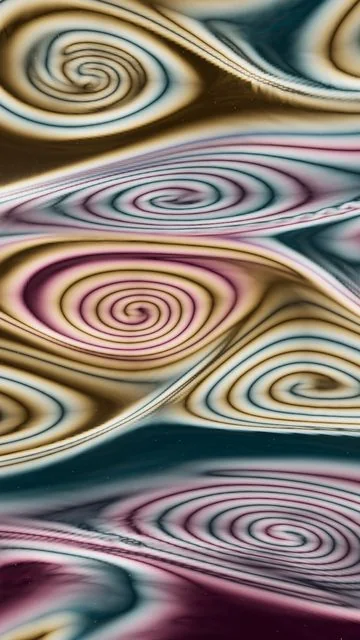
Bands of cloud racing past each other curl into spirals, as on Jupiter.
Bands of cloud surround you, each racing the other way from its neighbors. Where two streams rub past each other the boundary starts to wave, the waves curl over into spirals like breakers on a beach, and the spirals pair up and merge into larger eddies. Time is sped up, and the colors are invented.
This is the Kelvin–Helmholtz instability, described by Hermann von Helmholtz in 1868 and Lord Kelvin in 1871 [19][20]: wherever two layers of fluid slide past each other, the boundary waves and rolls up. On Earth it makes billow clouds that look like breaking ocean waves [21]. On Jupiter the bands are separated by strong east-west winds blowing in opposite directions [22], and NASA's Juno spacecraft sees turbulence along their edges where the winds go different ways [23]. The Great Red Spot measured 16,350 kilometers across in 2017, 1.3 times as wide as Earth [24], and has been watched for at least 150 years [25]. See where Jupiter is tonight on Jupiter tonight.
What’s simulated, and what isn’t
Every chapter is a live fluid simulation. The bubble's colors are computed from the simulated thickness of its draining film; the raindrops stick, slide, merge and bead and bend light like lenses; the tank's water follows the tilt of your device; the sea's waves follow a measured ocean spectrum, with real underwater optics; and Jupiter's bands roll up by the real instability. Some things are changed so you can see them: the bubble's burst is slowed about sixty times, the tank is drawn hand-sized though it moves like one a meter wide, and the Jupiter chapter runs far faster than real weather, in invented colors. It is simulated live, not video.
Watch The Secret Life of Fluids in Everdust
The Secret Life of Fluids is in the Everdust app on Android now, and coming to iPhone, iPad and Apple Vision Pro. Open Everdust, choose Stories, then The Secret Life of Fluids. Free: all 5 chapters.
Everdust on Google Play (Android)
Everdust is free to download, with no ads and no account. Every chapter of The Secret Life of Fluids is free on Android.
Questions people ask
Why does a soap bubble have rainbow colors? Light reflecting from the front and back of the thin film interferes, and which colors reinforce depends on the film's thickness, so the colors map the thickness [1].
What is the Kelvin–Helmholtz instability? The rolling-up of the boundary between two layers of fluid sliding past each other. It makes billow clouds on Earth and swirls along Jupiter's bands [21][23].
How big is Jupiter's Great Red Spot? About 16,350 kilometers across when measured in 2017, 1.3 times as wide as Earth [24].
Sources
- Atkins, L. J. & Elliott, R. C. (2010). Investigating thin film interference with a digital camera. American Journal of Physics 78, 1248.
- National Nanotechnology Initiative. Just How Small Is "Nano"?
- Couder, Y., Chomaz, J. M. & Rabaud, M. (1989). On the hydrodynamics of soap films. Physica D 37, 384.
- Culick, F. E. C. (1960). Comments on a ruptured soap film. Journal of Applied Physics 31, 1128.
- McEntee, W. R. & Mysels, K. J. (1969). Bursting of soap films. I. An experimental study. The Journal of Physical Chemistry 73, 3018.
- Seychelles, F., Amarouchene, Y., Bessafi, M. & Kellay, H. (2008). Thermal convection and emergence of isolated vortices in soap bubbles. Physical Review Letters 100, 144501.
- Meuel, T. et al. (2013). Intensity of vortices: from soap bubbles to hurricanes. Scientific Reports 3, 3455.
- Vargaftik, N. B., Volkov, B. N. & Voljak, L. D. (1983). International tables of the surface tension of water. Journal of Physical and Chemical Reference Data 12, 817.
- Furmidge, C. G. L. (1962). Studies at phase interfaces. I. The sliding of liquid drops on solid surfaces and a theory for spray retention. Journal of Colloid Science 17, 309.
- Podgorski, T., Flesselles, J.-M. & Limat, L. (2001). Corners, cusps, and pearls in running drops. Physical Review Letters 87, 036102.
- de Gennes, P.-G., Brochard-Wyart, F. & Quéré, D. (2004). Capillarity and Wetting Phenomena. Springer.
- Batchelor, G. K. (2000). An Introduction to Fluid Dynamics. Cambridge University Press (first published 1967).
- NOAA National Ocean Service. What is a seiche?
- Pierson, W. J. & Moskowitz, L. (1964). A proposed spectral form for fully developed wind seas based on the similarity theory of S. A. Kitaigorodskii. Journal of Geophysical Research 69, 5181.
- Lynch, D. K. (2014). Snell's window in wavy water. Applied Optics 54, B8.
- NOAA National Ocean Service. What is marine snow?
- NOAA National Ocean Service. Why does the ocean have waves?
- NOAA Ocean Exploration. What causes ocean waves?
- Helmholtz, H. von (1868). On discontinuous movements of fluids. The London, Edinburgh, and Dublin Philosophical Magazine and Journal of Science 36, 337.
- Thomson, W. (Lord Kelvin) (1871). Hydrokinetic solutions and observations. The London, Edinburgh, and Dublin Philosophical Magazine and Journal of Science 42, 362.
- UCAR Center for Science Education. Kelvin-Helmholtz Clouds.
- NASA Science. Jupiter Facts.
- NASA/JPL-Caltech (2025). PIA26595: Juno Sees Turbulence in Jupiter's Atmosphere.
- NASA/JPL-Caltech (2017). PIA21774: Jupiter's Great Red Spot Swallows Earth.
- NASA Goddard Space Flight Center (2024). NASA's Hubble Watches Jupiter's Great Red Spot Behave Like a Stress Ball.
Chapter stills: Everdust, from each chapter’s live simulation. The Story’s script was written for Everdust from the sources above; River reads it. This page retells it in its own words.
More Stories
When Galaxies Collide
Galaxies pass through each other, tear out tails, light up and become one.
Clockwork to Chaos
Three hundred years of perfect clockwork, undone by one more hinge.
Chaos: The Attractor We Found
From Lorenz's rounding error to a strange attractor our own search turned up.
Hidden Patterns
Fireflies, starlings, sand, magnets and light, each making a pattern no one designed.