When Galaxies Collide: how two galaxies, and then their black holes, become one
When two galaxies meet, almost none of their stars hit each other, and yet the collision remakes them both. This Story shows how in five chapters, each a live simulation of gravity at work that you can turn and watch while River, the narrator, explains it: a small galaxy punching straight through a big one, tides pulling out bridges and tails of stars, gas clouds crashing into bursts of new stars, dark matter dragging two galaxies together until they are one, and the two black holes at their hearts spiraling in to merge.
Each chapter takes one piece of what astronomers have learned about collisions, from 1972, when Alar and Juri Toomre showed that gravity alone can draw out the long tails of stars seen in pairs of colliding galaxies [1], to 2015, when detectors on Earth first heard two black holes merge [2].
At a glance
- Chapters
- 5, each a live simulation
- Length
- about 4 minutes played straight through
- Narrator
- River, with subtitles
- Free or Plus
- Free: chapters I–II. Everdust Plus: chapters III–V
- Where
- Everdust on Android now, and coming to iPhone, iPad and Apple Vision Pro
Chapter by chapter
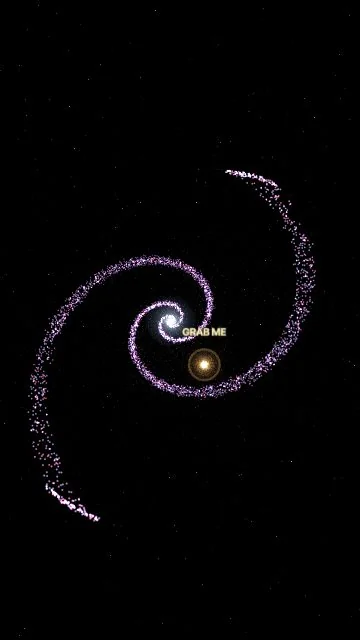
Chapter I Straight Through Free
A small galaxy plunges through a big one, as one did to make the Cartwheel.
A small galaxy falls right through the middle of a big one and out the other side. Its stars don't crash into the big galaxy's stars; they are far too spread out. Instead, the plunge tugs the big galaxy's stars inward, they rebound, and a ring of stars ripples outward like the ring from a stone dropped in a pond. Here, a second is about 19 million years. Then the chapter turns to the Antennae: two spirals about to fling out long tails.
This is how ring galaxies form. A companion that passes through a disk near its center adds its pull for a moment; the disk's stars swing inward and bounce back, and the crowding of their orbits travels outward as an expanding ring [3][4]. The Cartwheel Galaxy, about 500 million light-years away in Sculptor, got its rings from just such a high-speed collision with a smaller galaxy [5]. The stars come through unharmed because the gaps between them are vast: nearly 30 million Suns would fit in a row between the Sun and Proxima Centauri, the nearest star, 4.25 light-years away [6][7]. Our post on why stars almost never collide when galaxies do goes further.
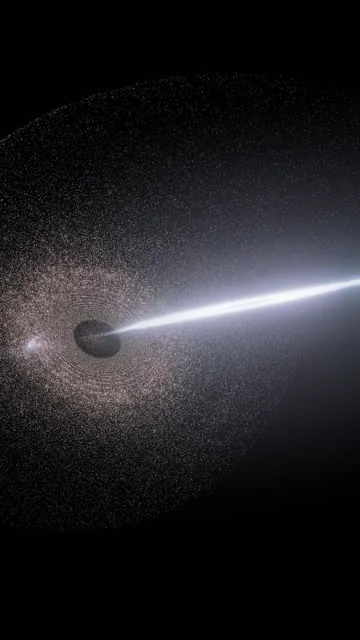
Chapter II Tides Free
Two spirals swing close, and tides pull out a bridge and long tails of stars.
Two spiral galaxies swing close. Gravity weakens with distance, so each galaxy pulls the near side of the other harder than its center, and its center harder than its far side. That difference stretches the disks, and it is called a tide. It draws out a bridge of stars between the galaxies and a long tail flung out behind. Here stars go around their galaxies in seconds; the Sun takes about 230 million years to circle the Milky Way once [8]. The stars glide past one another. The gas clouds cannot.
In 1972 Alar and Juri Toomre showed with simple computer experiments that bridges and tails are tidal relics of close encounters, pulled out by gravity alone in pairs such as the Antennae and the Mice [1]. Tails grow longest when a galaxy spins the same way it orbits its partner, so that its stars stay in step with the pull; a disk spinning the other way comes through nearly intact [9]. The chapter's two disks show both cases: one spins with its orbit and grows a long tail, the other is tilted against it and keeps a short one. Later simulations matched the Antennae's own orbit and its bursts of star formation [10]. You can run this collision in your browser.
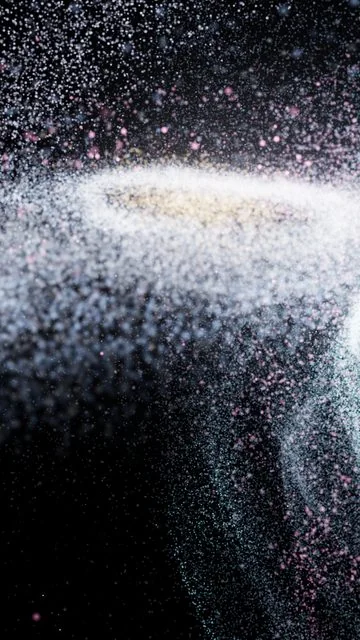
Chapter III Fireworks of New Stars Plus
Inside a collision, where crashing gas clouds light up with new stars.
Step inside a collision. Stars are tiny next to the gaps between them, but gas clouds are huge, so instead of slipping past each other they crash. The crash squeezes the gas until it collapses into new stars; here the squeezed gas glows pink, as real star nurseries do. Gravity also funnels gas down into each galaxy's heart. A collision doesn't just wreck galaxies. It lights them up.
Simulations of colliding galaxies show shocks where the gas clouds meet compressing the gas into new stars [11], and tidal forces driving gas toward the centers, where it feeds a burst of star formation [12][13]. You can see the result in Hubble's picture of the Antennae, where billions of stars are being born as the two galaxies smash together [14]. In the heart of Arp 220, a merging pair about 250 million light-years away, stars form at probably 100 times the rate of the whole Milky Way [15], and mergers like it are among the most luminous galaxies in the infrared [16]. The pink knots in the chapter mark gas squeezed well past its starting density, not single stars.
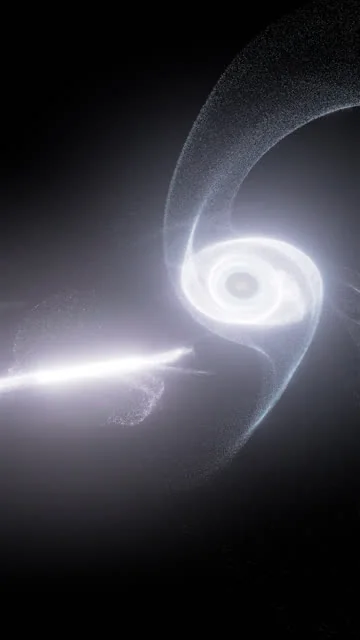
Chapter IV Becoming One Plus
Dark matter drags two galaxies back together until they merge into one.
Now each galaxy sits inside a far bigger cloud of dark matter, an unseen mass that outweighs all its stars many times over. As each galaxy moves through the other's cloud, it gathers a wake of dark matter behind it, and the wake's pull acts like a brake. So the two swing back sooner and pass closer each time, until their disks are scrambled into one smooth, oval swarm of stars: an elliptical galaxy.
The Milky Way's dark matter halo holds about 1.3 trillion times the Sun's mass, against roughly 50 billion Suns in stars [17]. The brake is called dynamical friction, worked out by Subrahmanyan Chandrasekhar in 1943: a heavy body moving through a sea of lighter ones pulls them into a wake whose gravity slows it down [18]. Inside overlapping halos, galaxies lose their orbital energy this way and merge [19][20]. Many giant elliptical galaxies, astronomers think, were built like this, and simulated mergers of two disks leave remnants that look much like real ellipticals [19][21].
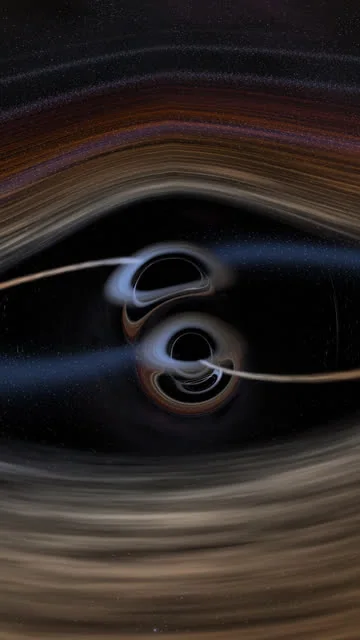
Chapter V The Final Chirp Plus
Two black holes spiral together, shake space itself, and become one.
Two black holes circle each other inside a disk of glowing gas. When galaxies merge, their central black holes sink to the middle and pair up. Each orbit shakes space itself, sending out gravitational waves that carry energy away, so the orbit shrinks and quickens: a chirp. Faster and faster they go, until they touch, merge, and the new black hole rings like a bell. Here the ripples are drawn huge. Real ones are vanishingly faint.
Most big galaxies have a supermassive black hole at the center [22]. After two galaxies merge, their black holes sink together and form a bound pair [23], and in the merging galaxy NGC 6240 astronomers have found two active black holes in one core [24]. Gravitational waves then drain the pair's orbit until the two collide [25]. LIGO first heard such a chirp on 14 September 2015, from black holes of about 36 and 29 Suns that merged into one of about 62, turning about three Suns' worth of mass into gravitational waves in a fraction of a second [2][26]. The chapter's pair follows those proportions. Gravity works the same way at every scale, so giant black holes go through the same dance, only more slowly.
What’s simulated, and what isn’t
Every chapter is a live simulation of gravity. In the first, each galaxy is built from published measurements of its dark matter, central bulge and disk, and its stars feel the pull of every galaxy, so encounters take their real time, about 19 million years a second; the Cartwheel and the Antennae start on their real orbits. In the second and third, stars orbit two galactic cores and feel both, as in the Toomres' experiment, and the third adds gas that glows where it is shocked and squeezed. The fourth wraps each core in dark matter that brakes the pair until it merges. The fifth follows the shrinking orbit of a merger like the ones LIGO hears and bends the light of everything behind it around both black holes. What is drawn rather than real: the pink of squeezed gas is a marker, the gravitational waves are hugely exaggerated so you can see them, and time everywhere runs millions of times faster than in nature.
Watch When Galaxies Collide in Everdust
When Galaxies Collide is in the Everdust app on Android now, and coming to iPhone, iPad and Apple Vision Pro. Open Everdust, choose Stories, then When Galaxies Collide. Free: chapters I–II. Everdust Plus: chapters III–V.
Everdust on Google Play (Android)
Everdust is free to download, with no ads and no account. Everdust Plus, an optional subscription, opens every chapter of every Story on Android.
Questions people ask
What happens when two galaxies collide? Their stars almost never hit one another, but gravity pulls out long tails of stars, crashing gas clouds burst into new stars, and dark matter brakes the pair until it merges into one bigger galaxy [1][20].
Do stars collide when galaxies collide? Almost never. The gaps between stars are enormous: nearly 30 million Suns would fit between the Sun and the nearest star [6][7]. Gas clouds are far bigger, so they do collide. Our post on why stars miss explains more.
Will the Milky Way collide with Andromeda? Maybe. A 2025 study using Hubble and Gaia measurements found close to even odds that the two galaxies do not merge within the next 10 billion years [27]. Our post on the Milky Way and Andromeda has the details.
What was the first gravitational wave ever detected? GW150914, picked up by LIGO on 14 September 2015: two black holes of about 36 and 29 Suns merging into one of about 62 [2].
Sources
- Toomre, A. & Toomre, J. (1972). Galactic bridges and tails. The Astrophysical Journal 178, 623.
- Abbott, B. P. et al. (LIGO Scientific Collaboration and Virgo Collaboration) (2016). Observation of gravitational waves from a binary black hole merger. Physical Review Letters 116, 061102.
- Lynds, R. & Toomre, A. (1976). On the interpretation of ring galaxies: the binary ring system II Hz 4. The Astrophysical Journal 209, 382.
- Struck, C. (1999). Galaxy collisions. Physics Reports 321, 1.
- NASA (2022). Webb captures stellar gymnastics in the Cartwheel Galaxy.
- NASA Goddard Space Flight Center. Sun Fact Sheet (NSSDCA).
- NASA Goddard Space Flight Center, Imagine the Universe! The nearest star.
- NASA Goddard Space Flight Center, StarChild. Does the Sun move around the Milky Way?
- D'Onghia, E. et al. (2010). Quasi-resonant theory of tidal interactions. The Astrophysical Journal 725, 353.
- Karl, S. J. et al. (2010). One moment in time: modeling star formation in the Antennae. The Astrophysical Journal Letters 715, L88.
- Barnes, J. E. (2004). Shock-induced star formation in a model of the Mice. Monthly Notices of the Royal Astronomical Society 350, 798.
- Barnes, J. E. & Hernquist, L. E. (1991). Fueling starburst galaxies with gas-rich mergers. The Astrophysical Journal 370, L65.
- Mihos, J. C. & Hernquist, L. (1996). Gasdynamics and starbursts in major mergers. The Astrophysical Journal 464, 641.
- NASA/ESA Hubble (2006). Colliding galaxies make love, not war: the Antennae galaxies (image heic0615a).
- NASA Hubble (1997). A collision in the heart of a galaxy (Arp 220).
- Sanders, D. B. & Mirabel, I. F. (1996). Luminous infrared galaxies. Annual Review of Astronomy and Astrophysics 34, 749.
- Bland-Hawthorn, J. & Gerhard, O. (2016). The Galaxy in context: structural, kinematic, and integrated properties. Annual Review of Astronomy and Astrophysics 54, 529.
- Chandrasekhar, S. (1943). Dynamical friction. I. General considerations: the coefficient of dynamical friction. The Astrophysical Journal 97, 255.
- Barnes, J. E. (1988). Encounters of disk/halo galaxies. The Astrophysical Journal 331, 699.
- Barnes, J. E. & Hernquist, L. (1992). Dynamics of interacting galaxies. Annual Review of Astronomy and Astrophysics 30, 705.
- Naab, T. & Burkert, A. (2003). Statistical properties of collisionless equal- and unequal-mass merger remnants of disk galaxies. The Astrophysical Journal 597, 893.
- Kormendy, J. & Ho, L. C. (2013). Coevolution (or not) of supermassive black holes and host galaxies. Annual Review of Astronomy and Astrophysics 51, 511.
- Begelman, M. C., Blandford, R. D. & Rees, M. J. (1980). Massive black hole binaries in active galactic nuclei. Nature 287, 307.
- Komossa, S. et al. (2003). Discovery of a binary active galactic nucleus in the ultraluminous infrared galaxy NGC 6240 using Chandra. The Astrophysical Journal 582, L15.
- Peters, P. C. (1964). Gravitational radiation and the motion of two point masses. Physical Review 136, B1224.
- LIGO Laboratory, Caltech (2016). GW150914 press release: gravitational waves detected from two merging black holes.
- Sawala, T. et al. (2025). No certainty of a Milky Way–Andromeda collision. Nature Astronomy 9, 1206.
Chapter stills: Everdust, from each chapter’s live simulation. The Story’s script was written for Everdust from the sources above; River reads it. This page retells it in its own words.
More Stories
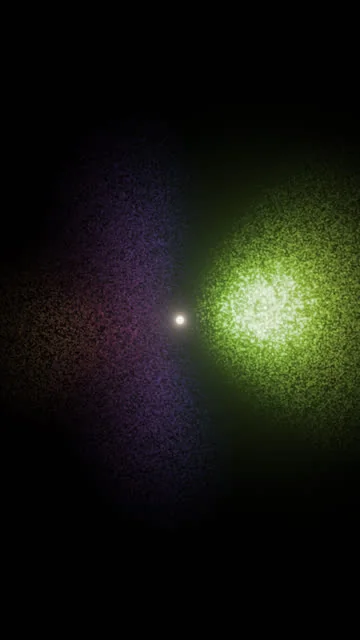
The Quantum World
An atom's cloud, light from a leap, single particles at two slits and a wave that leaks through a wall.
The Story of Everything
13.8 billion years, from the first light to the lights of Earth tonight. Free in full.
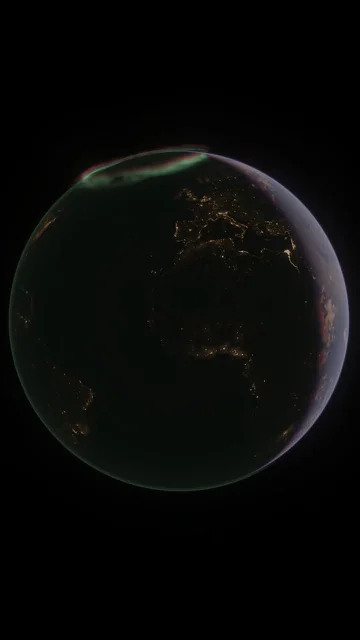
The Future of Everything
From Earth's lights tonight to the last black hole, following the physics forward.
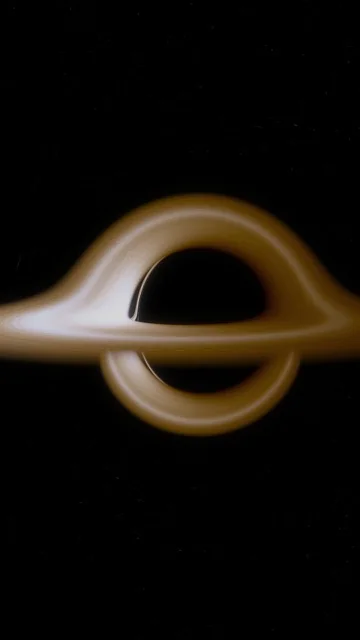
The Life of a Black Hole
Birth, feeding, a shredded star, a merger and the long fade, with light bent by real geometry.