The Quantum World: what an atom looks like, light from a leap, the double slit and tunneling
Quantum mechanics is the physics of the very small, and it is strange: an electron has no orbit, a single particle seems to pass through two slits at once, and a wave can leak through a wall it doesn't have the energy to climb. This Story lets you see it, in four chapters computed from the real equations of quantum mechanics, while River, the narrator, explains what you are looking at and says plainly where the picture shows something no experiment could see.
You start inside a hydrogen atom, the simplest there is. Then you watch it give off light as its electron drops from state to state, see single particles build up stripes behind two slits, and end with the effect that lets the Sun shine: tunneling.
At a glance
- Chapters
- 4, each a live simulation
- Length
- about 3 minutes played straight through
- Narrator
- River, with subtitles
- Free or Plus
- Free: chapters I–II. Everdust Plus: chapters III–IV
- Where
- Everdust on Android now, and coming to iPhone, iPad and Apple Vision Pro
Chapter by chapter
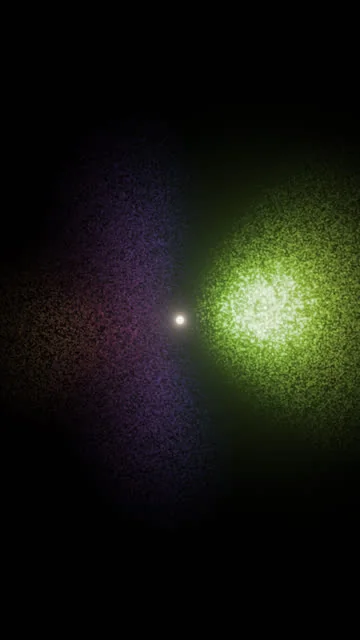
Chapter I What an Atom Looks Like Free
Hydrogen's real wavefunctions: the electron's cloud, moving from state to state.
An electron doesn't circle its nucleus like a planet. What you see instead is a glowing cloud that maps where the electron would be found if you looked, brighter where it is more likely. Each steady shape is one state the electron can be in, and the dark gaps, called nodes, are places where it is never found. Between states the electron is in a superposition, partly in two states at once, and the cloud sloshes back and forth.
The shapes are hydrogen's real wavefunctions, the solutions of Schrödinger's equation for one electron bound to one proton [1]. Quantum mechanics gives the electron no path at all, only the probability of finding it in each place, a rule Max Born set out in 1926 [2]. A cloud that mixes two states of different energy really does oscillate, at a rate set by the energy difference [1]; in hydrogen that is between about 160 trillion and 2.5 quadrillion times a second, so the slosh here is slowed down trillions of times. The colors show the wave's phase, which has no color in nature. And the shapes matter: chemical bonds form along the directions of atomic orbitals [3].
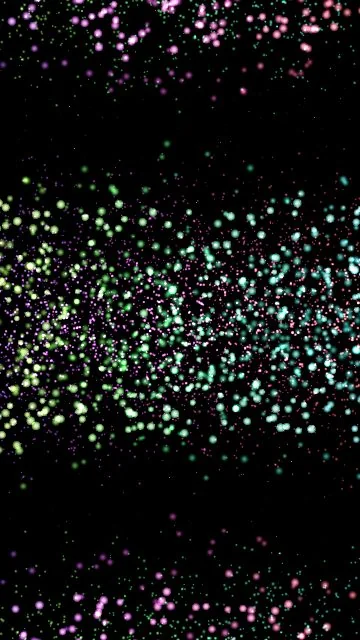
Chapter II Light from a Leap Free
Standing at the nucleus as the atom drops to lower states and sends out light.
Now you stand at the nucleus of a hydrogen atom, inside the electron's cloud. The electron drops to a lower state and a photon, a particle of light, flies out as a spreading shell. The first one is infrared, invisible to you, so it is drawn dim red. As the electron drops again the cloud sloshes, and the sloshing sends out light: the faster it sloshes, the bluer the light. One drop makes red light at 656 nanometers, hydrogen's signature.
Each photon carries exactly the energy difference between the two states, which is why hydrogen shines only at certain colors, its spectral lines [1]. The red one, called H-alpha, sits at 656.28 nanometers in air, and the ultraviolet Lyman-alpha line at 121.57 [4]. That red is the glow of hydrogen in nebulae such as the Orion Nebula. Erwin Schrödinger saw in 1926 that a mixed state's charge cloud oscillates at exactly the frequency of the light it gives off [5]: for H-alpha, about 457 trillion times a second. The chapter ends on a puzzle. Light spreads like a wave, yet a single photon is always detected whole, in one place, never in two detectors at once [6].
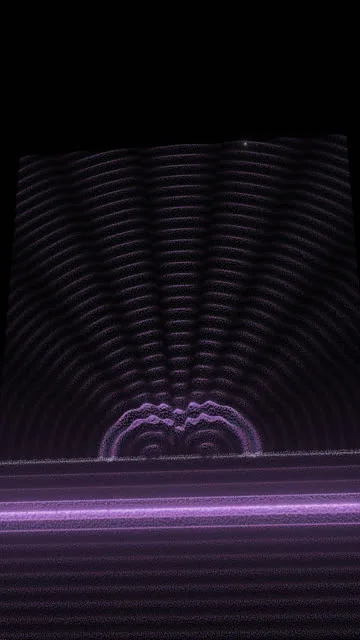
Chapter III One Particle, Two Slits Plus
Single particles land one by one, and stripes build up out of chance.
A sheet of waves passes through two slits and spreads into ripples. On the far screen, particles land one at a time, each in a single spot, and at first the hits look random. Where each one lands can't be predicted, but the odds follow the wave: where the waves from the two slits cancel, almost none land. After thousands of hits the stripes of an interference pattern are plain. Check which slit each particle takes, and the stripes vanish.
This is the double-slit experiment. In 1989 a team at Hitachi in Japan sent electrons through their apparatus one at a time and watched exactly this pattern build up from single dots [7]. Each landing follows Born's rule: the chance of a hit at each place is set by the wave [2]. Marking which way each particle went wipes out the stripes, as experiments with atoms have shown [8], and the same interference appears even for molecules of 60 carbon atoms [9]. The glowing sheet is the wave drawn for you; real experiments record only the landings.
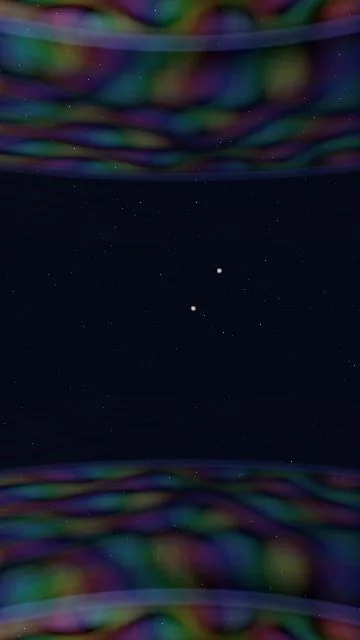
Chapter IV Through the Wall Plus
A wave meets a wall it cannot climb, and part of it leaks through anyway.
A particle's wave runs at a wall too high for it to climb. Most of it bounces back, but some leaks straight through, and dots on a detector wall show where particles are caught, drawn from the wave's odds. Some atoms decay this way, microscopes that see single atoms rely on it, and the Sun would not shine without it.
This is quantum tunneling, and the chapter solves Schrödinger's equation live; for a barrier like this one, well under a tenth of the wave gets through at each hit [1]. In 1928 George Gamow, and separately Ronald Gurney and Edward Condon, explained alpha decay as an alpha particle tunneling out of an atomic nucleus [10][11]. The scanning tunneling microscope, which maps single atoms by the tiny current that tunnels across a gap, won Gerd Binnig and Heinrich Rohrer the 1986 Nobel Prize in Physics [12]. Flash memory stores data by pushing electrons through a thin insulating layer the same way [13]. And in the Sun's core, at about 15 million degrees, protons can't climb over their electric repulsion; they fuse by tunneling through it [14][15]. Sunlight begins with a particle passing through a wall.
What’s simulated, and what isn’t
All four chapters are computed from real quantum mechanics: hydrogen's true wavefunctions in the first two, with photons in the real colors of hydrogen's lines; landings drawn at random from the true odds at the double slit; and Schrödinger's equation solved live for the wave meeting the wall. Where a scene shows what no eye could see, the narration says so: color stands for the wave's phase, which has no color of its own; the sloshing between states is slowed down trillions of times; infrared light is drawn dim red and ultraviolet dim violet; and the double slit's glowing sheet is the wave itself, which no experiment records. Not narrated: each orbital is scaled to fill the same space, though a real 4f cloud is about 12 times wider than the smallest one; the first chapter also sloshes between some states that in real hydrogen have the same energy and would not slosh; and the room-sized atom you stand in is about a ten-billionth of a meter across in life.
Watch The Quantum World in Everdust
The Quantum World is in the Everdust app on Android now, and coming to iPhone, iPad and Apple Vision Pro. Open Everdust, choose Stories, then The Quantum World. Free: chapters I–II. Everdust Plus: chapters III–IV.
Everdust on Google Play (Android)
Everdust is free to download, with no ads and no account. Everdust Plus, an optional subscription, opens every chapter of every Story on Android.
Questions people ask
What does an atom actually look like? Not like a tiny solar system. An electron has no orbit: quantum mechanics gives only a cloud of probability showing where it is likely to be found [2]. For hydrogen those clouds have exact shapes, with dark nodes where the electron is never found [1].
What is the double-slit experiment? Particles sent one at a time at two slits land as single dots, yet together they build up stripes that only a wave passing through both slits could make. In 1989 it was done with single electrons [7]. Our double-slit page goes deeper.
What is quantum tunneling? The way a particle can cross a barrier it doesn't have the energy to climb, because its wave leaks a little way through. It explains alpha decay [10] and lets the Sun fuse hydrogen [15].
Why does hydrogen glow red? When hydrogen's electron drops from its third state to its second, it gives off red light at 656 nanometers, the H-alpha line [4].
Sources
- Griffiths, D. J. & Schroeter, D. F. (2018). Introduction to Quantum Mechanics, 3rd ed. Cambridge University Press.
- Born, M. (1926). Zur Quantenmechanik der Stoßvorgänge. Zeitschrift für Physik 37, 863.
- Pauling, L. (1931). The nature of the chemical bond. Application of results obtained from the quantum mechanics and from a theory of paramagnetic susceptibility to the structure of molecules. Journal of the American Chemical Society 53, 1367.
- National Institute of Standards and Technology. Handbook of Basic Atomic Spectroscopic Data: strong lines of hydrogen.
- Schrödinger, E. (1926). Quantisierung als Eigenwertproblem (Vierte Mitteilung). Annalen der Physik 386, 109.
- Grangier, P., Roger, G. & Aspect, A. (1986). Experimental evidence for a photon anticorrelation effect on a beam splitter: a new light on single-photon interferences. Europhysics Letters 1, 173.
- Tonomura, A. et al. (1989). Demonstration of single-electron buildup of an interference pattern. American Journal of Physics 57, 117.
- Dürr, S., Nonn, T. & Rempe, G. (1998). Origin of quantum-mechanical complementarity probed by a 'which-way' experiment in an atom interferometer. Nature 395, 33.
- Arndt, M. et al. (1999). Wave–particle duality of C60 molecules. Nature 401, 680.
- Gamow, G. (1928). Zur Quantentheorie des Atomkernes. Zeitschrift für Physik 51, 204.
- Gurney, R. W. & Condon, E. U. (1928). Wave mechanics and radioactive disintegration. Nature 122, 439.
- NobelPrize.org. The Nobel Prize in Physics 1986 (Ernst Ruska; Gerd Binnig and Heinrich Rohrer).
- Pavan, P., Bez, R., Olivo, P. & Zanoni, E. (1997). Flash memory cells: an overview. Proceedings of the IEEE 85, 1248.
- NASA Goddard Space Flight Center. Sun Fact Sheet (NSSDCA).
- Adelberger, E. G. et al. (2011). Solar fusion cross sections. II. The pp chain and CNO cycles. Reviews of Modern Physics 83, 195.
Chapter stills: Everdust, from each chapter’s live simulation. The Story’s script was written for Everdust from the sources above; River reads it. This page retells it in its own words.
More Stories
Hidden Patterns
Fireflies, starlings, sand, magnets and light, each making a pattern no one designed.
Clockwork to Chaos
Three hundred years of perfect clockwork, undone by one more hinge.
Chaos: The Attractor We Found
From Lorenz's rounding error to a strange attractor our own search turned up.
Why Things Glow
Glowworms, fireflies, glowing seas, blue ice and molten rock: seven rivers of light.