The double-slit experiment: how single particles build a pattern only waves can make
In the double-slit experiment, light or matter is sent toward a barrier with two narrow openings, and what arrives behind it forms stripes: bright bands where the waves from the two slits add up, dark bands where they cancel. The strange part is that the stripes still appear when particles are sent one at a time, each landing as a single dot. Every particle seems to pass through both slits as a wave and arrive as a particle, and if you find out which slit it used, the stripes disappear.
Young's experiment with light
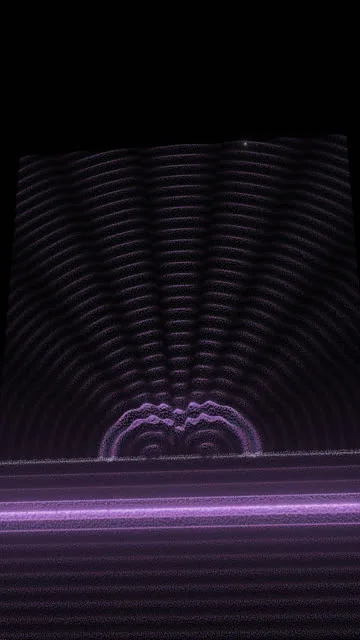
Thomas Young described experiments to London's Royal Society, published in 1804, in which light from two sources overlapping on a screen made a pattern of light and dark fringes [1]. Fringes like that are what waves do. Where the crest of one wave meets the crest of another, they add up to a bright band; where a crest meets a trough, they cancel to a dark one. How far apart the bands sit depends on the wavelength and on the spacing of the slits, so the pattern reveals the wavelength.
Fringes are strong evidence for waves. The surprise of quantum physics was that light also arrives in lumps, called photons, and that matter has a wave side too.
Matter waves
In 1923 Louis de Broglie proposed that particles such as electrons carry a wave of their own [2]. Four years later Clinton Davisson and Lester Germer saw electrons bounce off a nickel crystal in a pattern only waves could make [3]. A true double-slit experiment with electrons had to wait for slits fine enough: in 1961 Claus Jönsson made several fine slits artificially and recorded electron interference through two and more of them [4].
One particle at a time
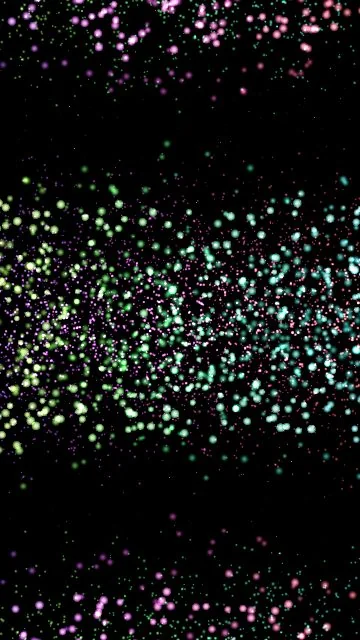
The deepest version sends the particles through one by one, so that there is never more than one in the apparatus. In 1976 Pier Giorgio Merli and colleagues did this with electrons [5], and in 1989 Akira Tonomura and colleagues at Hitachi filmed it: each electron arrives as a single point of light at a random spot, and as thousands accumulate, the dots fill in the bright bands and avoid the dark ones [6]. In 2013 a team ran it with two real slits and a movable mask that could cover either one, the experiment Richard Feynman had described as a thought experiment in 1965, and again built the pattern from single electrons [7].
Light behaves the same way. In 1986 Philippe Grangier, Gérard Roger and Alain Aspect sent single photons into an interferometer: each one was detected whole, in one place, and never at two detectors at once, yet over many photons they still interfered [8].
Bigger and bigger things
Nothing in quantum mechanics limits this to small particles. In 1999 Markus Arndt, Anton Zeilinger and colleagues saw interference from buckyballs, football-shaped molecules of 60 carbon atoms [9]. In 2019 an experiment reached molecules more than 25,000 times as heavy as a hydrogen atom [10]. Each molecule still lands in one place, and together they still build stripes.
Why marking the slits erases the stripes
If the experiment records which slit each particle went through, the stripes vanish and the hits pile up as if from two separate slits. In an experiment with atoms, marking which way each atom went was enough to wipe out its interference [11]. That is not about a person looking. In a 2002 experiment, small optical plates in front of the two slits marked each photon's path and the stripes disappeared; then measuring a partner photon in a way that erased that marking brought them back [12]. What matters is whether the path information exists, not whether anyone reads it.
What it means
Quantum mechanics describes each particle with a wave that passes through both slits and interferes with itself. The wave doesn't say where a particle will land, only how likely each place is, a rule Max Born set out in 1926 [13]. So each landing is random, but the pattern of many landings is exactly predictable. What the wave really is, and what happens when a particle lands, are questions physicists still argue about. But for every version of the experiment described here, the predictions match what was found.
Watch it in Everdust
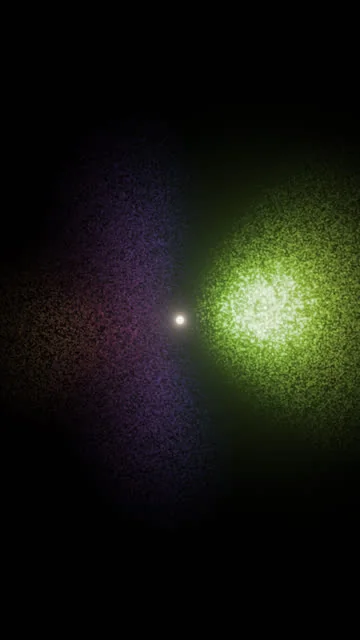
This is Chapter III of The Quantum World. A glowing sheet shows the wave: its height is the wave, its brightness the chance of finding a particle there, its color the wave's phase. Particles land one at a time at spots drawn at random from the true odds, and within about forty seconds the stripes are plain. The sheet is drawn for you to see; real experiments only ever record the landings, and the narration says so.
Watch it in Everdust
The Quantum World is in the Everdust app on Android now, and coming to iPhone, iPad and Apple Vision Pro. Open Everdust, choose Stories, then The Quantum World; One Particle, Two Slits is chapter 3. Free: chapters I–II. Everdust Plus: chapters III–IV.
Everdust on Google Play (Android)
Everdust is free to download, with no ads and no account. Everdust Plus, an optional subscription, opens every chapter of every Story on Android.
The rest of the Story, chapter by chapter: The Quantum World.
Questions people ask
Who first did the double-slit experiment? Thomas Young, with light, in experiments published in 1804 [1]. Claus Jönsson first did it with electrons through real slits, in 1961 [4].
Why does observing the double-slit experiment change the result? Any record of which slit a particle took removes the interference, even a record no one reads; erase the record and the stripes come back [12].
Does the double-slit experiment work with molecules? Yes. It has been done with 60-atom buckyballs [9] and with molecules more than 25,000 times as heavy as a hydrogen atom [10].
Sources
- Young, T. (1804). The Bakerian Lecture. Experiments and calculations relative to physical optics. Philosophical Transactions of the Royal Society of London 94, 1.
- de Broglie, L. (1923). Waves and quanta. Nature 112, 540.
- Davisson, C. & Germer, L. H. (1927). Diffraction of electrons by a crystal of nickel. Physical Review 30, 705.
- Jönsson, C. (1961). Elektroneninterferenzen an mehreren künstlich hergestellten Feinspalten. Zeitschrift für Physik 161, 454.
- Merli, P. G., Missiroli, G. F. & Pozzi, G. (1976). On the statistical aspect of electron interference phenomena. American Journal of Physics 44, 306.
- Tonomura, A. et al. (1989). Demonstration of single-electron buildup of an interference pattern. American Journal of Physics 57, 117.
- Bach, R., Pope, D., Liou, S.-H. & Batelaan, H. (2013). Controlled double-slit electron diffraction. New Journal of Physics 15, 033018.
- Grangier, P., Roger, G. & Aspect, A. (1986). Experimental evidence for a photon anticorrelation effect on a beam splitter: a new light on single-photon interferences. Europhysics Letters 1, 173.
- Arndt, M. et al. (1999). Wave–particle duality of C60 molecules. Nature 401, 680.
- Fein, Y. Y. et al. (2019). Quantum superposition of molecules beyond 25 kDa. Nature Physics 15, 1242.
- Dürr, S., Nonn, T. & Rempe, G. (1998). Origin of quantum-mechanical complementarity probed by a 'which-way' experiment in an atom interferometer. Nature 395, 33.
- Walborn, S. P. et al. (2002). Double-slit quantum eraser. Physical Review A 65, 033818.
- Born, M. (1926). Zur Quantenmechanik der Stoßvorgänge. Zeitschrift für Physik 37, 863.