Clockwork to Chaos: from Galileo's pendulum to the butterfly effect, in nine live chapters
For three centuries the pendulum was the picture of a predictable world. Clockwork to Chaos is nine short chapters about how that picture held, and then broke, each a live simulation of real pendulums that you can turn and watch while River, the narrator, explains what you are seeing.
It starts with Galileo's lamp, Huygens's two clocks and Laplace's dream of a perfectly predictable universe, then adds one more hinge. From there the same laws give double pendulums no forecast can follow, maps with fractal borders, an upside-down pendulum held up by shaking, and a chaotic pendulum you throw yourself.
At a glance
- Chapters
- 9, each a live simulation
- Length
- about 8 minutes played straight through
- Narrator
- River, with subtitles
- Free or Plus
- Free: chapters I–III. Everdust Plus: chapters IV–IX
- Where
- Everdust on iPhone and iPad, Android, Apple Vision Pro, Mac, Apple TV and Meta Quest 3 and 3S
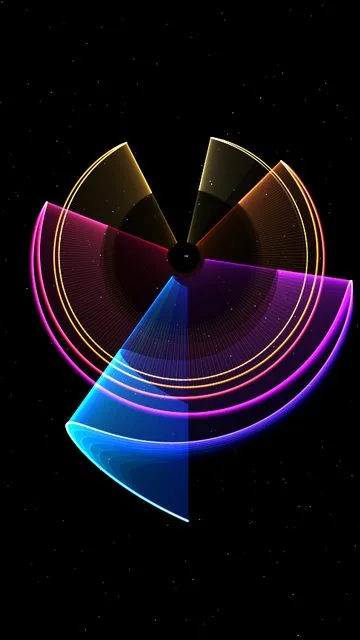 IGalileo's Lamp
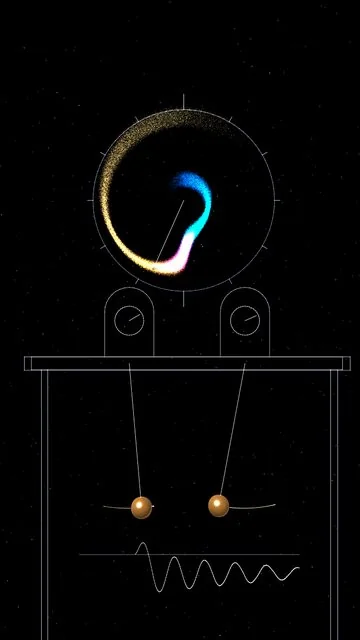 IIOdd Sympathy
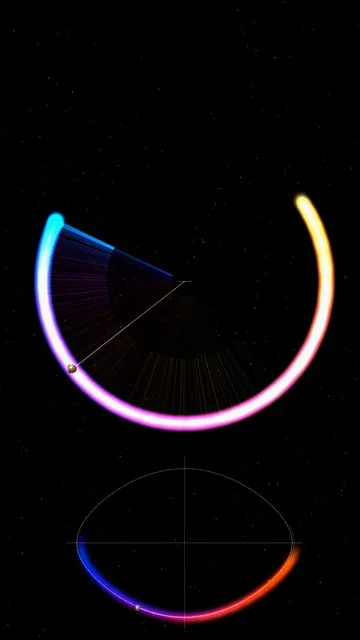 IIILaplace's Demon
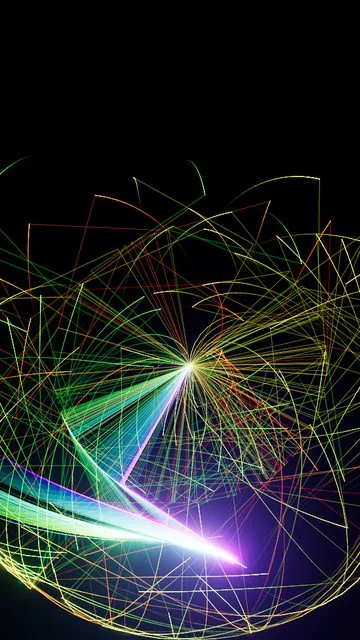 IVOne More Hinge
 VHow Long Can We Predict?
 VIMore Hinges
 VIIWhere Will It Stop?
 VIIITaming Chaos
 IXYour Throw
Chapter by chapter
Chapter I Galileo's Lamp Free
Small swings keep the same time whatever their size; wide ones fall behind.
A long row of identical pendulums is released all at once, small swings near you and wider ones farther away. With small swings they move as one rigid fan. With wide swings the far pendulums fall behind and the sheaf twists into a spiral: every size of swing keeps its own time.
The rule that a small swing takes the same time whatever its size is called isochronism, and it is only almost true. The exact solution shows the period growing with the swing: a 90-degree swing takes about 18 percent longer than a tiny one, a 170-degree swing nearly two and a half times as long [1]. Small swings were still steady enough to run the best clocks from Huygens's first pendulum clock in 1657 until quartz took over around 1930 [2]. The tale of the young Galileo timing a lamp in Pisa cathedral against his pulse, around 1583, comes from a 1654 biography and is usually treated as a legend [3]. Every pendulum here follows the exact solution, with no friction; the colors mark the size of each swing.
Chapter II Odd Sympathy Free
1665: Huygens finds two clocks on one beam swinging exactly opposite.
Two pendulum clocks hang from one beam. Above them, a dial of light: every mote is a whole pair of clocks, placed by how their swings line up, 12 o'clock in step and 6 o'clock exactly opposite. The rainbow spiral unwinds into a single hand at 6 as the pairs lock opposite. Then the beam slides more freely, and a second hand grows at 12.
In February 1665 Christiaan Huygens, ill in his room, noticed that two of his clocks on a common support always ended up swinging exactly opposite: an odd kind of sympathy, he called it. In 2002 a team rebuilt the experiment and explained it. The clocks talk through tiny shakes of what holds them, and swinging opposite, their pushes on the support cancel, so it keeps still [4]. The chapter runs a published model of clocks on a movable beam [5], coupled far more strongly than Huygens's, so it takes seconds rather than about half an hour; the beam's sliding is drawn six times larger.
Chapter III Laplace's Demon Free
Laplace's demon: for a clock, ten times better knowledge buys ten times longer forecasts.
A gold pendulum swings beside a cloud of ghosts: a forecast of it from a start known only roughly. Below, the same states are drawn as angle against speed. A rough start smears into a rainbow band; a start a hundred times sharper, then a million times sharper again, stays a single white pendulum.
In 1814 Pierre-Simon Laplace imagined an intellect that knew every force in nature and the position of every thing; for it, he wrote, nothing would be uncertain, and the future would be as present to its eyes as the past [6]. Later writers called it Laplace's demon, and with a regular pendulum it does well. A wider swing takes slightly longer, so a blurry start makes the forecast drift, but only in step with time: ten times better knowledge buys a ten times longer forecast. Here a start known to a thousandth of a radian holds for about 13 minutes, a billionth for about 24 years. That steady payoff is clockwork.
Chapter IV One More Hinge Plus
Add one hinge: a thousand pendulums a billionth of a radian apart swing as one, then part.
Now each pendulum gets one more hinge. More than a thousand double pendulums, started less than a billionth of a radian apart, swing as one white pendulum for about twenty seconds. Then a difference far too small to measure takes over: they part, and bloom into a rainbow fan of every possible motion.
This is chaos. Every copy follows the same laws exactly, but tiny differences in the start grow exponentially instead of steadily. Henri Poincaré saw the possibility in 1908, writing that small differences in the initial conditions can produce very great ones in the final phenomena, so that prediction becomes impossible [7]. Edward Lorenz rediscovered it in a simple model of the weather and published it in 1963 [8]. It is shown at about half speed; colors mark each copy's start. More in Double pendulums and chaos.
Chapter V How Long Can We Predict? Plus
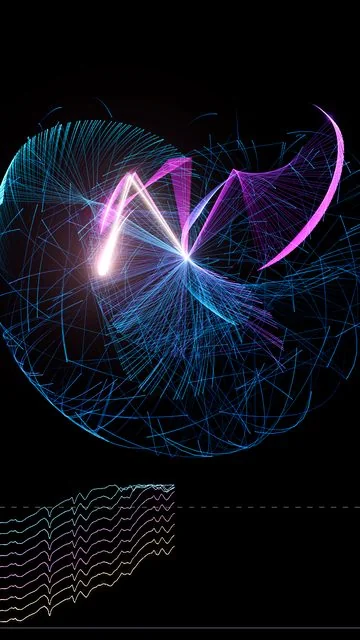
Ten forecasts, each ten times more precise, part one after another at even intervals.
One double pendulum and ten forecasts of it, each starting ten times closer to the truth than the last, from a thousandth of a radian away down to a trillionth. They peel off one after another, at even intervals. Below, a chart where every step up is ten times bigger shows each forecast's error: ten parallel lines climbing the same slope.
In a chaotic system an error grows, on average, by the same factor in the same time. That rate is the Lyapunov exponent, named after the Russian mathematician Aleksandr Lyapunov; the standard way to compute it was set out in 1980 [9]. Here an error grows about tenfold every one and a half to two seconds, so each tenfold gain in precision buys only a fixed extra stretch of forecast: a billion times more precision gains about 17 seconds. Real double pendulums do the same; on a tabletop one, uncertainties were measured growing exponentially [10]. The chapter runs in slow motion.
Chapter VI More Hinges Plus
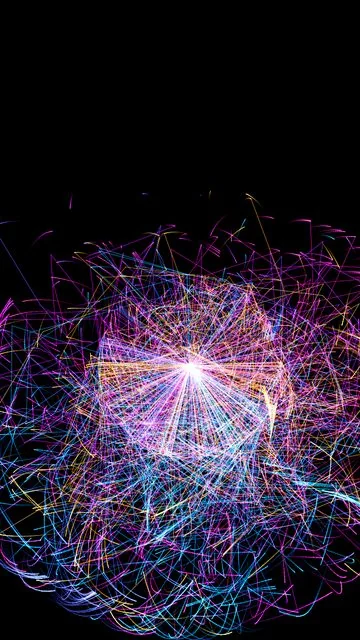
Three hinges: the same tiny difference takes over sooner.
Three hinges instead of two. Again the pendulums start a billionth of a radian apart and swing as one, but this time the bloom comes sooner, into a wilder tangle.
Every hinge adds another direction in which a small difference can grow, and each one feeds the next. Measured in this simulation, the triple pendulum's errors grow about 1.6 times faster than the double's (Lyapunov exponents of about 2.3 and 1.4 per second), so the same tiny difference takes over in about half the time. Most real things, from the air in a room to the weather, have vastly more ways to move than three hinges, which is why their futures blur so fast.
Chapter VII Where Will It Stop? Plus
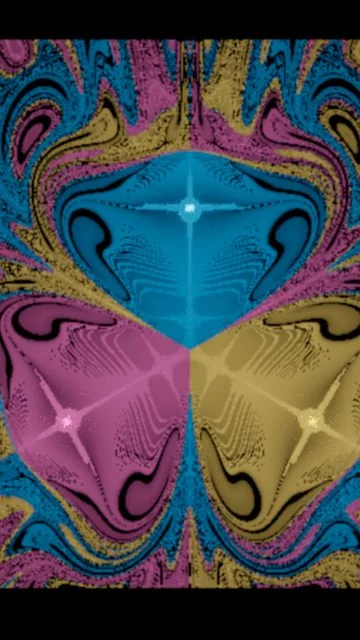
A pendulum over three magnets: which one it stops over has fractal borders.
A pendulum hangs over three magnets, released at rest from every point of a grid at once. Friction means each start must come to rest over a magnet, and each lights up in that magnet's color, later settlers darker, so the map paints itself.
Where the pendulum stops is completely decided by where it starts, yet the borders between the colors are fractal: however closely you look, neighboring starts end on different magnets, and near a border the smallest nudge changes the ending. The motion is chaotic only until friction wins, but that is enough to make even the final state unpredictable. Physicists call this doubly transient chaos and argue it is common in systems that lose energy as they move [11]. Every start is computed live; the colors mark which magnet each reaches.
Chapter VIII Taming Chaos Plus
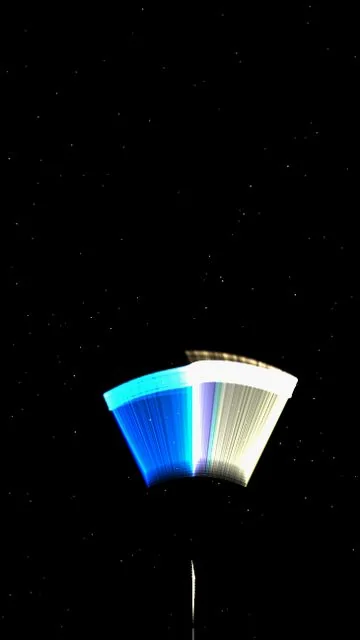
Kapitza: shake the pivot fast enough and upside down becomes stable.
Turn a pendulum upside down and it falls. Here a sheaf of rods stands on an axle; held still, they all topple. Shake the axle thirty times a second and the whole sheaf stands on its head, swaying slowly. Slow the shaking and the outer rods fall first; shake it fast again and they stand once more.
Pyotr Kapitza explained this in 1951: fast vibration of the pivot adds an average force that makes a hollow at the top, so upright becomes stable [12]. It works only when the shaking is fast and large enough for the pendulum's length [13]; for these half-meter rods and a 3-centimeter shake, that means more than about 16.6 shakes a second. The shaking is too fast for any screen, so it is drawn as a motion blur. A related idea, not shown here, tames chaos itself with tiny, well-timed nudges [14].
Chapter IX Your Throw Plus
Your turn: throw a 3-D double pendulum and watch its copies part.
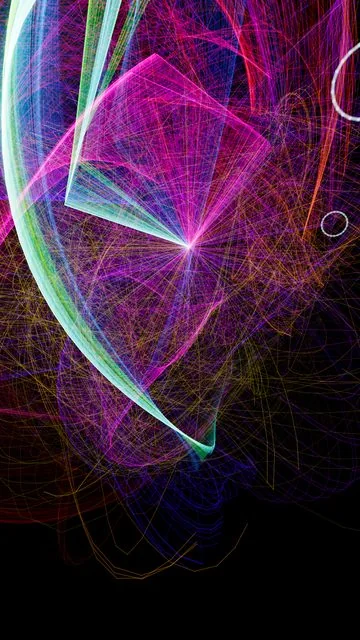
Now the pendulum is yours: one glowing double pendulum whose hinges swing in any direction, really thousands of copies started almost exactly where yours is. It throws itself once; then you grab the bob, swing it and let go. The copies leave your hand as one white pendulum, then their tiny differences, sideways ones too, bloom into a bouquet around the pivot. Grab it again and they flow back to your finger, a convenience for the eye, not physics.
However carefully you throw, the bloom always comes, and no two throws bloom alike. Clockwork and chaos follow the very same deterministic laws; the difference is only how fast small errors grow [8][7]. Knowing the rules is not knowing the future. Try it in your browser in The Butterfly.
What’s simulated, and what isn’t
Every pendulum follows the real equations of motion: the single pendulums move on the exact solution, and each copy of the double and triple pendulums obeys the same laws, kept apart by differences as small as a billionth of a radian. Some things are changed so you can see them: Huygens's clocks are coupled far more strongly than his beam, so they lock in seconds, and the beam's motion is drawn larger; the chaos chapters run in slow motion; colors only mark starts or outcomes; the shaken pendulums are a motion blur. It is simulated live, not video.
Watch Clockwork to Chaos in Everdust
Clockwork to Chaos is in the Everdust app on iPhone and iPad, Android, Apple Vision Pro, Mac, Apple TV and Meta Quest 3 and 3S. Open Everdust, choose Stories, then Clockwork to Chaos. Free: chapters I–III. Everdust Plus: chapters IV–IX.
Everdust on the App Store (iPhone, iPad, Apple Vision Pro, Mac, Apple TV)Everdust on Google Play (Android)Everdust on the Meta Horizon Store (Quest 3 and 3S)
Everdust is free to download, with no ads and no account. Everdust Plus, an optional subscription, opens every chapter of every Story on iPhone, iPad, Android, Apple Vision Pro, Mac and Apple TV (on Meta Quest, which chapters are free can differ).
Questions people ask
Why is a double pendulum chaotic? Any difference in its start grows exponentially, so after a few swings two almost identical throws look nothing alike. Tabletop experiments measure that growth directly [10].
What is a Lyapunov exponent? The average rate at which tiny errors grow in a system. If it is positive the system is chaotic, and each tenfold gain in precision buys only a fixed extra stretch of prediction [9].
How can an upside-down pendulum stay up? If its pivot is shaken up and down fast enough, the shaking creates an average force that holds the pendulum upright. Pyotr Kapitza explained it in 1951 [12][13].
Sources
- Beléndez, A. et al. (2007). Exact solution for the nonlinear pendulum. Revista Brasileira de Ensino de Física 29, 645.
- National Institute of Standards and Technology. Second: The Past.
- Museo Galileo, Florence. Cathedral of Santa Maria, Pisa (itinerary: Pisa, following the path of Galileo).
- Bennett, M., Schatz, M. F., Rockwood, H. & Wiesenfeld, K. (2002). Huygens's clocks. Proceedings of the Royal Society of London A 458, 563.
- Czolczynski, K. et al. (2009). Clustering and synchronization of Huygens' clocks. Physica A 388, 5013.
- Laplace, P.-S. (2009). Essai philosophique sur les probabilités. Cambridge University Press (reissue; first published in Paris in 1814).
- Motter, A. E. & Campbell, D. K. (2013). Chaos at fifty. Physics Today 66(5), 27.
- Lorenz, E. N. (1963). Deterministic nonperiodic flow. Journal of the Atmospheric Sciences 20, 130.
- Benettin, G., Galgani, L., Giorgilli, A. & Strelcyn, J.-M. (1980). Lyapunov characteristic exponents for smooth dynamical systems and for Hamiltonian systems; a method for computing all of them. Part 1: Theory. Meccanica 15, 9.
- Shinbrot, T., Grebogi, C., Wisdom, J. & Yorke, J. A. (1992). Chaos in a double pendulum. American Journal of Physics 60, 491.
- Motter, A. E., Gruiz, M., Károlyi, G. & Tél, T. (2013). Doubly transient chaos: generic form of chaos in autonomous dissipative systems. Physical Review Letters 111, 194101.
- Kapitza, P. L. (1965). Dynamical stability of a pendulum when its point of suspension vibrates. In Collected Papers of P. L. Kapitza, 714. Pergamon (first published in Russian in 1951).
- Butikov, E. I. (2001). On the dynamic stabilization of an inverted pendulum. American Journal of Physics 69, 755.
- Ott, E., Grebogi, C. & Yorke, J. A. (1990). Controlling chaos. Physical Review Letters 64, 1196.
Chapter stills: Everdust, from each chapter’s live simulation. The Story’s script was written for Everdust from the sources above; River reads it. This page retells it in its own words.
More Stories
Chaos: The Attractor We Found
From Lorenz's rounding error to a strange attractor our own search turned up.

Hidden Patterns
Fireflies, starlings, sand, magnets and light, each making a pattern no one designed.

Why Things Glow
Glowworms, fireflies, glowing seas, blue ice and molten rock: seven rivers of light.

The Secret Life of Fluids
A soap bubble's skin, rain on a window, the sea and Jupiter's storms: the same rules at every scale.